Wildfire Wednesdays #141: Hermit's Peak/Calf Canyon Fire

Hello Fireshed community, 

Today marks exactly two years since firefighters at last contained the historic Hermit’s Peak/Calf Canyon Fire on August 21, 2022. 

Families, communities, forests and watersheds in Northern New Mexico are still recovering from the destructive wildfire. In fact, the Santa Fe National Forest is hosting two public meetings next week to present and gather public input on recovery efforts and long-term recovery planning.

Meanwhile, forest, water, and fire managers are rebuilding support for prescribed fire as an essential land management tool – one not without risk, but key to reducing future risk of catastrophic wildfires.

This Wildfire Wednesday features a review of the Hermit’s Peak/Calf Canyon Fire, including: 

Best, Maya 


How the Fire Began
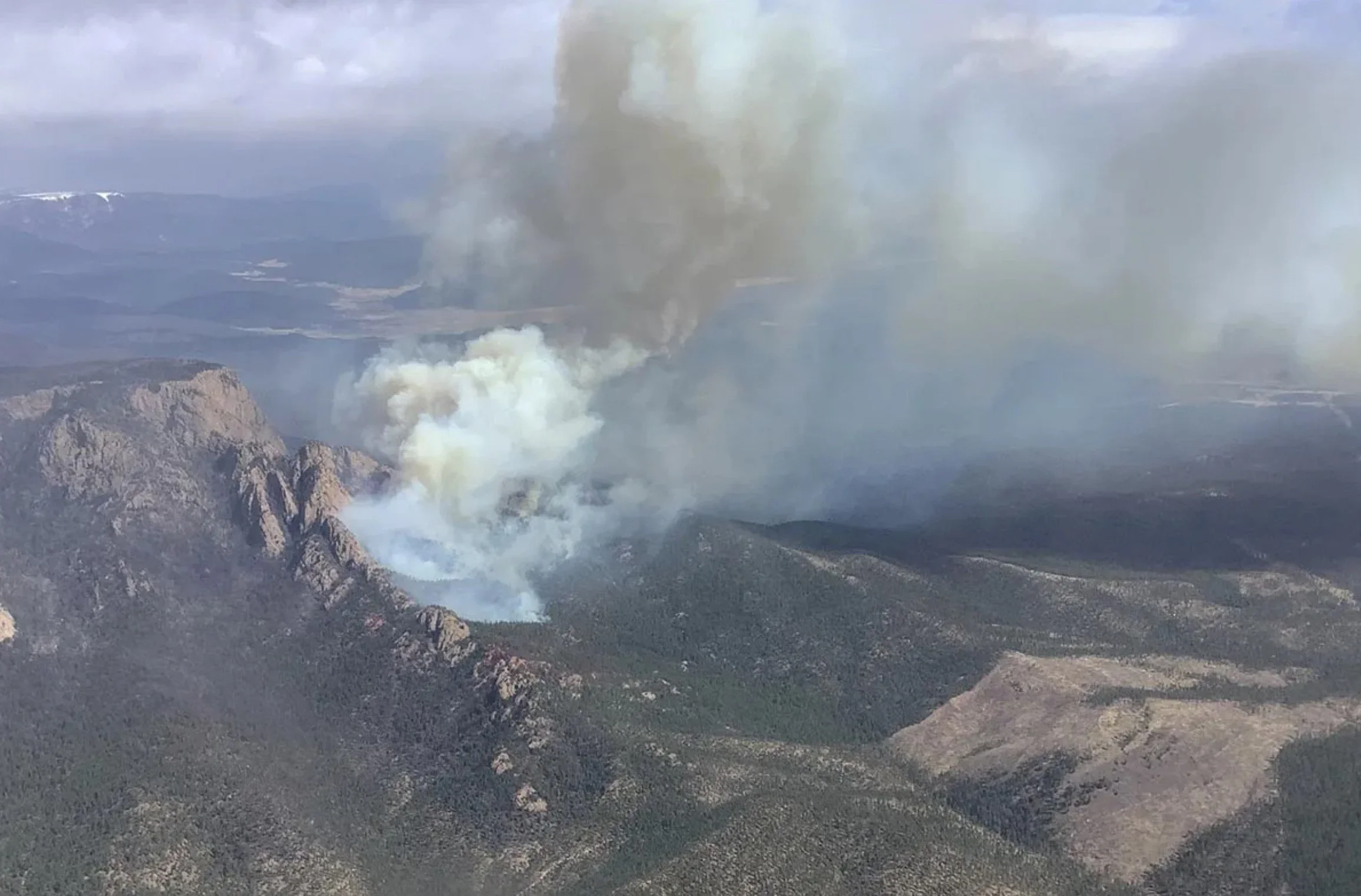
An aerial photo shows smoke rising near of Hermit's Peak, April 10, 2022.

Hermit’s Peak, April 10, 2022. Source: U.S. Forest Service
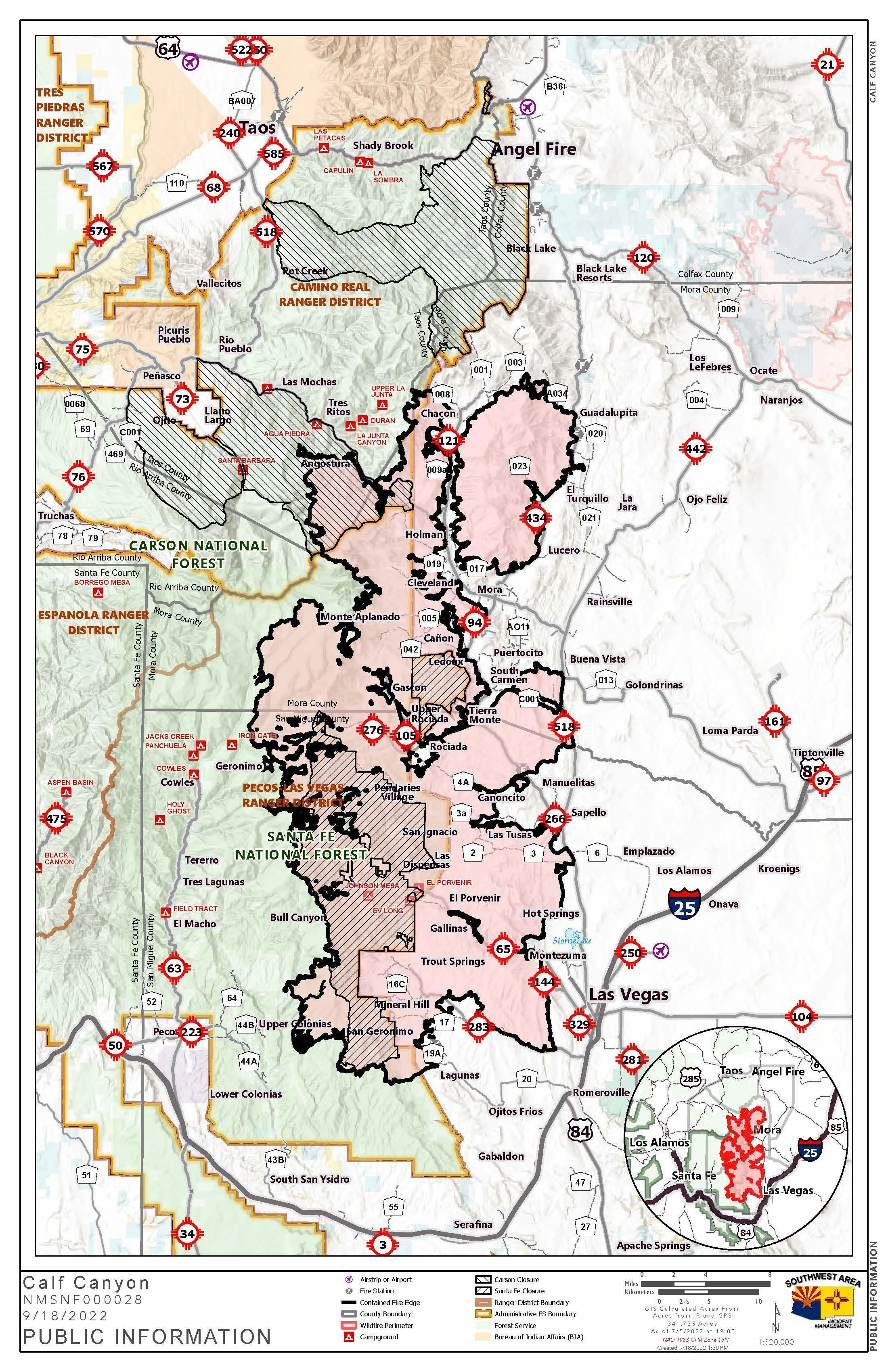
A map of the HPCC wildfire boundary.

HPCC Wildfire Boundary. Source: Inciweb

In April 2022, a Forest Service prescribed fire just outside of the Pecos Wilderness area of the Santa Fe National Forest became the Hermit’s Peak wildfire when erratic winds carried embers outside the boundary of the planned burn area and ignited multiple fires in surrounding forests dried out from severe drought.  

About two weeks later, the Calf Canyon Fire began spreading on National Forest land nearby when a pile burn ignited by the Forest Service in January resurfaced. The pile had smoldered underground for months through several snowstorms, an event “nearly unheard of until recently in the century-plus of experience the Forest Service has in working on these landscapes,” Forest Service leaders wrote in a review of the escaped prescribed fires. 

The two wildfires merged due to unprecedented wind events and historically dry fuels and soils and burned more than 530 square miles over four and half months, until firefighters contained the blaze in late August. 


The Costly Road to Recovery
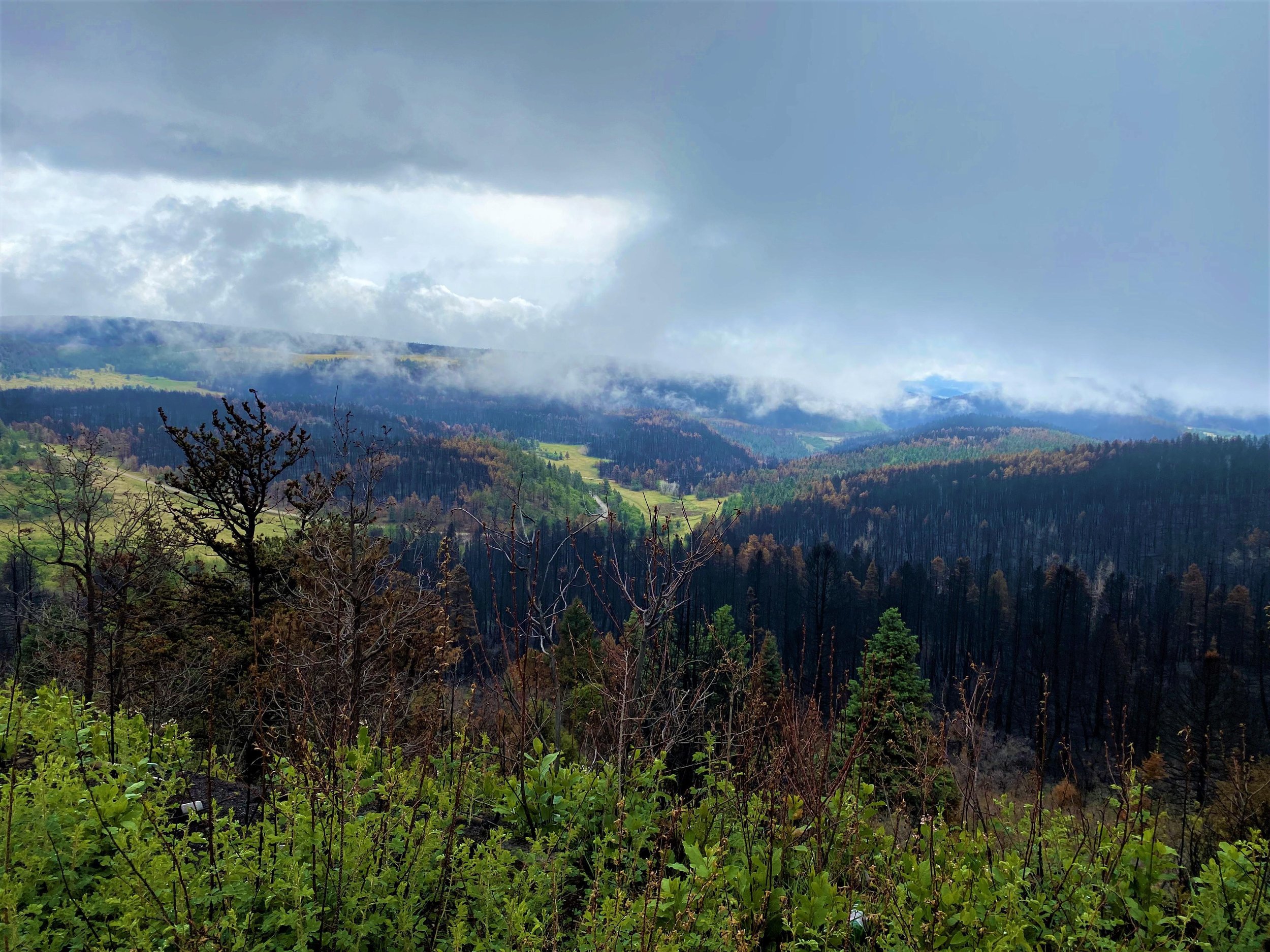
Mora Valley, June 28, 2022. Source: Inciweb

The Hermit’s Peak/Calf Canyon Fire, the largest wildfire in New Mexico history, triggered evacuation orders for more than 27,000 people and destroyed over 900 structures, including 433 homes. Most of the land burned – 58% – was privately owned. 

Because the Forest Service was responsible for igniting the fire, Congress and President Joe Biden allocated almost $4 billion to compensate victims of the fire and subsequent floods. As of July 2024, while still processing and receiving additional claims, the federal government had paid out 5,633 claims totaling $926.7 million.  

Payments covered economic damages, up to five years of flood insurance coverage, and natural resource restoration projects for landowners. Additional recovery efforts in years following the burn have included aerial seeding of the burn scar and flooding prevention work by federal agencies and local organizations. 


Post-fire Flooding: A Prolonged Disaster

High-severity wildfires burn not only vegetation but also soils, changing the chemical and physical properties of soil such that it becomes hydrophobic, or water-repelling. This reverses forests’ sponge-like ability to soak up rainfall and instead makes burn scars susceptible to debris flows and flash floods.  
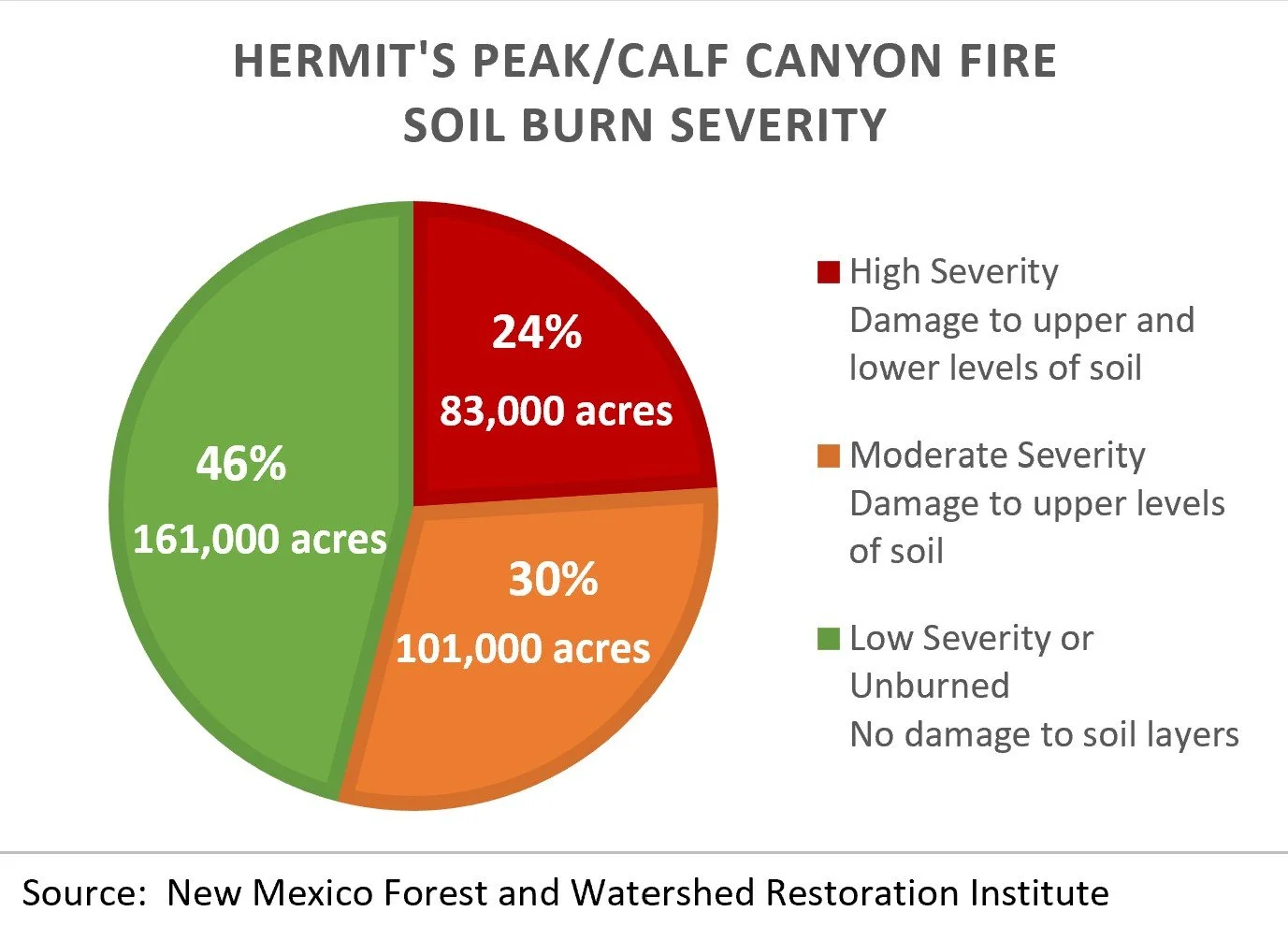
The pie chart shows HPCC soil burn severity: 30% (101,000 acres) was moderate severity, with damage to upper levels of soil. 24% (83,000 acres) was high severity, with damage to upper and lower levels of the soil. 46% was unburned or low severity.

The Hermit’s Peak/Calf Canyon Fire damaged soil in over half the burn scar, causing floods that killed at least three people, washed out buildings and infrastructure, and contaminated the city of Las Vegas’s water supply with ash and debris in 2022. The National Weather Service received over 75 preliminary reports of flash floods and debris flows in the burn scar from June 2022 to June 2024. For multiple years following the fire, surrounding communities expect to be at elevated risk for flooding.  


Prescribed Fires Remain a Crucial Tool for Reducing Wildfire Risk

The Hermit’s Peak/Calf Canyon Fire spurred the Forest Service to pause all prescribed burns pending a 90-day review of its national prescribed burn program. Forest Service Chief Randy Moore said the decision “reflected the growing recognition that extreme conditions resulting from drought, weather, dry fuels, and other climate change effects were influencing fire behavior in ways we had never seen before." The prescribed burn that became the Hermit’s Peak Fire had been ignited in “much drier conditions than were recognized,” the review found.  

We cannot guarantee that prescribed fires will never escape, but the alternative to using this proven tool is larger, more destructive wildfires.
— Santa Fe National Forest Supervisor Shaun Sanchez  

The review underscored the necessity of prescribed burns as one of the most effective tools for forest, fire and water managers to reduce the risk of catastrophic wildfires, protect watersheds, and increase the resilience of forests. Over a century of fire suppression in fire-adapted forests of the Southwest has, in combination with climate change, created conditions for high-severity wildfires that threaten people, property and drinking water sources and threaten forests’ ability to regenerate. Prescribed burns, on the other hand, facilitate a return to low-severity fires that promote forest health and increase firefighters’ success in safely managing fires. Of the about 4,500 prescribed burns conducted by the Forest Service annually, 99.84% have gone according to plan, the review noted.  

The Forest Service resumed prescribed burning with updated guidelines aimed at further reducing the risk of escaped prescribed fires. New requirements include daily, higher-level review of prescribed burn plans; more localized weather data; heightened consideration of drought conditions in burn plans; long-term monitoring of burns; and more extensive public outreach about prescribed fires, among other changes. 


Additional Resources

  • View this blog post in an easy-to-read PDF format on the Greater Santa Fe Fireshed Coalition’s Briefing Papers webpage. Other briefing papers on the webpage cover topics including: 

  • Stewarding the Greater Santa Fe Fireshed 

  • Source Water: Fire and the Santa Fe Municipal Watershed 

  • Containing Wildfire: The Medio Fire Success Story 

  • Pollinators and Wildfire 

  • Post-fire Impacts 

  • Forest Type Conversion 

  • Fire History in the Greater Santa Fe Fireshed 

  • NEPA 

  • Insect Defoliation in the Greater Santa Fe Fireshed 

  • The Intersection of Bird Habitat and Forest Restoration in the Southwest 

Wildfire Wednesdays #140: Wildland Fire Workforce

Hi! I am Maya Hilty, a new Fireshed Coordinator with the Forest Stewards Guild. In this role, I support the Greater Santa Fe Fireshed Coalition; conduct home hazard assessments; facilitate fuels reduction projects on public and private lands; and grow our Fireshed Ambassador program, where neighbors influence neighbors to make communities better prepared for fire. I will also be contributing to Fire Adapted New Mexico Learning Network into the future, including authoring Wildfire Wednesday blog posts. 


Hello Fireshed community, 

As of today, almost 28,000 firefighters across the U.S. are battling 95 large fires burning over 3,400 square miles. 

For the past five years, an annual average of ~59,100 wildfires, including both natural ignitions and human-caused fires, have burned almost 12,000 square miles across the nation each year. That includes roughly 2,800 fires per year in Arizona and New Mexico – more than 7 ignitions per day on average, if the fires were spread evenly throughout the year – which have burned 1,150 square miles, or approximately the size of Bernalillo County, annually.  

Many of us take for granted that, where fires ignite, firefighting resources will quickly follow. However, for reasons explored below, those resources are stretched increasingly thin during severe fires or during the most fire-prone times of the year. 

This Wildfire Wednesday features an overview of the wildland fire workforce, including: 

Best, Maya 


The Wildland Fire Workforce: A Who's Who

From the local to federal level, here’s who fights wildfires.

As outlined by the Santa Fe County Community Wildfire Protection Plan as well as U.S. Forest Service and Department of the Interior materials, the wildland firefighting workforce includes responders at the: 

  • Local level. This includes, for example, the Santa Fe city and county Fire Department Wildland Divisions. 

  • State level. The New Mexico Forestry Division created two full-time crews in 2024 and trains additional firefighters for hire in an emergency. The Division also collaborates with a state prison in Los Lunas to run the Inmate Work Camp Program, through which the state hires four to six crews of people who are incarcerated to respond to wildland fires alongside other professional firefighters.

  • Federal level. This year, the federal wildland firefighting workforce includes roughly 11,300 firefighters in the Forest Service and 5,750 firefighters employed by four agencies in the Department of the Interior: the Bureau of Indian Affairs, Bureau of Land Management, Fish and Wildlife Service and National Park Service. Half the federal wildland firefighting workforce is only employed seasonally, for a maximum of six months, according to data from 2022.

In 2023, costs to suppress and contain wildfires amounted to nearly $3.2 billion in federal firefighting costs alone. Still, the Forest Service, which employs most federal wildland firefighters, needs more funding to meet their capacity needs to address the “ongoing wildfire crisis,” agency leaders say. 

Firefighters have a wide range of specialties, from members of handcrews and hotshots, who construct and patrol firelines; engine crews; smokejumpers, who parachute out of airplanes to reach fires in remote areas; helitack crews, who reach fires by helicopter; equipment operators; dispatchers; and other support staff. For more info, visit this Forest Service webpage about firefighting jobs. 

Collaboration is key

Thanks to mutual aid and joint powers agreements between tribes and local, state, and federal government agencies, the geographically closest firefighting forces often respond to the initial report of a fire regardless of their jurisdiction over where the fire started. 

Firefighting agencies also share an Incident Management System that enables initial responders to more seamlessly scale up a response. In northern New Mexico, that usually means soliciting help from a Southwest Area Incident Management Team. 

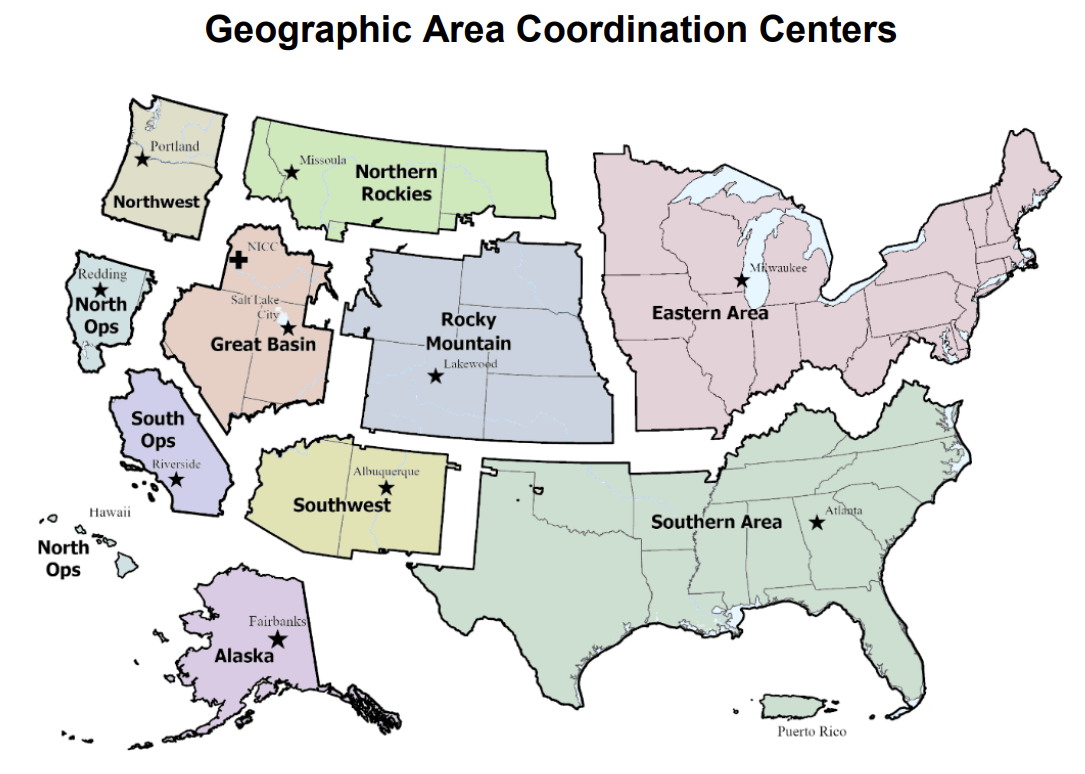
If a wildfire grows beyond the capability of teams in the Southwest Area (one of 10 wildfire Geographic Area Coordination Centers across the U.S.), the Boise, Idaho-based National Interagency Coordination Center assumes responsibility for mobilizing more resources from elsewhere across the nation. Because there is often a greater need than there is availability of firefighting personnel and equipment, the National Multi-Agency Coordinating Group comprised of state and federal fire management leaders ultimately oversees where to allocate firefighting resources.
In addition, the United States has ever-evolving agreements with Canada, Australia, New Zealand, Mexico and Portugal that enable the countries to share firefighting personnel and equipment. The U.S. considers requesting international help when ~60% or more of domestic wildland firefighting personnel are committed to fires, and the U.S. has received assistance in the form of aircraft or up to 600 personnel from Canada, Australia or New Zealand most years over the past two decades, as detailed in this 2022 paper in the journal Fire. 


Challenges in Wildland Fire Management

"Over the last few decades, the wildland fire management environment has profoundly changed. Longer fire seasons; bigger fires and more acres burned on average each year; more extreme fire behavior; and wildfire suppression operations in the wildland urban interface (WUI) have become the norm.” ~ U.S. Forest Service

Growth in fire seasons and severity

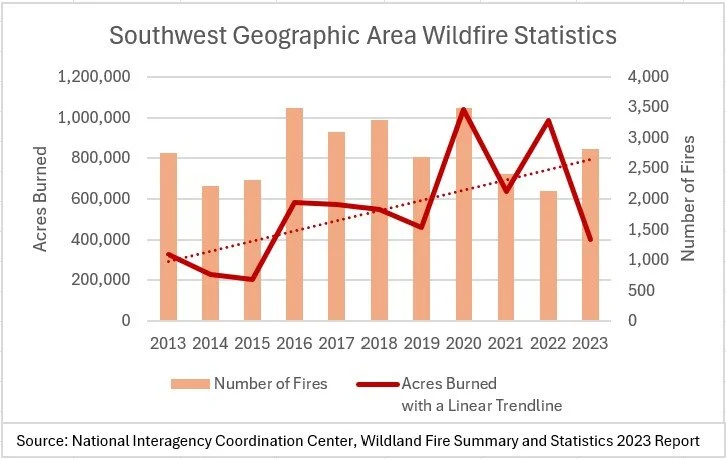
This figure shows the number of fires and acres burned each year in the Southwest Geographic Area from 2013 to 2023. A linear trendline of acres burned steadily trends upwards.
Due to factors including climate change, fuel build-up from fire exclusion, and expansion of the wildland-urban interface through continued construction of the built environment in previously undeveloped areas, wildfires have become larger, more severe, and more destructive. For example, the land area in the U.S. burned annually by wildfire has doubled over the past 20 years. Meanwhile, fire seasons have become longer – more than 80 days longer in the western U.S. – straining seasonal and regionally shared firefighting resources.

“We all recognize now we have a fire year, but we continue staffing for a fire season,” fire managers reflected in a review of the destructive 2022 Hermit’s Peak/Calf Canyon Fire.

Resource strain and scarcity

As we transition out of the months traditionally considered the Southwest fire season – from April to July, when monsoons typically begin – more state and federal firefighting resources will flow to California and the Northwest, and fewer will be readily available to county and community fire managers in the Southwest.
Changes to the workforce

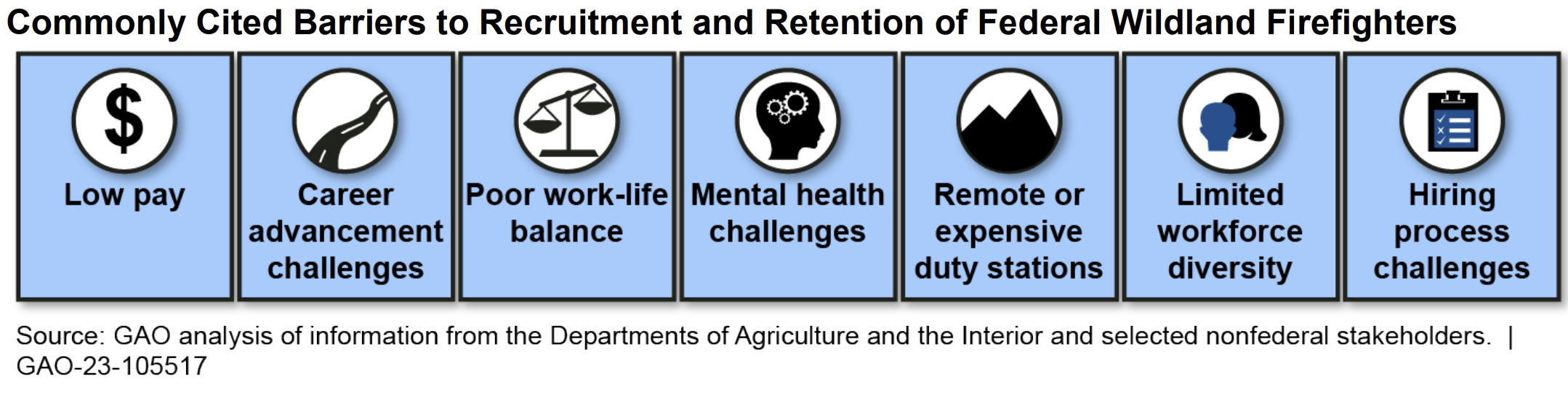
Agencies of varying sizes across the country are struggling to retain and recruit firefighters. In March, the investigative news organization ProPublica reported that the Forest Service has had an attrition rate of 45% of its permanent staff in the past three years. ProPublica and other news outlets reported several factors contributing to attrition in the Forest Service, including low pay, with starting wages of $15 per hour that do not reflect the demands of the job; inadequate attention to physical and mental health problems faced by firefighters; and the growing difficulty of the job as severe fires and extended fire seasons translate more frequent deployments. 

This figure shows 7 barriers to retaining federal wildland firefighters: Low pay, limited career advancement, poor work-life balance, mental health challenges, remote/expensive duty stations, limited workforce diversity and hiring process challenges.

A 2022 Government Accountability Office report similarly identified low pay as the primary barrier to the recruitment and retention of federal wildland firefighters, among other barriers such as a poor work-life balance; mental health challenges; and limited workforce diversity.


Enacted and Proposed Policy Changes

The existing wildfire management system has not kept pace with demands.
— National Cohesive Wildland Fire Management Strategy, 2023 addendum

Bolstering the wildland firefighting workforce

Federal agencies have made some headway in recent years to address challenges facing the wildland fire workforce, including raising the pay of wildland firefighters. In 2022, the Bipartisan Infrastructure Law raised the minimum wage of federal wildland firefighters from $13 to $15 per hour and provided firefighters with a temporary pay increase of at least $20,000 per year, which lawmakers extended through September 2024. 

For the upcoming FY25 fiscal year that begins October 1, the Biden administration has proposed a permanent pay increase for wildland firefighters, along with investments in firefighter mental and physical health and increases in the number of permanent (rather than seasonal) positions. Those proposals are currently making their way through Congress. 

A 2023 update to the National Cohesive Wildland Fire Management Strategy recommended additional solutions, such as ensuring that recruitment efforts reach firefighters of diverse backgrounds and identities. In 2022, 84% of federal firefighters were men and 72% were White. Increasing the representation of women and marginalized groups will not only make the wildland firefighting world more just but will grow the dwindling applicant pool for firefighting positions. 

As outlined in the national strategy, the nation ultimately needs a larger permanent firefighting workforce to tackle the year-round work of wildfire mitigation, preparedness, prevention, and postfire recovery, in addition to what we typically think of when we hear wildland fire workforce: wildfire response and containment. 


Additional Resources

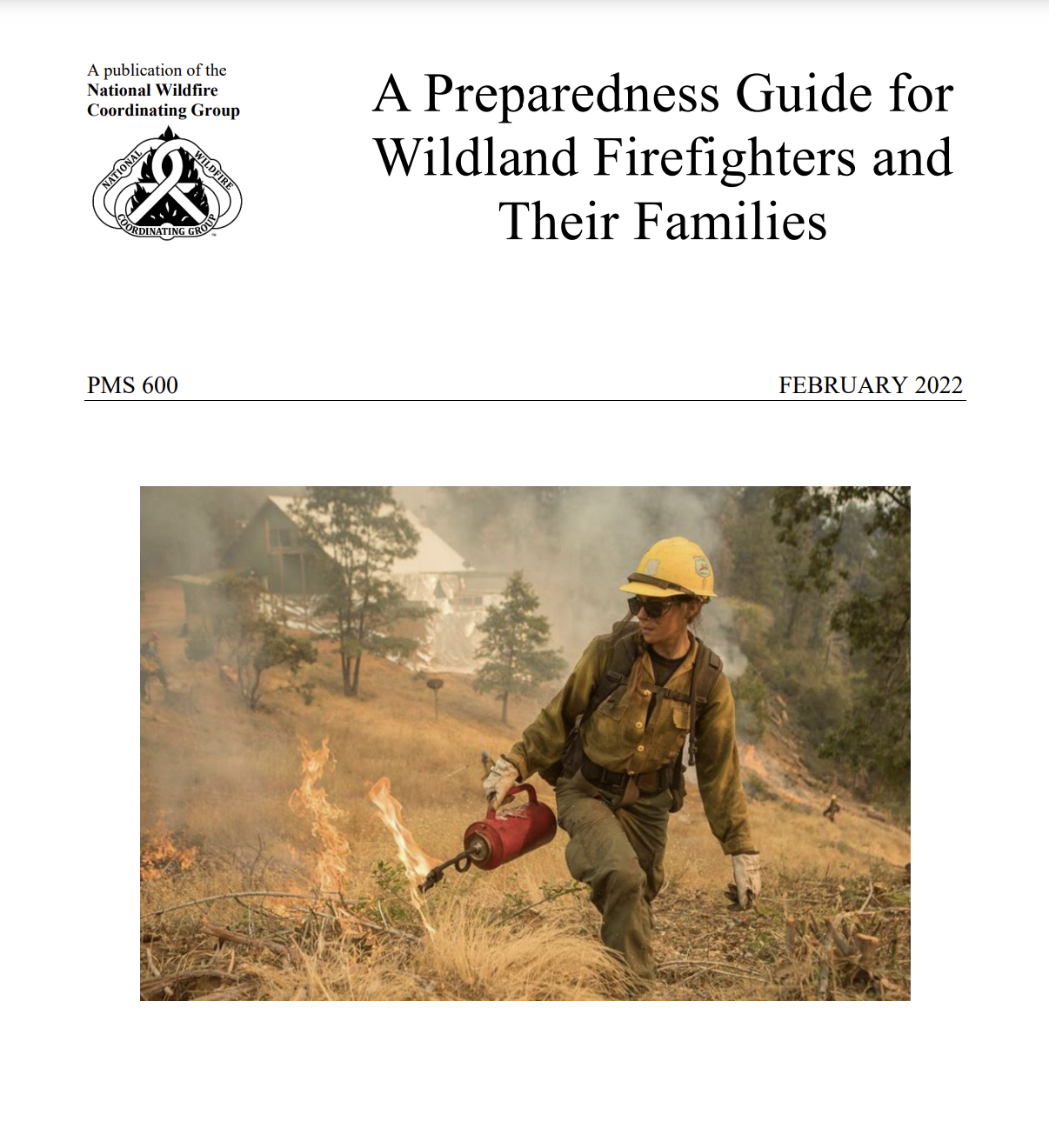
For more information about the rewards and challenges of a career in wildland firefighting, check out this Preparedness Guide for Wildland Firefighters and Their Families from the National Wildfire Coordinating Group.

Wildfire Wednesdays #139: Proactive Home Protection Against Wildfire

As monsoonal rains impact the Southwest, post-fire debris flows and flooding are a major and ongoing concern for those affected by and adjacent to the recent South Fork and Salt Fires. Visit Wildfire Wednesday #138 for information and links to support the community.


Happy Wednesday, Fireshed Coalition community!

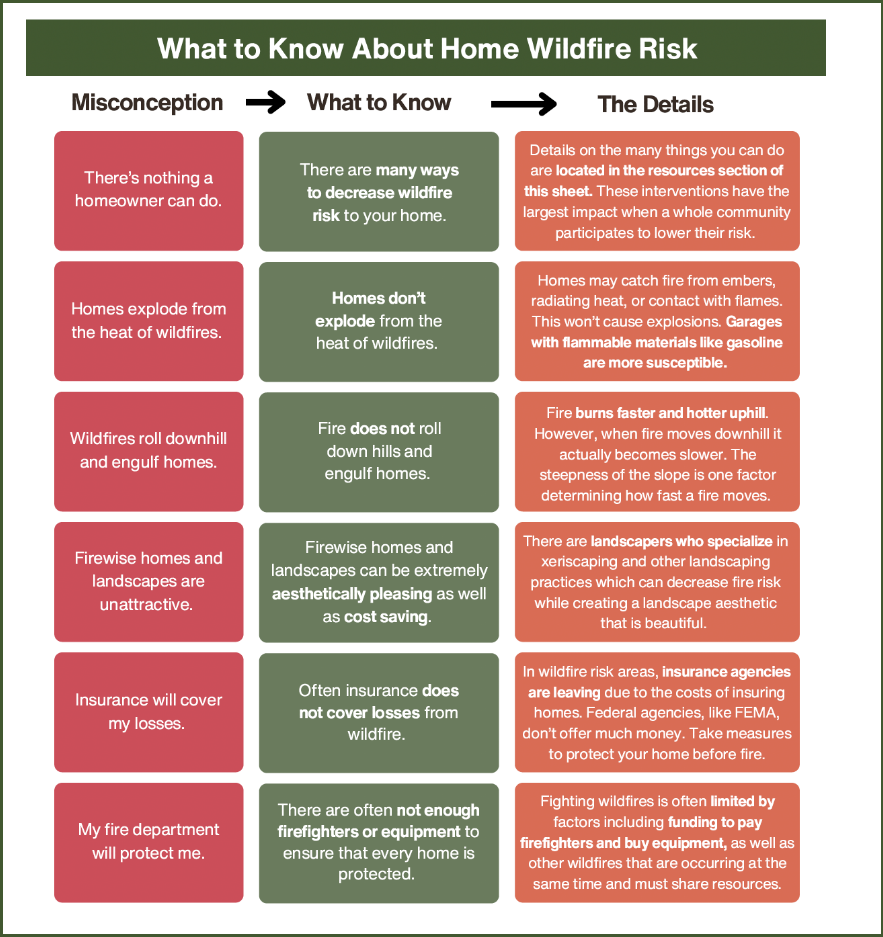
Over the past year, news about advancements in wildfire protection and hazard reduction has been coming out faster than most of us can keep up. One common theme that runs through all of the new research is the emerging importance of approaching fire adaptation from a community, rather than an individual, perspective. From the 2018 fire in Paradise to the 2023 fire in Lahaina, this community of practitioners is seeing, in real time, the shift from wilderness wildfire to urban conflagrations.

Today’s blog focuses on resources from organizations such as the Institute for Business and Home Safety which can help residents, neighborhoods, communities, and cities better align their fire preparedness efforts with the latest science.

This Wildfire Wednesday features:


Living With Wildfire


Challenges across the American West

Wildfire disasters occur when wildfire flames and embers enter communities and destroy hundreds or thousands of homes. Multi-billion-dollar property losses in single wildfire events have become recurrent in the American West over the past three decades. An estimated 45 million residential buildings across the US are at risk of destruction from wildfires. This is a result of a combination of factors, including:

  • Historic population growth

  • Unregulated building in wildfire-exposed areas

  • Overgrowth of forests and rangelands

  • The effects of climate change

These disasters affect not only lives and property, but the safety and effectiveness of the fire service, the ability of businesses and local governments to recover, and the insurance industry’s ability to provide a financial safety net that makes it possible for people to rebuild their lives and livelihoods.

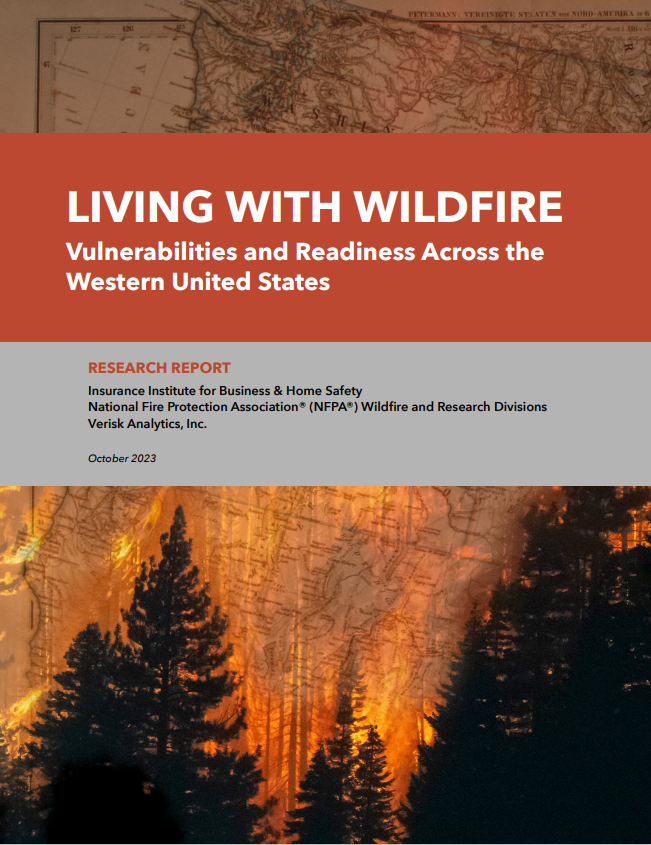
In a new report from the Institute for Business and Home Safety and National Fire Protection Association (NFPA), some key findings from an investigation into fire vulnerability of communities and measures of wildfire readiness in the WUI include:

  • Few states and counties with the greatest risk of wildfire disasters are using sound regulatory approaches backed up by consistent enforcement. Outside of California and Utah, there are no enforced, statewide codes addressing wildfire exposures to residential and commercial property; code use and enforcement at the local level remains limited.

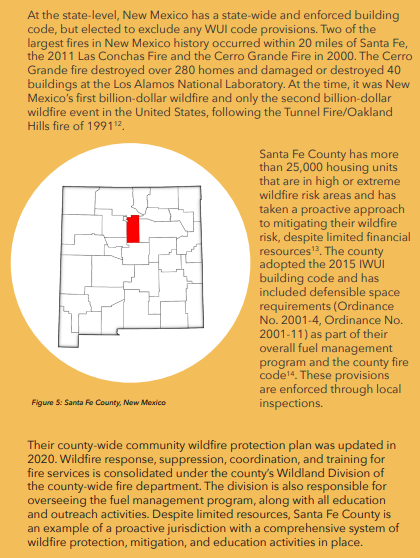
  • The separation of wildfire safety elements from traditional building codes has resulted in limited use by state and local officials. This includes the absence of clear guidance on how such elements can be integrated into building codes. At the state-level, New Mexico has a state-wide and enforced building code, but elected to exclude any WUI code provisions.

  • A majority of counties and local communities largely fail to address wildfire risks to life and property in a comprehensive manner. These stand in sharp counterpoint to the few local jurisdictions have taken proactive approaches across a range of wildfire safety concerns.

  • Despite incentives to financially support wildfire mitigation and response capabilities in areas adjacent to national forests and rangelands, one in four high-risk counties have no Community Wildfire Protection Plans (CWPPs), while 17% of counties have not updated their plans in over ten years.

  • Data on fire service capability, response, and outreach activities in the wildfire arena is difficult to obtain and is highly variable in its form. These inconsistencies make it difficult to compare or evaluate the effectiveness of these activities in a meaningful way.

  • While local fire departments serve as a vital and trusted communications link for communities to understand how to reduce risk, support for inspection and outreach programs is highly variable across the West because local fire departments often lack both trained staff and financial resources.

  • There is no correlation between the amount counties spend on wildfire related activities and the use of WUI codes or community wildfire preparedness plans in those counties. Put simply, the investment of public dollars does not necessarily equate to strong codes or planning efforts.


Defining Wildland Fire vs. Wildfire Driven Urban Conflagrations

According to a recent public safety blog from ESRI, wildland fire refers to fires within natural landscapes such as forests, grasslands, and other undeveloped areas. These regions play a crucial role in ecosystem health, biodiversity, and carbon sequestration. However, when fires ignite within these wildland areas, they pose significant threats to nearby communities, infrastructure, and lives.

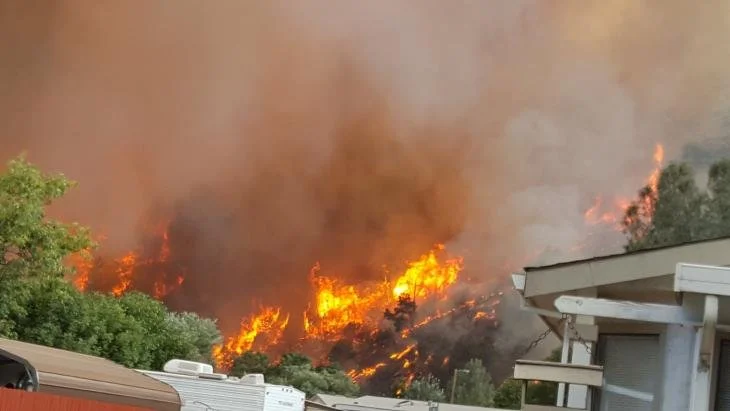
Photo of the 2018 Carr Fire approaching a neighborhood in the WUI. Photo credit: Brenna Jones, US Forest Service.

The distinction between wildland fire and urban conflagration lies in their context: wildland represents the untouched natural environment, while urban conflagration signifies an uncontrolled fire that spreads rapidly through communities. A recent article available on USDA’s website, “WUI Is Not a Wildland Problem,” emphasizes that these urban conflagrations present unique challenges requiring tailored solutions beyond traditional risk reduction, mitigation, and firefighting approaches.

Policy lessons for improving wildfire readiness

According to Living with Wildfire, policymakers at all levels should work to establish much greater levels of wildfire readiness by:

  • Using and enforcing the most recent model WUI codes for new residential and commercial construction.

  • Requiring frequent updates of community wildfire mitigation plans.

  • Incentivizing and encouraging wildfire risk reduction activities at the parcel and community level.

  • Providing firefighters with the training, equipment, and other resources they need to be safe and effective in response, and serve as a valuable source of education for their communities


What can be done to improve readiness?

Resources for Home and Business owners and community planners

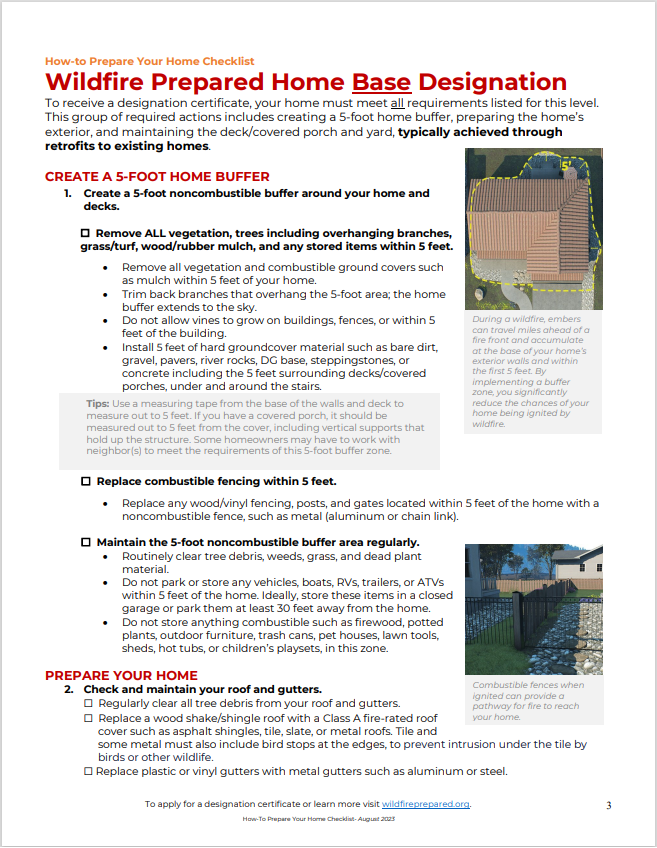
Wildfire researchers at the Insurance Institute for Business & Home Safety (IBHS) have spent years researching wildfire through both field and lab studies. Now, in collaboration with other wildfire community experts, IBHS has identified the mitigation actions critical to reducing your wildfire risk. While we can’t stop wildfire, there are some steps from the Wildfire Prepared Program that can guide you through required actions to help protect your property. For those who are interested or who require one for insurance purposes, the program provides a pathway to receive a wildfire prepared designation certificate.

Wildfire Prepared Program

The program offers step-by-step instructions for where to start with your home or business preparation process, including a checklist of preparatory items that correspond to different levels of designation (Base, Plus, etc.).

For those seeking a Wildfire Prepared designation, the program provides a quiz to ensure applicants are familiar with the Homeowner Guide and taken the steps necessary for their home to meet all the requirements of this program before paying the application fee for an inspection. This increases the chances of properties passing inspection and being properly designated.

Keeping your designation comes with the requirements of an annual review and a three-year recertification.

Resource bundle: how to prepare your home for fire

The Southwest Fire Science Consortium and Arizona Wildfire Initiative have produced a fact sheet, adapted from the National Volunteer Fire Council - Wildland Fire Assessment Program training course, with a plethora of resources for learning about and protecting your home from wildfire. They suggest starting with a home hazard assessment to determine your wildfire weak points and opportunities for improvement, prioritizing you hazard reduction options, creating a list of all the steps involved to get to a point of being fire prepared, and identifying potential evacuation options as part of your Ready! Set! Go! preparation.


Additional Resources


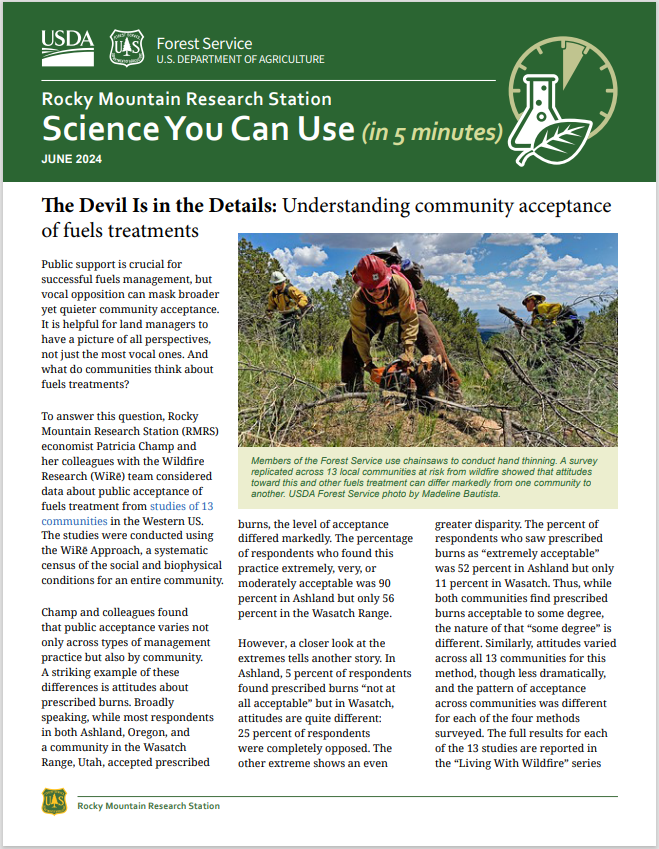
Understanding community acceptance of fuels treatments

“Public support is crucial for successful fuels management, but vocal opposition can mask broader yet quieter community acceptance. It is helpful for land managers to have a picture of all perspectives, not just the most vocal ones. And what do communities think about fuels treatments? To answer this question, researchers from Rocky Mountain Research Station (RMRS) and Wildfire Research (WiRē) considered data about public acceptance of fuels treatment from studies of 13 communities in the Western US.”

Key findings and management implications of the study included:

  • Surveys of 13 communities at risk of wildfire showed that public acceptance varies not only across types of fuels management practices but also by community.

  • Planning and implementation of fuels treatments can benefit from understandings of public acceptability.

  • Systematic social surveys can provide managers with representative data to complement existing methods for gathering public comments related to acceptance of fuels management projects.

  • Detailed data can show not only who accepts or doesn’t accept fuels treatment, but whose acceptance could shift towards support or opposition, providing a fuller picture.

  • Understanding the fuller picture can provide the opportunity for managers to be more strategic with communications and engagements.

LEARN MORE ABOUT ACCEPTANCE OF FUELS TREATMENTS

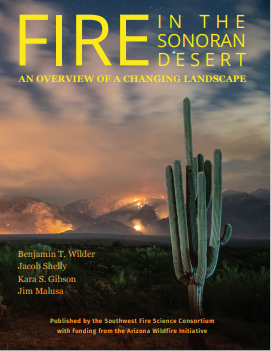
Fire in the desert: an overview of a changing landscape

In the hot shrub-dominated deserts of southern New Mexico and Arizona, unprecedented large-scale fires in recent years have been driven by the exponential expansion of introduced invasive plants. A new fire mosaic is being established in the region whereby wildfires can spread from fire-prone forested mountains to the desert valleys, and vice versa, carried by greater connectivity of invasive grass patches. In the Sonoran Desert and other mid-elevation shrublands, an ecological transition from desert scrub to grassland has begun, which creates management and societal challenges as fire becomes a part of the ecology.

Increased urbanization at foothill elevations put tens of thousands of residents and billions of dollars of infrastructure in the wildland-urban interface (WUI) in jeopardy. The increasing likelihood of the alignment of fire-ready conditions (dry fuels, low relative humidity, wind) that can lead to loss of life and infrastructure in the Sonoran Desert at a scale similar to that seen in the 2023 Lahaina, Maui wildfire. To boot, the cost of wildfire mitigation and control efforts available today is orders of magnitude smaller than the economic impact of the grassification of the foothills ‘viewsheds’ and recreation areas, meaning that mitigation is actually cheaper than the true cost of doing nothing. In this report from the Southwest Fire Science Consortium, the authors summarize the history and trends of fire and discuss future conservation strategies.

In determining what land managers can do, the report provides a management toolbox specific to fire in the desert:

  • Fuel break methods for the desert

  • Wildfire operation tactics for the desert

  • Identifying and protecting refugia

  • Fuels control

  • Public policy

  • Restoration

READ MORE ABOUT FIRE IN THE DESERT

Wildfire Wednesdays #138: Supporting Communities Affected by New Mexico Wildfires

Hello Fireshed community,

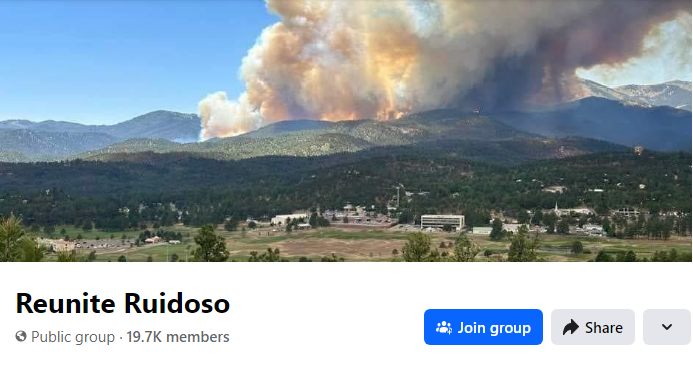
The South Fork and Salt fires, which ignited on June 17, have burned through thousands of acres and hundreds of homes on Mescalero Apache land and in the area of Ruidoso, NM, driven by high winds, hot temperatures, and low humidity. The burn area also continues to be hit by severe storms and flash flooding, together leaving many New Mexicans displaced. To help with recovery efforts, this Wildfire Wednesday focuses on resources to help those affected by the fires, including a gofundme page hosted by the Forest Stewards Guild. The path to recovery for any major disaster, especially wildfire, is long, and there is often a lack of resources in the early stages. Please help by circulating this post to your networks to support the recovery process or by donating time and resources, if you are able.

This Wildfire Wednesday features resources to assist those impacted by the recent fires:

-Rachel


Donation Options

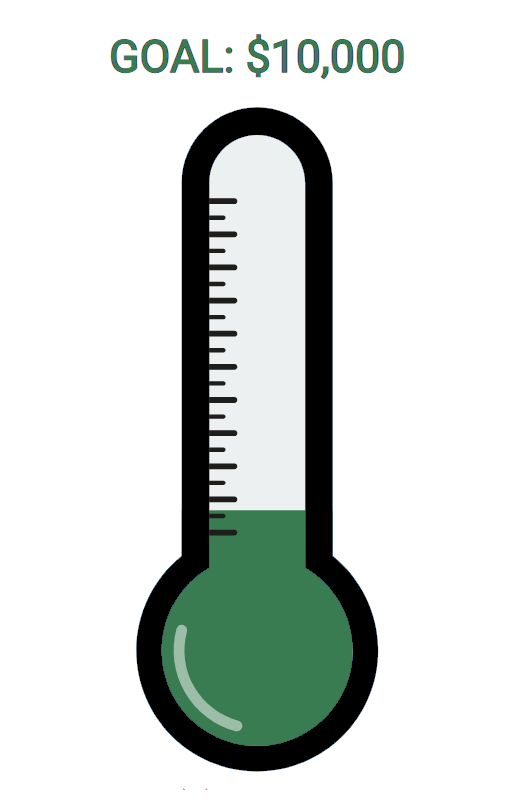
Go Fund Me: Donations to this fund, hosted by The Forest Stewards Guild, will be passed through to a reputable local entity to support evacuation centers and other costs associated with the early recovery effort. Typical expenses include: gas cards, clothing, toiletries, medications, etc.

DONATE TO GOFUNDME

Greatest Needs Impact Fund: Hosted by the Community Foundation of Southern New Mexico, this Fund is currently directing efforts to Lincoln and Otero Counties. It will provide financial resources to support the immediate and long-term recovery needs for the people, animals, and places effected by the South Fork and Salt fires. This fund is in partnership with the Community Foundation of Lincoln County and their ongoing Shelter Fund, New Mexico Wildfire Relief Fund, and Emergency Action Fund held within the Albuquerque Community Foundation.

DONATE TO THE IMPACT FUND

Other reputable funds:
The Community Foundation of Lincoln County is taking donations to help the Village of Ruidoso, Ruidoso Downs, and Lincoln County (details here). Donations, such as food and water, can go to the evacuation center at the Inn of the Mountain Gods.
PNM is directing people to donate to the Mescalero Apache Tribe’s Fire Relief fund (details) and the Emergency Action Fund for New Mexico Fire Relief (details).

Supply donations:

The Rio Rancho Regional Chamber of Commerce is partnering with Edit House Productions to collect essential items. Supplies can be dropped off at either the Chamber of Commerce or Edit House Productions on weekdays from 9 a.m. to 4 p.m. The Chamber is also open Saturdays from 9 a.m. to 1 p.m.
New Mexico United is hosting a supply drive for Ruidoso Fire Relief. They’re collecting items at The Team Shop daily from 10 a.m. to 6 p.m.
These items are urgently needed: Blankets, pillows, towels, toiletries and hygiene items, nonperishable food items, bottled water, clothing, new socks/underwear, diapers/formula, feminine hygiene products, first aid, pet supplies and food, sleeping bags, bandanas and work gloves and flashlights and batteries.


Emergency Information

Emergency response:
A temporary phone number on the First Responders Network is in place to circumvent the failed cell phone system in the area. Call (202) 794-5044 to check on friends, family, or the status of your home. Call the Public Information Line for general information: 575-323-8258.
If you are having difficulty locating a missing loved one due to a disaster event, call 1-800-Red Cross (1-800-733-2767) for reunification support.


Unemployment Assistance

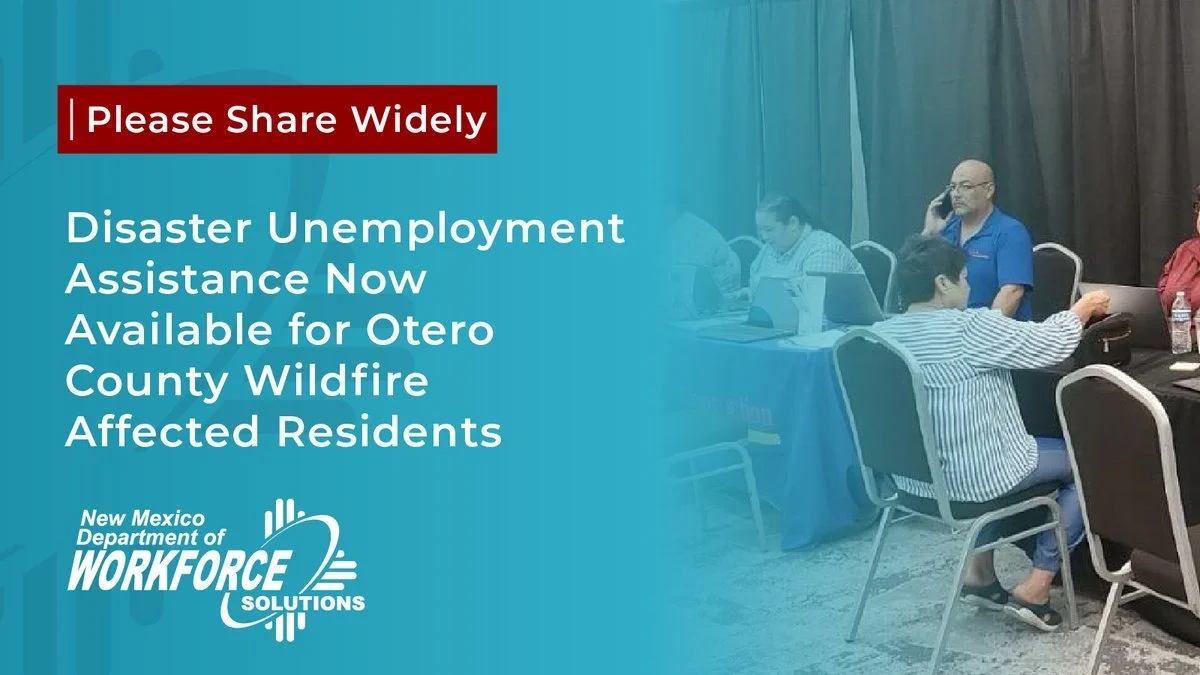
Unemployment assistance from the state is now set up for people losing wages from their displacement due to the South Fork and Salt fires. This assistance is available to people living in Lincoln and Otero counties or on Mescalero Apache land that are workers or business-owners. The assistance is available from June 23, 2024 until December 21, 2024, as long as unemployment is related to the fire and flood disasters. To receive benefits, applications must show how their ability to work was impacted by the fire.

It’s a two-step process to qualify for Disaster Unemployment Financial Assistance.
First: qualifying individuals must apply for Standard Unemployment Insurance online at https://www.jobs.state.nm.us, in-person at a New Mexico Department of Workforce Solutions office, or by calling the Unemployment Insurance Operations number at 1-877-664-6984.
To qualify for the disaster benefits, the state agency will first reject the application for the Standard Unemployment Insurance. Only then can people apply for Disaster Unemployment Assistance. Keep the rejection letter for the second step.
Second: after the application for standard unemployment insurance has been rejected, individuals must call or visit the New Mexico Department of Workforce Solutions (1-877-664-6984, open M-F 8:00-4:30) to submit a disaster benefit application. Proof of employment documents must be submitted to the New Mexico Department of Workforce Solutions within three weeks after filing for disaster unemployment benefits.

The New Mexico Department of Workforce Solutions has set up an office in the Roswell Convention center and deployed a van with computers onboard to assist with applications. Individuals may also visit any Workforce Connection Centers. Local offices are open weekdays from 8 a.m. to 5 p.m.

People are urged to file as soon as possible to meet an Aug. 19 deadline. Any applications filed after Aug. 19, 2024 may be considered “untimely,” and may be denied, according to a press release from the Department of Workforce Solutions.


Fire Updates

Evacuation orders lifted
Parts of the Village of Ruidoso reopened to full-time residents on Monday (6/24) morning at 8 a.m. By Tuesday afternoon, about half of the 8,000 village residents who were evacuated from the South Fork and Salt fires had returned.

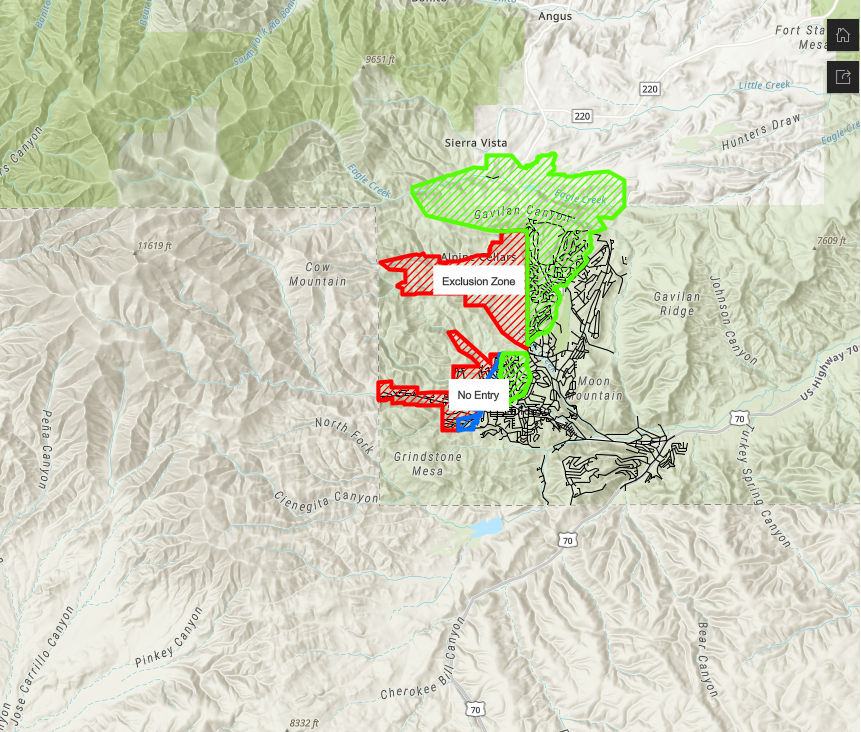
The Village of Ruidoso published an updated map showing parts of the village that were still closed off, called “exclusion zones,” or burned areas with many different crews working in them. In these areas, there was massive fire-caused damage and burned houses. Authorities have cordoned off these places and are treating them as crime scenes until any evidence can be collected.

Federal Disaster Declaration
Otero County was added to the federal disaster declaration in the wake of the South Fork and Salt fires, according to an amendment filed Monday. This means that spending by Lincoln and Otero counties, along with the Mescalero Apache Tribe, to address the fires and floods from last week will be eligible for assistance from the U.S. government. People living in those areas will also be able to seek direct aid, such as unemployment payments (see section above).


Extreme Weather Awareness

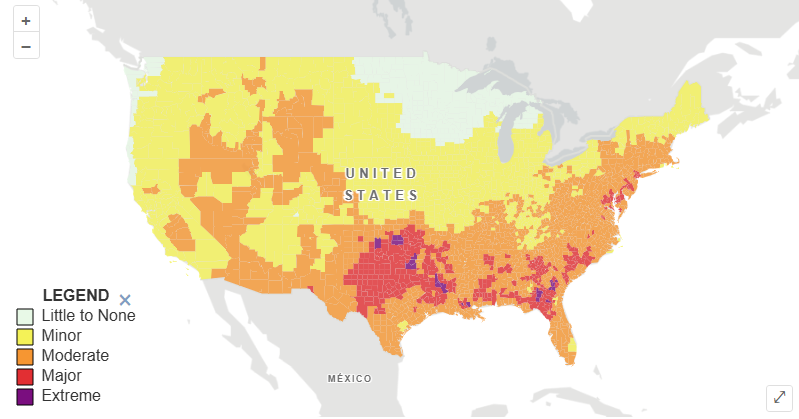
Heat: In addition to fueling wildfires and flooding, extreme weather itself can be a threat to life and property. The Environmental Protection Agency (EPA) has released the HeatRisk Tracker which allows users to view heat risk, especially to those who are pregnant, a child or teen with asthma, or have a heart condition or other chronic health conditions, across the country. While hot days can affect anyone, those with the above conditions can be more susceptible to heat.

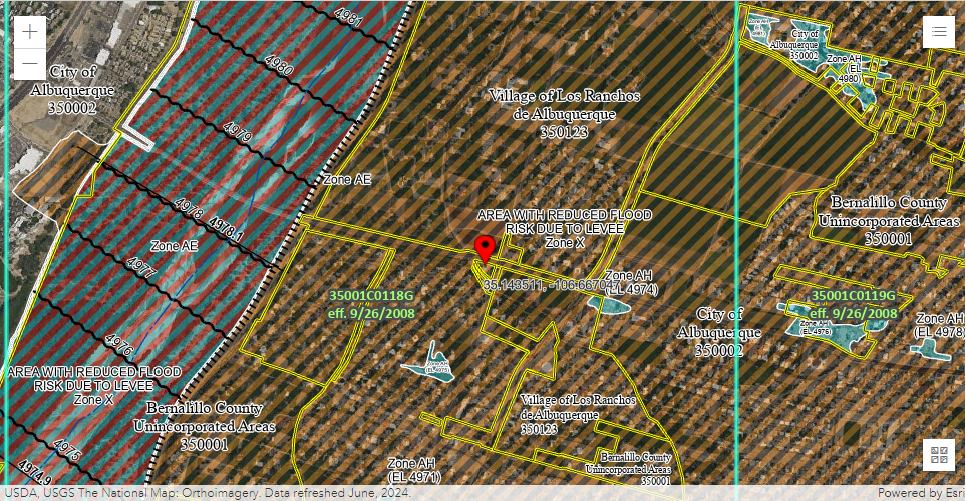
Floods: Unexpected floods occur naturally and can happen almost anywhere. Although river and coastal flooding are two of the most common types, fire scars and other areas with drought-ridden or hydophobic soils are often affected, especially when impacted by heavy rains. Flood maps, which show how likely it is for an area to flood, are one tool that communities can use to know which areas have the highest risk. Any place with a 1% chance or higher chance of experiencing a flood each year is considered to have a high risk. Use the FEMA Flood Map Service Center (MSC) to find your official flood map, access a range of other flood hazard products, and take advantage of tools for better understanding flood risk.

Wildfire Wednesdays #137: The FAC Framework

Hi Fireshed Community,

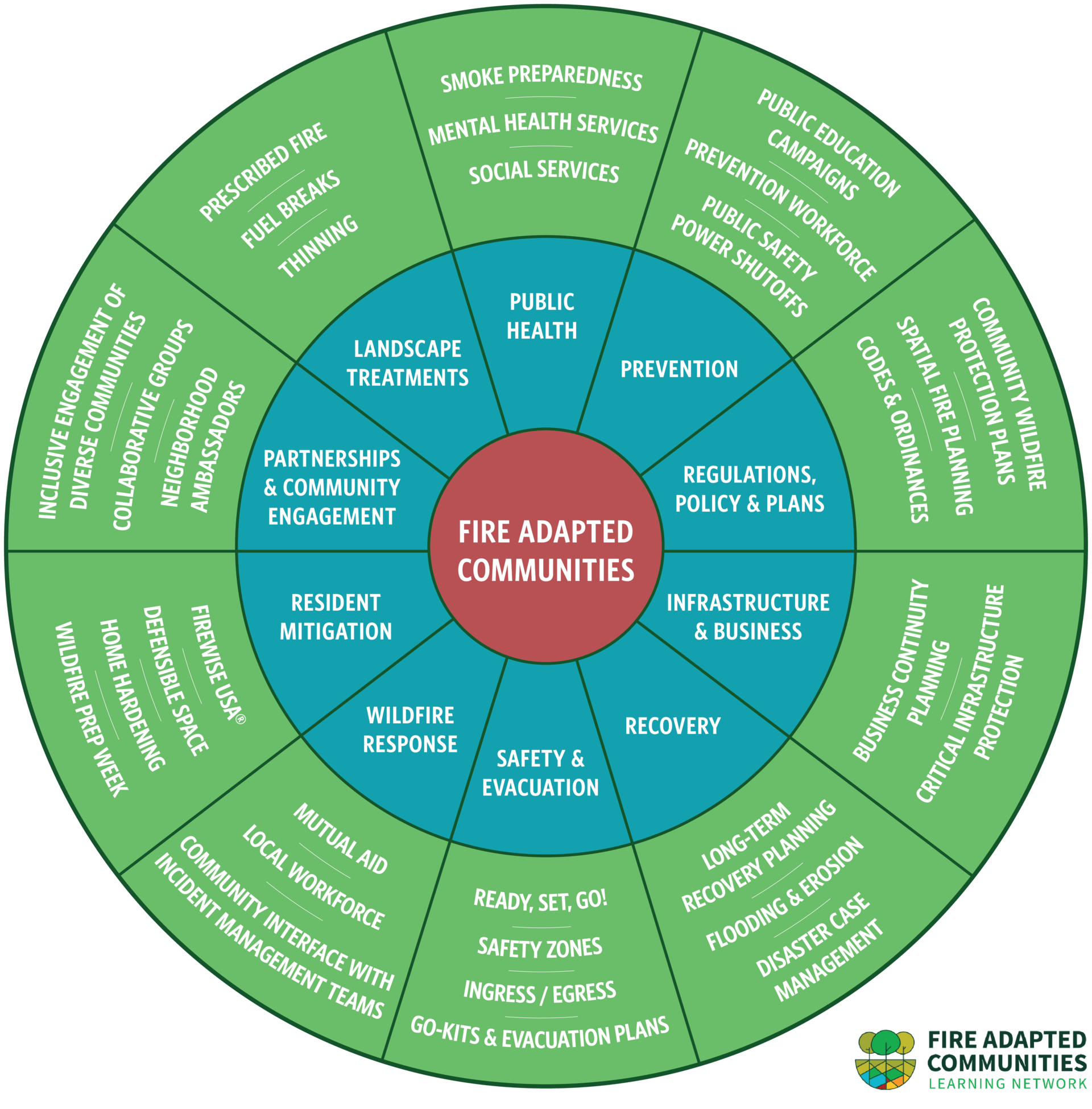
Much of the work that we do towards community wildfire adaptation in the Greater Santa Fe Fireshed involves working together across boundaries and across disciplines. The Fire Adapted Communities framework may be helpful in guiding some of our work in Santa Fe. Fire Adapted Communities include community leaders, fire departments, local businesses, local governments, and land management agency representatives. It involves many people working in different roles, towards the common goal of making our communities better adapted to the reality of wildfire. The Fire Adapted Communities graphic and facilitator’s guide are helpful tools to support our work within and across these different roles. With that in mind, today’s Wildfire Wednesdays revisits the FAC graphic and facilitator’s guide as a framework for our development of Fire Adapted Communities.

This week’s Wildfire Wednesdays includes:

  • Fire Adapted Communities Graphic and Facilitator’s Guide

  • An Index of Funding Opportunities developed by Coalitions and Collaboratives and the Watershed Research and Training Center

Best,
Gabe

Fire Adapted Communities Graphic and Facilitator’s Guide

This graphic and facilitator’s guide were designed to help explain the fire adapted communities (FAC) framework. It describes a set of components that make up community wildfire adaptation, and gives examples of specific programs and activities that communities can undertake to reduce their wildfire risk and increase their resilience. Remember, FAC is not a one-size-fits-all approach; every community’s journey to living better with fire is unique. This graphic was created by the FAC Learning Network with input from community-based practitioners from across the United States.


Important Notes

  • This graphic is NOT comprehensive. It does not include all of the potential actions or programs a community could undertake to advance fire adaptation. The graphic includes examples of some of the most common actions and programs. When talking about FAC, you should include examples that are relevant to efforts in your community.

  • This graphic is not a checklist. Community-based leaders are best positioned to change a community's relationship with fire. Every community has different assets and challenges, and contexts that are always changing. Do not instruct people to use this graphic as a checklist. It is intended to inspire people to consider a range of issues and actions, not prescribe strategies for communities.

  • The content in this graphic was contributed by fire resilience practitioners working across the United States. Not all of the programs or actions will be priorities for your community.

What does this graphic explain?

The graphic is designed to communicate the fire adapted communities (FAC) framework. It depicts a set of components that make up community wildfire adaptation, and gives examples of specific programs and actions that a community could undertake to advance their work. FAC is not a one-size-fits-all approach. Community context matters and it is dynamic.

When should you use this graphic?

The FAC graphic can be used in presentations, or workshops where a facilitator walks participants through the graphic. The standalone graphic can also be used on websites or in printed materials. However, in these applications we encourage users to include a written description to explain that the graphic is not prescriptive or comprehensive of all valid FAC approaches.

Who is the graphic for?

The graphic can be used with community partners, FAC practitioners, the media, and agency partners. When talking with different audiences, remember to use language that will resonate with them. This graphic was designed with community wildfire resilience practitioners as the primary audience, so some language may be need to be adjusted for use with community members or others. Adapt the examples and language in this guide as needed to best reach your intended audience.

Grants and Funding Opportunities

Finding and managing funding for climate mitigation and forest resilience may appear challenging, but fear not. There exists a multitude of financial resources dedicated to support creating sustainable and fire-adapted communities, creating healthy and resilient landscapes, and safe and effective wildfire response. 

To support your development goals, the Watershed Research and Training Center and Coalitions and Collaboratives have created a Grants and Funding Opportunities page.

BIL/IRA funding opportunities

The Bipartisan Infrastructure Law and Inflation Reduction Act provisions and funding broadly support these efforts through grants and agreements. The four main grant categories are listed below.

  • Community Wildfire Defense Grants

  • IRA Forest Landowner Support

  • Wood Innovations Program Grants

  • Urban and Community Forestry

Other funding opportunities

Combining grants from various sources broadens the pool of funding, lessening reliance on any single source and bolstering financial stability and resilience. Below are potential funding avenues to fortify your community’s capacity for climate resilience.

This effort is supported through the Community Navigator Program of the USDA Forest Service.

CLICK HERE FOR GRANT AND FUNDING INFORMATION