Happening tomorrow: A Public Event to Become Fire Adapted!

Ready, Set, Go! A Wildfire Preparedness Event

Saturday, April 27th, 10 am – 1 pm
Christ Church Santa Fe, 1213 Don Gaspar

Special Topic - How does the Threat of Fire Affect Your Homeowner’s Insurance?
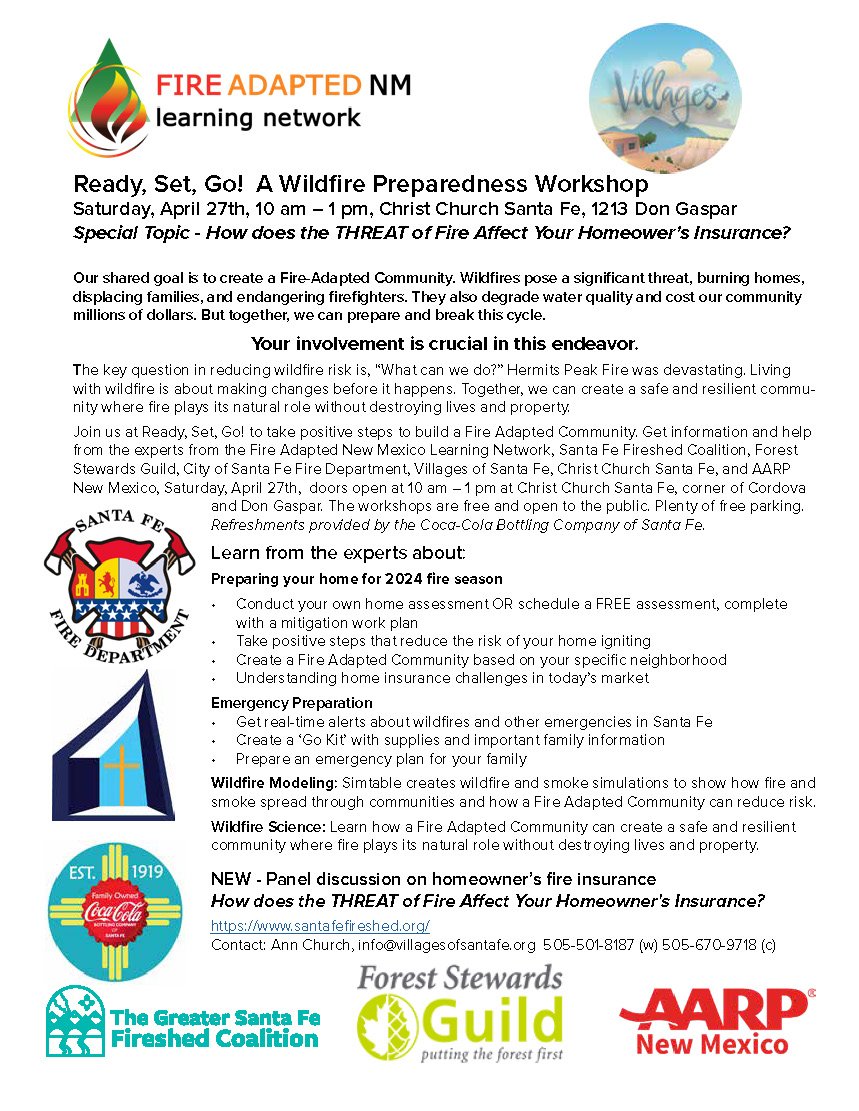
Join us TOMORROW, April 27, at the family-friendly Ready, Set, Go! Wildfire Preparedness Workshop! Learn from experts, enjoy refreshments, and spend some time in community taking positive steps to build a Fire Adapted Community. Get information and help from the experts from the Fire Adapted New Mexico Learning Network, Santa Fe Fireshed Coalition, Forest Stewards Guild, City of Santa Fe Fire Department, Villages of Santa Fe, Christ Church Santa Fe, and AARP New Mexico. Doors open at 10:00 am and the event runs through 1:00 pm at Christ Church Santa Fe on the corner of Cordova and Don Gaspar. The workshops are free and open to the public and the site offers plenty of free parking.

Refreshments provided by the Coca-Cola Bottling Company of Santa Fe.

Learn from the experts about:

Preparing your home for 2024 fire season

  • Conduct your own home assessment OR schedule a FREE assessment, complete with a mitigation work plan

  • Take positive steps that reduce the risk of your home igniting

  • Create a Fire Adapted Community based on your specific neighborhood

  • Understanding home insurance challenges in today’s market

Emergency Preparation

  • Get real-time alerts about wildfires and other emergencies in Santa Fe

  • Create a ‘Go Kit’ with supplies and important family information

  • Prepare an emergency plan for your family

Wildfire Modeling

  • Simtable creates wildfire and smoke simulations to show how fire and smoke spread through communities and how a Fire Adapted Community can reduce risk.

Wildfire Science

  • Learn how a Fire Adapted Community can create a safe and resilient community where fire plays its natural role without destroying lives and property
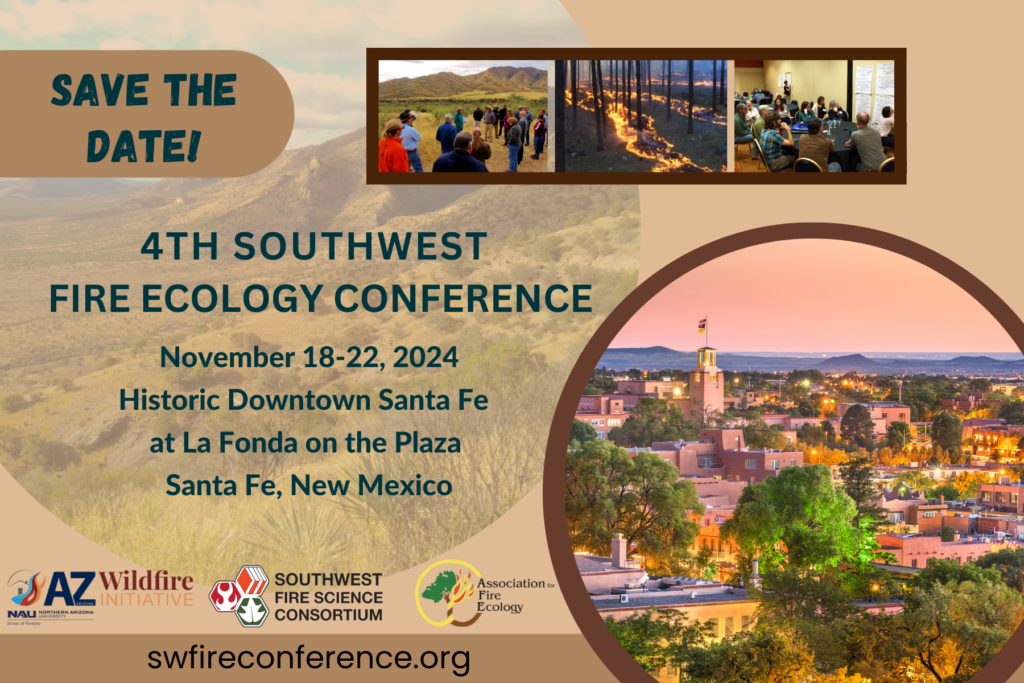
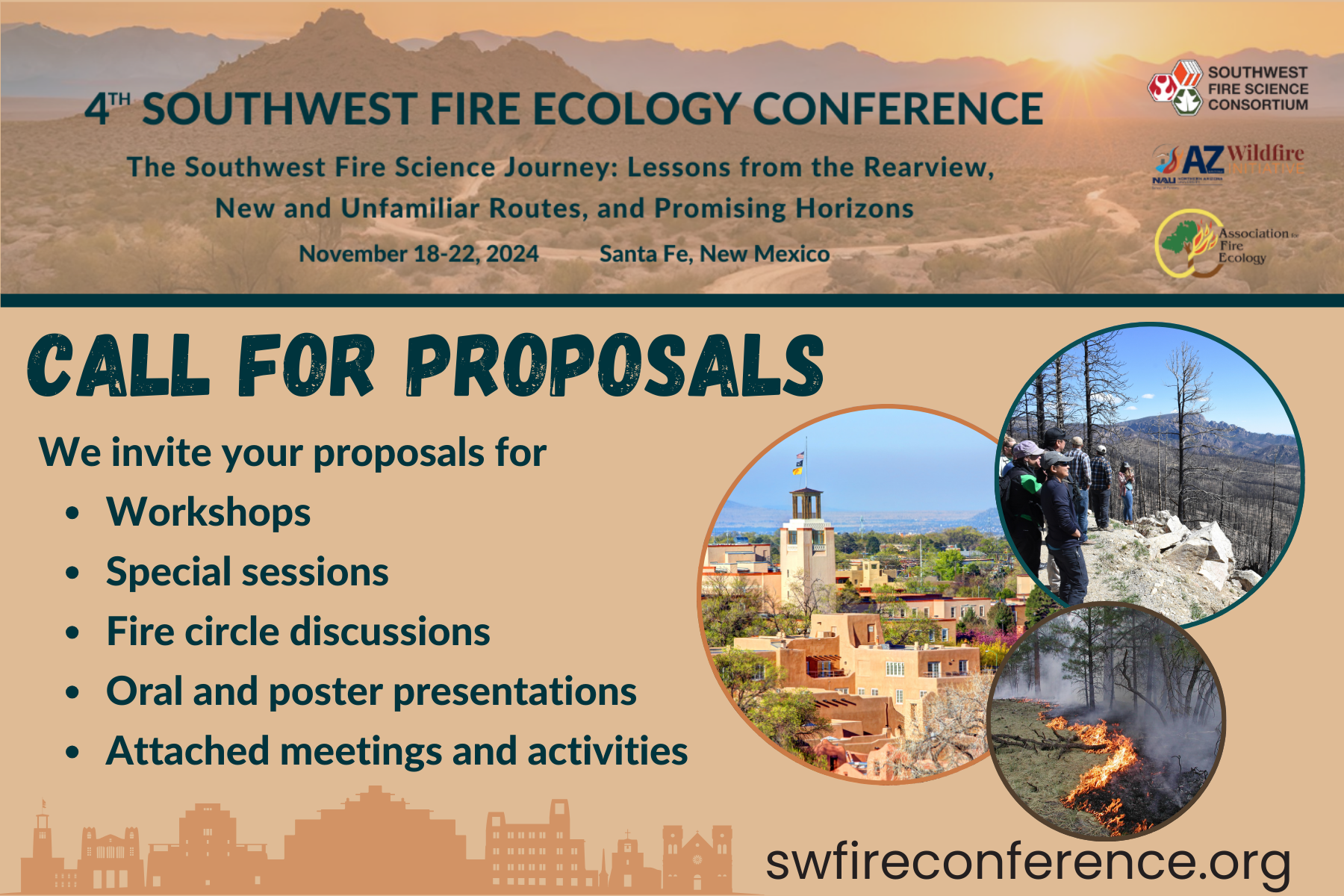
4th Southwest Fire Ecology Conference - Save the Date!

The Southwest Fire Science Journey: Lessons from the Rearview, New and Unfamiliar Routes, and Promising New Horizons

November 18-22, 2024 // Santa Fe, NM // La Fonda on the Plaza

To learn more about the conference, visit https://swfireconference.org/

The Southwest Fire Science Consortium, Arizona Wildfire Initiative, and the Association for Fire Ecology invite your participation in the 4th Southwest Fire Ecology Conference this November! This event is a gathering space for aspiring and established professionals to share knowledge, exchange ideas, and discuss the latest advancements in fire ecology research and management with a focus on the future of the southwestern United States. Save the date and plan to attend for a unique opportunity to connect with colleagues in the field and engage in stimulating discussions that will help shape the emerging profession and growing field of fire ecology in this region. The call for proposals is open now and registration opens on July 1; see other important dates.

Call for Proposals is Now Open

The Call for Proposals is now open for workshops, special sessions, fire circle discussions, oral presentations, and poster presentations. With the conference theme, The Southwest Fire Science Journey: Lessons from the Rearview, New and Unfamiliar Routes, and Promising Horizons, the group seeks to gain a better understanding of the past, present, and future of fire ecology and management in this region. The group invites proposals on topics related to fire ecology, science, and management with a focus on results and lessons learned that are applicable to the Southwest.

Proposal Due Dates:

To view proposal requirements and learn more about focal topics, visit https://swfireconference.org/cfp/

  • May 15: Proposals Due for Special Sessions and Workshops

  • July 15: Proposals Due for Oral Presentations

  • August 15: Proposals Due for Poster Presentations and Meetings/Activities

The Theme: Past, Present, and Future

Lessons from the Rearview, New and Unfamiliar Routes, and Promising New Horizons

As wildland fire scientists, managers, educators, and students in the Southwest, we find ourselves in an era of rapid change and in need of new approaches, well-planned investments, and meaningful collaborations. Typical land and fire management strategies no longer suffice in the face of escalating challenges posed by more intense fires and the impacts of climate change on precipitation patterns and temperatures. While recent and substantial investments aim to tackle these issues, they often operate on timelines that are misaligned with natural processes. Simultaneously, a cultural shift is imperative—one that recognizes our integral connection to fire-prone lands, embraces the evolving reality of wildfire and ecosystem transition, and equally respects the knowledge held by Indigenous and land grant communities of the Southwest.

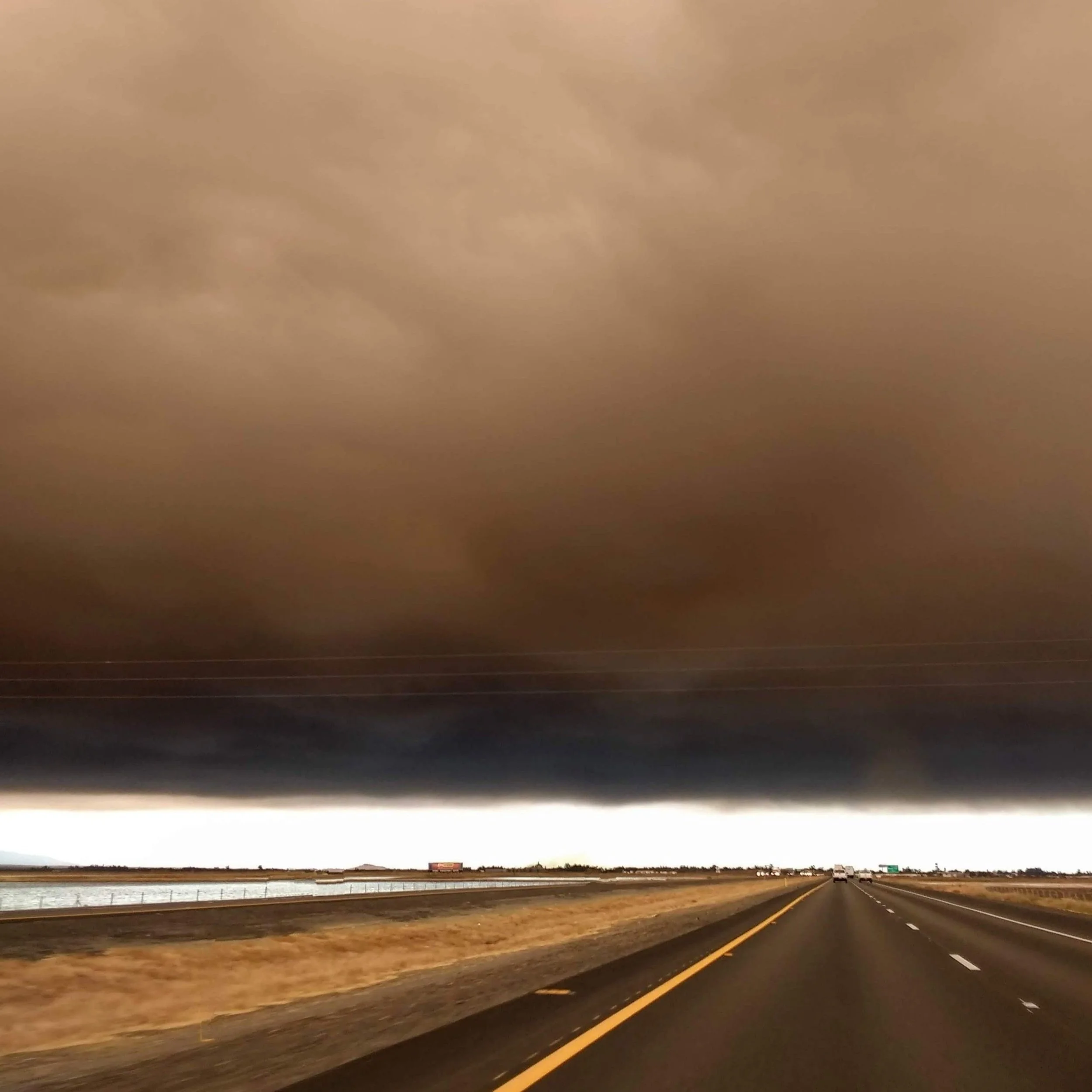
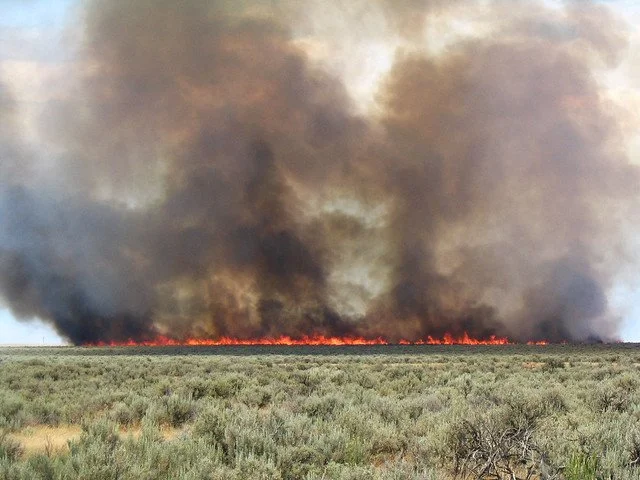
Smoke column over I-5 on November 8, day 1 of the 2018 Camp Fire.

At this pivotal juncture, AFE and its partners advocate for a reflective pause to better understand the past, present, and future of the fire science journey in the southwestern US. The integration of past insights with modern approaches is paramount as we invest in creating resilient landscapes and peoples of tomorrow.


The following topics will be of special interest and focus during this year’s conference:

  • Biodiversity and fire

  • Climate adaptation

  • Collaborative and cross-jurisdictional case studies

  • Cultural fire

  • Education and workforce development

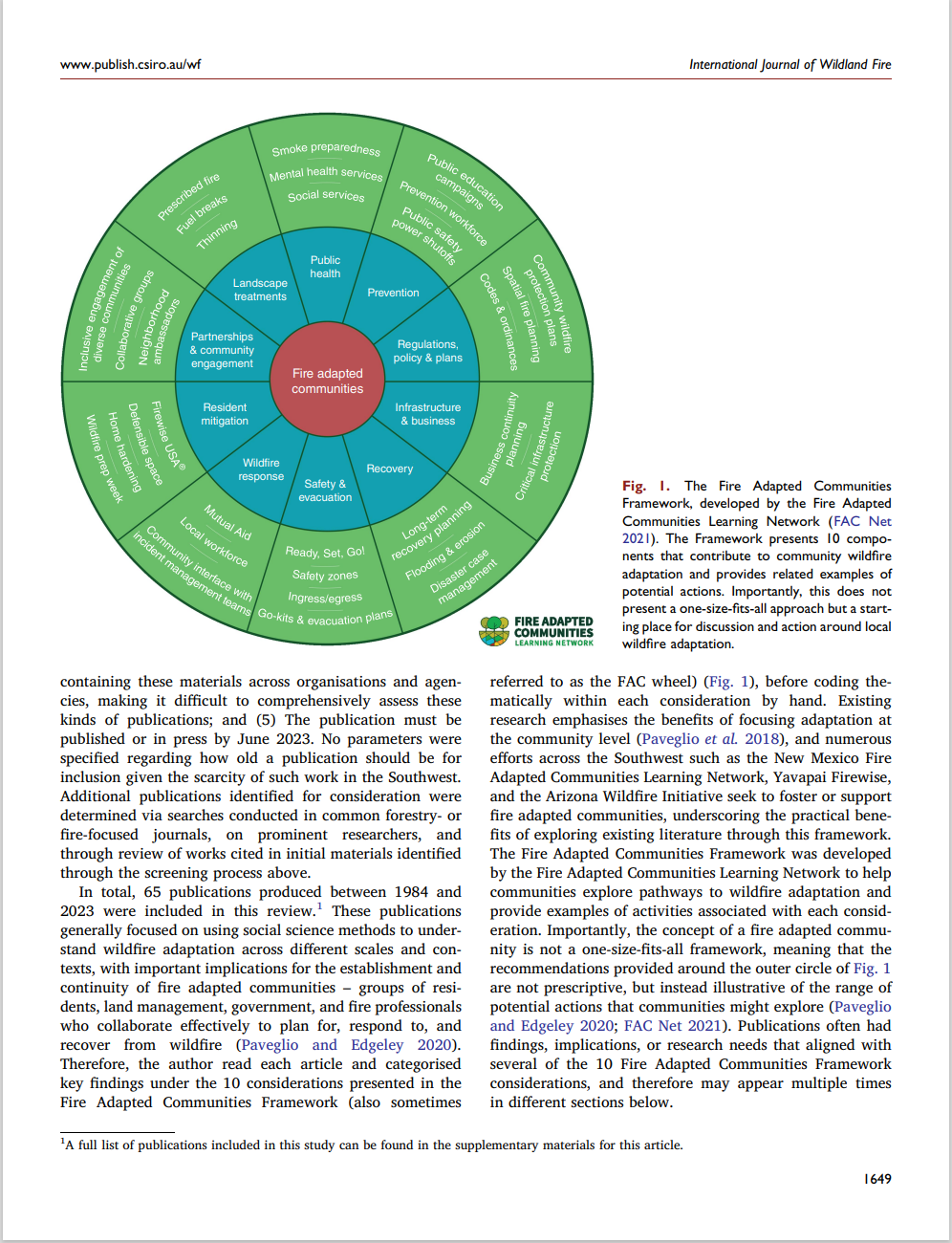
  • Fire-adapted communities and Firewise

  • Invasive species and fire

  • Lessons learned in science and management

  • Planning for resilience in uncertain future

  • Post-fire recovery

Wildfire Wednesdays #133: Technical Assistance for Federal Funding

Hi all,

Spring is a time for action when it comes to wildfire mitigation around your home and wildfire resilience in the surrounding landscapes. If you have been interested in taking your wildfire mitigation or landscape resilience implementation to another level, now is a great time to consider applying for funding to achieve these goals. Within the Inflation Reduction Act (IRA) and Bipartisan Infrastructure Law (BIL) there are a variety of funding mechanisms that can support your work. We encourage you to get to know some of these opportunities, because they will only be available for a short period of time.

With that in mind, this Wildfire Wednesday’s is about the Community Navigators Initiative, which is intended to support folks like you with awareness and technical support for accessing federal funding programs.

This Wildfire Wednesdays includes:

  • A recording of the 03/29 webinar about the Community Navigator Initiative

  • Grant News and Updates

  • Sign-up for technical assistance through Community Navigator Initiative through the Fire Adapted New Mexico learning network

Best,

Gabe

The Community Navigator Initiative

Watch this webinar about the Community Navigator program from the Fire Adapted New Mexico learning network (FACNM)

The Fire Adapted New Mexico learning network (FACNM) is working with the Forest Stewards Guild and the Watershed Center, along with several other national and regional nonprofit organizations, is partnering with the US Forest Service on a community navigator initiative. 

The goal of this effort is to connect communities facing wildfire risk and climate change impacts, as well as historically underserved, rural, and low-income communities, to Forest Service funding and partnership opportunities supported by the Inflation Reduction Act and the Infrastructure Investment and Jobs Act (also known as the Bipartisan Infrastructure Law). For a snapshot of the programs and activities that received funding through these laws, see our overview of BIL & IRA-supported Climate and Wildfire Resilience Funding Opportunities.

Key aspects of FACNM’s community navigator work include:

  • Developing relationships with communities who may benefit from new funding opportunities and connecting them with sources of technical assistance and support within our networks.

  • Creating tools, trainings, and other resources to support organizational capacity-building.

  • Providing individual technical assistance to help communities identify and apply for funding opportunities and comply with post-award financial management and reporting requirements. 

Another important aspect of our work involves elevating community perspectives and feedback about the barriers that communities face in accessing US Forest Service support and partnership, with the goal of helping vision a more equitable system for all. 

The other organizations working on the Forest Service community navigator initiative include Coalitions and Collaboratives, Hispanic Access Foundation, Federation of Southern Cooperatives, First Nations Development Institute, and the American Indian Alaska Native Tourism Association.

Grant News and Updates

All federal grant applicants must be registered with SAM.gov. Register NOW as this process can take weeks and is needed to apply for funding opportunities via Grants.gov. If SAM.gov registration issues arise, contact Procurement Technical Assistance Center (PTAC) for free assistance.

IRA Forest Landowner Support

Deadline is August 21, 2024

Provides grant opportunities to entities and organizations delivering technical and financial assistance to private forest landowners - including Tribes, underserved landowners, and small-acreage landowners - to participate in emerging private markets for forest resilience and climate mitigation.

NOFO #1 USDA-FS-2023-IRA-FLS-01:

Supporting Underserved and Small-Acreage Landowner Participation in Emerging Private Markets

Last month, the Forest Service announced the award of the first round of this funding. A total of $116 million was awarded to 20 Forest Landowner Support projects (scroll down to the Spring 2024 dropdown under “Forest Landowner Support Awardees”) to provide equitable access to emerging climate markets. Many of the awardees represent or will support underserved landowners located in or providing benefits to disadvantaged communities.


Funding is still available for proposals under $2 million that support the participation of underserved landowners and landowners owning less than 2,500 acres in emerging private markets for climate mitigation or forest resilience. Proposals for NOFO 1 are reviewed in batches on a quarterly basis:

  • Upcoming batch: All proposals received March 1, 2024 - May 31, 2024.

  • Final batch: All proposals received June 1, 2024 - August 21, 2024
    IRA-FLS NOFO1 Frequently Asked Questions (available in Related Documents under the “full announcement materials” dropdown)

NOFO #2 USDA-FS-2024-IRA-FLS-02:

Tribal Access to Emerging Private Markets for Climate Mitigation or Forest Resilience

The Forest Service’s Forest Landowner Support program has a new funding opportunity focused on Tribal access to emerging private markets for forest resilience or climate mitigation (see announcement here). Eligible applicants include: Federally recognized Tribes, Alaska Native Corporations/Villages, and Tribal Organizations.

IRA-FLS NOFO2 Frequently Asked Questions (available in Related Documents under the “full announcement materials” dropdown)

Resources:

Community Wildfire Defense Grant

Funding communities to 1) develop and revise Community Wildfire Protection Plans (CWPPs), or 2) implement projects described in a CWPP that is less than 10 years old. Contact sm.fs.usfs_cwdg@usda.gov for more information.

Round 2 applications are currently being reviewed. The agency received 500 applications requesting $965 million, and has about $250 million in available funding. We are waiting on official announcements about Round 2 awards and Round 3 release.

Resources:

Applicants are highly encouraged to coordinate with their State Forestry Agency (or equivalent) during proposal development. See a list of State Forestry Agencies and State Forest Action Plans here.

Sign up for Community Navigator Assistance

CALENDAR: Check out our calendar of events for upcoming application deadlines, trainings, informational webinars and other opportunities coordinated through the Watershed Center.

 ASSISTANCE: Fill out a request form to connect with one of our navigators who can help brainstorm proposal and funding ideas, provide information and insight on funding and resources opportunities, review your application, or help with post-award grant management questions.

FEEDBACK: Have you worked with a community navigator and want to share feedback? We’d love to hear from you! Your response will be used to improve our future services.

Upcoming events: Foresters for the Birds May webinars!

The Forest Stewards Guild and Southern Rockies Foresters for the Birds are offering a two-part webinar series this May on the intersection of climate, forest stewardship, and birds! Please register and save the date to learn more about avian research through citizen science, the impact of fuels reduction treatments on the composition of bird species, and the impact of a hotter and drier climate will impact bird populations, especially those with obligate molting grounds in monsoonal areas.


Over the past 5 years, community volunteers from the Weminuche Audubon Society have conducted a study of bird communities in Ponderosa Pine-dominated forested sites that received wildland fuels reduction treatments. This webinar from the Forest Stewards Guild dives into the effects of these treatments, specifically prescribed fire or shrub-layer thinning, on the composition of bird communities in the southern Rocky Mountains, showing that tree canopy and shrub-layer composition and structure have important influences on the number of bird species present and the predominate feeding and nesting behaviors of the avian community.

Tuesday, May 14, 2024, 12:00 – 1:00 p.m. MT: Bird Population Trends and Climate Effects in Southwestern National Parks

Climate change is considered a major driver of recent avian population declines, particularly in the drought-stricken southwestern United States. Predicting how bird populations will respond requires understanding the climatic drivers influencing population density across the region’s diverse habitats. In this webinar from the Forest Stewards Guild, Harrison Jones of The Institute for Bird Populations discusses his research modeling breeding-season densities of 50 bird species in relation to spring and summer drought and the timing of North American monsoon rainfall.

Wildfire Wednesdays #132: Wildfire Resilience Science Round-Up

Hello and happy spring, Fireshed readers!

Four years ago this week, the Fireshed Coalition and Fire Adapted Communities New Mexico (FACNM) started this newsletter with the intent to parse through trustworthy sources for relevant fire preparedness information, recommendations, and tips to bring to readers across the Southwest. The content and format have evolved since its inception, but one essential part of the newsletter has remained constant throughout the years: our commitment to be informed of, and able to incorporate, the best available science into our understanding of fire and our relationship to it. Today’s Wildfire Wednesday revisits some science we’ve shared over the years and shares a round-up of some of the most recent regional fire science from the Southwest Fire Science Consortium.

Today’s Wildfire Wednesday features:

Take care and enjoy the spring blooms,
Rachel


Southwest Research Publications

Sharing the latest wildfire research relevant to the Southwest

Selected articles are presented below based on their relevance and accessibility to the public. For a full round-up of the latest science and to view publications from earlier in 2023, visit the SWFSC website!

Open access articles


Local Science and Research

Forest and fire ecology findings relevant to the Santa Fe Fireshed landscape

The Greater Santa Fe Fireshed Coalition has pulled together a sampling of local and Southwest-focused scientific articles and forest treatment reports. These journal publications and manager resources, representing the best available science, highlight the importance of forest restoration and conservation treatments happening in the greater Santa Fe area and across the state. While a large body of research can be overwhelming at first, a good place to start is the five topically diverse forest and fire research publications highlighted at the top of the page: a look at climate change in NM over the next 50 years, a study of past Native American fire management in the WUI, carbon stabilization via proactive forest management, the impact of extreme fire on water quality, and fire climate relationships within the Santa Fe Municipal Watershed. If you want to dive in deeper, the page also features a broader list of northern New Mexico- and Southwest-focused forest and fire research articles and local forest treatment success stories.


Throwback to Science from Our Sweet Sixteen

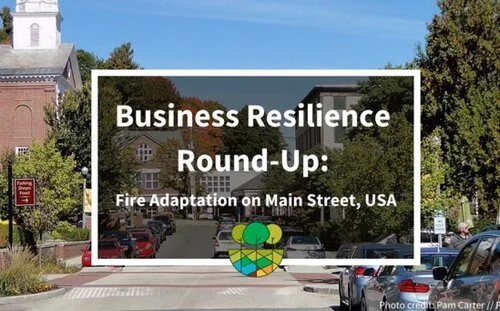
Business resilience and wildfire

Living in a fire adapted area means many things, but what does it mean for businesses and the local economy? In May 2019, the Island Park Sustainable Fire Community in Idaho tackled this question. Their ultimate takeaways were that, in practice, business resilience involves both helping to prepare businesses to operate through wildfire and helping businesses thrive in a fire-prone environment. Wildfires pose a serious threat to a community’s continuity and can have devastating effects on the small businesses that depend on it. Business resiliency and risk mitigation strategies help to defend communities from losses and are especially important for small businesses as they experience the highest risk in proximity to wildfire. Read the full write-up to glean all of these lessons learned.


Events and Resources


In the news

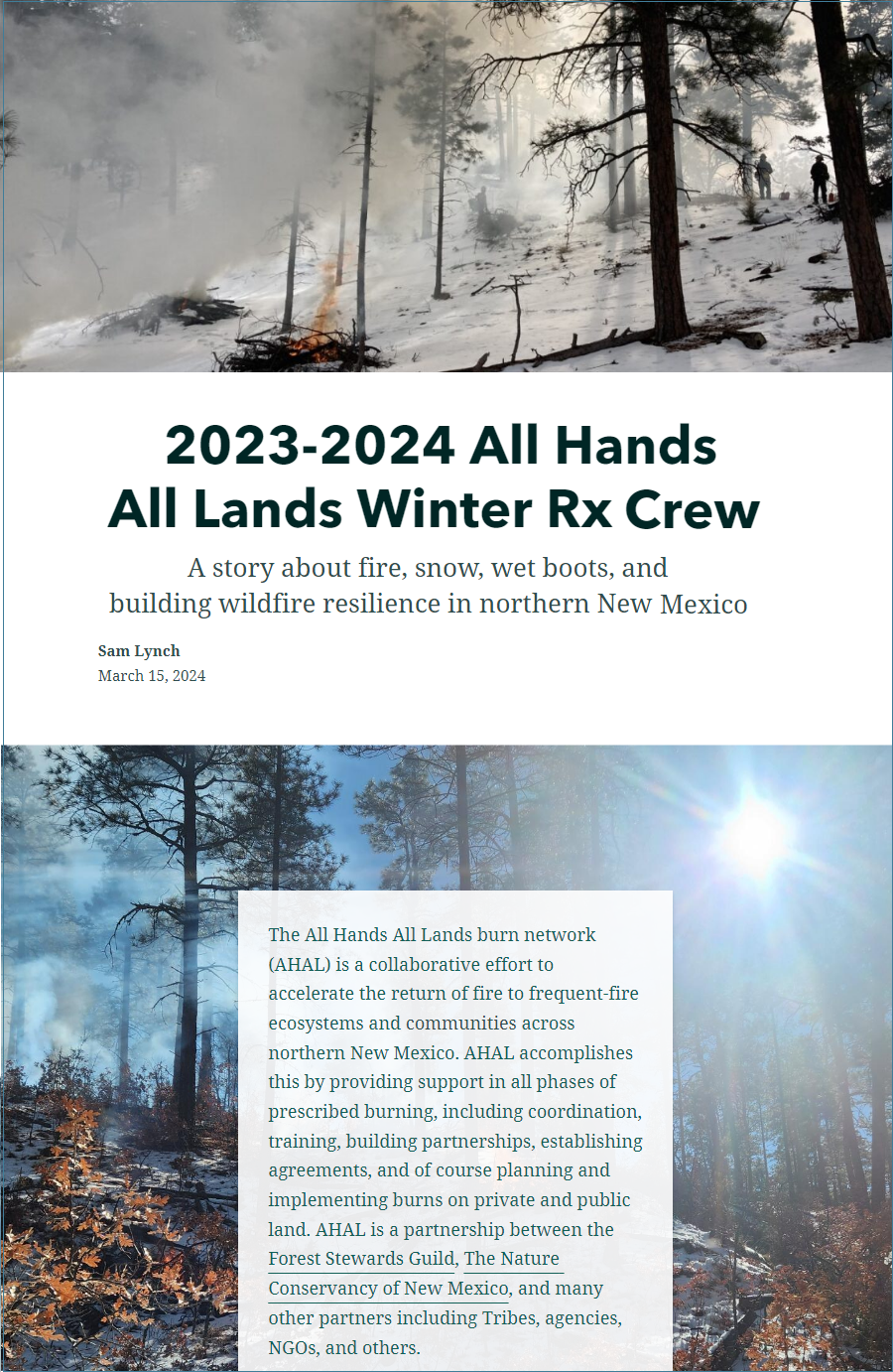
2023-2024 All Hands All Lands Winter Pile Squad: a story about fire, snow, wet boots, and building wildfire resilience in northern New Mexico.

About the squad: this StoryMap from the All Hands All Lands Burn Team discusses the concept of AHAL, the work accomplished by this collaborative burn team over winter 2023-2024, and how this work aligns with the stewardship of fire adapted forests and use of prescribed burning as advocated in the Forest Stewards Guild’s 2021 Policy Statement on Fire, Forest Management, and Communities. In light of the 2022 Hermits Peak-Calf Canyon fire, federal fire agencies and their partners instituted a strategic pause on all prescribed fire activity, during which they researched and released recommendations on how to make this essential forest and community resiliency tool safer. One key takeaway from the recommendations was the need for larger and more diverse burn teams - that is, more boots on the ground, more eyes on the fire, and more perspectives and a greater breadth of experience contributing to the decision of whether or not to burn. The AHAL burn team fills that gap and makes it possible to meet the spirit and letter of this recommendation during collaborative burns. The winter pile squad, active between November and April, adds capacity to the type of prescribed fire which happens during the cooler months - slash pile burning.

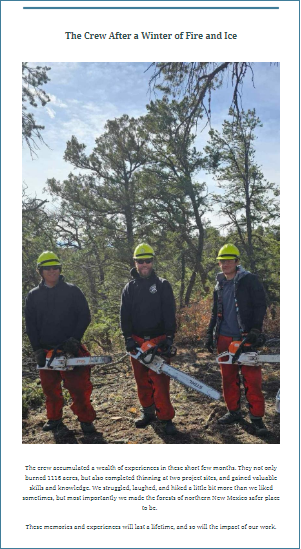
Accomplishments: During the winter season, the Pile Squad assisted with 8 controlled burns, helping to accomplish 1,116 acres of high-priority forest restoration. Much of this work was completed in close proximity to communities and was within the wildland-urban interface (WUI). When not actively burning or patrolling, the pile squad assisted with forest thinning and slash management to prepare for future burns in areas such as the Rio de Las Trampas Forest Council’s Community Forestry plot in between the communities of Trampas and El Valle. They also invested in training and hands-on experiences with city and county fire departments to advance their professional skillsets.


Webinars

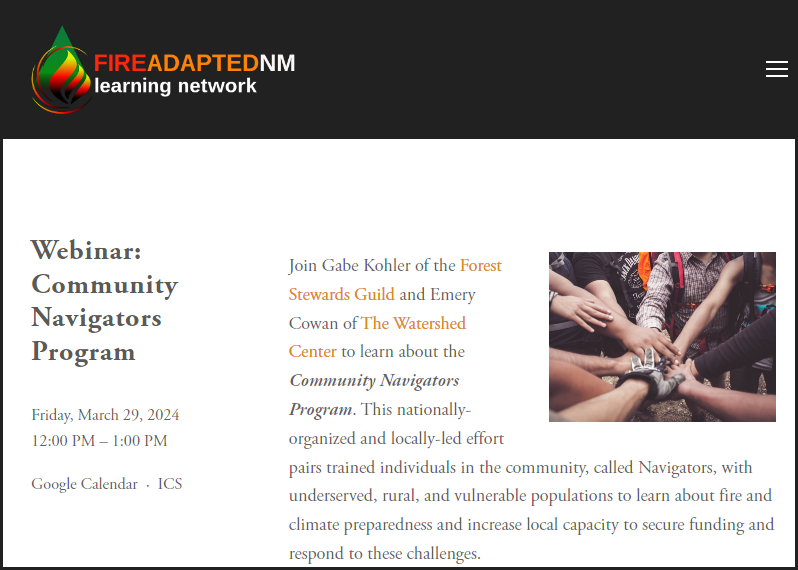
Friday, March 29 from 12:00-1:00pm: What is the Community Navigators Program?
FACNM is launching its spring webinar series on March 29th! Join Gabe Kohler and Emery Cowan as they introduce the national and regional intent of the Community Navigators Program and discuss how communities across the state can access this resource. Learn more by visiting the FACNM Events page!


Learn more and register for the full spring webinar series from FACNM at www.facnm.org/events