Wildfire Wednesdays #94 Counteracting wildfire misinformation

Interested in reading more?

The Coalition has developed resources specifically anchored in the best available science for this landscape.

Check out these related materials:

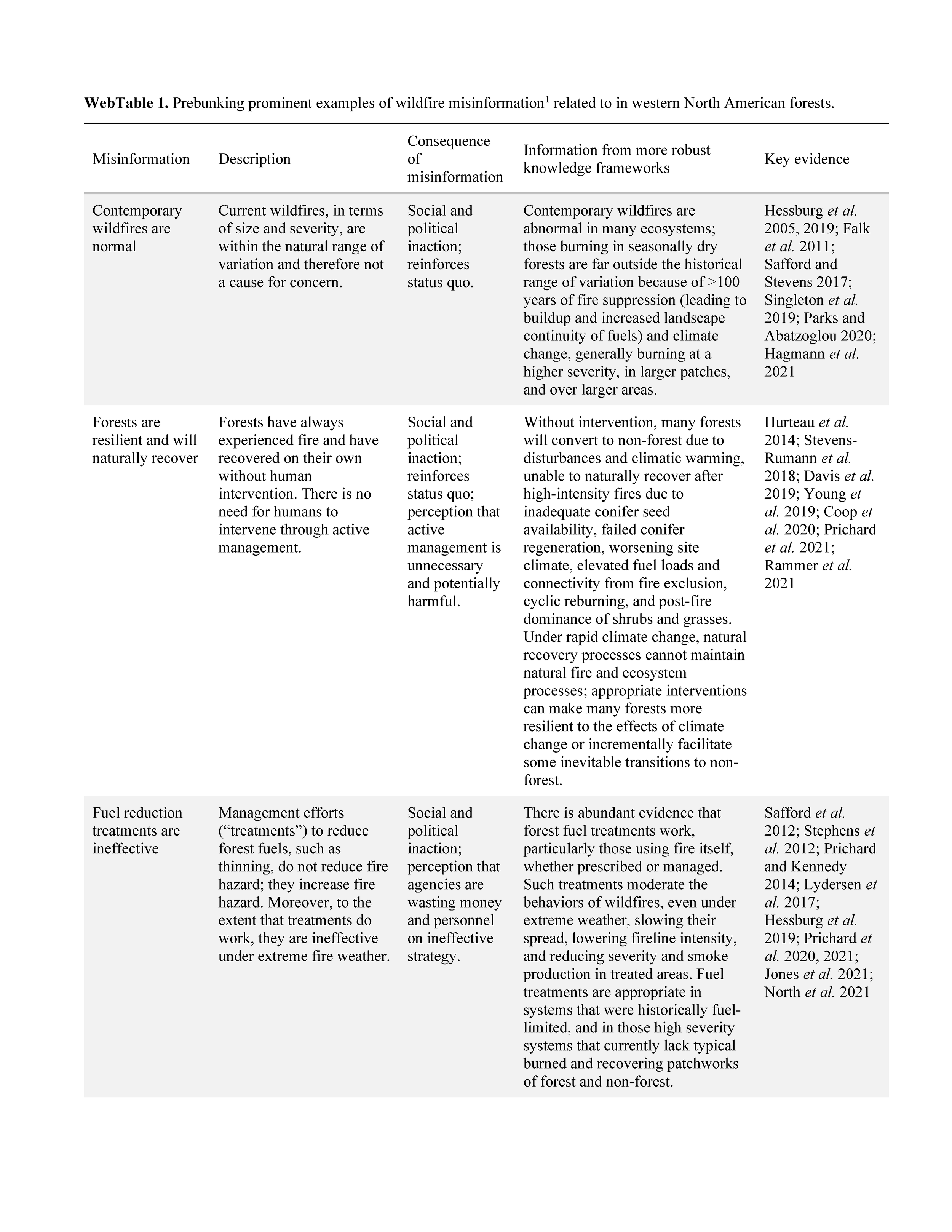
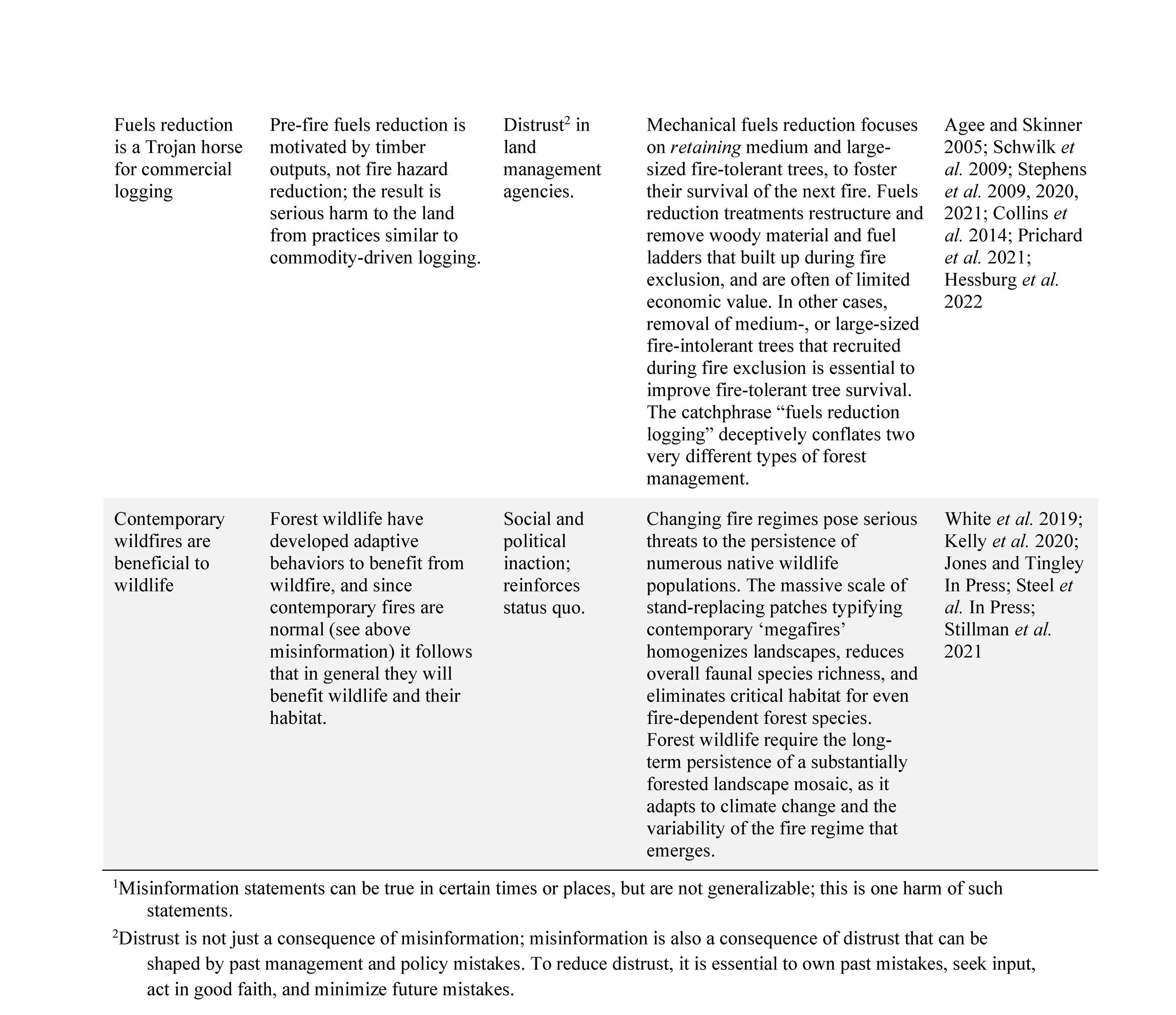
There is misinformation about wildfire, ecosystem health, fire mitigation and forest resilience in Santa Fe. Misinformation about wildfire in Santa Fe has led to significant roadblocks to mitigation and resilience projects that address our wildfire crisis. With climate change exacerbating the consequences of each wildfire year, the outcome of this misinformation could come at high environmental an community cost. The Coalition stands with the consensus among scientists summarized in the recently released Jones et al. (2022) paper and associated table. The paper and table address misinformation about wildfire and debunks prominent examples of wildfire misinformation.

Click on any of the photos or text below to access the PDF versions of this research.

“Wildfire mitigation requires accurate information about drivers of wildfire change, the impacts to society and ecosystems, and actions that alter trends. Misinformation confuses people about the causes, contexts, and impacts of wildfire and substantially hinders society’s ability to proactively adapt to and plan for inevitable future fires. (Jones et al. 2022)”.

Click on the image to access the PDF version of this research and the associated reference pages for the webtable.
Wildfire Wednesdays #93: BACK TO sCHOOL

Hi Fireshed community,

It is normal to feel overwhelmed and somewhat unsure about how to discuss difficult and potentially traumatic subjects like the 2022 wildfire season. Many New Mexicans were personally affected or know someone who was affected by wildfire this year. With kids heading back to school this August, now may be an important opportunity to talk with the youngest in our community about the ecological role of wildfire and how wildfire behavior is changing. To support these important conversations, this Wildfire Wednesdays includes information on:

  • Teaching: how to talk about fire ecology - the science behind wildfire

  • Preparation: how to get your kids ready for wildfire

  • Coping: how to talk to kids about upsetting news and current events

  • Plus a wildfire graphic novel and coloring book for kids or the young at heart, upcoming wildfire recovery events in the Mora and San Miguel areas, and more!

We encourage you to please share these resources with parents and educators in your network to help them with this difficult subject.

Best,
Gabe

Teaching: breaking down fire ecology

What is fire?

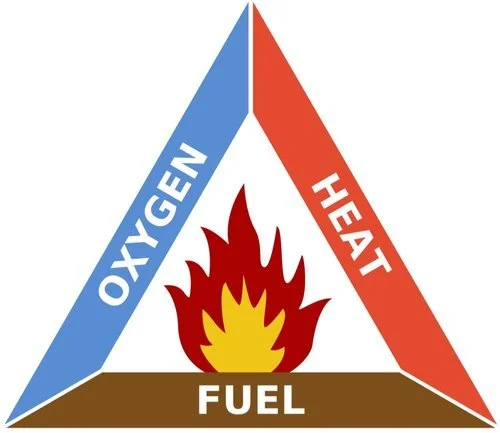
Before we can talk about how fire spreads, we need to understand what fire is. We can feel its heat, smell its smoke, and see its light, but fire is actually not a solid, liquid, or gas. Rather, it is the result of a chemical reaction called combustion. Combustion is the process by which a substance called fuel reacts rapidly with oxygen and gives off heat. There are three components needed for ignition and combustion to occur. A fire requires fuel ­to burn, air to supply oxygen, and a heat source to bring the fuel up to ignition temperature. Heat, oxygen and fuel form the fire triangle. Fire’s heat is the result of super-excited molecules releasing energy in the form of heat as they break and reform their atomic bonds. Smoke is the result of organic material in the fuel being heated to the point that it converts from a solid to a gas. Light is the result of that released energy incandescing, or glowing, and giving off visible light waves at a very high temperature.

How does fire spread?

“After combustion occurs and a fire begins to burn, there are several factors that determine how the fire spreads. These three factors include fuel [what burns], weather [such as temperature and how dry the air is], and topography [the flatness (such as a grassland) or steepness (such as a mountain slope) of the ground]. Depending on these factors, a fire can quickly fizzle or turn into a raging blaze that scorches thousands of acres” (How Wildfires Work).

Fire ecology: the study of fire as a natural part of the ecosystem

Learning about the Calf Canyon Hermit’s Peak Wildfire

Use this interactive story map from the New Mexico Forest and Watershed Restoration Institute to learn about and teach your young ones about the largest wildfire in New Mexico's recorded history and its lasting impacts.

To view the story map, click here.

Preparation: getting ready for wildfire

Preparing an evacuation kit

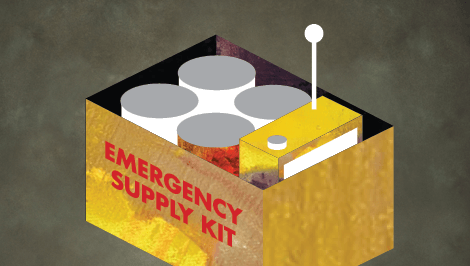
When a wildfire is spreading quickly and your family receives orders to evacuate, your safety is the top priority. This means you probably won’t have time to go through the house and decide what you want or need to take with you, you will just need to get moving. One key to readiness is “having an emergency supply kit ready to grab on the go, long before a wildfire or other disaster occurs. Keep it easily accessible so you can take it with you when you have to evacuate [and] plan to be away from your home for an extended period of time.” Follow the link to learn how to assemble your kit.

Making a family plan

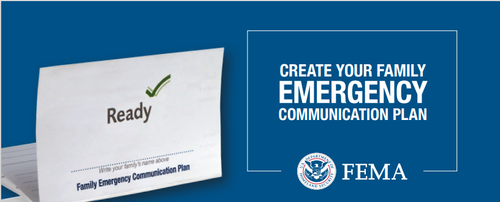
Figure out before a disaster strikes how the whole family will react. Know how you’ll contact one another and reconnect if separated, establish a family meeting place that’s familiar and easy to find, consider the specific needs of your household, and practice ahead of time! Learn how to make a plan today.

Staying up-to-date on wildfires near you

Now that you’re prepared with an evacuation kit and a plan, you need to know where to find accurate information on a wildfire burning nearby.

The National Wildfire Coordinating Group (NWCG) maintains InciWeb, a website where official responding agencies such as the US Forest Service and NM Forestry Division can announce new wildfire ignitions and update wildfire incidents with location, containment status, acres burned, and evacuation notices. Search by incident name or find an incident on their national map (InciWeb).

New Mexico Fire Information (NM Fire Info) is an interagency effort by federal and state agencies to provide timely and accurate fire and restriction information for the entire state. The aim is to maintain one website where the best available information and links related to wildfire and restrictions can be accessed. Find updates on wildfires in the state, links to other helpful sites, and information on fire restrictions and smoke management (NM Fire Info).

VISIT INCIWEB

VISIT NM FIRE INFO

Coping: how to talk about challenging subjects

“After disturbing incidents like… natural disasters, feelings of panic and fear increase. Extensive news coverage and posts on social media can heighten those feelings, especially in kids and teens. As adults grapple with how to move forward in the aftermath these events, it's important to help kids and teens process them, too.” Follow these General Guidelines for helping your kid(s) cope and find security in the face of upsetting current events.

During and following a wildfire, “routine is disrupted and one's sense of security is undermined. Families and communities should not underestimate the accumulative effects of evacuation, displacement, relocation, and rebuilding”. Talking to your child, providing them with facts and explanations of what fire is and why it happened, and allowing them time to process and ask questions can all help them cope with the stress and fear associated with living through a wildfire. Visit this link to learn how to help children impacted by wildfires.

Additional resources

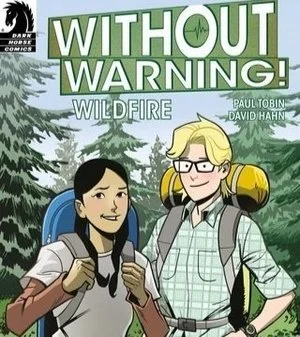
Graphic novel: create an account on Dark Horse to access this open-source graphic novel. Follow along as Meghan and Alexx encounter a wildfire, experience what it is like to be evacuated, and talk about fire safety in Without Warning! Wildfire Safety Comic.

Coloring book: educational wildland fire coloring sheets, available for download from The Smokey Generation (Wildfire Coloring Sheets).


Wildfire Wednesday #92: Commitment to Learning

Happy Wednesday, Coalition Members and Partners.

As our communities strive to recover from the impacts of recent wildfires and continue to make incremental progress toward risk reduction from future wildfires, we recognize the ongoing importance of knowledge sharing. Workshops, webinars, trainings, and other tools enable us to work together toward a Fire Adapted New Mexico. FACNM is taking a break from our usual Wildfire Wednesday structure to provide information on upcoming opportunities which align with this commitment to learning.

Today’s Wildfire Wednesday features information on:

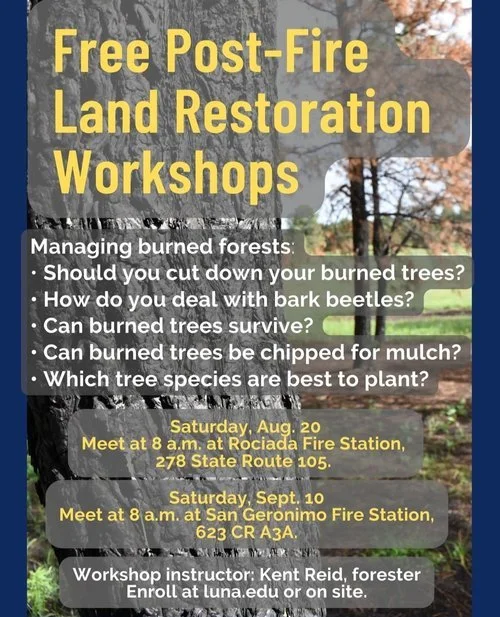
  • Free post-fire land restoration workshops

  • Webinars from the Southwest Fire Science Consortium

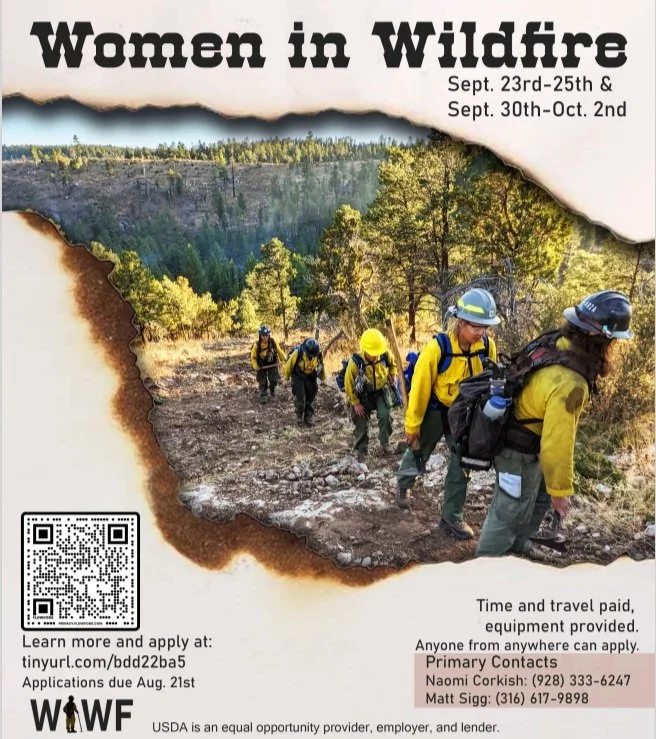
  • Women in Wildfire Training through the US Forest Service

  • Wildland Urban Fire Summit call for presentations

  • Funding opportunity: Community Wildfire Defense Grants

Best wishes,

Rachel


Wildfire Response and Recovery in New Mexico

Post-Fire Land Restoration Workshops

Luna Community College and the NM Forest and Watershed Restoration Institute at Highlands University are partnering to offer two one-day workshops to help landowners with tips and techniques for reducing erosion and restoring forests in burned areas.
Enroll on-site to learn how to manage, treat, and utilize burned forested lands.

For more information, contact Karen Wezwick at (505) 454-5308 or email at kwewick@luna.edu


Southwest Fire Science Consortium

Upcoming webinars

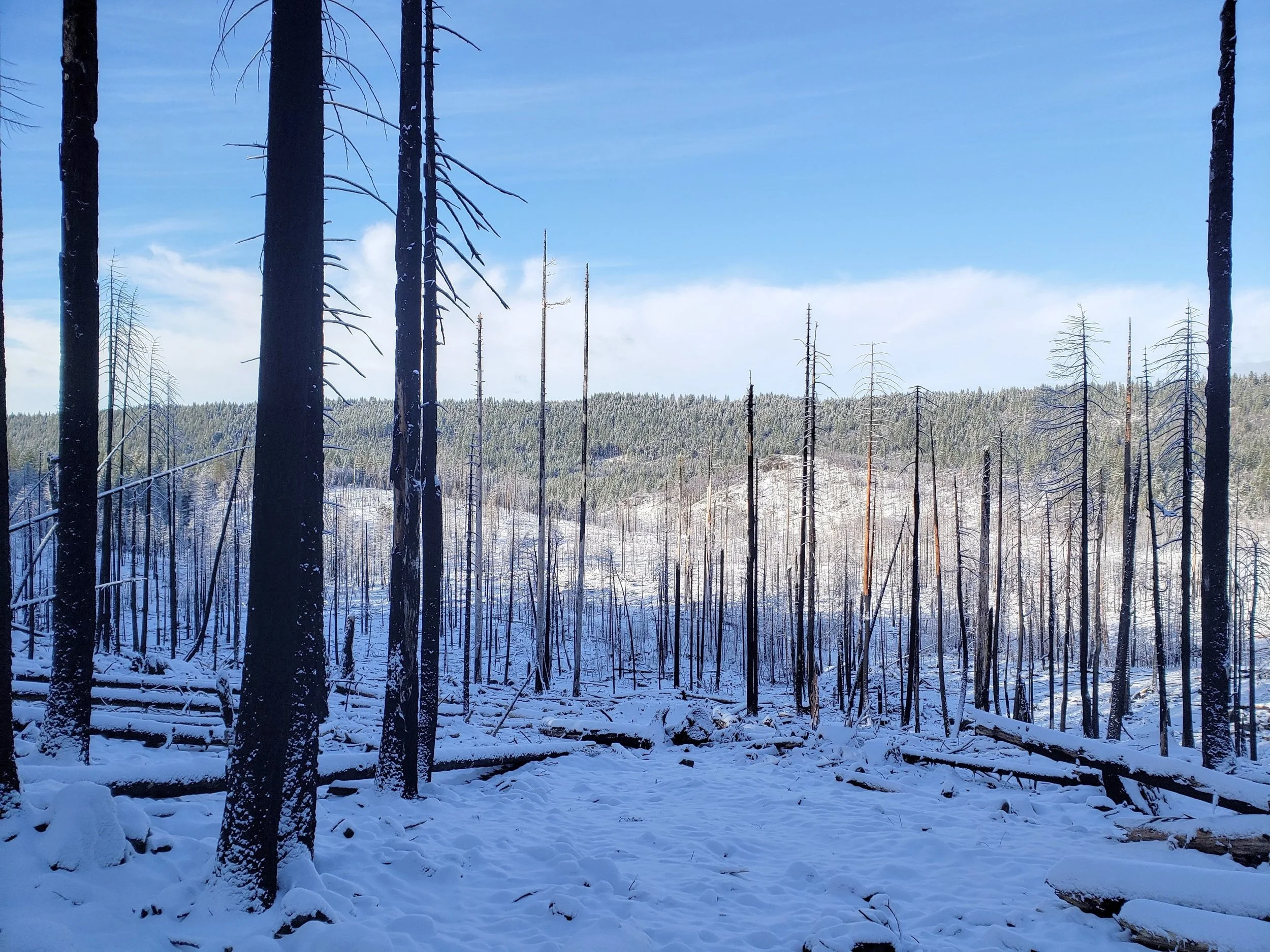
A snow-covered burned forest, half in shadow and half sunlit, with green pine trees visible in the distance
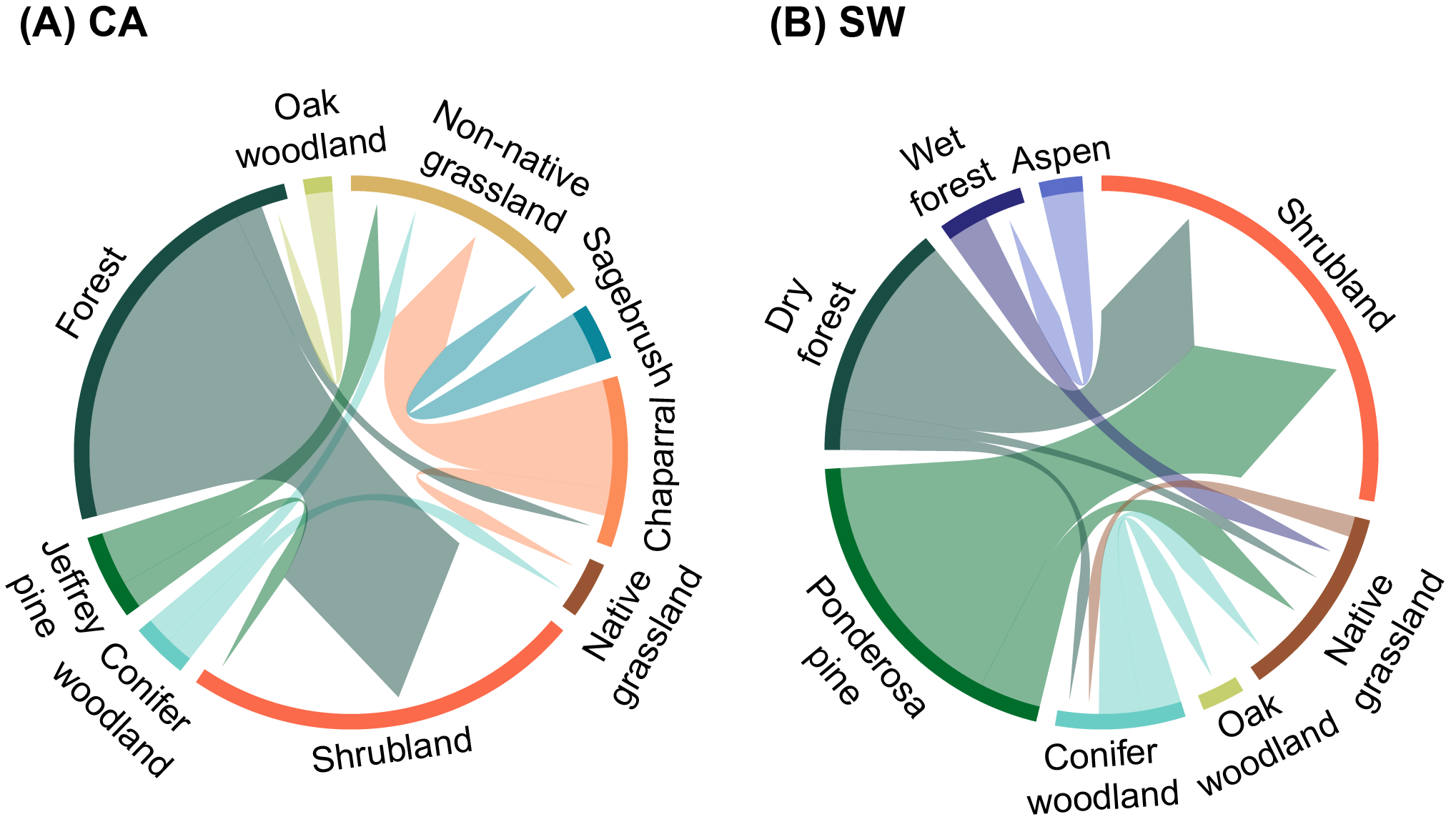
Pie chart from the published paper showing vegetation type regrowth following a high-severity wildfire in california versus the southwest

Image courtesy of C. Guiterman, NOAA

  • Wednesday, August 31 at 1:00pm MDT - Post-Fire Logging in Southern Colorado: Changes to Post-Fire Recovery
    Following a wildfire, successful tree regeneration is mediated by multiple factors, from the microsite to landscape scale. This presentation demonstrates the importance of microsite conditions such as soil moisture and temperature in predicting conifer tree establishment and the impact that post-fire salvage logging can have on these conditions.

  • Wednesday, September 21 at 12:00pm MDT - Vegetation type conversion in the US Southwest: Frontline observations and management responses
    Ecosystems of the western U.S. are experiencing vegetation type conversions (VTC) in response to land-use change, climate warming, and their interactive effects with wildland fire. This presentation discusses VTC challenges, management responses, and outcomes from the collective experience of managers, scientists, and practitioners across the southwestern US.


Women in Wildfire

Training opportunity in Lakeside, AZ

The Apache-Sitgreaves National Forests will be hosting the annual Women in Wildfire Training this fall. This is a fast paced, six-day training where women from around the nation have to opportunity to participate in hands-on wildland fire training in a simulated fire assignment. Anyone is welcome to apply, no experience necessary. After the completion of the training, students become certified as FFT2 (Firefighter Type 2) and will be provided with information on how to apply in USAjobs if interested in working on a fire crew.
Time and travel are paid, and equipment is provided.

Where: the Pinedale Work Center on the Lakeside District of the Apache-Sitgreaves National Forests.

When: Friday-Sunday, Sept 23-25 and Sept 30-Oct 2; participants must attend both timeframes.

How to apply: visit the wildland fire learning portal by August 21st.

If you have any questions, please contact Naomi Corkish at naomi.corkish@usda.gov / (928) 333-6247) or Matt Sigg at matthew.sigg@usda.gov / (316) 617-9898.


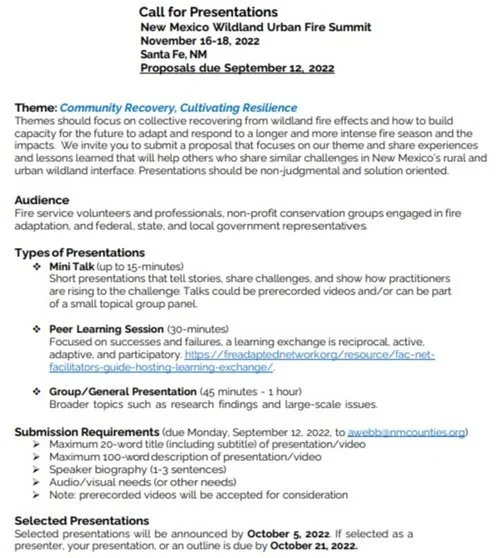
Wildland Urban Fire Summit 2022

Community Recovery, Cultivating Resilience:
Call for submission of presentation proposals!

WUFS logo with colorful "W U F S" letters and white "wildland urban fire summit" imposed against a black silhouette of the state of new mexico

The New Mexico Wildland Urban Fire Summit invites you to share experiences and lessons learned that will help others who share similar challenges in New Mexico’s rural and urban wildland interface. Please consider submitting a proposal that focuses on this year’s theme: collective recovery from wildland fire effects and how to build capacity for the future to adapt and respond to a longer and more intense fire season and its impacts. Presentations may range from 15 minutes to one hour and should be non-judgmental and solution oriented.

Audience: fire service volunteers and professionals, non-profit conservation groups engaged in fire adaptation, and federal, state, and local government representatives.

Submission Requirements:

  • Maximum 20-word title (including subtitle) of presentation/video

  • Maximum 100-word description of presentation/video

  • Speaker biography (1-3 sentences)

  • Audio/visual needs (or other needs)

  • Note: prerecorded videos will be accepted for consideration

All submissions due by Monday, September 12, 2022

For more information, contact Aelysea Webb at NM Counties: 505-310-3564 or awebb@nmcounties.org


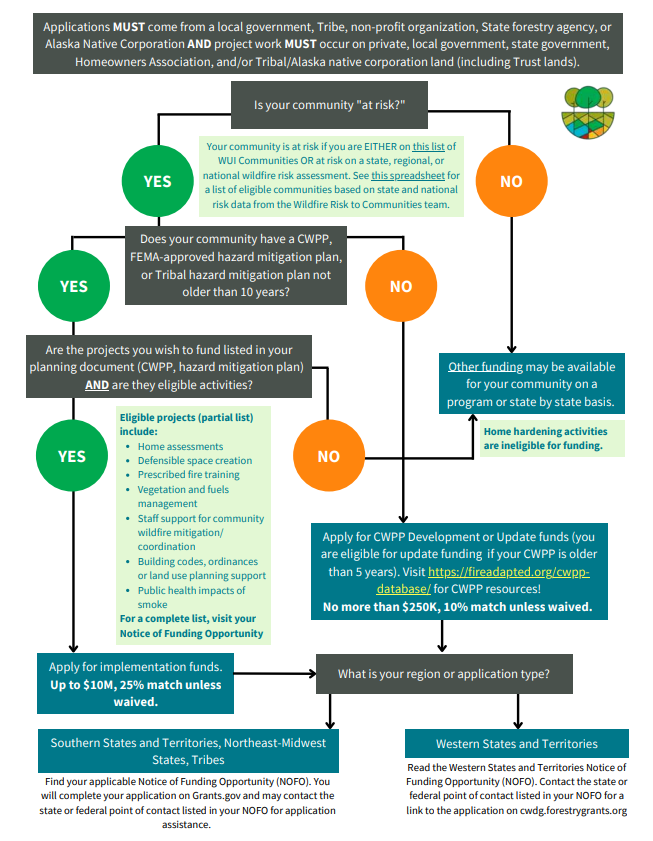
Community Wildfire Defense Grants

A primer on preparing to apply

What are Community Wildfire Defense Grants?

The Community Wildfire Defense Grants (CWDG) are intended to help at-risk local communities and Tribes plan and reduce the risk against wildfire. The program prioritizes at-risk communities in an area identified as having high or very high wildfire hazard potential, are low-income, and/or have been impacted by a severe disaster. Applications are due Oct. 7, 2022.

There are two primary project types for which the grant provides funding:

  1. The development and revision of Community Wildfire Protection Plans.

  2. The implementation of projects described in a Community Wildfire Protection Plan that is less than ten years old.

Before proceeding with this grant opportunity, determine if the program is the right fit for your community:

  • The application must come from a local government, Tribe, non-profit organization (including Homeowners Associations), State forestry agency, or Alaska Native Corporation.

  • Project work must occur on non-federally administered land. Work may occur on lands held in trust for Native American Tribes and individuals.

Wildfire Wednesdays #91: The Home Ignition Zone

Hi Fireshed Coalition Members and Partners,

With all the devastation and grief of the 2022 wildfire season, it is normal to feel overwhelmed and debilitated when thinking about wildfire risk. We recognize the real frustration and danger that many are feeling related to the consequences of public land management. In light of all of this, we need to keep making incremental progress toward wildfire risk reduction by taking action on our properties and talking to those in our communities about wildfire. Our options are to do the work ourselves by following defensible space and home hardening principles or to work with contractors in our area to reduce wildfire risk on our properties.

This blogpost will share some resources to support you, your loved ones, and those in your communities/neighborhoods in your efforts to reduce wildfire risk on your property. Read on for:

  • The Home Ignition Zone

  • Home hazard assessments

  • International WUI codes

  • Community Wildfire Defense Grants - new funding opportunity

Stay safe,

Gabe

The Home Ignition Zone - Residents

The Home Ignition Zone encompasses the concepts of home hardening and defensible space. Home hardening involves the materials that you build with and the receptivity of your structure to ignition from flames, embers, and radiant heat. Defensible space is the buffer that you create between your home and the vegetation that surrounds it. By working on these two components, we can make a meaningful reduction in the risk of home loss from wildfire. Remember, up to 90% of ignitions from wildfires are caused by embers blown by the wind, so be sure to think of where embers may collect and start your home/property on fire.

Proper defensible space provides firefighters with a place to defend your home. We encourage homeowners to take the concept one step further and plan to have your home survive wildfire even if there are not firefighter stationed around it — this is type of planning could be called survivable space. The following information about defensible space is courtesy of the National Fire Protection Association.

Immediate Zone

“The home and the area 0-5’ from the furthest attached exterior point of the home; defined as a non-combustible area.  Science tells us this is the most important zone to take immediate action on as it is the most vulnerable to embers. START WITH THE HOUSE ITSELF then move into the landscaping section of the Immediate Zone.

  • Clean roofs and gutters of dead leaves, debris and pine needles that could catch embers.

  • Replace or repair any loose or missing shingles or roof tiles to prevent ember penetration.

  • Reduce embers that could pass through vents in the eaves by installing 1/8 inch metal mesh screening.

  • Clean debris from exterior attic vents and install 1/8 inch metal mesh screening to reduce embers.

  • Repair or replace damaged or loose window screens and any broken windows Screen or box-in areas below patios and decks with wire mesh to prevent debris and combustible materials from accumulating.

  • Move any flammable material away from wall exteriors – mulch, flammable plants, leaves and needles, firewood piles – anything that can burn. Remove anything stored underneath decks or porches.”

Intermediate zone

5-30’ from the furthest exterior point of the home. Landscaping/hardscaping- employing careful landscaping or creating breaks that can help influence and decrease fire behavior

  • Clear vegetation from under large stationary propane tanks.

  • Create fuel breaks with driveways, walkways/paths, patios, and decks.

  • Keep lawns and native grasses mowed to a height of four inches.

  • Remove ladder fuels (vegetation under trees) so a surface fire cannot reach the crowns. Prune trees up to six to ten feet from the ground; for shorter trees do not exceed 1/3 of the overall tree height.

  • Space trees to have a minimum of eighteen feet between crowns with the distance increasing with the percentage of slope.

  • Tree placement should be planned to ensure the mature canopy is no closer than ten feet to the edge of the structure.

  • Tree and shrubs in this zone should be limited to small clusters of a few each to break up the continuity of the vegetation across the landscape.

Extended zone

30-100 feet, out to 200 feet. Landscaping – the goal here is not to eliminate fire but to interrupt fire’s path and keep flames smaller and on the ground.

  • Dispose of heavy accumulations of ground litter/debris.

  • Remove dead plant and tree material.

  • Remove small conifers growing between mature trees.

  • Remove vegetation adjacent to storage sheds or other outbuildings within this area.

  • Trees 30 to 60 feet from the home should have at least 12 feet between canopy tops.*

  • Trees 60 to 100 feet from the home should have at least 6 feet between the canopy tops.*

Home Hazard Assessment - Fire Departments

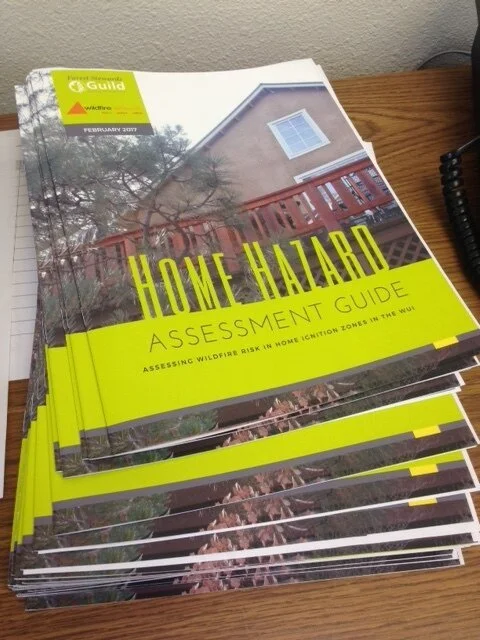
There are many programs for home hazard assessments. A good place to start is to reach out to your local fire department, a local soil and water conservation district, or a wildfire risk reduction organization to see if they offer a home hazard assessment walk-through to help you better understand how to reduce your wildfire risk. This type of program may not exist in your area. To support people that may not have access to a walk through, the Guild created a Home Hazard Assessment Guide.

This guide provides homeowners with tools to assess your home's wildfire risk and prioritizes actions you can take to reduce that risk. The assessment worksheet included with this guide is intended to help you understand your risk and where vulnerabilities on your property may lie. Every home is different in terms of wildfire risk and hazards. The goal for this worksheet is not to get a hazard rating of zero, but simply to address certain vulnerabilities that present a wildfire risk to your home. Where you choose to reduce risk on your property is specific to your property's unique features. Start by inquiring with your local fire department about wildfire risk in your area. Your community may have a Community Wildfire Protection Plan (CWPP) which will provide you with a CWPP ranking and recommendations for reducing risk in your community.

Use the Home Hazard Assessment Guide and the Home Hazard Assessment Worksheet (to be used with guide) to analyze your risks and develop a plan for action.

Developed in partnership between the Wildfire Network and the Forest Stewards Guild

Wildland Urban Interface Codes

In New Mexico, many communities have existing adjacent to forested areas for centuries. In newer areas, population growth and expanding urban development have increased the contact between humans and wildfire.

For those that work in county or municipal governments, or those that would like to advocate for more wildfire adapted development in your area, the International Wildland-Urban Interface Code (IWUIC) is a good place to start. The IWUIC is referenced in many community wildfire protection plans (CWPPs) across New Mexico.

The IWUIC is a model code that is intended to be adopted and used supplemental to the building and fire codes of a jurisdiction (e.g. county, or municipal government). The unrestricted development of property in the WUI is a potential threat to life and property from wildfire and resulting erosion. The objective of the IWUIC is to establish minimum special regulations to safeguard life and property from intrusion of wildland fire into communities.

Community Wildfire Defense Grants

Stakeholders in Colfax County discuss wildfire risk and treatment priorities

As you may know, on July 26, 2022, Agriculture Secretary Tom Vilsack formally announced the new $1 billion Community Wildfire Defense Grant (CWDG) program. This new, five-year, competitive program funded by President Biden’s historic Bipartisan Infrastructure Law is designed to assist at-risk communities, including Tribal communities, non-profit organizations, state forestry agencies and Alaska Native corporations with planning for and mitigating wildfire risks.

There will be a series of webinars August 4th, 8th and 9th to provide potential applicants with an overview of the grant program.

The registration links for the applicant webinars just went live earlier today, so folks may now register.  The dates/times below are the ones that have been posted on the CWDG website. Here is the link to register, and the attached document should walk you through the registration process:

Community Wildfire Defense Grant Program Applicant Webinars

Upcoming Webinars for Applicants

  • Northeast-Midwest States: August 4, 2022 at 10:00 a.m. (Eastern Time)

  • Western States and Territories: August 8, 2022, at 2:00 p.m. (Eastern Time)

  • Southern States: August 9, 2022, at 10:00 a.m. (Eastern Time)

  • Tribes: August 9, 2022, at 2:00 p.m. (Eastern Time)

For instructions on how to register for these webinars, click here.

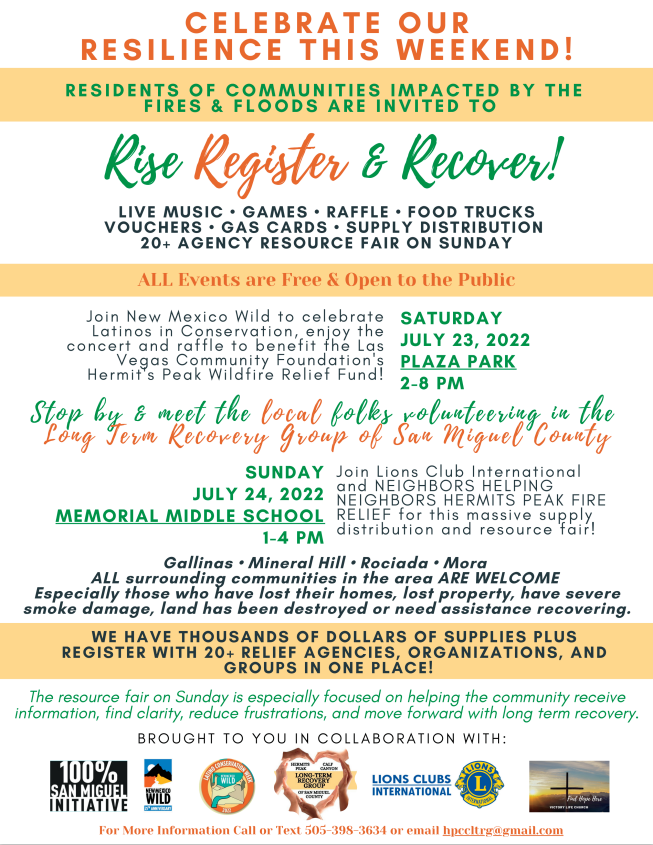
Wildfire Recovery Event July 23 and 24 - Las Vegas, NM

Celebrate community resilience this weekend!

Residents impacted by the Hermit’s Peak/Calf Canyon wildfires and flooding are invited to Rise, Register, and Recover in Las Vegas, NM this Saturday and Sunday.

On Saturday, July 23, from 2:00-8:00pm, enjoy a concert and wildfire relief benefit raffle in the Plaza Park.

On Sunday, July 24, from 1:00-4:00pm, meet at Memorial Middle School for a resource fair and supply distribution focused on sharing information with the community and helping everyone move forward with long-term recovery.

This event is free and open to the public.

Please help share the word!