Wildfire Wednesdays #172: Full Cost Accounting of Wildfires

Happy Wednesday, Fireshed Community!

How do we measure the cost of a wildfire? The financial burden of suppression and containment efforts is one metric which is documented fairly consistently at the national level; however, this doesn’t account for the broader range of expenses such as property damages, public health impacts, and long-term economic, social, and environmental impacts. A 2013 study out of New Mexico found that the full cost of wildfires far exceeds suppression, that costs vary significantly from fire to fire, and that direct and indirect costs are incurred first by individuals and private businesses and then by federal, state, and local governments. Today’s newsletter dives into full cost accounting of wildfires, a perspective shift which can help to highlight the financial, as well as ecological, importance of fire prevention and resilience work.

This Wildfire Wednesday features:

Stay warm and healthy,
Rachel


What is Full Cost Accounting?

“Wildfire costs greatly vary depending on factors within the built and unbuilt environment. Socioeconomic context, housing density, the duration and size of a wildfire, and other variables influence the overall cost. In general, upward trends in urban growth and development in areas at risk to wildfires suggest a parallel rise in total wildfire costs.” On average (nationally), suppression costs comprise only about 9% of total wildfire costs, and “almost half of all wildfire costs are paid for at the local level, including homeowners, businesses, and government agencies. Many local wildfire costs are due to long-term damages to community and environmental services, such as landscape rehabilitation, lost business and tax revenues, and property and infrastructure repairs” (Headwaters Economics, 2018) and other unexpected impacts such as declining property values after a fire, harm to health, and changes to ecosystem processes. The economic impacts of wildfire can permeate and accrue for years to decades. Full cost accounting takes all of these fiscal impacts into consideration to reach a more holistic estimate of the cost of wildfire.

“Full cost accounting after wildfires is critical for adequate government budgeting, post-wildfire resource allocation such as disaster recovery assistance and understanding the full scope of wildfire to help communities learn to better live with fire” (Hjerpe et el., 2023). For a good overview of the complexity of full cost accounting, view this blog from the Council of Western State Foresters.

How is full cost accounting measured?

Full cost accounting is dependent on a number of highly nuanced factors. The Full Cost of New Mexico Wildfires mentions that:

  • Costs depend on the location of the wildfire as well as the severity and length. For example, a wildfire occurring near a heavily populated area may result in significant evacuation costs through displacement of residents and businesses, and smoke-related illnesses will likely be greater. In contrast, a wildfire occurring in a remote area may incur more costs through impacts to wildlife habitats, watershed and water supplies, or recreation areas.

  • Costs are incurred initially and over succeeding years - there is a temporal dimension to wildfire costs. Many costs are incurred during or immediately after the fire and their impacts are relatively temporary (e.g. suppression, evacuation, disruption of tourism and transportation routes) while others (e.g. impacts to respiratory health and water sources and destruction of habitat, timber resources, residential and commercial structures, and watershed areas) may occur concurrent with the wildfire but the rehabilitation, rebuilding, and repair will take much longer.

    • In the arid American West, long-term damage to forest watershed resources (such as damaged water supply infrastructure and post-wildfire flooding) may represent the largest, and least documented, costs of uncharacteristic wildfire over time (Lynch, 2004).


A national average of the breakdown of full wildfire costs over time from Headwaters Economics. It should be noted that the exact proportions vary widely from one fire to the next depending on local factors.

 
  • The burden of costs varies - just as the magnitude and type of cost is case-specific for each wildfire, the distribution of who absorbs these costs is different for each incident. 

The Western Forestry Leadership Coalition published a 2022 report which breaks costs down into three categories -

Those costs which occur as a result of a wildfire:

  1. Direct Costs, which are incurred directly during an incident.

  2. Indirect Costs — losses which are incurred after an incident but are attributable to it.

And those which represent expenditures that would reduce the incidence of and damage from future catastrophic fire:

3. Indirect Costs — mitigation Investments.


Read the full report for a detailed breakdown


FCA in New Mexico and the Southwest

While there are examples of full cost accounting for fires in the West (see “Case Studies”, pages 7-16), the practice is still comparatively rare because of the difficulty obtaining the relevant data. A recent remeasure of the full cost of the 2010 Schultz Fire in Arizona, while illuminating the longevity of post-fire impacts and expenses, was still conservative as it did not account for every potential direct and indirect ‘net value change’ (e.g. non-mortality related impacts to physical and mental health).

2013 Full Cost Accounting of the Schultz fire estimated total costs around $138.8 million; ten years later, researchers found that costs had continued to accrue to the tune of $179.1 - 187.4 million.


This remeasure found that 10 years post-fire, total accrued wildfire costs were 29–35% higher than the initial full cost accounting performed in 2013, bringing the current-day cost for this 15,000-acre fire to ~$180.4 million. The authors write “given the trends of increasing wildfire severity and duration of fire seasons, combined with… myriad costs of wildfire, it is safe to assume the full costs of wildfire are vastly underrepresented and enormous. Additionally, as the Schultz Fire example demonstrates, a single fire often has many costs that are difficult to quantify and are temporally dispersed, such as costs to ecosystem services or community well-being. This further emphasizes the importance of proactive fuel treatments and forest restoration work to reduce the risk of uncharacteristic fire and restore ecosystem health… Millions of dollars may have been saved by forest restoration treatments in key parts of the Schultz Fire perimeter before the fire.”

Types of Forest Restoration Benefits Quantified in the Literature (Gray boxes are broad benefit types; blue boxes are individual benefit types that compose broad AWC categories).
From https://doi.org/10.1016/j.ecolecon.2024.108244

One key to understanding the full cost of wildfires is recognizing that these climbing costs and consequences are linked to increasingly uncharacteristic fire behavior and impacts driven by changes to our climate and ecosystem conditions. In these southwestern fire adapted landscapes, wildfires can also result in ecological benefits, especially in the areas that do not burn at high severity and are long overdue for fire. It is when fires burn hot and large enough to cause severe impacts to ecosystem functions and communities that the damages really begin to accrue. Forest restoration treatments result in overall lower-severity fires, which lessens the intensity of subsequent impacts, including post-wildfire flooding; “in the most valuable and at-risk watersheds, every dollar invested in forest restoration can provide up to seven dollars of return in the form of benefits and provide a return-on-investment of 600%” (Hjerpe, 2024).

The fire prevention triangle, adapted from Riebold (1957) and NWCG (2021). Illustrated by Kara Skye Gibson. Sourced from Preventing Human-Caused Wildfire Ignitions on Public Lands: A Review of Best Practices

Investing in prevention of human-caused ignitions and emerging wildfire detection tools and technology are also promising financially prudent measures to avoid or reduce the full cost of wildfires. These approaches can decrease the number of wildfires which burn into communities and devastate landscapes - especially during times of the year when wildfires are more prone to rapid spread and growth in intensity due to weather, wind, and availability of fuel. Remote sensing enables the early identification and tracking of wildfires over large geographic areas, providing valuable information for engagement, decision-making, and fire resources allocation. Decision-support data products may have a large impact in some situations (e.g., an extreme day with multiple ignitions, a fire threatening a high value asset, etc.), and a limited impact in others (e.g., wet fire seasons, fire activity beyond the capacity of suppression resources, etc.). Preventing or mitigating one future extreme event may economically justify these tools many times over (Hope et al., 2024). While the cost of operating fire detection tools (towers, cameras, etc.) exceeds their value in the reduction of direct suppression costs, the benefits are realized in the reduction of total wildfire costs. Further research on the cost-benefit ratio of these tools is needed as current analyses are limited.


Upcoming Opportunities and Additional Resources

Job Opportunities with NM Forestry Division

Community Wildfire Defense Grant (CWDG) Manager

New Mexico Forestry Division is currently hiring for a Community Wildfire Defense Grant (CWDG) Manager. The position application will be open through December 5, 2025.

This position will manage the state's Community Wildfire Defense Grant program. The position responsibilities are to manage, direct, and actively engages in forest and watershed management and community wildfire risk reduction within the Forestry Division's jurisdiction of 43 million acres of state and non-municipal private land. The position is responsible for ensuring the eligible local governments, Tribes and non-governmental organizations receive funding for Community Wildfire Protection Planning (CWPP) and implementation of wildfire mitigation projects described in CWPP.

For questions about the position, please reach out to Melissa McLamb, (505) 394-2277, (Melissa.McLamb@emnrd.nm.gov).

Permanent Part-Time Engine Boss

This is a Lead Wildland Firefighter (EMNRD #10116150) job located in Tierra Amarilla out of the Chama District. This position application will be open through January 1, 2026. The salary is $26.57 - $39.86 Hourly, $55,273 - $82,909 Annually (Pay Band C7). To learn more and apply, please visit the Forestry Division’s Careers site.

……………………………………………..

Fire Planning Task Force Updates

November 2025 Public Meeting Minutes

On November 17th, 2025, the NM Fire Planning Task Force convened to review recommendations from the CWPP Sub-group, hear updates from both the Mapping and Standards Sub-group, hear a report on F.A.I.R Insured Home Hardening Grants, and more.

The attached minutes provide more details on all agenda items including:

  • Outcomes from the review of CWPPs from Eddy County, Sandavol County, and Eldorado Communities

  • Adoption of the IBHS Wildfire prepared Home standards as voluntary standards for home hardening and mitigation in New Mexico

  • Pilot of the Office of the Superintendent of Insurance’s Home Hardening grant in Wimsatt, New Mexico

View the Minutes

……………………………………………..

Reserved Treaty Rights Lands Program: The Power of Partnership

The Nature Conservancy in Montana produced a short video, “Reserved Treaty Rights Lands Program: The Power of Partnership,” which looks at how the Confederated Salish and Kootenai Tribes are working with the Bureau of Land Management and The Nature Conservancy to conduct burns on off-reservation lands with Tribal treaty rights in a unique partnership made possible by the Reserved Treaty Rights Lands (RTRL) program. The RTRL program, which is administered by the Bureau of Indian Affairs, provides funds to protect and enhance natural and cultural resources on Tribes’ aboriginal lands that are at high risk of wildfire.

……………………………………………..

Treatment and Wildfire Interagency Geodatabase (TWIG)

The Southwest Ecological Restoration Institutes (SWERI) have launched the 1.0 version of their free tool, the Treatment and Wildfire Interagency Geodatabase (TWIG), a collaborative, open-access data platform that makes national fuel treatment and wildfire information accessible to all.  


As a national, open-access geodatabase, TWIG centralizes federal treatment and wildfire data in one publicly available platform. By doing so, it:

• Empowers communities and land managers to demonstrate the effectiveness of fuel treatments

• Helps researchers and policymakers understand treatment-wildfire interactions at landscape and local scales

• Promotes cross-agency coordination and transparency in wildfire risk reduction efforts

Wildfire Wednesdays #171: Fire Preparedness Frameworks, Risk Reduction, and Insurability

Happy Fire Friday!

Fire adaptation is an alternative to the costly and ineffective model of relying solely on fire suppression for community safety; it empowers communities to prepare for wildland fires, mitigate their impacts, and recover more effectively when they inevitably occur. However, there are many tools, pathways, and angles to consider when creating fire ready communities. Firewise, a program of NFPA, has gained popularity over the last decade as a means to get neighbors and friends engaged with defensible space and home hardening, as well as a way to retain insurability. The program and title of Firewise Recognized Community is one tool, one approach, and it nestles will with other programs and frameworks. Since November 20th marks the renewal deadline for communities who are Firewise Recognized, today we will be exploring some of these tools and programs in-depth, how they differ and can work in tandem to educate and motivate, and how following the recommendations of each one may impact a community’s risk vs insurability.

This Wildfire Wednesday Features:

Be well,
Rachel


Simplifying Firewise and FAC

This information was originally shared in Wildfire Wednesday #96; view the newsletter and watch the recent FACNM webinar to learn more, including how to choose the right program for your community.

What is Firewise?

The Firewise USA recognition program is administered by the National Fire Protection Association (NFPA) and provides a collaborative framework to help neighbors in a geographic area get organized, find direction, and take action to increase the ignition resistance of their homes and community and to reduce wildfire risks at the local level. As Firewise Program Manager puts it, Firewise “fits into [the Fire Adapted Communities framework] as a tool. It’s not the only tool and it doesn’t do all things. It is the built environment piece [of the FAC preparedness wheel] - how do we help self-defined neighborhoods come together and get started on that [fire preparedness] pathway?”

Firewise focuses primarily on homeowner and resident fire mitigation before a wildfire. Their recommended mitigation actions include home hardening, fortification of the home ignition zone, organization of a Firewise community board, neighborhood risk reduction activities, and joining the program as a Firewise USA Site.

Through risk assessments, community organization, and individual and collective action, the goal of Firewise is to effectively lower community susceptibility to fire.

New applications can be completed online at portal.firewise.org. More information on creating a firewise home and community can be found below.


What is the Fire Adapted Communities (FAC) Framework?

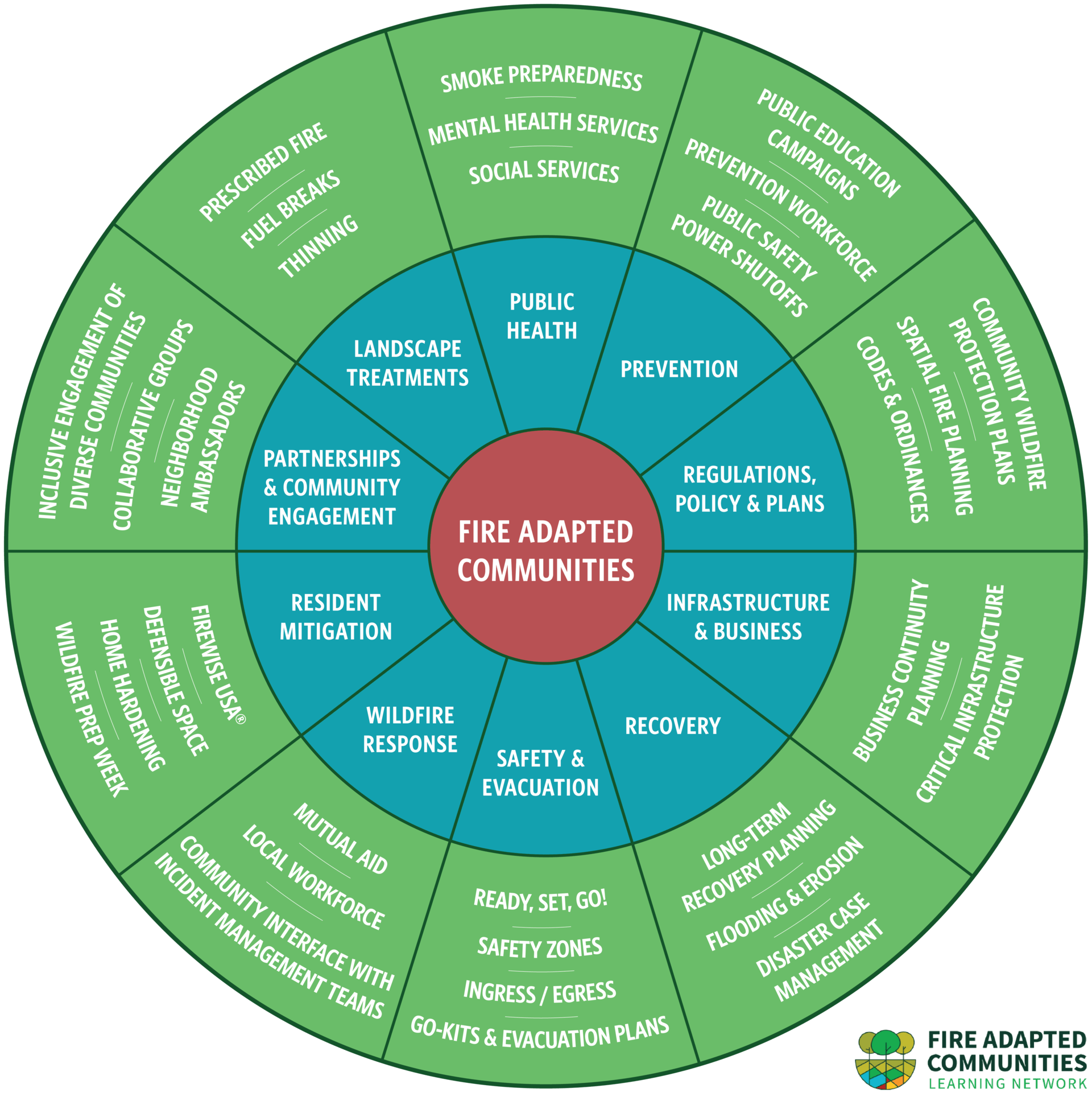
Fire Adapted Communities is a holistic, adaptive, and comprehensive framework to help communities live better with wildfires. A fire adapted community is one which understands its risk and takes action during all phases of the wildfire cycle - before, during, and after - to be more resilient. FAC was born out of the 2009 National Cohesive Wildland Fire Management Strategy. FAC looks beyond residents and individual actions and broadens the scope of what it means to be fire ready.

The Firewise USA® recognition program is one of many tools a community can use to address its fire risk. Focused primarily on residents and residential action, the Firewise USA® program is an important piece of the wildfire adaptation puzzle. The International Association of Fire Chiefs’ Ready, Set, Go! Program, focusing on empowering fire departments to communicate with their constituents, is another common tool used as part of a community’s overall fire adaptation framework. Additional strategies such as evacuation planning, developing and updating community wildfire protection plans, adopting WUI codes and ordinances, conducting controlled burns and performing post-fire recovery planning all contribute to a fire adapted community.

View the FAC community resilience framework, smoke ready framework, and suite of actions by clicking on the graphics below.

FAC encompasses the Fire Adapted Learning Network, a peer learning and professional relationship-building initiative. FAC Net connects people to resources and to other practitioners so they can share approaches, tailor strategies for their place, and make a difference in wildfire outcomes on-the-ground. They combine support for on-the-ground project work with professional development, peer learning and coaching, and long-range strategic planning.

While FAC offers many resources and opportunities to learn from other people doing similar work, there is no formal fire adapted communities recognition program. It does not guarantee prevention of ignitions nor does following the recommendations tailored to your community lead to a certification.


Program impact: insurability vs risk reduction

What is impactful risk reduction?

Frameworks like Fire Adapted Communities incorporate decades of lessons learned and recommendations from fire experts to provide a comprehensive suite of actions that individuals and communities can take to reduce their overall fire risk, increase their home and property’s chances of survival, lessen the devastation and interruption to daily life that wildfires cause, and work together to recover better after a fire happens. These approaches are focused on hazard mitigation, education, preparation, and teaching communities how to live with fire.

Image from Wildfire Risk to Communities.

The National Cohesive Wildland Fire Management Strategy is a strategic push to work collaboratively among all stakeholders and across all landscapes, using best science, to make meaningful progress toward three goals:
- Resilient Landscapes
- Fire Adapted Communities
- Safe and Effective Wildfire Response

The frameworks encourage community-level participation, because research has shown that collective action - everyone working individually, alongside their neighbors, to reduce their hazardous fuels, improve their structure’s fire resistance, advocate for improved routes of ingress and egress, etc. - creates a broad net of protection which is far more effective at reducing the impacts of a wildfire on the community than isolated individual action. Learn more about reducing risk. Following the recommended actions and approaches of these frameworks may help improve fire outcomes for the community; however, they do not guarantee insurability of homes and businesses.

What influences insurability?

“Viewed through a risk management lens, wildfire risk… throughout the western United States is becoming uninsurable. Risk is the product of hazard (the combination of the probability of wildfire and its characteristic intensity), exposure (where the item at risk is located and its value), and vulnerability (how damaging wildfire is to the item at risk)” (TNC, 2021). Insurance providers base their coverage decisions on many factors; when it comes to wildfire, underwriters will consider a property's fire protection class, location, proximity to fire services, exposure to nearby fire hazards, and the potential for loss as well as external factors such as wildfire and climate risk models. These factors culminate in an assessment and risk classification which then informs whether the insurer will offer coverage, and if so under what policy terms (e.g. coverage limits, deductibles, exclusions) and at what price. Home and business owners cannot influence many insurance assessment factors (e.g. the risk rating of a specific geographic location), nor know exactly what factors any given insurance provider will use (this is proprietary information). So what can you do reduce your property’s risk classification to retain or obtain coverage?

Start with the area around your home - is the structure itself built out of highly combustible materials? Are there gaps under the porch, along the roof, between door frames and windows where embers could land and smolder? Is the landscape immediately around your house thick with flammable vegetation? These things all contribute to your property’s risk rating and can be altered and improved.

Slide from 2025 NM WUFS presentation by Ahley Dalton Agency LLC, a New Mexico insurance provider representative, speaking about fire insurance and the IBHS Wildfire Prepared Homes program.

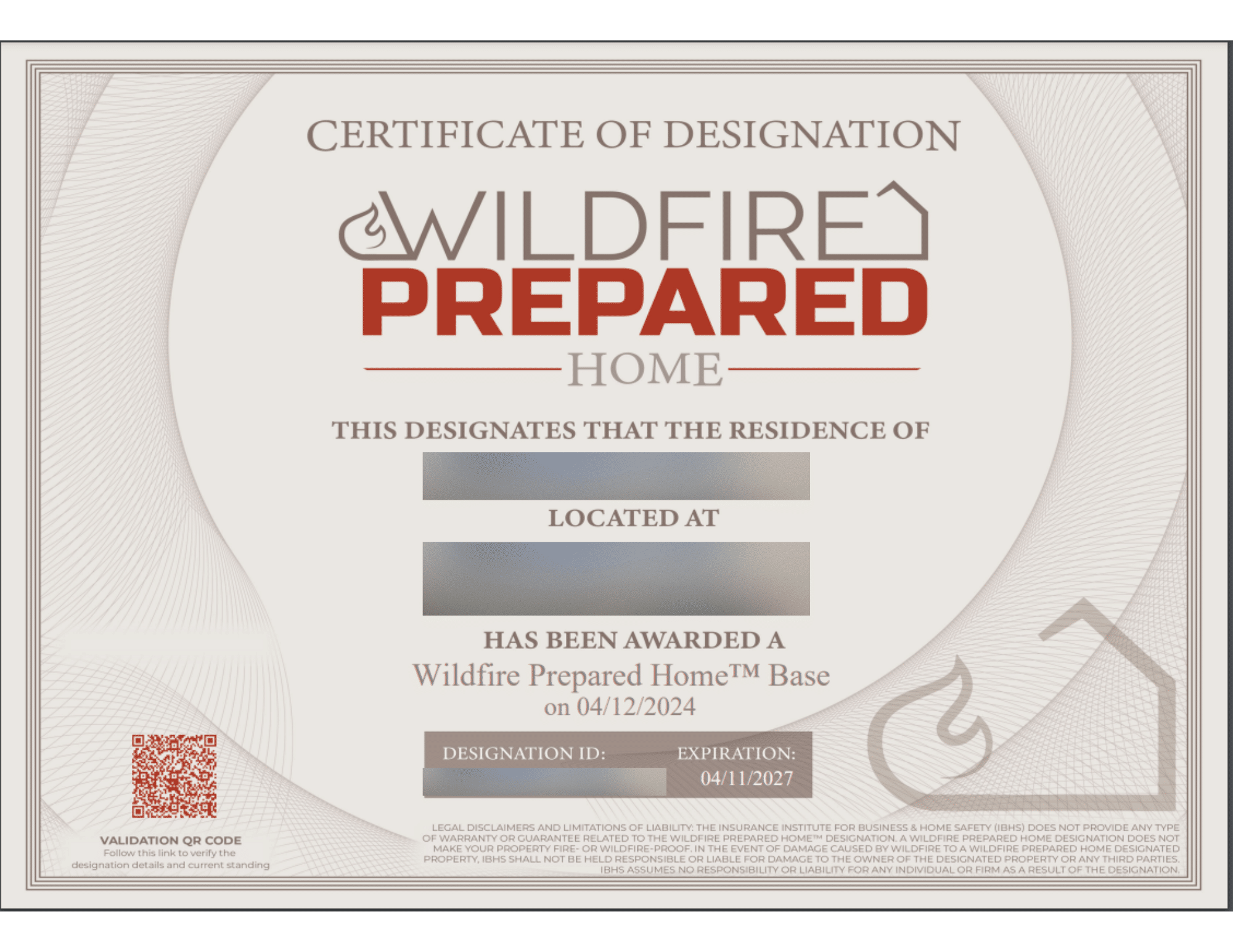
The Insurance Institute for Business and Home Safety (IBHS) worked with insurance providers to create the Wildfire Prepared Home (WPH) program. The program is supported by property insurers and other affiliated companies, and some insurers are now offering policies for homes that meet the standard. WPH provides recommendations for creating defensible space and improving property construction by replacing highly combustible materials with fire-resistant options. This program from IBHS is coming to New Mexico in 2026; this means that residents who follow the recommendations of the program to reduce their individual risk can then have their property inspected and receive a Wildfire Prepared Home designation certificate. The certificate, which demonstrates that the home has met specific mitigation actions, can then be shown to insurance companies. The designation is valid for three years. Learn more about the potential for loss of insurance and the space IBHS is looking to fill by viewing this presentation from the 2025 New Mexico Wildland Urban Fire Summit.

Additional actions that a community can take to improve their chances of retaining fire insurance include:

Image from Living With Fire

  • Adopt and enforce local codes (such as defensible space ordinances) that require fire-adapted landscaping and/or ignition-resistant building materials and design.

  • Thin vegetation in common areas (not just individual properties) to reduce wildfire risk.

    • Create defensible space on neighboring public lands by working with public land agency urban lot management programs.

  • Improve infrastructure by creating clear emergency alert systems and evacuation routes and increasing access to fire hydrants.

  • Improve access by ensuring roads are wide enough for emergency response vehicles (fire engines) to pass and home addresses are clearly visible from the street.

  • Work with local fire departments and specialists to conduct professional home and community hazard assessments and develop mitigation strategies.


Additional resources

Upcoming virtual town hall from the NM Fire Planning Task Force

The next public meeting of the New Mexico Fire planning task force, hosted by the Energy, Minerals, and Natural Resources Department (EMNRD) Forestry Division, will be held at 9:00 AM on Monday, November 17th, 2025. Agenda items include updates from the wildfire risk priority mapping, defensible space standards, and communications sub-groups; an update on F.A.I.R. Insured Home Hardening Grants; a report from the Community Wildfire Protection Plan (CWPP) sub-group; State Forester’s update; a round robin open discussion; and time for public comment. View the full announcement and instructions for joining virtually (recommended due to limited space) or in-person.

…………………………..

Resources for renters

Many fire preparedness and educational resources are targeted toward home and business owners, leaving short- and long-term renters in an information void. Scroll down to see resources collected and tailored to renters:

  • Short-term rentals like Airbnb and VRBO are increasing across the Southwest. While beneficial for local economies, many visitors are unaware of the state’s wildfire risks or how to stay informed. To address this, the Southwest Fire Science Consortium and the Arizona Wildfire Initiative created a wildfire information packet for short-term rentals. This customizable resource educates guests on wildfire risks and provides tools to help them stay informed and make safer choices.

  • As of 2023, 30.7% of housing units in New Mexico were renter-occupied (U.S. Census Bureau). Additionally, certain demographic groups—such as young adults and individuals with less formal education—are more likely to rent, and rental rates among these groups have increased nationwide over the past decade. To help promote wildfire preparedness for all New Mexicans, Wildfire Wednesday #156 focused on resources for renters, including topics like evacuation planning, renters’ insurance, and post-fire recovery.

…………………………..

Upcoming webinars

Thursday, November 20, 2025, 2:00pm MT: Wood you believe it? Aspen interactions with fire and wildfire spread in the Southwest

From disease resilience to browse pressure, recreational value to fire resistance, aspen has gotten a lot of attention over the past few years. This webinar will offer insights on various aspects of the intersection between aspen forests and fire in the Southwestern U.S., including: the ability of aspen to slow fire growth and act as a firebreak, fire radiative power/burn severity in aspen forests of the Southern Rockies, and the relationship between stand composition and suppression strategies.

Register now

Highlights from A Field Tour of Forest Treatments in the Santa Fe Mountains

Greetings,

In early August 2025, the Greater Santa Fe Fireshed Coalition held its summer-season quarterly meeting as a field tour in the forests northeast of Santa Fe.

The goals of this tour were to (1) observe local projects to improve landscape resilience to high-severity wildfire and (2) discuss priorities for continued landscape-scale restoration work into the future. Attendees from a diverse range of organizations and affiliations generated interesting discussion, including goals and adaptations for where the Coalition is headed. Scroll down to read about five highlights of the field tour, including:

  1. Takeaways from decades of fire ecology research in the Greater Santa Fe Fireshed

  2. Forest treatments underway in the Santa Fe Mountains

  3. Outcomes of past forest treatments in Pacheco Canyon

  4. Post-fire flood impacts in the Greater Santa Fe Fireshed

  5. The Pueblo of Tesuque’s stewardship of ancestral lands

Additionally, the City of Santa Fe produced a long-form video of the field tour; please check it out if you are interested in taking a virtual visit!

— Maya


Field Tour Stop #1

The field tour’s first stop was the pullout about 1 mile down Forest Road 102 (roughly 1/3 mile west of Big Tesuque Campground).


Takeaways from decades of fire ecology research in the Greater Santa Fe Fireshed

Local U.S.G.S. research ecologist Ellis Margolis, Ph.D., explained that researchers have spent decades collecting samples of tree ring fire scars in the Greater Santa Fe Fireshed. (Fire scars in tree rings show when a fire burned and scarred a tree, and then the tree healed over the wound and “lived to tell about it.”)

Researchers have 36 plots across the Fireshed, from the Rio en Medio area into the Santa Fe Municipal Watershed and south to La Cueva. They’ve dated fire scars from over 300 sampled trees, with over 1,400 individual tree ring fire scars dated. The oldest tree ring records going back into the 1300s and the last recorded fire was in 1880, Margolis said.

“The ubiquitous story is fires didn’t used to kill trees; now they’re killing everything,” he said.

“We have one (sampled) tree that survived and recorded 18 fires over its life. I mean, how many trees in the modern fires are surviving any, if not multiple (fires)? It starts to paint this picture of: There used to be fire all the time… but it was not killing the majority of the trees.”

By stitching together networks of samples, researchers have also been able to study the size of historical fires. Two fires in 1685 and 1748, for example, burned almost every tree researchers sampled, indicating their area burned reached over 35,000 acres.

The takeaway: “Fire used to be really ubiquitous,” Margolis said, “but much lower severity.”

What changed? The Forest Service began aggressively suppressing all wildland fires in the early 1900s. And most of the fires in the Santa Fe Fireshed had actually stopped before then – in the late 1800s – due to overgrazing.

A dense stand at field tour Stop #1. Tree ring fire scars show that historically, fires occurred on average about every 14 years, Dr. Margolis said.

“If you do the quick math, we owe this forest 10 fires. And that’s why you get that,” he said, pointing to the dense mixed conifer.

The railroad arrived in Lamy, New Mexico in 1879, leading to an immediate and exponential expansion the grazing industry, and the last widespread fire the Santa Fe Fireshed was in 1880, Margolis said.

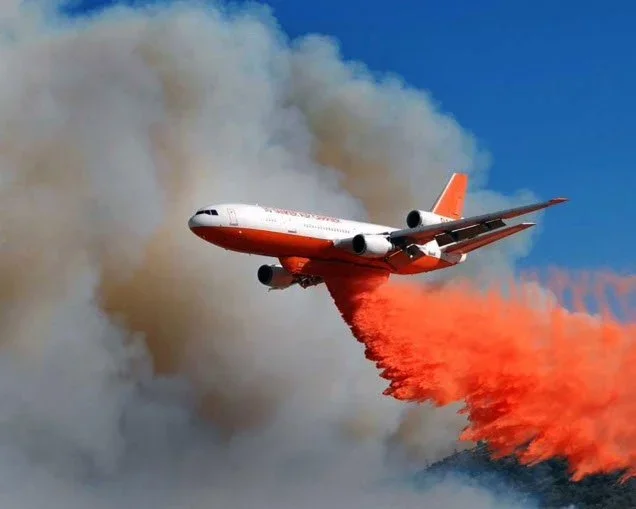
“This also gives you a little bit of a clue about what those fires were. If cows could have put out the fires, they weren't big, raging infernos where you drop in DC-10 slurry drops on them. They were little surface fires burning through grass. Then, the cows ate all the grass, and you couldn’t burn it anymore,” he said.

Now we have “145 years worth of fuel build up, 145 years of tree regeneration, and this is the problem that we hand over to our forest managers,” Margolis said.

Projects to age trees from tree rings indicate much lower tree densities in 1880 than today. Data from other monitoring projects in the Fireshed shows average current tree densities of around 700 trees per acre. That’s probably five times as many trees per acre today than historically, upwards of 10 times as many trees per acre, Margolis said.

The good news is we now “understand how we got here and where we need to go back to. These forests were much more resilient when fire was burning through them historically, so this sets the table for some of the management,” he continued.

“This forest WILL burn again, and hopefully we can get it back to a state of surviving these fires.”

Dr. Margolis shared data from researchers’ sampling plot nearest to the field tour stop. Horizontal lines show the records of individual trees sampled for tree ring fire scars. Vertical tick marks are the fire scars. Note that the most recent fire was in 1880, nearly 150 years ago.


Forest treatments underway in the Santa Fe Mountains


Piles of trees thinned as part of the Santa Fe Mountains Landscape Resiliency Project. The piles will be burned under snow during the winter.


At the field tour’s first stop, the Coalition observed thinned forest with unburnt piles south of Forest Road 102. The Forest Service had thinned and created the piles in the spring 2025 and will burn the piles while under snow during this upcoming winter (given the right snowy conditions) as part of the Santa Fe Mountains Landscape Resiliency Project.

Rian Ream, the Assistant Fire Management Officer for Española Ranger District and former fuels planner on the Santa Fe National Forest, explained the design of the treatments the group observed along Tesuque Creek: Santa Fe National Forest managers chose to focus on mixed-conifer forest in Tesuque Canyon partly because of the opportunity to anchor off of two already thinned and burned areas—Pacheco Canyon and the Santa Fe Municipal Watershed. Crews thinned fuel breaks along four treatment units in Tesuque Canyon by cutting conifers under 9’’ diameter (except white pine and aspen, which were not cut) and built piles of the downed material. Once those piles have been burned under snow, crews will dig hand lines along containment lines before the units will be ready for broadcast burning.

“The main thing we’re dealing with here is the fire problem,” Ream said, adding that a high-severity fire would be detrimental to wildlife habitat and watershed function. “This is going to burn, it’s just a matter of when.”

The challenge with prescribed fire is “it’s really getting harder and harder to find a good window to burn within,” particularly given stricter prescription parameters Santa Fe National Forest has written into burn plans since escaped prescribed fires grew into the destructive 2022 Hermit’s Peak/Calf Canyon Fire.

Managed fires would make a bigger impact for landscape resiliency (plus could be easier to implement, since firefighting resources come from across the country for a managed fire but not for a prescribed fire), but some vocal public opposition has meant “we’re just not there in the Santa Fe Fireshed yet to do that,” Ream said.

The good news is that about two decades of work thinning and prescribed burning the Santa Fe Municipal Watershed has put the watershed in “a much healthier situation,” said Eytan Krasilovsky, Deputy Director of the Forest Stewards Guild.

But one of the impetuses for the formation of the Greater Santa Fe Firehsed Coalition in 2016 was the recognition of the need to work north and south of the municipal watershed, he added. “All these watersheds need work, and if we can avoid some of the catastrophes that we're seeing around the country and in New Mexico, then it's all going to be worth it.”


Field Tour Stop #2

For the second stop on the field tour, we parked at Aspen Ranch Trailhead and walked northwest along a 2019 prescribed burn implemented through the Pacheco Canyon project.


Outcomes of past forest treatments in Pacheco Canyon

In 2016, the Reserve Treaty Rights Lands program rolled out, and the Pueblo of Tesuque collaborated with the Forest Service over the following years to plan and execute an over 2,000- acre forest treatment in Pacheco Canyon, said Pueblo of Tesuque Department of Environment and Natural Resources (DENR) Environmental Biologist Ryan Swazo-Hinds.

Prescribed fire cleaned up the understory as intended, but the biggest success of the project was enabling firefighters to contain the 2020 Medio Fire – a fire ignited by lightning, Ream said.

Ream, who responded to the fire, said the Medio Fire was on the move and “would have burned all the way up to the ski area and possibly into the Santa Fe watershed,” but “luckily, we had this prescribed burn unit.”

“Even though that thing had a head of steam, when it hit that fuel break where it had been thinned out, it changed to a lower severity,” he said.


Post-fire flood impacts in the Greater Santa Fe Fireshed

The Medio Fire, which burned roughly 4,000 acres, still had significant post-fire flood impacts, said Steve Vrooman, president of Keystone Restoration Ecology, which implemented a post-fire watershed stabilization project on the Rio en Medio following the Medio Fire.

A few years following the fire, the Rio en Medio flooded when a rainstorm dumped 3 ¼ inches in an hour and caused a cascading debris dam down the drainage, Vroom said. “Above that, this watershed is in pretty good condition. I mean, it got affected, but the ponderosas are still there, it still looks like the same stream; below that, it doesn't,” he said.

“Frankly one of the biggest impacts (of fire) is the flooding, as we’ve see in Ruidoso and Bandelier,” Vrooman continued. “The loss of trees is huge, impacts to wildlife are huge, but the post-fire flooding impacts are probably the biggest one. Things that can happen are you can lose most of your sediments in the watershed, you can lose the function of your streams, and you can actually lose the ability for that stream to support fish, to provide water to irrigators, and to even feed the watershed.”

“There’s generally a bifurcation between watershed restoration and fire. We don’t always talk together, and we need to be,” he continued. “The watershed impacts from fire can be extreme, and those are impacts that happen if we don't do what’s been talked about today… We thin to prevent flooding.”

Alan Hook, City of Santa Fe Water Division Water Resources Coordinator, added that post-fire flooding threats to the Santa Fe Municipal Watershed are still daunting, although forest treatments in the watershed have reduced that risk, a 2024 study showed.

The study concluded that a moderate- to high-severity wildfire in the watershed followed by a heavy rain event would fill part or most of the city reservoir with sediment, Hook said.

“That's a big risk for us as water utility – a big, big risk,” he said. “That means we’ve got to rely on San Juan-Chama Project water, which is coming from Colorado, and then secondarily, much of our supply would have to be pumped out of the groundwater near the Rio Grande in our city well field for a very long time… I mean, hate to break the news: We’re really not prepared for that.”

Information from the study may help the city create an emergency action plan for post-fire flooding in the watershed, Hook said.

The city does have funding capacity to support further forest treatments, he added, noting the city is spending roughly $50 million to upgrade Nichols and McClure dams – “it’s just a matter of convincing engineers and managers to invest in the green infrastructure instead of what's called gray infrastructure (pipes, dams, reservoirs, pumps). So that's kind of where we need the impetus of the public, because we are a community-owned utility,” he said.


Field Tour Stop #3

For the field tour’s final stop, the Coalition gathered at on the Pueblo of Tesuque’s lands at Aspen Ranch (which are not open to the public without tribal permission).


The Pueblo of Tesuque's stewardship of ancestral lands

In the early 2010s, the Pueblo of Tesuque and Santa Fe National Forest signed a Memorandum of Understanding, which later enabled a collaborative, cross-boundary prescribed burn — on Forest Service land and the Pueblo of Tesuque’s Vigil Grant — during the Pacheco Canyon project.

“Having those prior relationships, we’re able to work (with the Forest Service) on other stuff such as water quality and erosion control,” said Joseph Abeyta, the Pueblo of Tesuque DENR Interim Director and Water Quality Specialist. “So Tesuque is evolving with these relationships with multiple agencies, … and it’s a good opportunity for us because everything overlaps: water quality, forestry, wildfire, wildlife.”

The Pueblo has a cold-water fisheries designation for the Rio en Medio at Aspen Ranch and is looking to reintroduce native Rio Grande cutthroat trout as well as potentially beavers, Abeyta and Swazo-Hinds said.

One challenge at Aspen Ranch has been that, though the forest has long been thinned and piled, the Pueblo hasn’t yet received support from the Bureau of Indian Affairs to burn the piles. The Santa Fe National Forest can boss the pile burn but does not have capacity to monitor until the burn is out, which is where capacity from BIA or outside partners will hopefully come in, Swazo-Hinds said.


A field tour stop where the 2020 Medio Fire reached the area of a 2019 prescribed burn in Pacheco Canyon.

Coalition partner organizations present for the field tour included the Santa Fe National Forest, U.S. Geological Survey, Pueblo of Tesuque, City of Santa Fe Water Division, City of Santa Fe Fire Department, Santa Fe Watershed Association, Santa Fe Conservation Trust, Forest Stewards Guild, New Mexico Forest and Watershed Restoration Institute, and Santa Fe-Pojoaque Soil and Water Conservation District, along with additional contacts and VIPs.


Building Stonger Communities Through Volunteer Fire Service

Happy Fire Friday Santa Fe Fireshed community!

Across New Mexico, volunteer fire departments are the backbone of wildfire protection and emergency response. A volunteer firefighter’s work extends far beyond fighting fires; they provide emergency medical care, lead community education and prevention programs, and partner with land management agencies to protect lives and landscapes. In a state that is largely rural, these volunteers make up nearly 78% of the firefighting force. Yet, as State Fire Marshal Randy Varela shared at this year’s New Mexico Wildland Urban Fire Summit, there are only about 4,000 volunteer firefighters serving the entire state, and their average age is 65. This reality highlights a critical challenge: volunteer fire departments urgently need more local support to sustain their ability to keep communities safe.

This week’s blog looks at how community members, no matter their background, can help strengthen their local volunteer fire departments (VFDs) and shares inspiring success stories of local VFDs increasing their capacity. Supporting your local VFD is one of the most powerful ways to promote community safety, resilience, and equitable access to emergency services for everyone.

This Fire Friday features:

Be well,
Megan


Supporting New Mexico’s Volunteer Fire Departments: A Call to Community Action

Why it Matters

Across the country, communities rely on volunteer firefighter and yet, that force is shrinking. According to the U.S. Fire Administration, there were about 676,900 volunteer firefighters in 2020, a sharp decline from 897,750 in 1984, when the NFPA first began tracking this data. This demonstrates the steady decline in volunteer personnel while emergency response calls steadily increase. This volunteer shortage doesn’t just affect who shows up when a fire breaks out, but it also has broader impacts on community safety, insurance rates, and local resilience.

Staffing Impacts Your Community’s Insurance and Safety

The number of volunteers in a local fire department directly influences a community’s Insurance Services Office (ISO) rating. An ISO rating evaluates fire departments and the communities they serve, assigning scores on a scale from 1 to 10, where 1 represents the highest level of fire protection and 10 indicates that the department does not meet minimum standards. These ratings are important because insurance companies often use them to determine fire insurance premiums for homes and businesses.

To effectively respond to a fire, a volunteer fire department must have at least four responders. If a department cannot meet that minimum, its ISO rating could instantly drop to a 10, triggering a ripple effect that raises insurance costs for the entire community. Maintaining a strong volunteer base is therefore essential, not only for public safety, but also for insurance rates for the whole community.

How to Support Your Local VFD

Even if you do not want to participate in direct response, there are still many ways you can support your local VFD.

Volunteer - One of the most impactful ways to support your local firefighters is by volunteering your time and skills so firefighters can focus on protecting lives and property. Volunteer firefighters often require additional assistance in various non-emergency roles including:

  • Administrative Support: Non-response need’s of VFD’s often include record-keeping, data/report entry, or cleaning/maintaining equipment.

  • Fundraising: Help organize fundraising events or campaigns to generate funds for necessary equipment, training, and resources. Fundraising initiatives can include community events, donation drives, or partnerships with local businesses.

  • Community Outreach: Assist with community outreach programs, which can involve educating the community on fire safety, organizing public awareness events, or conducting fire prevention campaigns.

Donate Supplies and Equipment - Fire departments rely on well-maintained gear, equipment, and essential supplies. While local governments often provide funding, additional community donations can make a significant difference in ensuring firefighters have what they need to effectively respond to emergencies.

Spread Awareness - Help raise awareness about the work of volunteer firefighters and the challenges they face. Use social media, community newsletters, or local media outlets. Share stories, highlight their accomplishments, and encourage others to support their local fire department. Increased awareness can lead to a more robust support system for firefighters and attract more individuals to join the department.

The best way to join your local VFD and learn more about what assistance they need is to reach out to your local department directly.

If you’re unsure which departments serve your area, you can explore the Fire District Response Boundaries (FDRB) dataset, created by the National Association of State Foresters (NASF). This map provides a visual of fire district boundaries and was last updated in April 2025 for New Mexico.


Incentives in NM to Join Your Local VFD

Beyond the reward of serving your community, New Mexico offers tangible benefits for volunteer firefighters. Individuals who serve as a volunteer firefighter in New Mexico are eligible to access a retirement.

Volunteer Firefighter Retirement - Established in 1983, the Volunteer Firefighters Retirement Act allows volunteer firefighter’s at least 55 years old and with at least 10 years of service to qualify for a pension.

The monthly amount of you pension is determined by your years of service.

    • At least age 55 with 25 or more years of service you will receive $250 per month

    • At least age 55 with 10 or more years of service you will receive $125 per month

You will earn one year of service credit as a volunteer firefighter for each year that you:

    • Attend 50% of all scheduled drills;

    • Attend 50% of all scheduled business meetings, and;

    • Participate in at least 50% of all emergency response calls you held responsible to attend.

These benefits recognize the vital role that volunteer firefighters play in protecting New Mexico’s people, landscapes, and communities.

Learn more about NM's Volunteer Firefighter Retirement

Local VFD Successes

As mentioned above, sharing the stories and accomplishments of volunteer fire departments helps build community pride and inspires others to get involved. FACNM is proud to spotlight some local VFD successes, particularly those made possible through the Volunteer Fire Assistance (VFA) Grant Program.

Through the VFA program, local fire departments can secure funding to purchase wildland firefighting equipment and strengthen their capacity for wildfire response. These grants make a difference in ensuring communities across New Mexico remain prepared and protected.

FY25 VFA Success Story - County of Sierra Emergency Services

Sierra County Emergency Services is made up of 7 county volunteer fire departments, with 2 paid members and 100 volunteer firefighters, serving over 4236 square miles. Upon receiving a VFA grant, Sierra County Emergency Services was able to purchase much needed personal protective equipment, apparatus equipment, Bendix King radios, and fire hose/fittings.

The equipment has been placed on a reserve type 6 brush truck, available for county wide fire response. That apparatus can now be used as a backup type 6 engine for any of their fire districts in the event that a unit is down for repairs. The increasing effectiveness this equipment gives Sierra County helps their surrounding communities and partners by allowing volunteers to provide adequate mutual-aid response to all emergencies.


FY25 VFA Success Story - Cochiti Volunteer Fire Department

The Cochiti Fire Department (CFD) is a primarily volunteer municipal fire department comprised of 30 volunteer firefighters and EMTs, located in northeastern Sandoval County with a response area spanning 181 square miles. The Cochiti Fire Department was the recipient of the VFA Wildland Coordinator Grant, implemented in 2023, allowing CFD to hire Captain Dominick Ortiz. Wildland Coordinator Ortiz organized training for 25 new wildland firefighters from across the region and was integral to the success of implementing the Cochiti Wildfire Risk Reduction plan.

Cochiti VFD firefighters facilitating an After Action Review (AAR) after assisting on Cochiti Pueblo’s agricultural burn.

The intent of the plan was to educate the public on safe practices during seasonal agricultural burns, provide firefighter training, and promote multi-agency cooperation. Implementation of the plan resulted in over 200 acres of agricultural fields safely and successfully treated for the growing season, as well as 20+ firefighters and farmers received hands on training in a controlled environment. Cochiti firefighters participated in approximately 1500 hours of collective training in the 2023 season.

To learn more about other counties and municipalities that have successfully received VFA grant funding, visit: Volunteer Fire Assistance (VFA) Grant – Forestry


Upcoming Opportunities

Join the Natural Resources Journal, UNM School of Law, Utton Transboundary Resources Center, and the Intermountain West Transformation Network for the “Life After Fire: (Re)Imagining Post Fire Recovery for Headwater Dependent Communities” symposium on Friday, October 24, 2025 in the UNM Continuing Education Building in Albuquerque, NM.

This event will explore the legal, ecological, and community dimensions of post-wildfire recovery, anchored in the aftermath of the 2022 Hermits Peak/Calf Canyon Fire. This interdisciplinary event will highlight emerging research, policy responses, and adaptation strategies shaping the future of natural resource management in a warming world.

Register Now
 

Toas and Colfax County residents are invited to participate in a study discussing wildfire mitigation in the Enchanted Circle. Participants will be asked to share their thoughts and experiences related to wildfire mitigation, and take part in an interactive demonstration and discussion exploring wildfire treatments.

This study is part of a research collaboration between UNM, New Mexico Highlands University, Texas Tech University, and the USDA Forest Service Southern Research Station.

The research team is currently gauging interest and collecting potential names of people who live in the area to participate in a virtual focus group. Individuals selected to participate will receive a $100 gift card upon completion of their participation. Space is limited.

Pre-register here or by emailing carmanmelendrez@unm.edu.


National Forest Foundation (NFF) is hiring a full-time, exempt 3-year term position that will support the restoration and improvement of recreation areas on the Lincoln National Forest. The Lincoln National Forest Project Coordinator will report to the New Mexico Program Manager and will work closely with other NFF Southwest Team field staff and regional nonprofit partners to cooperatively plan, develop, and implement priority projects on the Lincoln National Forest. The coordinator will assist in forestry related projects such as pre implementation unit prep, fuels reduction projects such as thinning, mastication and cut, skid, deck work, as well as community engagement, fundraising, and project management to assist in post-fire forest and water restoration projects. This work requires close coordination with the U.S. Forest Service, community organizations and implementation partners to accomplish identified goals and activities.  

Click here to view more specific position duties and responsibilities. The location for this position is Southern New Mexico in Ruidoso, Cloudcroft, Alamogordo, or Las Cruces, with the applicant able to travel regularly throughout the Lincoln National Forest.


In this webinar from the Southwest Fire Science Consortium, Dr. Christopher Roos and colleagues use published and unpublished tree-ring fire history records from pine forests in Arizona and New Mexico to demonstrate that Indigenous foragers, pastoralists, and farmers influenced Southwestern fire regimes in similar ways. This research shows that population size, culture, and economic organization were not limiting variables on the influence of Indigenous populations on fire regimes and that new methodological approaches may offer new insights into long histories of Indigenous fire stewardship that can contribute to discourse on contemporary fire management, fire-co-management, and restoration of traditional fire management practices.

Presenter: Dr. Christopher Roos, Professor of Anthropology and Earth Sciences, SMU

Register Now

Forest Health, Pests, Disease, and Fire: A Primer on the Current Tussock Fir Outbreak

New Mexico’s forests are facing growing challenges from insects and disease, and the impacts are becoming increasingly visible across the landscape.

In recent years, hotter and drier conditions have created the perfect environment for widespread outbreaks, leaving many residents concerned about the health of the trees that surround their communities. According to New Mexico’s 2024 Forest Health Summary, The total number of forest and woodlands mapped in 2024 with damage from insects, disease and abiotic conditions was 406,000 acres on all landownership types in New Mexico, an increase of 42,000 acres or 12% since 2023.”

This year, northern New Mexico residents have noticed large patches of trees turning brown, raising alarm about what’s happening in the forests. Much of this damage is linked to the insect activity.

The relationship between insects, drought, and wildfire is an ongoing cycle. Hotter temperatures and reduced precipitation weaken trees, making them more susceptible to insect attack. In turn, beetle-killed or disease-weakened trees create more dead and susceptible fuel for future wildfires. By looking closer at how insects and fire interact, we can better prepare for the challenges ahead and explore strategies to make our forests more resilient.

Below you will find information about:

Stay safe and be well,
Megan


A Primer on Tussock Fir Outbreaks


Summary of today’s primer:

History - High-elevation forests across New Mexico have experienced a tussock moth outbreak over the past three years which has left many trees, primarily Douglas fir and White fir, with damaged orange crowns and has caused some mortality.

Takeaways - The Douglas-fir tussock moth is just one of many insects and diseases impacting forest health across the state. Although the current tussock moth epidemic is waning in many places, forests across New Mexico continue to face growing pressures from bark beetles, defoliating moths, engraver beetles, and other pests and pathogens. These disturbances weaken individual trees and can trigger large-scale mortality events. As the climate becomes hotter and drier, and forests experience greater water and resource stress, pest and disease activity is intensifying. The resulting tree death reshapes landscapes in different ways depending on forest type.

Next steps - Targeted, ecologically sound thinning remains one of the most effective tools for strengthening forest resilience, both against insects and disease, and against wildfire.

………………………………


The basics of defoliation

The following is based on a presentation from Victor Lucero. For more information, visit the Forest Health website or contact Victor.

Why do all those trees look dead?

An outbreak of a native insect called the Douglas-fir tussock moth (DFTM) has defoliated trees – meaning, damaged the leaves of trees – in and around the Santa Fe National Forest. The three-year outbreak has likely just ended, according to Victor Lucero, Forest Health Program Manager for the New Mexico Forestry Division. In late August 2025, the Greater Santa Fe Fireshed Coalition Ambassadors invited Lucero to talk about the insect, what caused its outbreak, and how the outbreak has impacted forest health. 

What is the Douglas-fir tussock moth? 

The Douglas-fir tussock moth is endemic to western North America: It belongs here, it will always be here, and it’s always present in the forest.  

The Douglas-fir tussock moth overwinters in an egg mass that contains a few hundred eggs. In the spring, those eggs hatch into the first instar caterpillars (the first stage of development), which disperse by “ballooning” – so wherever the egg masses are, the insect will disburse through wind currents or thermals. The emergence of this first instar coincides with bud burst (the emergence of new growth on trees). Near Santa Fe, that has been around the middle of May for the last couple of years. The insect then begins to develop into larger caterpillars and finally reach a stage of caterpillar that resembles the photo below. Tussock moths generally pupate in late summer, forming cocoons from which they emerge as moths.

This insect is a strict defoliator, meaning that it feeds on the needles of trees; it does not feed on buds, it does not burrow into trees, it does not kill trees by girdling the tree stems. As the name suggests, Douglas fir is one of the hosts, but the tussock moth can also attack other trees such as spruce and true firs. 

Douglas-fir tussock moths are defoliators. Does that mean they’re killing trees? 

The affected trees, especially visible with their reddish-brown needles, are in different stages of defoliation. Many of them will die, and many of them will not. 

Seeing the discolored tree canopies leads a lot of folks to wonder why the trees are dying. This has led to a lot of commentary, a lot of concern, and rightfully so; nobody wants to see the forest going from green to this. However, these needles are just responding to either one single bite or multiple bites from caterpillars.

So what is actually happening to the trees, post-defoliation? When we look closely, the buds of many impacted trees are, even now, starting to open. Defoliation stresses trees, but won’t necessarily kill them unless they are hit multiple years in a row. Victor Lucero has observed trees that are 80% defoliated, and the following year they break bud and are fine, given no other defoliation event by Douglas-fir tussock moth or another insect. That said, there will be some mortality. Driving through the forest, you’ll see some gray, dead trees; those will not come back, and those can be potential wildfire hazards. 


What is the cause and extent?

What caused this outbreak in New Mexico? 

It's important to note that whenever there's an outbreak of an insect, it usually is triggered by something else.  In this case, there is a problem with too many trees per unit area (the forests are too dense) in many woodlands and forests. The reality is that this insect is responding to an abundance of food.  

The Douglas-fir tussock moth has a high rate of mortality early after hatching because of either starvation or predation, but more so when needles aren't readily available. Our dense forests provide a veritable buffet table for the moths and provide a safe place for them to mate and lay their eggs, continuing the cycle. It’s common for Victor to count 50 trees in a 20-foot by 20-foot area, and that's just not sustainable for the viability of the tree or for the health of the entire forest.  

The Douglas-fir tussock moth has been attacking white fir because it is extremely overstocked in our high-elevation and northern forests. Fire, which we have long been unnaturally suppressing, belongs in our forests because it reduces the amount of fuel (flammable material) on the forest floor and keeps certain species of trees at levels that were historically documented. For white fir, historically, there were notably fewer trees per acre and were less widespread than they are now. The high density of a tree like white fir is supporting a very large population of the tussock moth which in turn is reaching the point of an outbreak wherever we see high densities of white fir. 

How do we know how bad the outbreak is?

One way we monitor and track tussock moth activity is through pheromone traps. The traps have a lure and are coated with sticky glue impregnated with a sex pheromone to attract male moths (the females do not have wings and are not mobile). This acts as an early detection system – if we catch 25 male moths on average at a five-trap site, that triggers us to then go and subsequently count for egg masses.

Last year, in an area of Hyde Park (near Santa Fe Ski Basin), there were 300-400 egg masses in 29 trees. That’s a breaking point. Victor recently monitored six different sites in northern NM, from Black Canyon to the Aspen Ranch, and didn't find a single egg mass. 

Is the outbreak over? 

There are naturally occurring predators and parasitoids, mostly wasps and fly species, that affect tussock fir populations and keep them in check, but more importantly there is something called a nuclear polyhedrosis virus, NPV. It occurs naturally in the environment, and when caterpillars of the Douglas-fir tussock moth come in contact with that virus, they begin to wilt, like a dangling ornament on a tree.  

When a caterpillar gets infected with this virus, the virus quickly reproduces and then causes the caterpillar to rupture. When this happens, it releases millions of viral particles per caterpillar which then spreads to and infects other caterpillars. Around the third year of a tussock moth outbreak, the viral load becomes widespread enough that the population collapses. 

Typically, an outbreak lasts three, maybe four years. In northern NM, we're at the end of the third year and we’re seeing that population collapse happening.

Why are there signs instructing people “DO NOT TOUCH” the Douglas-fir tussock moth? 

There have been multiple incidents over the last couple of years of people experiencing tussockosis. This is an affliction where tufts of very small, compressed hairs on the Douglas-fir tussock moth come into contact with someone’s skin and cause irritation, especially among people who are predisposed to allergic reactions.


What’s next, and what can be done?

What should we expect to happen next? 

Victor and state Forestry Division will continue to monitor tussock moth activity. Based on rudimentary sampling, it looks like the Douglas-fir tussock moth population has collapsed and now it’s a matter of determining how much tree mortality has occurred. Land managers will then have to decide what to do about the standing dead trees. Monitoring will also continue because there is a potential for bark beetles, like fir engraver beetles, to come in and attack these weakened defoliated trees. Knowing how much insect activity is happening in these defoliation sites allows Forestry Division to give a better assessment as to the overall health of the trees.

Bark beetles attack stressed trees – and they’re outright tree killers. Male bark beetles colonize the trees, emit a sex pheromone to draw in females, and eggs hatch into grubs which feed on the phloem - the phloem is what transports water and nutrients between the roots and leaves. The beetles also introduce a staining fungus, blue-stain fungus.  

All of this is happening underneath the bark where we don’t see the damage. Often, the first sign of a beetle outbreak is the tree canopy turning an orange color, called fading. The feeding action that girdles the stem and the introduction of the staining fungus very quickly leads to mortality.

Bark beetles have been here, they’ll continue to be here, and they will typically target stressed trees because they’re easier to colonize: If trees are doing well, there's a sustained sap flow, and the system is under pressure so a bark beetle trying to attack it will literally be pitched (pushed) out because of the resiliency of the host.  

However, if there's a beetle outbreak that is triggered by a big tussock moth defoliation event, the numbers of bark beetles can increase dramatically, disperse widely, and overcome even healthy trees. That’s where things can become very problematic, where you have outbreaks of bark beetles that continue for several years. For now, Victor hasn’t seen a whole lot of bark beetles in the areas near Santa Fe that have been hit by defoliation.

What can be done to help the forest?

Wherever we see thinning treatments, those trees have less competition, but where we have high densities of trees, there’s a lot of competition going on. Where densities of trees remain unnaturally high, the data collected on the Douglas-fir tussock moth over multiple decades shows that every ~7 to 10 years, we can expect to see another outbreak of Douglas-fir tussock moth like this, which will last 3-4 years. These insects are capitalizing on the abundance of food: where the trees are canopy-to-canopy and there are lots of them, it’s easy for these animals to disperse from one tree to the next. The best thing we can do is continue to thin the forest in a targeted and ecologically-sound way to improve its resilience to pests, something which also improves its resilience to wildfire.


Pests and Fire

How defoliation and insect-driven mortality impacts wildfire susceptibility

A western USA coniferous forest landscape where BDAs are a common and natural feature. BDAs interact with abiotic factors such as fire and drought to determine forest composition and structure at stand and landscape scales.

A common belief is that forests infested by insects, pathogens, and parasitic plants, also known as biological disturbance agents, or BDAs, are “unhealthy” and are, therefore, at greater risk of fire. However, more recent research indicates that BDAs often have a more nuanced, context-dependent influence on fire. Collaborative research, funded by the U.S. Environmental Protection Agency, U.S. Forest Service and Oregon State University, is described in the article, “The complexity of biological disturbance agents, fuels heterogeneity, and fire in coniferous forests of the western United States.” This manuscript provides a conceptual framework for how to relate BDAs, fuels and fire based on a review of supporting literature.

Main takeaways from the review:

  • BDAs include diverse biota, including native and non-native pathogens, insects, and parasitic plants, which both respond to and reshape forest composition and structure by causing tree decline and mortality and changing species composition.

  • BDAs impacts on fuels, and thus on fire likelihood, behavior, and severity, depend on the timing, scale, and extent of outbreaks, as well as preexisting stand conditions.

  • Most BDA groups have received little attention from fire researchers, despite many being pervasive across the western United States. The role of BDAs in shaping fuel characteristics and fire risk is very relevant under today’s warming and drying climate.

  • The way BDAs interact with fire depends primarily on how significantly BDAs influence canopy, surface, and litter/duff fuels.

  • BDAs influence fuel structure in live crowns by killing leaves, branches, and whole trees, they cause species-specific tree mortality, and affect competitive interactions among tree species, all of which modify canopy, surface, and litter and duff fuels, which also vary with time.

  • Dead canopy biomass eventually moves to the forest floor and understory, increasing surface and ground fuels, decreasing canopy fuels and affecting microclimate at the scale of the mortality or defoliation. The influence of BDAs on horizontal and vertical patterns of fuels is complicated by the magnitude of mortality, as well as the structure and composition of the stand before and subsequent to BDA events. In general, surface fuels increase, and canopy fuels decrease, while litter and duff may increase associated with the conversion of aboveground live biomass to dead biomass.

  • The role of BDAs in increasing active crown fire is when the temporal aspect of the outbreak is at its peak of intensive tree mortality and there are many trees with dead (green foliage can be dead and dry) and red foliage. Fires in systems in the red phase can have higher fire intensity, faster rate of spread, lower crowning thresholds, greater consumption of fine dead branches, and more crown fire than predicted by fire behavior models. However, the potential for active crown fire decreases after snags fall due to lower canopy connectivity and canopy bulk density, as well as conversion to surface fuels that do not play a large role in fire spread.

  • Although BDAs may increase fire severity in some stands during some time periods, heterogeneity in fuels created by BDAs can increase diversity in fire severity by reducing homogeneity in forest conditions and fuels that support larger patches of high-severity fire.


A conceptual framework of the influence of BDAs on fuels and fire behavior and the relationships among associated factors. Together, with forest management and weather, BDAs influence the spatial heterogeneity of fuels and associated fire risk and outcomes.


Although BDAs may elevate fire risk in some stands or time periods, their influence is variable. A useful way to understand their role is to distinguish between outbreaks that cause rapid tree mortality and chronic agents that slowly drive decline. This framing highlights how BDAs shift live fuels to dead fuels, alter moisture and chemistry, and redistribute fuels across canopy, surface, and ground layers over short- and long-term timescales. Ultimately, the effects of BDAs on fire cannot be generalized. They depend on the type of BDA, the structure and composition of the forest, and the spatial and temporal patterns of disturbance.