Environmental Assessment released for the Santa Fe Mountains Landscape Resiliency Project

 The Santa Fe National Forest released their Environmental Assessment for the Santa Fe Mountains Landscape Resiliency Project (SF Mountains Project) yesterday. The 30-day Public Comment period started on September 29th. This project is a significant portion of the Greater Santa Fe Fireshed, covering over 50,566 acres. The final Environmental Assessment (EA) is expected to be released in late January or early February next year and a final Decision Notice and Finding Of No Significant Impact is expected to be released in March.
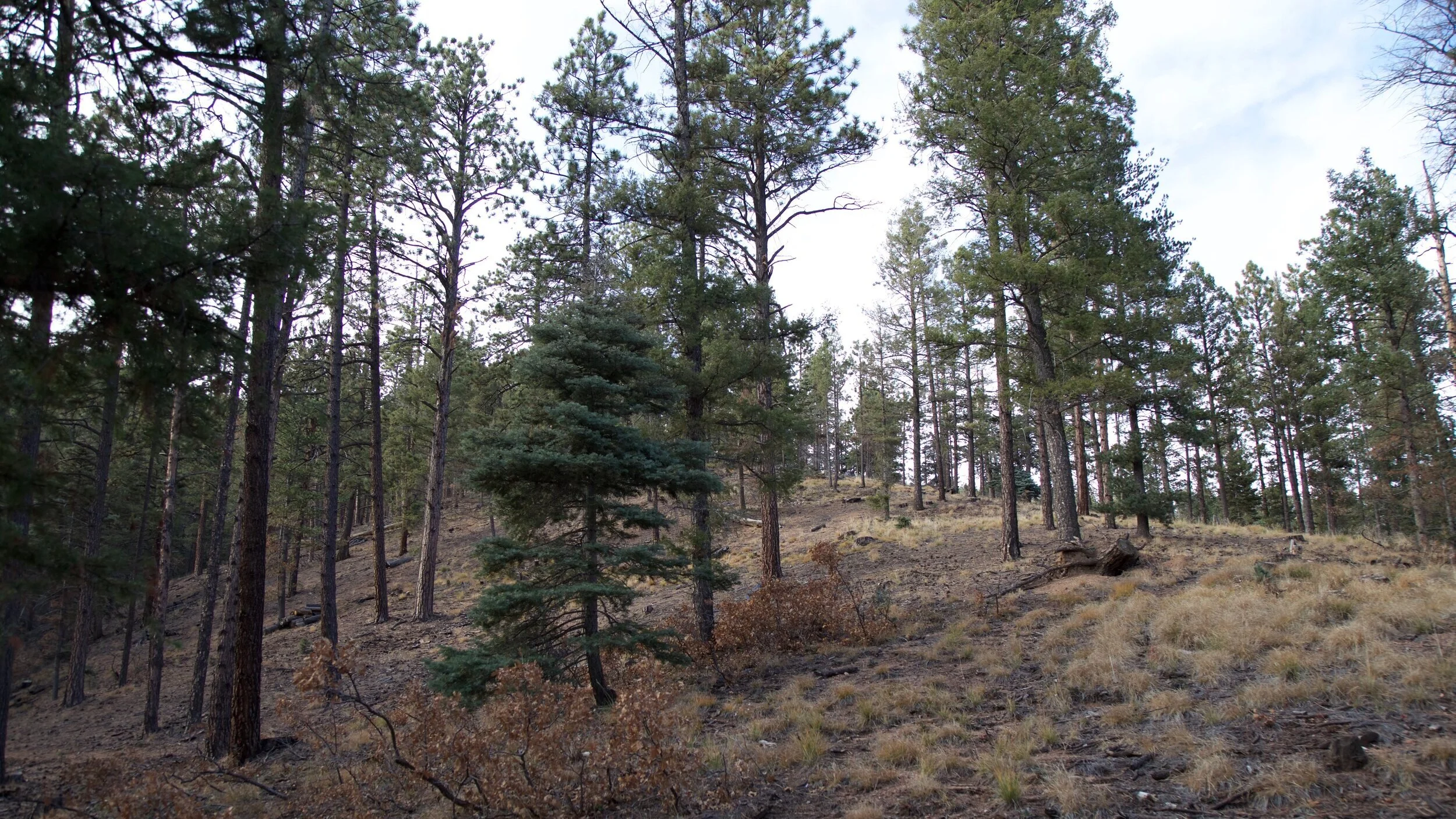
 
IMG_0129.jpg
 

The connection between the project and the Coalition

The purpose of the SF Mountains Project is to improve the ecosystem resilience of a priority landscape to future disturbances by restoring forest structure and composition and reducing the risk of catastrophic wildfire. The Fireshed Coalition was founded to help initiate, support and implement landscape-scale vegetation management such as this. The project aligns with the Fireshed Coalition’s stated mission to “use a proactive collaborative approach to improve the health and long-term resilience of forested watersheds and communities… [by] identify(ing) and implement(ing) high priority on-the-ground projects that make the Fireshed and its communities more resilient to wildfire while maintaining and restoring resilient landscapes.” 

Understanding the Santa Fe Mountains Landscape Resiliency Project

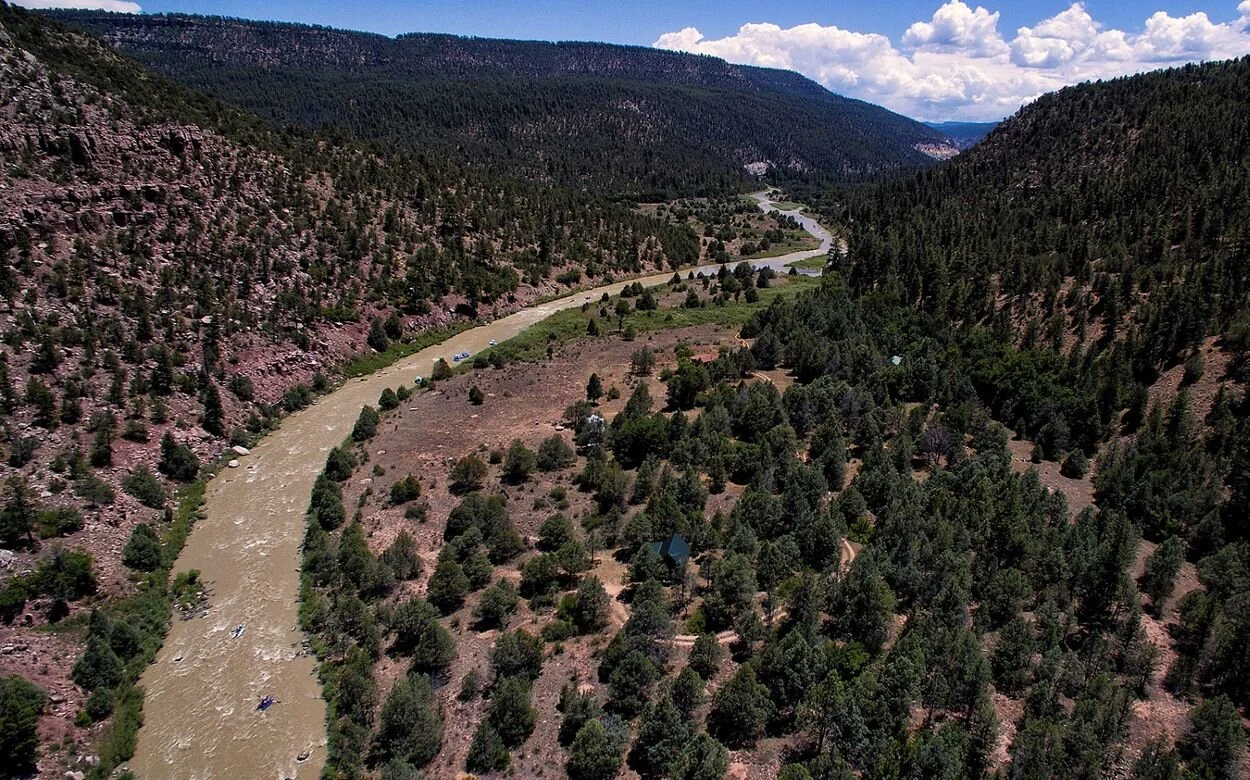
The SF Mountains Project is a forest management response to an increase in forest vulnerability due to insect outbreaks, disease, and high severity wildfire. As global climate changes, temperature increases and overcrowded forests from a century of fire suppression have changed the structure and composition of the forests surrounding Santa Fe. The susceptibility of adjacent forests to high severity wildfire, of the watersheds to dramatic post-fire flooding and erosion, and of our local economy to the disruption wreaked by these natural disasters have become increasingly apparent. The purpose of the project is to improve the ecosystem resilience of a priority landscape to future disturbances including wildfire, climate change, and insect outbreaks. To meet this purpose, the U.S. Forest Service proposes mechanical and manual vegetation thinning treatments, use of prescribed fire, and riparian restoration on National Forest System (NFS) lands within the project area. The project also includes road closure on up to 1.5 miles of NFS roads.

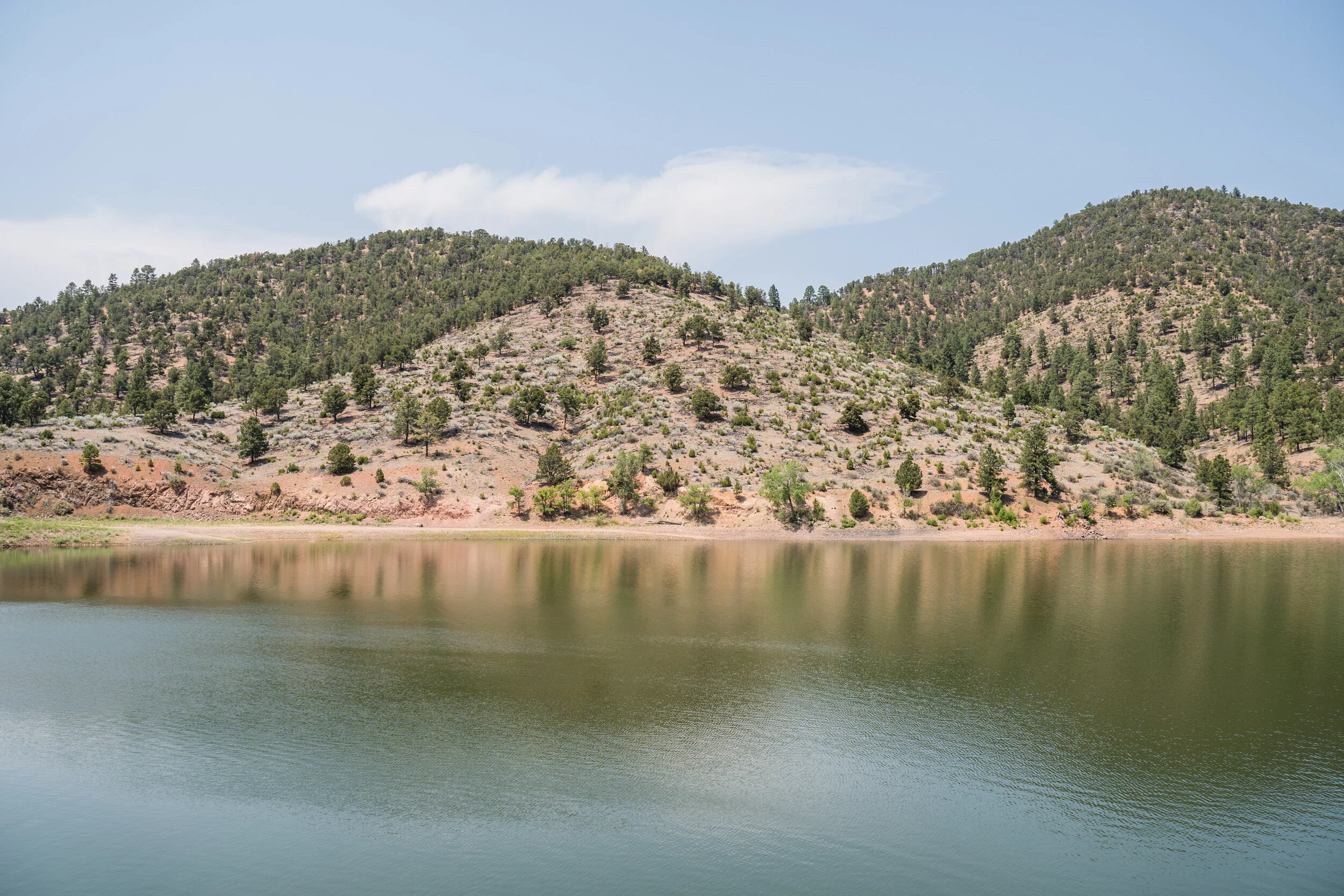
A critical component of improving resilience in the project area is creating conditions that facilitate the reintroduction of fire, a keystone ecological process, in the frequent-fire vegetation types found across this landscape. This translates to managing forest structure, composition, and densities that would not contribute to active crown fire. Mitigating for catastrophic wildfire is also a way to protect the City of Santa Fe’s Municipal Watershed from post-fire flooding and debris damage to the drinking reservoirs and earthen dams. Protecting this clean water source from high severity fire requires the ecologically-sensitive and science-driven forest management that is proposed in this project. 

Learn more about the project here.

Developing a multiparty monitoring plan

The Fireshed Coalition is aiding in the development of the Multiparty Monitoring Plan that is intended to complement and support Forest Service monitoring and community engagement in the SF Mountains Project. This plan proposes multiparty monitoring questions identified and prioritized by the Fireshed Coalition’s Monitoring Committee and the Santa Fe National Forest (SFNF). It also includes a proposed community science bird monitoring effort developed based on public commentary through the NEPA process and other community engagement activities. A proposed review process would allow the monitoring committee, working with SFNF resource specialists and other interested individuals, to periodically review interim monitoring results and make recommendations for future restoration planning and management actions.

How to submit a public comment

  1. Read the EA and the supporting documents found on the USFS project page here. You can browse through maps, appendices, and scoping issues that were addressed.

  2. Visit The commenting webpage to submit your comment electronically. Comments and letters regarding concerns about the project, as well as support for the project, are accepted here.

  3. Submit your comment by 10/29/21

  4. You can review others’ comments in the reading room after they have been submitted and reviewed. Letters that may contain proprietary or sensitive resource information, or that may be otherwise sensitive, are automatically withheld from being displaying in the reading room, but all letters received will still be considered and included as part of the record for this project.

  

Wildfire Wednesdays #69: Prescribed Fires

Hello Fireshed Coalition!

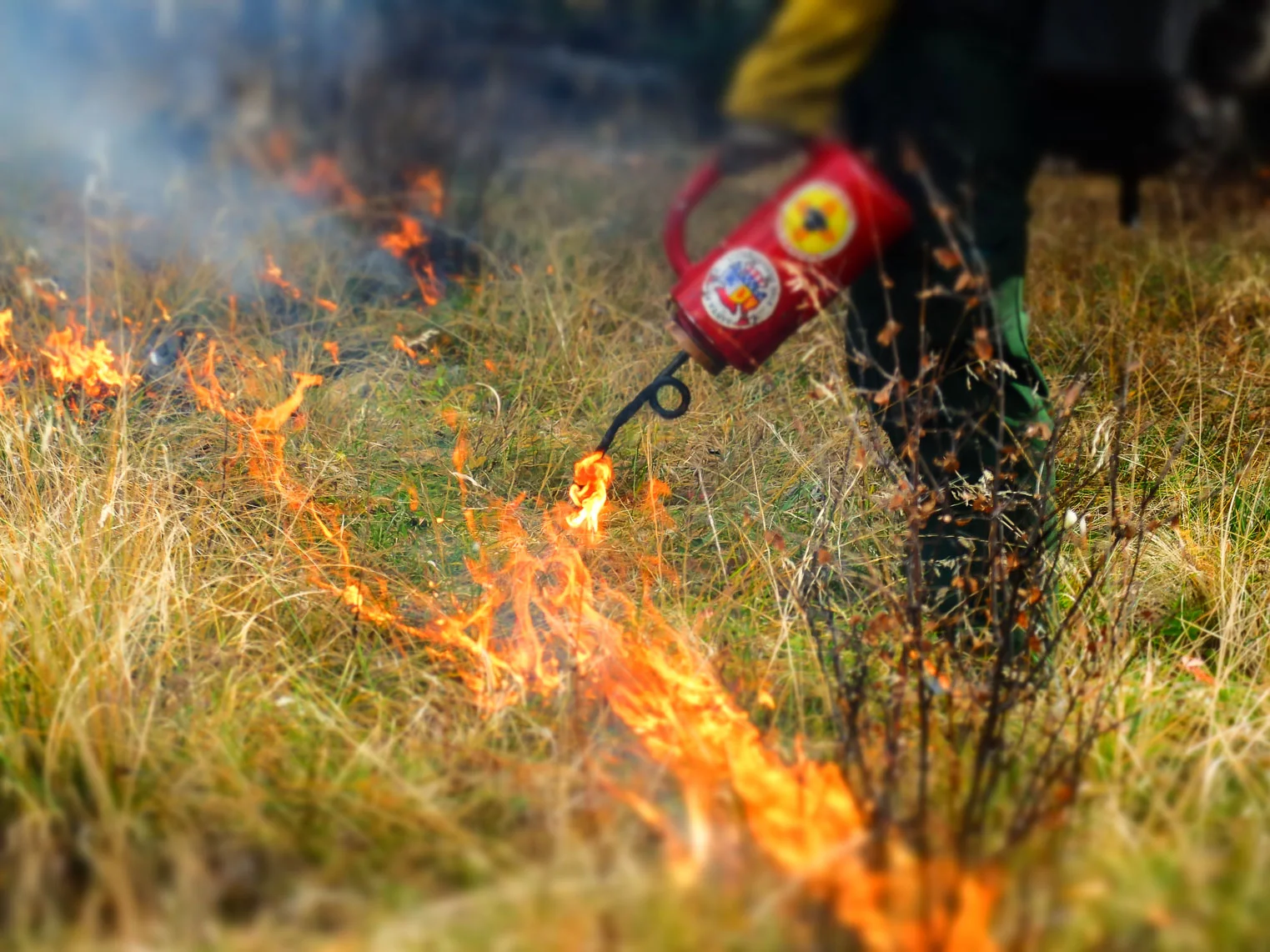
Happy Wednesday, we hope you’re enjoying this cooler weather and the start to Fall here in Northern New Mexico! With Fall comes the start of another season; prescribed fire season. Fire adapted forests historically experienced low-severity wildfire in a way that protected them from widespread mortality and land-type conversion across large acreages. While it is essential that we put fires out to protect our homes and communities, our effectiveness at putting fires out over the last 100 years or so has largely removed fire from these forests. To reintroduce low-severity fire, land managers across New Mexico use prescribed fire under carefully planned conditions that typically align with Fall weather. Keep reading to learn more!

This Wildfire Wednesday features information on:

  • What are prescribed/controlled burns?

  • Effects of prescribed fires

  • Lessons learned on prescribed burning from the Southeastern US

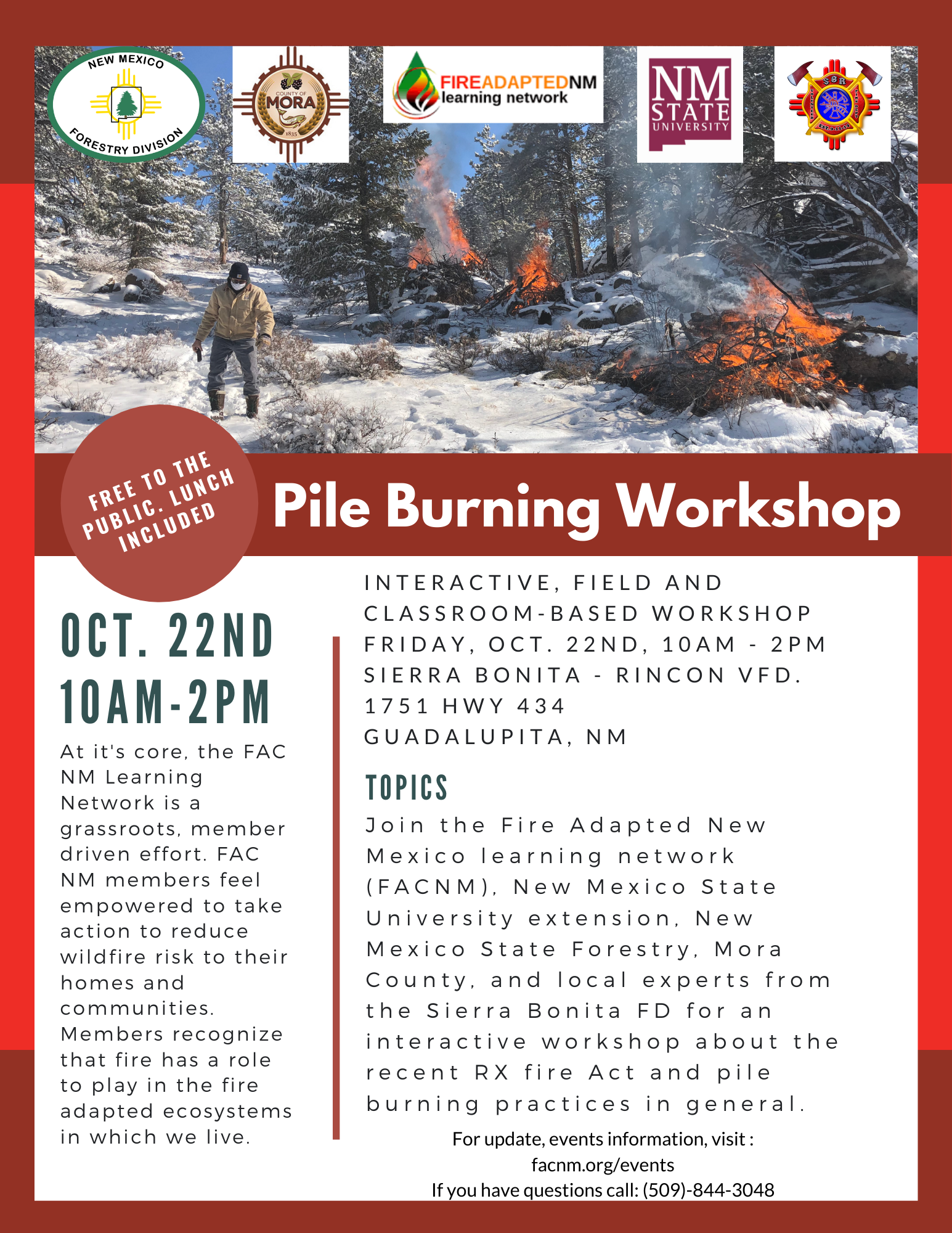
  • An upcoming pile burning workshop opportunity

Have a great week!

Liz

Prescribed burns

What is a prescribed burn?

“Prescribed fires, also known as prescribed burns or controlled burns, refer to the controlled application of fire by a team of fire experts under specified weather conditions to restore health to ecosystems that depend on fire.” (Forest Service)

What are the outcomes of a prescribed burn?

From the Forest Service:

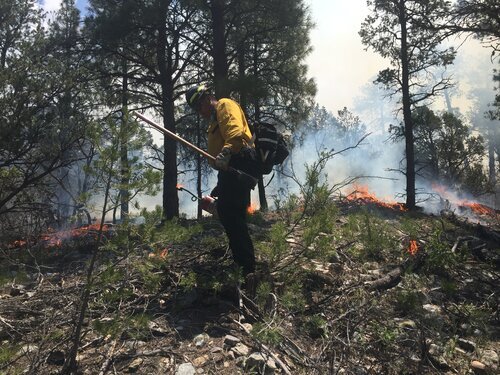
Photo from an All Hands All Lands prescribed burn in 2019

Photo from an All Hands All Lands prescribed burn in 2019

Reduces hazardous fuels, protecting human communities from extreme fires;

  • Minimizes the spread of pest insects and disease;

  • Removes unwanted species that threaten species native to an ecosystem;

  • Provides forage for game;

  • Improves habitat for threatened and endangered species;

  • Recycles nutrients back to the soil; and

  • Promotes the growth of trees, wildflowers, and other plants.

What are the types of prescribed burns?

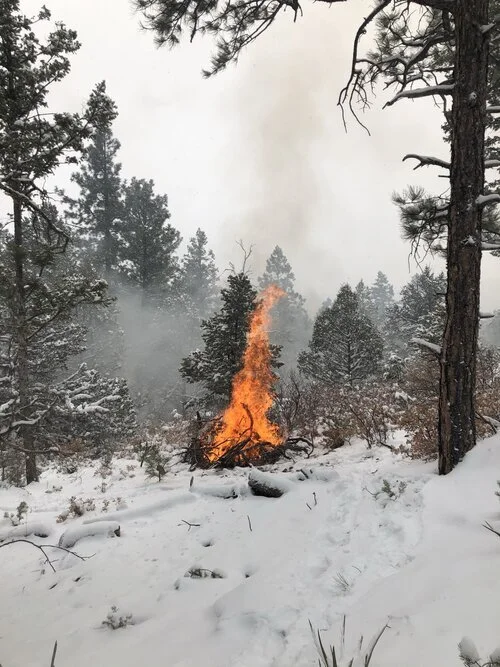
Photo from an All Hands All Lands pile burn in 2021

Photo from an All Hands All Lands pile burn in 2021

Broadcast burning: “Broadcast burning involves fire applied across a predetermined area ranging in size from an acre or less to tens of thousands, generally after an area has not received precipitation for some amount of time to encourage fire movement” (NW Fire Science Consortium)

  • Understory burning: “A prescribed fire ignited under the forest canopy that focuses on the consumption of surface fuels but not the overstory vegetation. Underburning is generally used following a pre-treatment such as thinning and /or pile burning to further reduce the surface fuels, help maintain the desired vegetation conditions and enhance the overall health and resiliency of the stand.” (Bureau of Land Management)

  • Pile burning: “A prescribed fire used to ignite hand or machine piles of cut vegetation resulting from vegetation or fuel management activities. Piles are generally burned during the wet season to reduce damage to the residual trees and to confine the fire to the footprint of the pile. Pile burning allows time for the vegetative material to dry out and will produce less overall smoke by burning hot and clean.” (Bureau of Land Management)

  • Jackpot burning: “A modified form of underburn or broadcast burn where the target fuels to be ignited are the concentrations (or jackpots) of vegetative fuel. The result is a mosaic burn pattern. This technique works well when surface fuels loading is very high following vegetation treatments such as juniper encroachment removal used to improve rangeland ecosystems.” (Bureau of Land Management)

  • Cultural burning: Cultural burnings have been performed by aboriginal and indigenous peoples across the world for millennia and are practiced by many tribes today. These burnings can have many different objectives but what sets cultural burnings apart from other prescribed fires it that the cultural burnings and the resources they affect are “pertinent and substantial to their cultural livelihood”. Visit last week’s Wildfire Wednesday blog to learn more!

How are prescribed burns planned?

“Specialists write burn plans for prescribed fires. Burn plans identify – or prescribe – the best conditions under which trees and other plants will burn to get the best results safely. Burn plans consider temperature, humidity, wind, moisture of the vegetation, and conditions for the dispersal of smoke. Prescribed fire specialists compare conditions on the ground to those outlined in burn plans before deciding whether to burn on a given day.” (Forest Service)

Effects of prescribed fires

There are many public concerns regarding prescribed fires, particularly around air quality and wildlife, but the benefits of prescribed fires far outweigh any negative side effects. Click on the resources below to learn more about how prescribed fire effects these areas of concern.

“Prescribed fire can result in significant benefits to ecosystems and society. Examples include improved wildlife habitat, enhanced biodiversity, reduced threat of destructive wildfire, and enhanced ecosystem resilience. Prescribed fire can also come with costs, such as reduced air quality and impacts to fire sensitive species. To plan for appropriate use of prescribed fire, managers need information on the tradeoffs between prescribed fire and wildfire regimes. In this study, we argue that information on tradeoffs should be presented at spatial and temporal scales commensurate with the scales at which these processes occur and that simulation modeling exercises should include some realistic measure of wildfire probability. To that end, we synthesized available scientific literature on relationships between prescribed fire and wildfire regimes, and their associated ecological and societal effects, focusing specifically on simulation modeling studies that consider wildfire probability and empirical and modeling studies that consider prescribed fire and wildfire regimes at spatial and temporal scales beyond individual events.”

Lessons learned from the Southeastern US

Although we typically hear more about wildfires and prescribed burns occurring in the Western US, there are approximately 45,000 wildfires in the Southeastern US each year. From 1998 to 2018, about 70% of all prescribed burns in the United States occurred in the Southeast (Kolden, 2019). To learn more about fire in the Southeast visit the Wildland Fire in the Southeast webpage.

Why is the Southeast so far ahead in their utilization of prescribed burns? While in the Western US the approach of fire suppression was widely practiced, European settlers in the Southeast learned prescribed burning from the indigenous people and integrated that into their own relationship with the land. Prescribed burning, and selective logging, have been culturally accepted by communities in the Southeast and have been a part of land management since its early inhabitance. Learn more about the history of prescribed burning in the Southeast by reading this paper: The Historical Foundations of Prescribed Burning for Wildlife: a Southeastern Perspective.

To learn more about how Western states are learning from Southeastern fire practices check out:

Upcoming Pile Burning Workshop

pile burning wksp..png

Wildfire Wednesdays #68: Cultural Forest Practices

Hello Fireshed Community!

We’re halfway through September and we hope you’re looking forward to fall as much as we are! Today we wanted to share with you some information about cultural forest practices and the complex relationship humans have had with forest management for millennia. It is a common misconception that that the American West was “shaped entirely by natural forces” prior to arrival of Europeans, however, burning and logging have played a significant role across our landscape for nearly 15,000 years. Read on to learn more about these forest management techniques and the indigenous peoples who practice them today.

This Wildfire Wednesday features information on:

  • Cultural burning

  • Ancestral logging practices

  • Upcoming opportunity to be involved in (or learn more about) a prescribed burn!

Have a great week,

Liz


Cultural Burning

What is cultural burning?

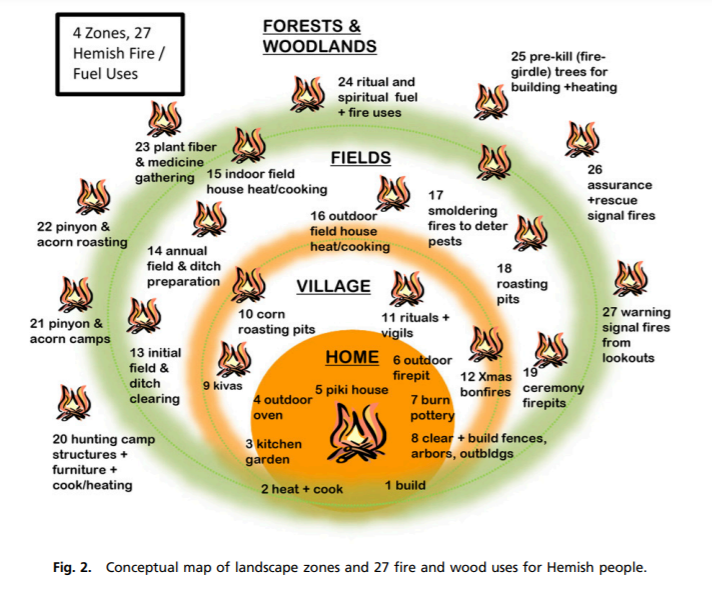
Cultural burning falls within the broader category of prescribed (or controlled) burns. What sets cultural burning apart is that within indigenous communities, these burnings are “pertinent and substantial to the cultural livelihood”. Anthropologists have found identified more than 70 different purposes for using fire within indigenous and aboriginal cultures. Some uses of fire include communication across long distances, reduction of pest populations, opening forests to attract game species, and moving herds in desired directions. To learn more about cultural burning watch this video by The Nature Conservancy “Revitalizing Cultural Burning practices, New Mexico and Beyond” or visit the Indigenous Peoples Burning Network for more resources.

Cultural burning by Native Americans interconnected them not only to the
land but to their animal, reptile, bird and plant spiritual relatives.
Therefore, conducting a cultural burn relates to what they burned, how
they burned it, and why they burned it
— Ron W. Goode, Tribal Chair, North Fork Mono Tribe

History of cultural burning

As stated above, indigenous peoples have been using fire for many purposes across the American West for thousands of years. With the arrival of Europeans to the Western U.S. came the notion that all fire was bad and should be suppressed, a mentality that has taken generations to overcome. Only in the past few decades has the movement for revitalization of cultural burning practices and integration of indigenous peoples’ knowledge into policy and management gained traction. Click on the buttons below to check out academic papers detailing the history of cultural burning practices in the American West.

Cultural burning success stories

Photo credit: Kiliii Yuyan

Photo credit: Kiliii Yuyan

The Yurok tribe in California has been working to restore their cultural relationship with fire and “reclaim their right to use fire”. An internal assessment of community needs identified restoring the use of fire as the number one priority for tribal members. To address this, the Cultural Fire Management Council was created to return fire to Yurok lands. Since the establishment of this committee, there have been many Yurok TREXs (Prescribed Fire Training Exchanges) to share knowledge with collaborators and train tribal members. Click here to read the in-depth article from The Nature Conservancy about the Yurok Tribe and their “rekindling of the ancient art of controlled burning”

Mono tribe cultural burning (video below): “For thousands of years, California Indians used fire as a tool for managing natural resources. Throughout the state, Native peoples conducted cultural burns on a wide range of plants and it was their fire regimes that created diverse habitat mosaics that sustained meadows, coastal prairies, and grasslands. The careful application of fire increased fruit and seed production, caused new growth that was better suited for making baskets, and reduced the fuel load that could be burned by naturally occurring wildfires. But starting with the Spanish conquest and continuing today in the form of Forest Service and Cal Fire policies, fire suppression has drastically limited cultural burning. As a result, the forest has become incredibly dense and we are now facing a situation in the Sierras where drought is causing many trees to die. This massive tree mortality has brought the forest to a tipping point where large scale wildfires threaten to alter the Sierras permanently. In this video, we explore how cultural burning is being practiced today and what lessons it holds for the future of the forest. We visit the area just south of Yosemite National Park where two tribes are working to bring fire back to the land, the North Fork Mono Tribe and the Cold Springs Rancheria of Mono Indians.”

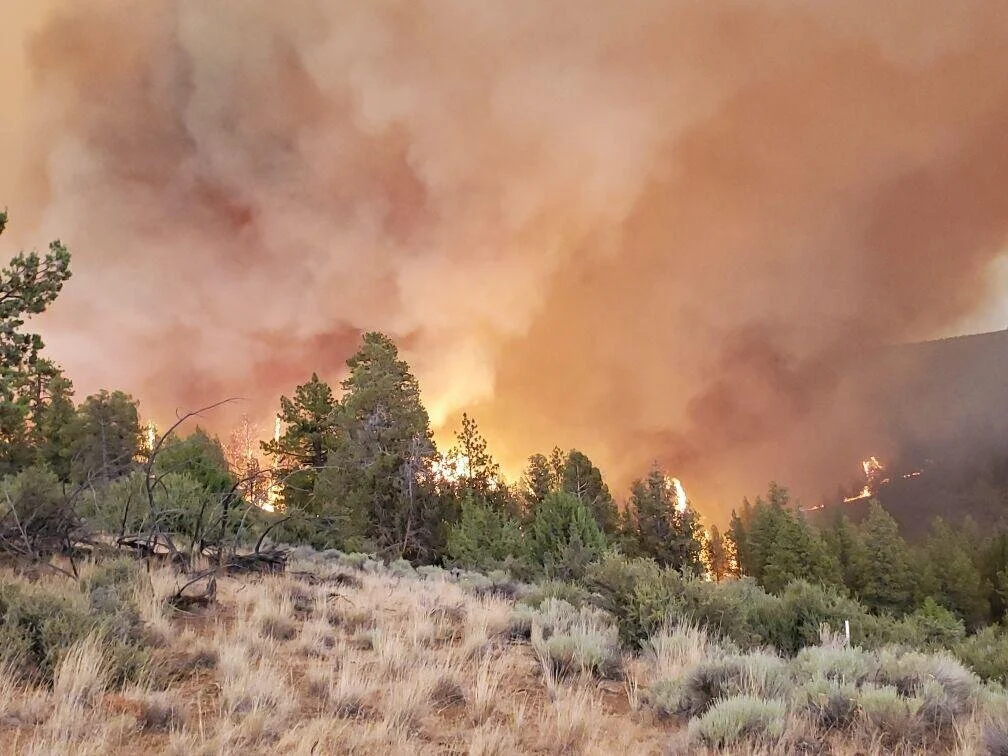
Photo Credit: Central Oregon Fire Info

Photo Credit: Central Oregon Fire Info

Our final success story comes from Washington and Orgeon where the Bureau of Land Management have been collaborating with tribal leadership to develop prescribed burning projects. This year they have already noticed a difference in the fire severity in the areas that were treated with controlled burns versus areas that were not treated. This collaboration is yielding positive outcomes, however, tribal members also want to be more than just consultants on these projects and hope to be allocated resources to carry out this kind of management on their own lands. Click here to read the article “Indigenous practice could be key to taming wildfires”


Ancestral logging practices

Screenshot 2021-09-15 161742.png

The original wildland-urban interface in New Mexico was on the Jemez Plateau nearly 12,000 years ago where inhabitants practiced a form of selective logging. “Life on the Jemez Plateau required all the fine fuels that villagers could get their hands on. In roof construction alone, villagers cut hundreds of thousands of small-diameter timbers for supportive vigas, while understory growth went for fuelwood. Outside of villages, trails and agricultural fields acted as firebreaks.” There were actually more fires burning on the Jemez Plateau during this time compared to today, however, in part due to these forestry practices the fires were small and low in severity. Visit this 2017 High Country News article or read the paper below to learn more!


Upcoming Zuni TREX

IMG_0374.jpg

In October 2021 The Forest Stewards Guild, Mt. Taylor Ranger District of the Cibola National Forest and other partners will lead a collaborative burn that will provide opportunities for local practitioners to build experience and contribute to the ecological resilience of these fire-adapted forests.

Wildfire Wednesdays #67: Water & Fire

Hello and happy September Fireshed community! 

Announcement kick-off: Wildfire Wednesdays is changing to become a bi-monthly post. We remain committed to bringing you useful and pertinent information and resources in this shift. Please continue to share widely! 

Today we have a guest writer, Rachel Bean, who is a project coordinator with the Forest Stewards Guild. Rachel will be diving into the connection between forest health, wildfire resiliency, and the water which fuels our community. Continue reading to learn more about source water and its relationship with wildfire preparedness. You can also check out the newly launched Greater Santa Fe Fireshed Coalition source water webpage here where you will find useful links, videos, and opportunities to get involved with watershed health and protection in your community. 

This Wildfire Wednesday features information on: 

  • Watersheds and forest health 

  • The connection between fire resiliency and source water 

  • Treatments that protect water

  • The “Local Communities Adapting to Fire” webpage from TNC featuring the Santa Fe fireshed

  • Upcoming virtual screening and panel discussion of The West is Burning, a documentary about forest restoration and increasing wildfire severity.


Watersheds and Forest Health

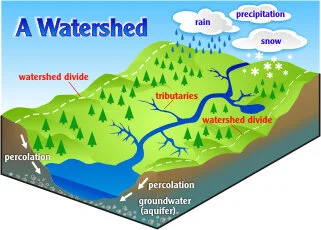
Image Credit: Delaware County Conservation District

Image Credit: Delaware County Conservation District

Forested ecosystems play a big role in supplying water for drinking and agriculture, from rural houses to small towns to large cities. They capture and retain snow in the winter at high elevation. This snow melts in the spring to feed streams and rivers, called surface runoff, flowing into our communities. They also act as a sponge, absorbing snow and rainwater into their soils to recharge wells, aquifers, and to feed acequias. Much of the water which comes out of the forests is stored in man-made reservoirs where it is treated for contaminants and transported into the municipal waterways, straight to your kitchen tap. From the highest peaks collecting snow to the mouth of the canyon where the reservoirs sit, these geographic areas which capture and supply water are called watersheds. The natural processes which take place in forested ecosystems provide the cleanest, cheapest, and most renewable form of drinking water in the southwest.


Fire Resilient Forests

20201213_143110.jpg

An intact forest absorbs more water in its soils, holds more snow in the winter, and leads to a consistent source of potable water for communities. When a forest becomes overcrowded with trees and brush, the vegetation uptakes more water from the soil. The trees begin to compete for resources and may become water-stressed, making them more vulnerable to pests and disease. Overcrowded and stressed forests are also more vulnerable to wildfire, with a thick closed canopy which fuels the fire and allows flames to move quickly across the landscape. When a forest burns hot and fast it can no longer serve as that absorbent sponge – there are no trees to filter the rainwater, no vegetation to insulate and hold the snowpack, and the scorched soil becomes hydrophobic and unable to soak up water. In order to protect our rivers and drinking water, it is essential that we ensure ecological integrity and long-term resiliency of our forests.


Protecting the Water 

NicholsTreatment_Watershed.jpg

As climate change reduces the reliable arrival of snow and rainfall and a growing population increases the demand for water, protecting our source water and the watersheds which supply it is critically important to New Mexico. Forest thinning projects, prescribed burns and wildfires managed for resource objectives, and community protection projects all play a role in increasing forest resilience to pests, disease, and wildfire.  These treatments can create a natural and functional forest structure while stimulating grasses and shrubs. Plants stabilize the soil, reducing surface runoff and increasing water quality. Treated areas also burn at lower severity and are less likely to experience flooding and debris flows following a wildfire. Like a wise retirement investment, proactive protection of our source water ensures a vibrant and sustainable future. Learn more about watershed health and the projects taking place in your community to protect it! 


Local Communities Adapting to Fire

Photo credit: Christi Bode

Photo credit: Christi Bode

From The Nature Conservancy’s Land and Water Stories is a new webpage, “Local Communities Adapting to Fire”. This page features several communities that are working towards becoming more fire adapted, including our own local fireshed! Click here to visit The Nature Conservancy’s “Local Communities Adapting to Fire” page

The West is Burning: Virtual Screening and Panel Discussion

September 16th, 6:30 - 8:30pm on Facebook Live

For full event info and to tune in on Facebook, click here.

Join the Santa Fe Fireshed Coalition and local experts Dennis Carril, Alan Hook, Laura Paskus, Michael Martinez, and Matt Hurteau for a virtual screening of The West is Burning followed by a panel discussion to situate the film within the Fireshed landscape.

For full event flyer, click here.

Wildfire Wednesdays #66: Debunking Fire Myths

Happy Wednesday fireshed community,

We hope you’re staying healthy and enjoying the last few weeks of summer! This week we wanted to focus on debunking some common misperceptions related to wildfires and prescribed fires. Our relationship with and management of fire has changed a lot in the past few decades and with that can come confusion or misunderstandings. Keep reading to clarify some commonly misconstrued myths related to fire!

This week’s Wildfire Wednesday features information on:

Have a great week!

Liz


Wildfire Myths

There is a lot of information available about wildfire and prescribed fires and it can sometimes be difficult to know what is true or what are common misconceptions. Read about some common fire-related myths below!

Myth: All wildfire is destructive and should be suppressed immediately.

Fact: Wildfire plays a critical role in many fire-adapted ecosystems and, when appropriate, can be managed for positive effects.

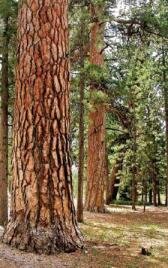
Ponderosa pine are one of the fire-resistant plants in the Western US (Photo credit: Robert Van Pelt/DNR)

Ponderosa pine are one of the fire-resistant plants in the Western US (Photo credit: Robert Van Pelt/DNR)

Ponderosa pine are one of the fire-resistant plants in the Western US (Photo credit: Robert Van Pelt/DNR)

From The Wilderness Society: “Fire has played an important ecological role in forests for thousands of years. Some species of plants depend on periodic wildfires as part of the natural cycle of recovery, and many other species easily tolerate naturally occurring, periodic fires.” Safety of communities and wildland firefighters is paramount when it comes to fire but when conditions are right, wildfires can be managed to “create wildlife habitat, renew soil nutrients and limit the size of subsequent fires by clearing old trees that would otherwise act as fuel”

Myth: There is nothing you can do to prevent wildfire damaging your property.

Fact: There are many things individuals can do to prepare their private property to reduce the risk of wildfire damage.

mitigation-42.jpg

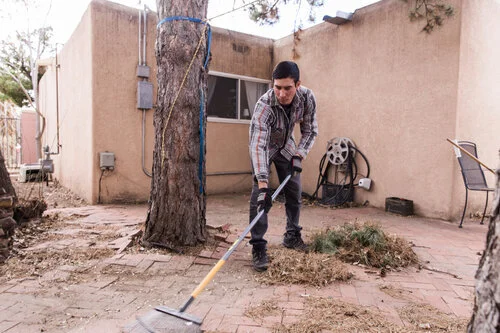
Studies show that as many as 80 percent of the homes lost to wildland fires could have been saved if their owners had followed a few simple firesafe practices. From removing brush and debris to changing the roofing materials on your home there are many opportunities to reduce the risk of damage from wildfire on your property. Click here to visit the Residents Resources page on the Fire Adapted Communities New Mexico webpage and learn more about what you can do on your property!

Myth: Regular logging is enough to prevent forest fires.

Fact: Logging operations can leave forests more vulnerable to intense wildfire, however, strategic thinning can prepare forests for low-intensity, beneficial wildfire.

(Getty Images)

(Getty Images)

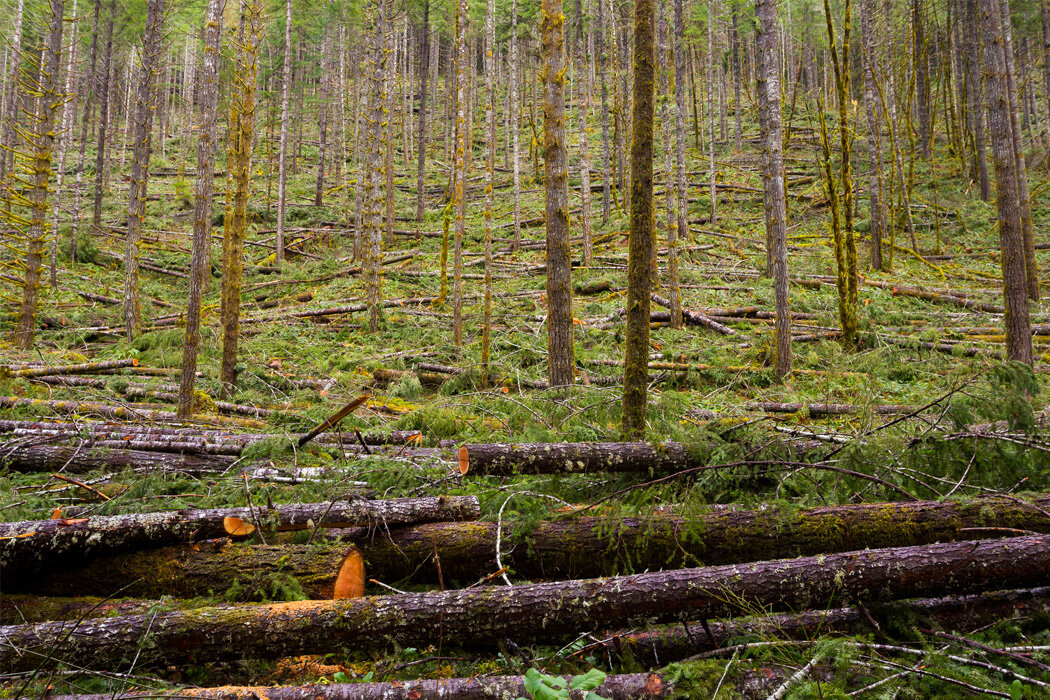
From the Wilderness Society: “On a basic level, this argument is sensible; after all, fewer trees means less fire fuel, right? But it's not so simple. Studies have actually found that fires burn more intensely in forests that have been logged. One reason is that the tree remnants left behind in the wake of a logging operation (limbs and tree tops, typically) form a kind of super-charged bed of surface fuel that is dried out thanks to the lack of forest canopy overhead. Another reason is that the new trees that grow in after a forest is logged are all the same age and densely clustered--exactly the kind of trees that burn extra hot and fast, leading to big, intense blazes. Strategically "thinning" forests is a different story. If trees are cut down in carefully planned locations, in forests that are well-adapted to regular ground fire, the practice can help reduce the intensity of wildfires.”


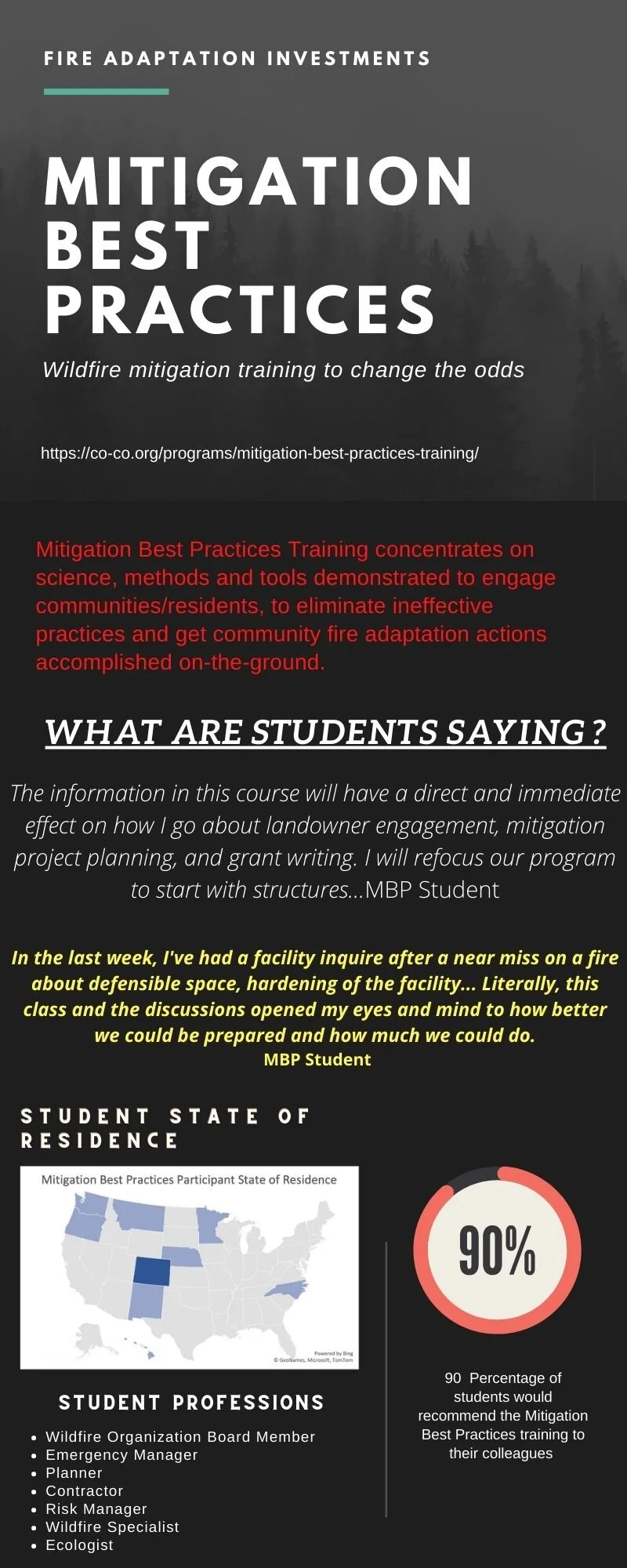
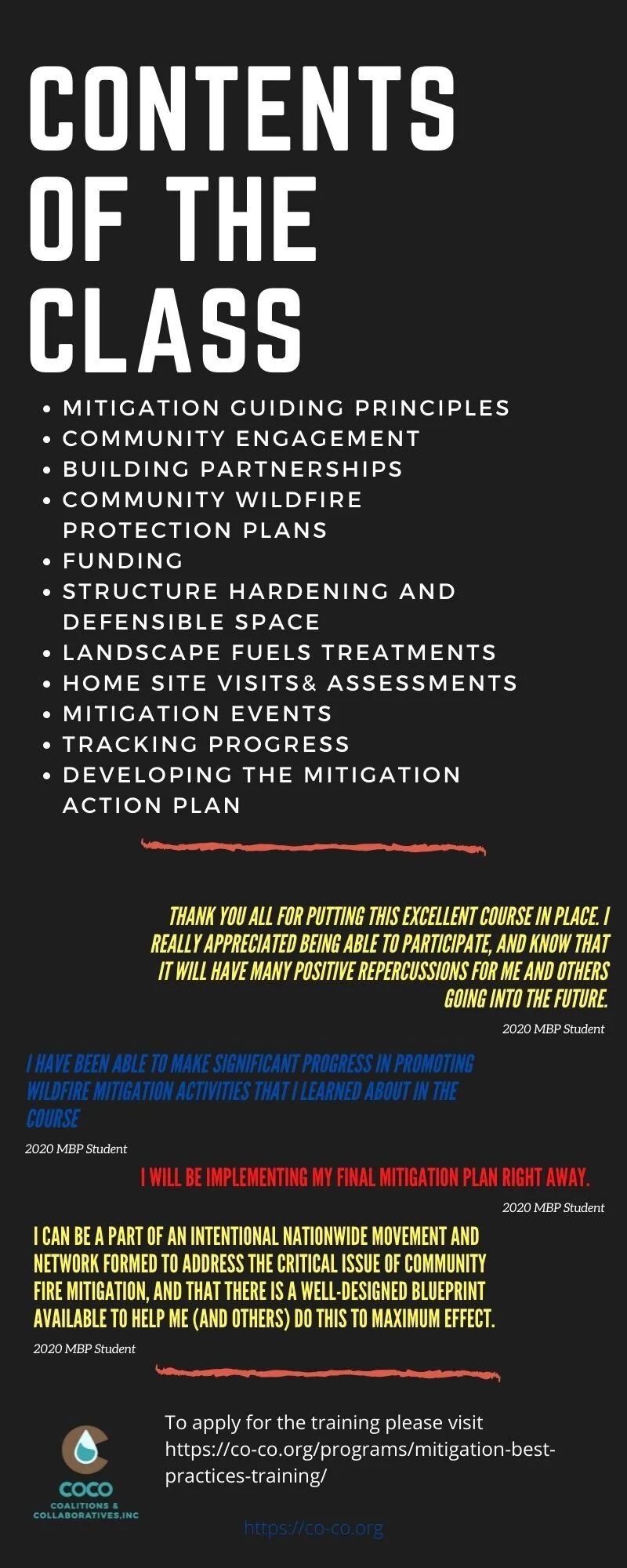
Mitigation Best Practices Training

“This national level training from Coalitions & Collaboratives, Inc. and the USDA Forest Service is designed for current or future mitigation specialists, wildfire program leads, and others who work with residents and their communities to reduce wildfire risk. The Mitigation Best Practices training concentrates on science, methods and tools that will help you engage communities/residents while also helping you to eliminate ineffective practices.

Participants should come with a basic understanding of wildfire, how homes burn, and vegetation management practices. The course assumes you know how to mitigate, but that you could use support engaging your community. In this workshop, you will work through some of the greatest challenges facing our wildland urban interface communities. The course will help you break down ineffective practices to make space for the more effective ones with a focus on the on-the-ground mitigation activities.”

Click here to learn more!

MBP2.jpg

Shortgrass Prescribed Burning Workshop

Are you curious about using prescribed burning in shortgrass rangelands, but not sure if it's safe, effective, and needed? Join us in learning about prescribed burning in the shortgrass prairie. Specialists will host an indoor workshop on November 4, 2021 in the multipurpose room of the Mosquero Municipal School in Mosquero, New Mexico.

Included in the November 4 workshop will be:

· reasons for burning

· special considerations for shortgrass prairie

https___cdn.evbuc.com_images_96560558_423214060085_1_original.jfif

· what to expect after a burn

· how long burn effects will last

· regulations affecting prescribed burning

· weather conditions needed

· formulating a burn plan

· techniques for achieving the burn you want

This workshop and training is being conducted by New Mexico State University Cooperative Extension and Kansas State University in conjunction with the Ute Creek Cattle Company. Additional assistance and cooperation provided by the Great Plains Fire Science Exchange, Southern Rockies Fire Science Network, and the Southwest Fire Science Consortium.

Click here to learn more or register for this workshop!

Action, Implementation, and Monitoring Grant Program

RFP is released August 30th

To sign up for an informational webinar on September 1st, click here.

download (1).jfif

“Action, Implementation and Mitigation (AIM) is a unique funding opportunity. The grant is administered through Coalitions and Collaboratives (COCO), where they understand that funding is only part of the picture. If awarded funding, awardees join a partnership of fellow fire and fuel-reduction practitioners. COCO recognizes that different groups are in different places in terms of partners and mentors and will provide training, mentorship and guidance to awardees throughout the term of their grant agreement. If you anticipate you will need some mentorship or guidance, please build time into your proposal to accommodate that.

Reimbursement funding is available for a wide variety of capacity building  activities, including personnel,  planning efforts and wildfire risk reduction work on nonfederal lands. COCO will be looking to fund a variety of different types of projects across the country. Applicants must demonstrate how their proposal fits into the bigger community wildfire picture, including coordination with federal partners on nearby public lands. Applicants must contribute a 100% match (cash or in-kind match is eligible).  Award funding may range from $10,000 – $75,000. Grants are contracted for a period of one year. Funding will be provided on a reimbursement basis.”