Wildfire Wednesdays #127: Homeowners Insurance & Escalating Wildfire Risk

Hello Fireshed Folks,

In the face of escalating wildfire risks in the Western U.S., homeowner's insurance stands as an important line of defense against climate change-induced calamities. The surge in unprecedented wildfires in recent times has prompted a reassessment of the risks associated with insuring homes in fire-prone regions by homeowners' insurance companies. Numerous conventional carriers now decline to provide insurance coverage for properties in high-risk areas, and some have stopped renewing existing policies. The reluctance of insurers stems from concerns about potential liabilities, exacerbated by the lengthening periods of drought and lessening wet seasons. This flight of insurance companies has happened perhaps first and worst in the state of California, and the struggle there can give context to what the rest of the west may face. Read on for more details.

In this post:

  • Background: California’s Insurance Challenges & the Impact Beyond CA

  • How Do Insurance Companies Determine Coverage?

  • Exploring Possible Solutions

  • Upcoming Opportunities

Happy Reading!

Best,

Dayl


Background

California’s Insurance Challenges

*Information sourced from this NY Times article and this KQED article.

Climate disasters, especially intensifying wildfires, have posed a significant threat to California, impacting the insurance industry and the millions of residents who rely on it. Seven major insurance companies, including Allstate, State Farm, Farmers Insurance, and AIG, have either left California or scaled back their operations in response to the escalating risks. The state's current business model is under threat, necessitating a comprehensive regulatory overhaul.
California Insurance Commissioner Ricardo Lara faced increased pressure to act as legislative efforts faltered. An executive order from Gov. Gavin Newsom urged swift action to strengthen the property market, prompting Lara to announce significant regulatory changes by the end of the next year. The proposed changes aim to enhance market stability, but they also raise concerns about potential premium increases.

Lara's proposed changes include agreements with insurance companies to offer coverage to at least 85% of homeowners in high wildfire-risk areas. This shift aims to transition homeowners from the state's insurer of last resort, the FAIR plan, back to the regular market. Additionally, allowing companies to use forward-looking climate catastrophe models and passing on California-related reinsurance costs are crucial components of the regulatory overhaul.

While the announced changes aim to address the challenges faced by the insurance industry, reactions have been mixed. Some see it as a necessary compromise to ensure both consumer and insurer viability, while others criticize it as a victory for the insurance industry. The potential for higher premiums has raised concerns, but the changing landscape suggests that the era of cheap insurance may be over, requiring homeowners to adapt to a new normal.

The Impact Beyond California

The challenges faced by California's insurance market are reflective of broader trends in the Western U.S. and beyond. Climate-driven disasters are accelerating price hikes, coverage withdrawals, and market instability, posing a global systemic risk. The potential collapse of the insurance market could have far-reaching consequences on the economy, affecting the real estate industry, mortgages, and overall economic stability.

How Do Insurance Companies Determine Coverage?

*Information courtesy of Ashley Dalton, an Insurance Agent with offices in Ruidoso and Alamogordo, NM. View her PowerPoint presentation slides on the topic here.

30-50% of underwriting decisions are based on the two following programs:

For typical structure loss due to fires

Public Protection Class ISO (1971)

• 50% comes from the quality of your local fire department, including staffing levels, training and proximity of the firehouse.

• 40% comes from availability of water supply, including the prevalence of fire hydrants and how much water is available to put out fires.

• 10% comes from the quality of the area’s emergency communications systems (911).

• An extra 5.5% can come from community outreach, including fire prevention and safety courses.

For predicting risks specific to wildland fires in rural areas

ISO Fireline (2004)

• Fuel — Grass, trees, or dense brush feed a wildfire.

• Slope — Steeper slopes can increase the speed and intensity of wildfire.

• Access — Limited access and dead-end roads can impede firefighting equipment.

• Scores range from negligible (0) to low (1), moderate (2–3),high (4–12), and extreme (13–30)

For the remaining 50-70%, it depends on the following: Construction type (fire-resistive, non-combustible, ordinary, heavy timber, wood-framed), roof type, renovations, condition, size, and age.

Exploring Possible Solutions

*Information and ideas are sourced from an interview with Nancy Watkins, a specialist in wildfire risk assessment and climate resilience. Listen to/watch the podcast episode here, and read her related research paper here.

The Need for Comprehensive Data

An important point in this conversation is the need for comprehensive data to thoroughly understand wildfire risk, and this is one of the main disconnects in the world of wildfire insurance. There are major challenges in quantifying risk, especially concerning community-level mitigation efforts, and the data needed to understand the current and future risk of wildfire is evolving rapidly. And while individuals may believe that mitigation efforts should guarantee insurance coverage, certain factors may still deter insurance companies.
The dynamic nature of mitigation work, changing annually, poses difficulties for insurers who cannot conduct on-site inspections regularly. Additionally, satellite imagery may not capture crucial zones near homes. One solution to these difficulties, as suggested by Nancy Watkins, would be to establish a data commons, providing parcel-level inspection data that is aggregated to enhance the quantification of wildfire risk. These data could provide invaluable insights for insurance companies, fire management professionals, scientists, and modelers, offering a more accurate depiction of wildfire risk. It can also lead to insights about where fire mitigation work can provide the most value relative to where a fire may come into a community, such as focusing on properties on the edge of the wildland-urban interface rather than in the middle of a residential development.

Community-Wide Mitigation and Market Incentives

So, what is going to motivate your neighbors to want to be wildfire prepared? Changes to the insurance industry may do the trick, in the form of communities getting official risk designations from insurance companies. This would involve having categories of community risk, just like there are currently categories of community hazard. These risk categories would be based upon what is done near communities to slow fire down, what fire response resources exist in communities, and how people have discouraged the fire from spreading from house to house.
An example of this process might look as follows: if 75% percent of a community has completed measurable mitigation actions, then the risk level as a community would decrease. This system would provide a way to differentiate communities and make them more attractive to insurance companies. These community-level distinctions could also serve to bring community members together and increase participation in programs such as Firewise.

Conclusion

The evolving landscape of homeowner's insurance in the Western U.S. amid escalating wildfire risks signifies a critical juncture where challenges and potential solutions intersect. The significant impact on California's insurance market, marked by the departure of major carriers and regulatory efforts, exemplifies the broader trends affecting the region and beyond. As climate-driven disasters continue to drive price hikes, coverage withdrawals, and market instability, the repercussions extend to the economy, impacting real estate, mortgages, and overall stability. The delicate balance between consumer protection and insurer viability underscores the need for continued dialogue and collaboration to navigate the evolving challenges posed by escalating wildfire risks in the Western U.S.
Upcoming Opportunities


Funding Opportunity

Spring 2024 Fire Adapted Communities grant funding: application portal opening soon!

Are you interested in promoting and developing your community’s fire adapted practices? Motivated to convene community events but need a little help? Consider applying for seed funding this Spring!

FACNM is offering grants of up to $2,000 to Leaders and Members seeking financial assistance to:

  • convene wildfire preparedness events,

  • enable on-the-ground community fire risk mitigation work, or

  • develop grant proposals to ensure the financial longevity of their Fire Adapted Community endeavor.

Learn more

Job Opportunity

The Forest Stewards Guild is hiring a Southwest Ecological Monitoring Technician for the 2024 season! Applications are due February 9th. Please include a resume, cover letter, and three references sent to collin@forestguild.org.

Read the full position description here.


Upcoming Events

FACNM January Connection Call for Network Members and Leaders

Jan 29, 2024 1:00pm Mountain Time

Network members and leaders, please join us for our January FACNM connection call! We will be discussing network building successes, challenges, and strategies, and experiences with active outreach in our communities.

join the conversation

FAC Net Vulnerability Webinar

Jan 29, 2024 12:00pm Mountain Time

This webinar will provide an overview and quick "how-to" on tools for gathering and leveraging vulnerability data, which can be used to apply for federal grants that benefit under-resourced communities. Topics will include the Resilience Analysis and Planning Tool (RAPT), Grant Equity Threshold Tool (GETT), and the Climate and Economic Justice Screening Tool (CEJST).

register here

Webinar: Overview of Prescribed Fire Liability in State Law

Feb 1, 2024 11:30am Mountain Time

Hosted By: The Nature Conservancy and the Fire Learning Network

In this 90-minute webinar, Sara Clark will provide an overview of prescribed fire liability in state law, including definitions of liability and how state laws defining liability interact with certified burn manager programs, tribal sovereignty and cultural burning, and prescribed fire insurance.

register here

Thinking and Working in Projects: A Free ArcGIS Pro training workshop

February 15 · 12:30pm – 4:30pm MST

February 16 · 12:30pm – 4:30pm MST

Objectives of this course: understanding project design and functionality, creating a project from a template, sharing maps, layouts and content between projects, collaborating and integration with AGOL, Portal, streaming services. 

To take part in this training you’ll need an active or trial license to ArcGIS Pro 3.X and will need to download the software before taking the course. You can download a 21-day trial here.

This free workshop is limited to 16 participants and is sponsored by the New Mexico Forest and Watershed Restoration Institute. Registering for the course will reserve your spot on both afternoons.
register here

Wildfire Wednesdays #126: Resolving to Prepare for Wildfire in the New Year

Happy Wednesday, Fireshed Community!

We hope you all are having a lovely holiday season. As our corner of the world tilts into winter, we are using this chilly contemplative time to get back to the basics - of wildfire preparedness. Join us in using this winter to work on home hardening and defensible space, plan a spring community preparedness event, and review best practices for the wildfire season to come.

This Wildfire Wednesday features:

Happy New Year,
Rachel


Learn more about Living with Fire!

Living with Wildfire

A guide for educators and homeowners

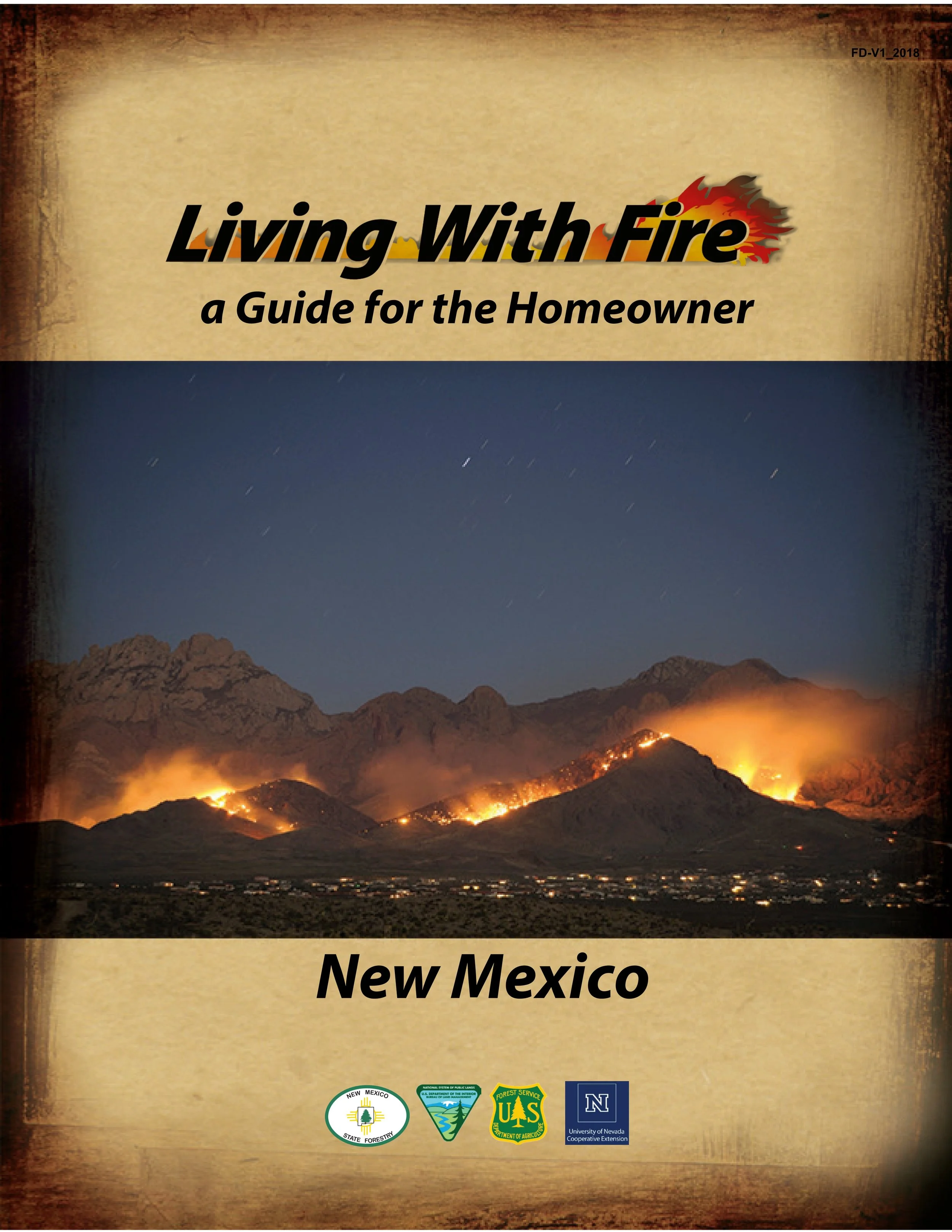
Living with Fire (LWF), a Guide for New Mexico Homeowners, provides recommendations and resources to homeowners, educators, community groups, and firefighting professionals to prepare for wildfire and reduce wildfire threats to homes and communities. LWF is a collaborative effort among federal, state, local firefighting agencies, and resource management agencies in New Mexico and across the nation. The LWF program is managed by the University of Nevada Reno, Extension, an EEO/AA institution.

In this Living With Fire Guide, you will find proven steps that communities can take to help protect family and property during wildfire. Responsibility and preparation is where it starts. Click on the image to learn more about community protection, access to your residence, defensible space, the built environment, and evacuation.


Learn more about Ready, Set, Go!

Ready, Set, Go!

Resources for evacuation readiness and safety

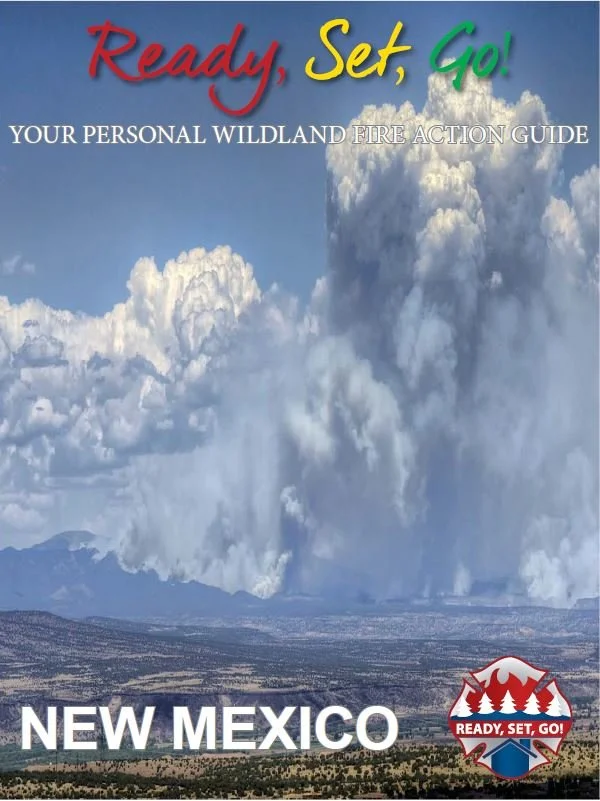
New Mexico’s Ready, Set, Go! Guide is designed to assist with planning and preparation for a wildfire emergency. The program helps residents be Ready with preparedness understanding, be Set with situational awareness when fire threatens, and to Go, acting early when a wildfire starts.

This is a great general resource to help you, your friends, family, and neighbors start to make progress toward wildfire preparedness. When doing work around your house or planning for wildfire, talk to those in your community about what you are doing and why.

To get started on the Ready, Set, Go! Guidebook, click here.

Record keeping for fire safety

Keeping important documents with you when evacuating, or storing them digitally in cloud based storage can help support you in the wildfire recovery process.

One often-overlooked aspect of fire preparedness is safekeeping important records, paperwork, photos, and other documents. Visit FACNM’s blog on preparing for spring ignitions to learn more about 10 key items that you should be sure to keep safe, if applicable, and how to store them ahead of time.

Resolve to take these steps for wildfire readiness

The beginning of a new year, when the risk of wildfire is relatively low, is a good time to start thinking about what you can do now to be ready for fire season later.
Our recommendations for your New Year’s resolutions:

  • Develop an emergency plan: choose a safe place to meet, learn evacuation routes, and establish an out-of-town contact. 

  • Take a current photo of you and your pet(s) together in case you get separated during a disaster. 

  • Get to know your neighbors and invite them to be a part of your emergency plan. 

  • Snap photos of important documents and save them in a secure place or online. 

  • Set up group text lists so you can communicate with friends and family during emergencies. 

  • Take a class in CPR and first aid. 

  • Keep and update emergency supplies, including cash. 

  • Have back-up power sources available to charge devices in case of a power outage. 

  • Check your insurance for coverage on disasters like wildfire and floods. Snap pictures of your property for insurance purposes. 

  • Sign up for emergency alerts and warnings. Download the FEMA app or check with your city or county government to see if they have an alert and notification system in place.  


Learn more about Home Improvements for Fire Readiness!

Home Improvements

Hardening for homeowners and renters

Even small actions can have a big impact on fire outcomes for your home, family and community. Whether you have 10 minutes or 10 hours to dedicate to wildfire preparedness, use that time increase your safety, strengthen community resilience and improve fire outcomes. Not sure where to start? Review the list of quick fire preparedness project ideas from the national Fire Adapted Communities learning network.

Home Hardening

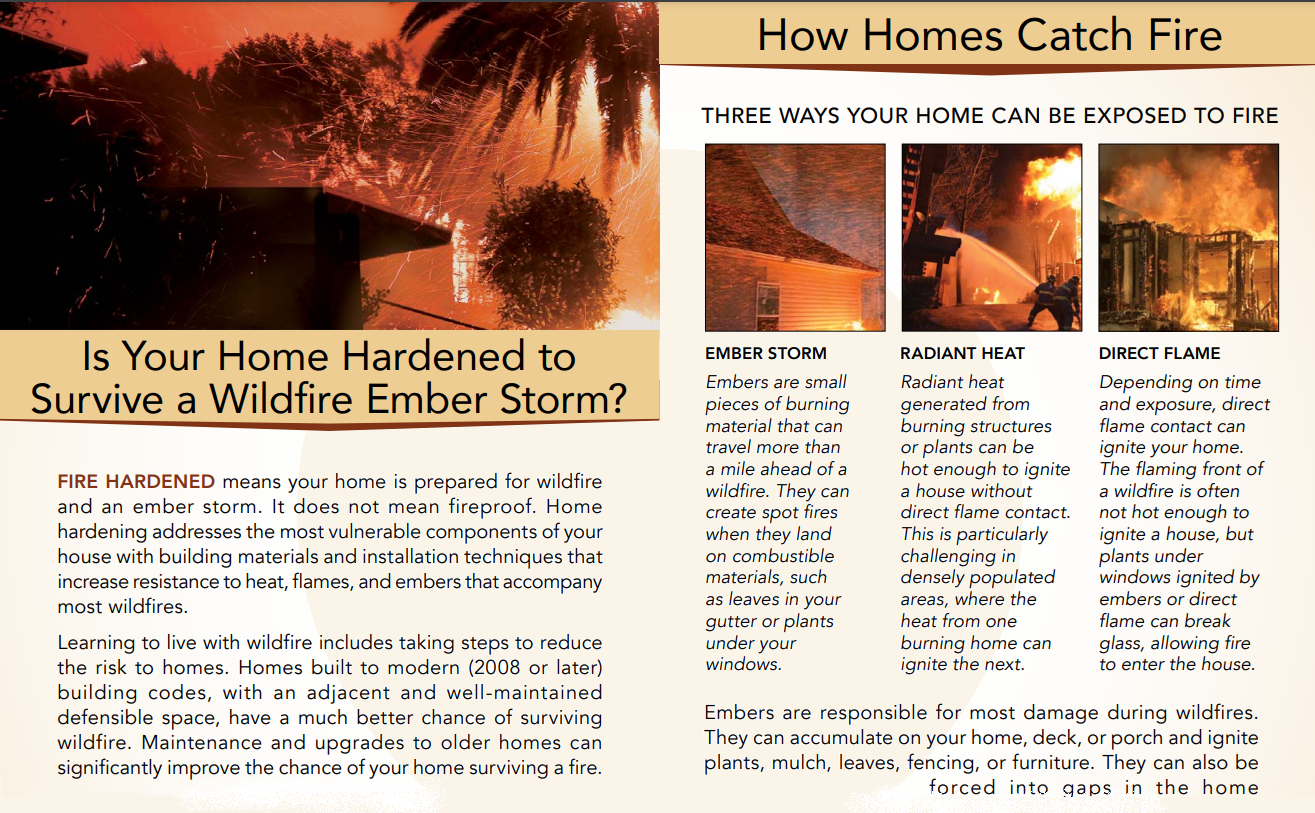
Fire hardened does not mean fireproof; it means your home is prepared for wildfire and ember storms. Home hardening addresses the most vulnerable components of your house with building materials and installation techniques that increase resistance to heat, flames, and embers that accompany most wildfires.

Priorities text courtesy of Santa Clara County FireSafe Council

Yard Preparation and Considerations

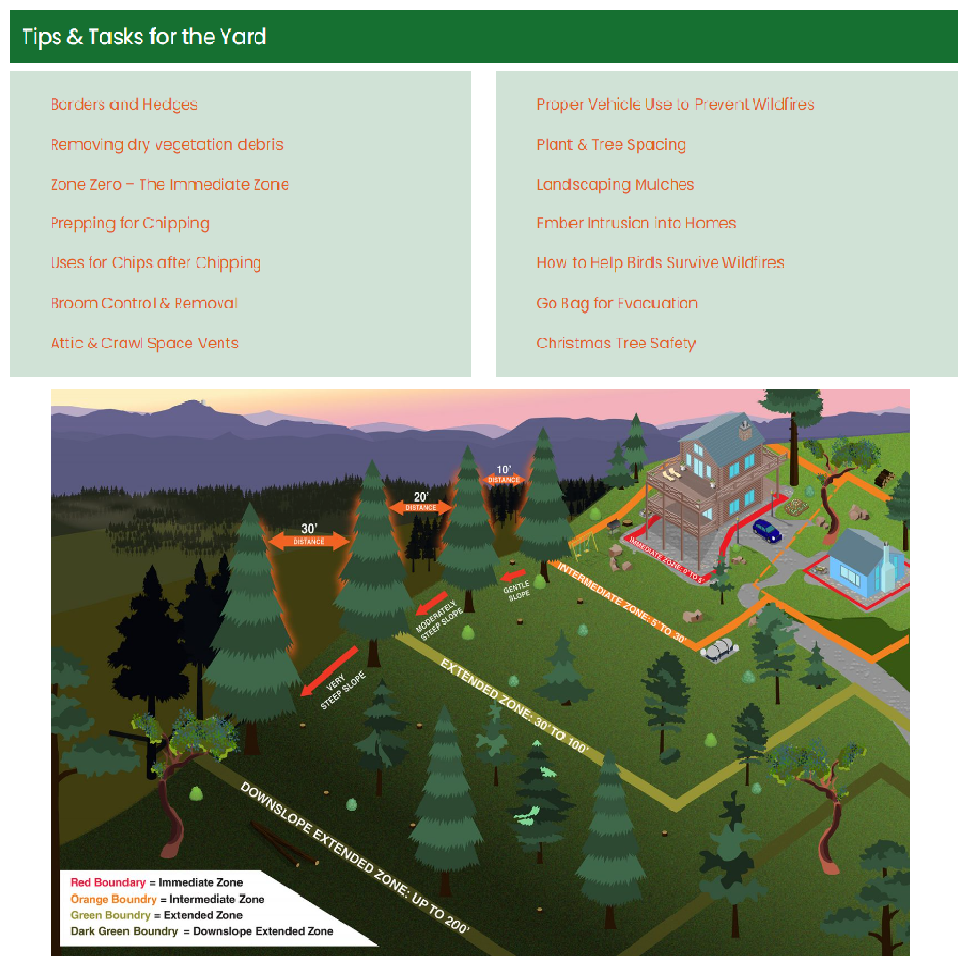
An extension of defensible space, the tips and tasks are presented below can be done to prepare your yard and property for wildfire season now and throughout the year.

Property areas and considerations include: borders and hedges, dry vegetative debris, slash chipping, pests and disease, attics and crawl space vents, vegetation spacing, mulch, considerations for birds, holiday tree safety, and more.

Image courtesy of the ‘Tips and Tricks for the Yard’ webpage from SCC FireSafe Council. Visit the website for additional resources related to each yard area.

Inside and Outside the Home

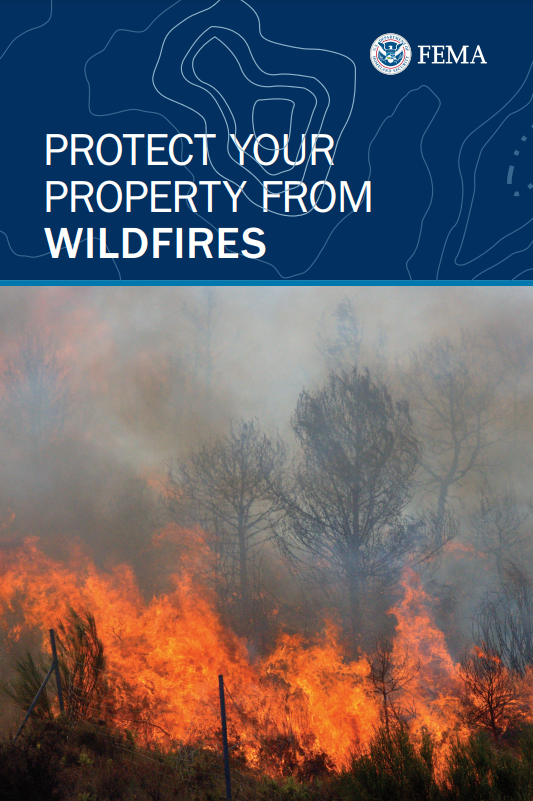
Property protection booklet cover image courtesy of FEMA.

“While you can’t prevent all wildfires from happening, there are some ways to secure your property to minimize damage and keep your home and your future safe.”

Click the image or download the PDF from FEMA to learn simple tricks for how to fortify your space this winter, inside and outside of the home.


Additional resources

Throughout the cold season, set aside some time to click through and visit these resources. An excerpt of topics includes:

VISIT THE CSU FIRE PREPAREDNESS RESOURCES PAGE
VISIT EMNRD'S LIVING WITH WILDFIRE GUIDE

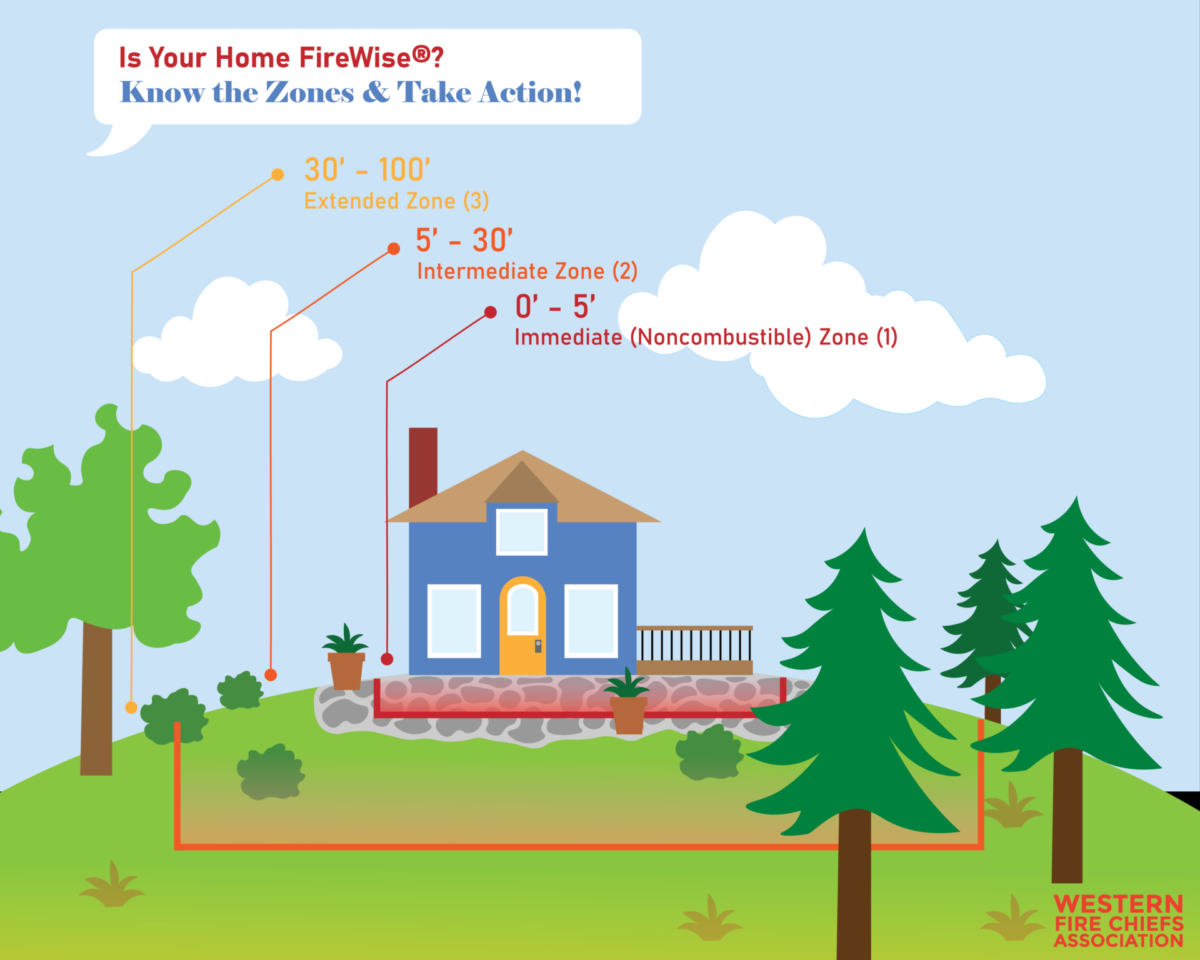
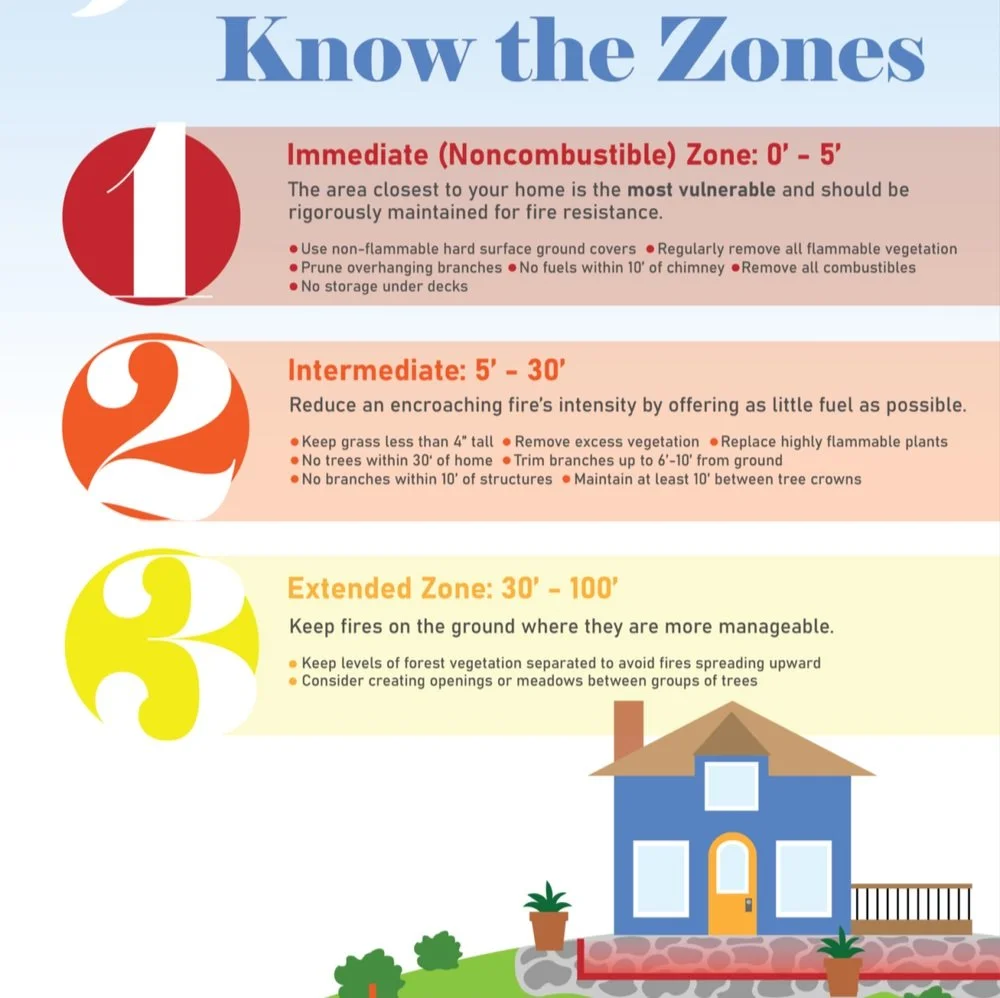
Defensible Space

Winter is often the best time to take steps to defend against fire, such as thinning out dense patches of trees, removing flammable brush and weeds, and pruning the limbs of mature trees to reduce contiguous fuels. Thinning and pruning during the cold winter months can also help reduce pest and disease infection in your trees and shrubs.

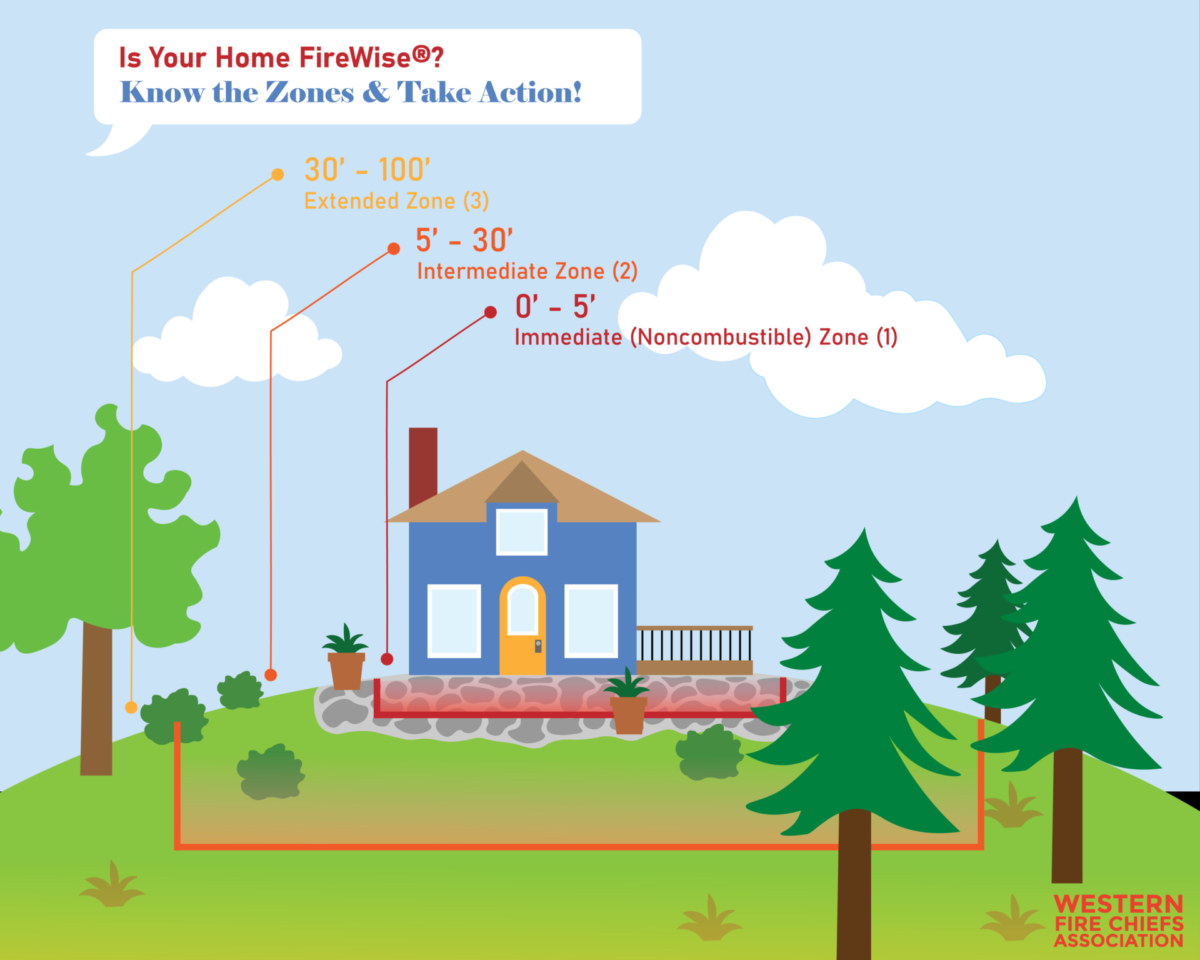
Maintenance tasks such as clearing flammable debris from gutters and around the home, making sure there are no flammable materials like firewood or patio furniture near your structures, and keeping grass and weeds mowed to less than 4 inches are all things you can do in these winter months and as part of spring cleaning to keep your home protected.

Like other parts of your home, defensible space requires upkeep and conscious decision-making about your space, such as the choice to plant native grasses.

Checklist adapted from NMSU and Firewise® on defensible space actions that can be taken annually

New Mexico State University ACES college, Firewise®, and Western Fire Chiefs Association (WFCA) are just a few of the entities which offer information and checklists to guide your creation of defensible zones and upkeep of defensible space.

“Defensible space is the buffer you create between a building… and the grass, trees, shrubs, or any wildland area that surrounds it. This space is needed to slow or stop the spread of wildfire and it helps protect your home from catching fire—either from embers, direct flame contact or radiant heat. Proper defensible space also provides firefighters a safe area to work in, to defend your home.”

- (CAL FIRE, Ready for Wildfire)


Learn more about Preparedness Event Planning!

Planning a Preparedness Event

How to bring your community together to learn and share

Plan your Project

The idea behind Wildfire Community Preparedness is to bring people together to take action to reduce wildfire hazards in their neighborhood or area. 2023’s Preparedness Day toolkit provided a list of project ideas, safety tips, and more to help guide your community event.

2023 WILDFIRE PREPAREDNESS TOOLKIT

Ideas for Action

Click here to download the action guide!

The National Community Wildfire Preparedness “menu” describes different project ideas that FAC members have organized in tandem with the National Fire Protection Association’s National Community Wildfire Preparedness Day. In addition to project overviews, the menu provides information about costs, equipment, planning needs, etc.

NATIONAL COMMUNITY WILDFIRE PREPAREDNESS MENU

When starting or revamping a chipping program, there are several things to consider, including  assessing need, funding, staffing, outreach and marketing, chipper selection, access and functional needs, chip dispersal and use, and program improvement year over year. FAC Net offers a toolkit for those wondering where to start.

GUIDE TO STARTING A CHIPPING PROGRAM IN YOUR COMMUNITY

Remember that there are many people across the country who are working toward the same goal as you - to bring their communities together for wildfire preparedness. Back in 2018, one FAC Net member wrote about their experience and applicable lessons learned with Seeking and Finding Community Capacity for Wildfire Resilience.


Learn more about Other Resources!

Other Resources

Educational recordings

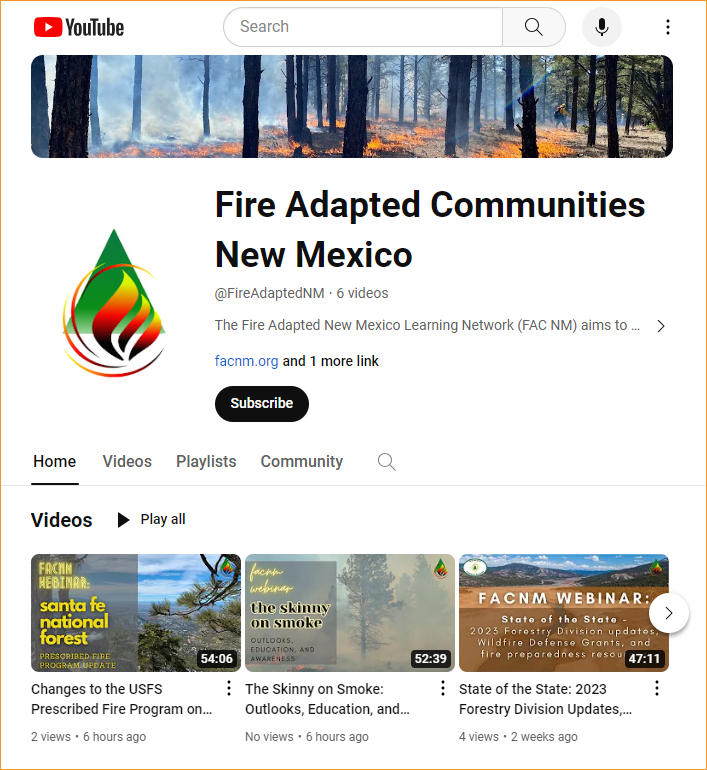
FACNM recently launched a YouTube webpage which will house recordings of past webinars and other important informational videos related to the New Mexico Fire Adapted Communities Learning Network. Subscribe and share to keep apprised of new recordings when they are released!

VISIT FIRE ADAPTED NEW MEXICO ON YOUTUBE

Readiness Apps

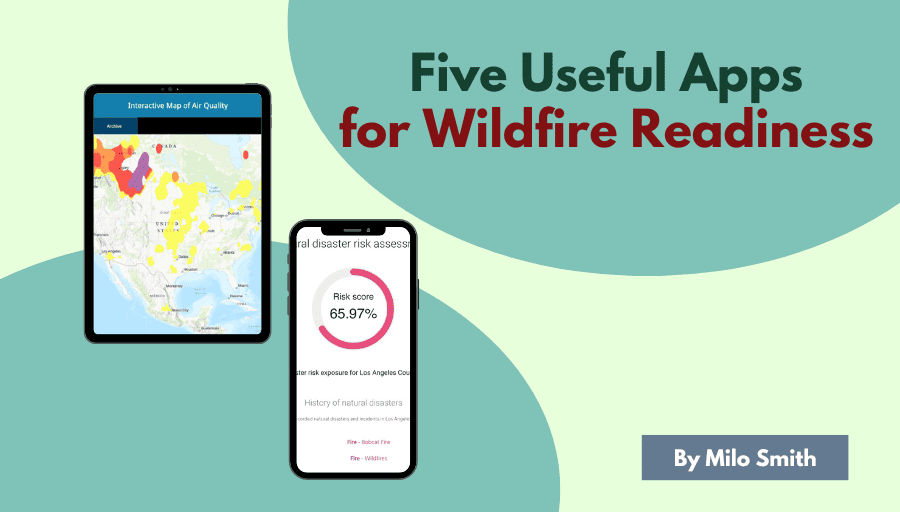
The Fire Networks blog post “Five Useful Apps for Wildfire Readiness” highlights apps and websites that give access to air quality information, real-time wildfire alerts, a wildfire tracker, and a natural hazard risk assessment tool.

Wildfire Wednesdays #125: Prescribed Burn Associations

Happy December, FACNM Community!

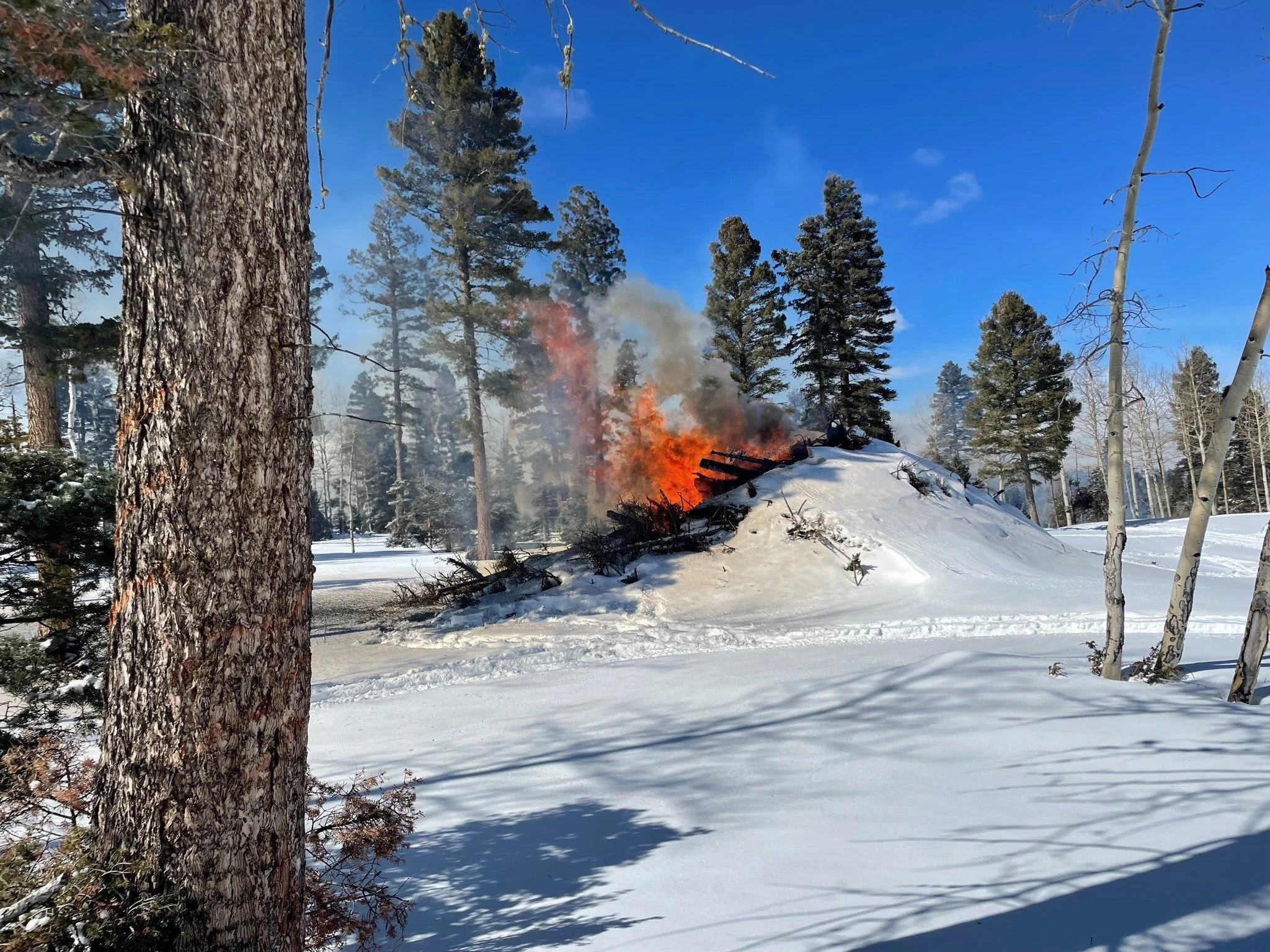
With winter upon us, the season for pile burning has begun. Prescribed burning is an incredibly important tool used to promote healthier forests and reduce the risks of wildfire, and it features prominently in many landscape-scale projects. Today we will cover Prescribed Burn Associations, which are integral to putting this tool into the hands of landowners and communities. We’ll delve into this in more detail in the following sections:

  • What is a Prescribed Burn Association (PBA)?

  • NM Prescribed Fire Council

  • NM State Forestry’s Prescribed Fire Training Course

  • Upcoming webinars & prescribed fire in the news

Best,

Dayl


What is a Prescribed Burn Association?

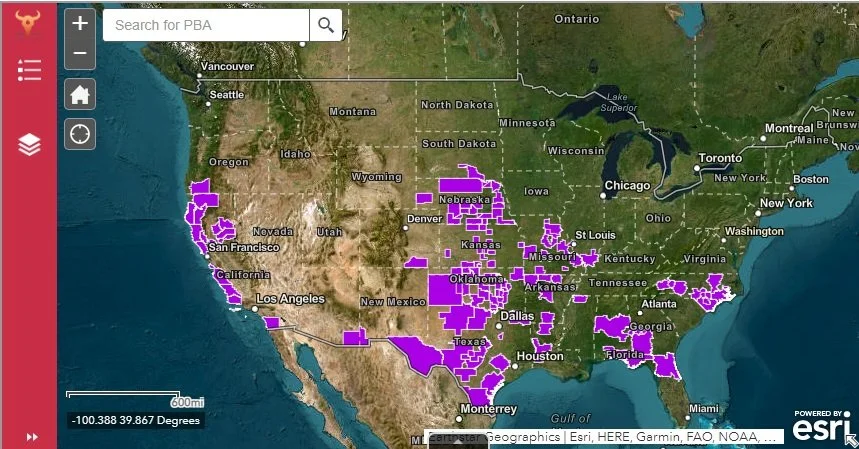
This Prescribed Burn Association Interactive Map from the Great Plains Fire Science Exchange shows active PBAs across the U.S.

A Prescribed Burn Association (PBA) is a group of landowners and other interested people from a specific geographic area that form a partnership to conduct prescribed burns. The first prescribed burn associations, also referred to as prescribed burn cooperatives, were formed in Nebraska around 1995, Texas in 1997, and shortly thereafter in Oklahoma in 2001 to overcome the constraints limiting the use of prescribed fire on rangelands.

These associations are community-built efforts in which members combine their knowledge, equipment, and other resources to provide learning opportunities and reduce the barriers to implementing prescribed burns as private landowners. Common barriers include the liability associated with fire use, lack of training, lack of equipment, and lack of resources. It can be very difficult for private landowners to gain the hands-on training needed to safely and effectively use prescribed fire, and PBAs can provide that training, while also building a network of engaged landowners who can connect on an array of land management concerns.

In the broader context of land management, PBAs can also help fill in the gaps that result from agencies being overburdened with millions of acres to burn. Because PBAs can operate with much less overhead and formality than that of an agency-implemented burn, they are more agile and flexible in the ways they can implement prescribed burns in their communities.

Another benefit of PBAs is that they can improve attitudes toward fire and increase the social acceptability of using prescribed fire as a management tool. One example of how quickly attitudes can change is story of the Sandhills PBA in North Carolina. In their initial community meeting rolling out the PBA, attendees were surveyed before and after the meeting. Before the meeting, 34% of the attendees planned to join the PBA and 16% said they would not join. After the meeting, 56% of attendees had decided to join and 0% remained opposed! Read more about this success story here.

For more information about prescribed burn associations, this FAC Learning network webinar recording discusses PBAs and is part of a webinar series about different wildfire resilience programs around the country.


NM Prescribed Fire Council

Here in New Mexico, we have what is called a Prescribed Fire Council (PFC). These councils are generally statewide organizations, and they often work in tandem and share many common goals with the more localized prescribed burn associations. PFCs allow private landowners, fire practitioners, agencies, non-governmental organizations, policymakers, regulators, and others to exchange information related to prescribed fire and promote public understanding of the importance and benefits of prescribed fire use.
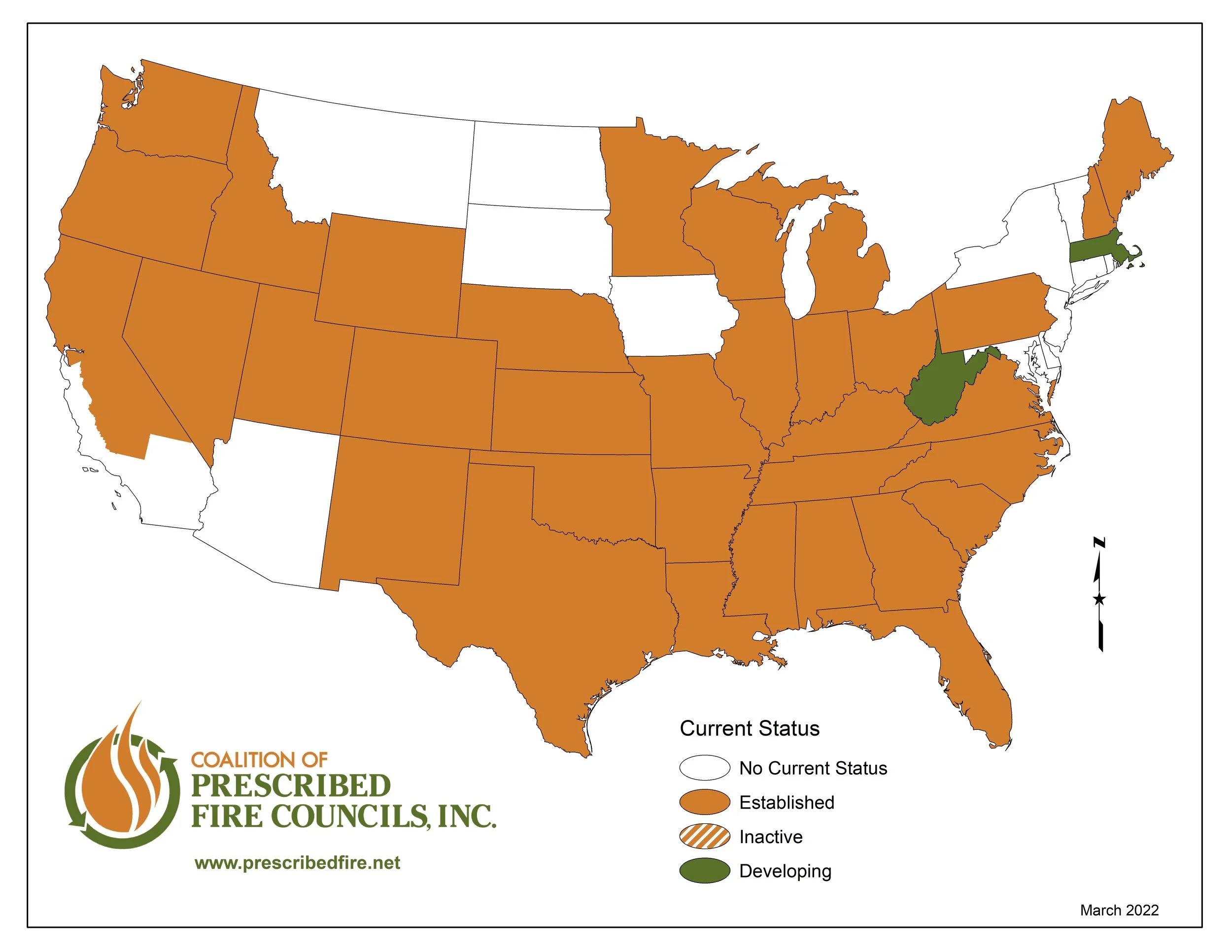
A map showing which states have Prescribed Fire Councils, from the Coalition of Prescribed Fire Councils, Inc.

PFCs date back to 1975, when the first council in the US was created in Florida in response to rapid development in Miami, followed by the North Florida Prescribed Fire Council in 1989, which more explicitly focused on prescribed fire. Neighboring states saw Florida’s program and began adopting the council model of including federal, state, and private, interests. Eventually, prescribed fire councils began spreading across the country, and today most states have established councils.

For those who want to get involved in New Mexico, membership in the New Mexico Prescribed Fire Council is open to anyone who has a passion for utilizing beneficial fire as a land management tool. Visit the website to become a member or to learn more about the resources provided by the council.

For more information about prescribed fire councils, this FAC Learning Network webinar recording gives an overview.


NM State Forestry’s Prescribed Fire Training Course

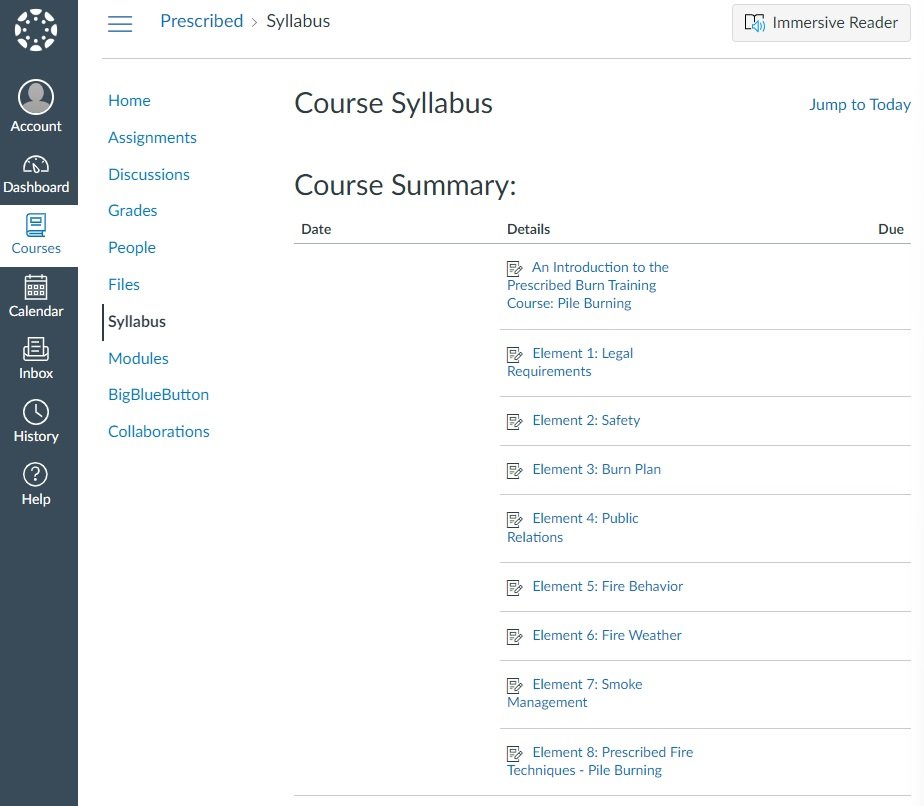
NM State Forestry has a free, publicly available prescribed burning curriculum available which is accessed through their website at this link. Follow their link to the Canvas portal, where you will create a free account using the provided code from the State Forestry webpage. You can choose to sign up for pile burning or broadcast burning courses and progress through the interactive modules, which cover topics such as safety, public relations, fire behavior, techniques, etc. The dashboard for the learning portal looks like the picture below.


Upcoming Webinars & Prescribed Fire in the News


Webinars

Webinar: Supporting Prescribed Fire in New Mexico

Thursday, December 7th

Join FACNM as we discuss New Mexico's new certified burn program and ways to responsibly and safely increase implementation of prescribed fire across jurisdictions and land boundaries in the state! This presentation is open to practitioners, leaders, and members of the public.

register now via zoom
watch on facebook live

Webinar: Developing Community Wildfire Protection Plans in Your Community

14 December, 2023 / 10 January, 2024 at 12:00pm

Learn what a Community Wildfire Protection Plan (CWPP) is and why your community may need one, what the process involves and what the components are, what resources you need to complete a CWPP, how to use CWPPs to support funding for implementation and more! Join the webinar to hear about how CWPPs are increasingly being used to direct various funding opportunities, including Community Wildfire Defense Grants (CWDG). This program will also be offered en español.


In the News

NM Fire Info - Pile Burning Projects Planned Across Carson National Forest
With the arrival of winter weather, Carson National Forest fire crews are preparing to continue prescribed fire activities, this time in the form of pile burning. Thinning and prescribed fire are two of the most important tools of the Wildfire Crisis Strategy to promote healthier forests and reduce the risks of wildfire. Planned pile burning in the Carson National Forest this winter will contribute to major landscape projects across the forest.  

NPR All Things Considered Radio Story - This year saw more prescribed fire than ever before

Listen to this recent story from a prescribed burn in El Rito, which paints the picture of a broadcast burn and much of what it entails. It also provides the unique historical and social context of prescribed fire in northern New Mexico—a teeter-totter where on one side we have communities understandably opposed to prescribed fire given the tragic events of last year, and on the other side the dire need for fuels reduction to avoid catastrophic wildfires in the future. The two are inextricably linked, and fire practitioners must find the balance.


HEPA Filter Loan Programs

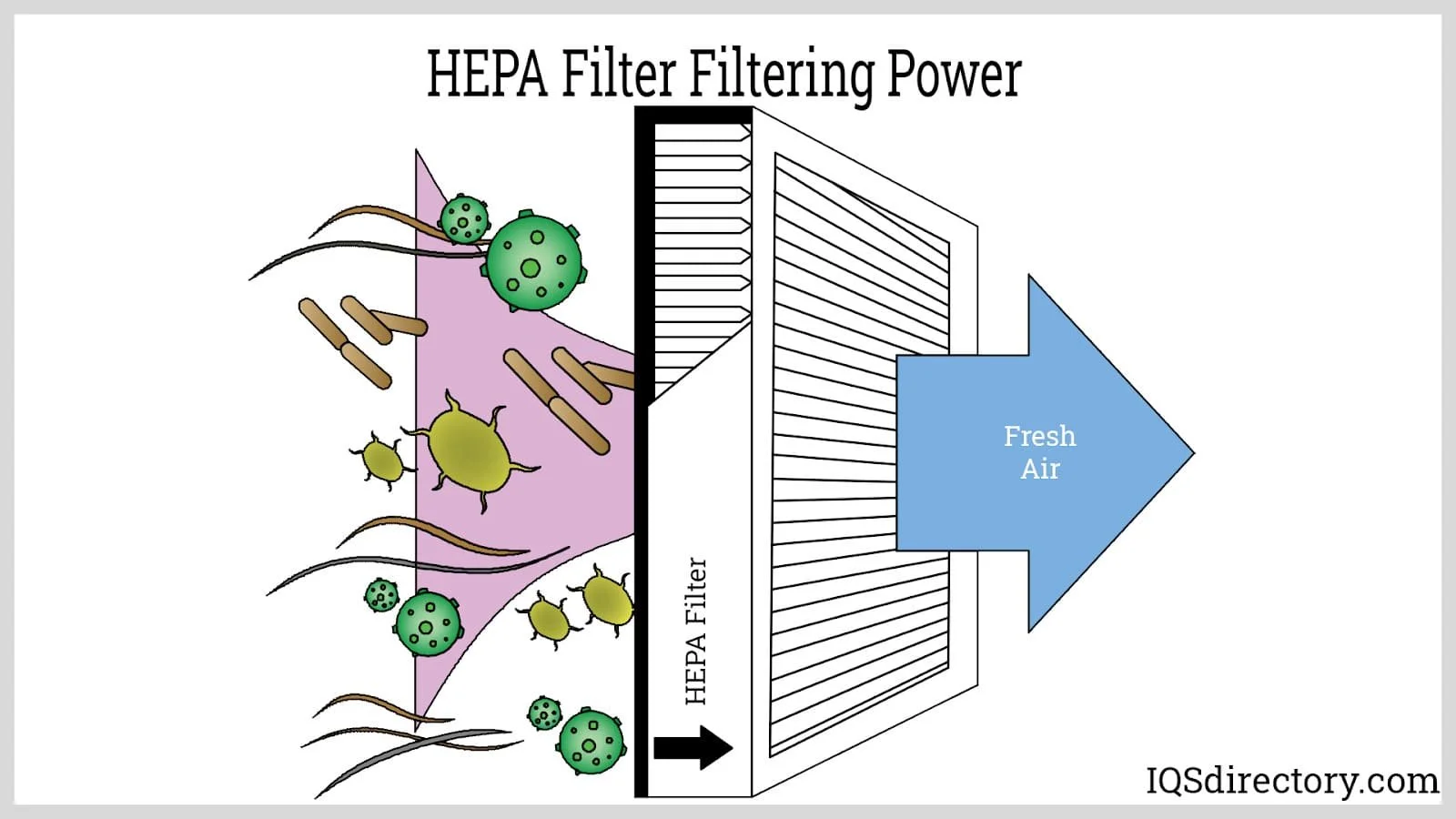
FACNM offers a HEPA filter loan program, with several participating areas across northern New Mexico. Portable air filters are available to be loaned out to smoke sensitive individuals during periods of smoke impacts in these areas. Smoke from wildfires and prescribed fires is a serious concern as it can cause or exacerbate health conditions for some people living in fire-adapted communities. The Carson National Forest - El Rito Ranger District is part of this program, and folks in that area can reserve filters directly with them by calling (575) 581-4554.

Wildfire Wednesdays #124: The Language of Wildfire

Happy Wednesday, Coalition community.

Language has always fascinated me, especially regional dialects - these variations of the same language that develop over time and differ, sometimes significantly, because they are built by the unique environment, activities, and influence on any one area. Native speakers of the same language may yet encounter a language barrier if they grew up learning different dialects!

The language of wildfire is not so different. Individuals who have been steeped in this terminology are well versed to understand and speak it easily, while ‘fire speak’ can sound pretty foreign and unintelligible to folks who haven’t encountered it before. Today’s Wildfire Wednesday seeks to simplify and explain this language and the way we use it so that we all have access to the same common lexicon, knowing that effective communications build support for sound wildfire policies.

Today’s Wildfire Wednesday features:

  • Basic fire terminology

  • Techniques for fire communication

  • Resources and opportunities

Be well and stay warm,

Rachel


Basic Terminology

Establishing a common vocabulary

Wildfire is our common denominator - regardless of age, background, place, or culture, we all are impacted by it in the Southwest (and increasingly across the country). We may be directly impacted as a fire burns close to our town or indirectly via smoke, the impacts on our loved ones living elsewhere, or the anxiety caused when we hear about it on the news. To understand one another when we talk about fire, from the names we give it (wildfire, managed fire, prescribed fire) to the way we interact with it (suppression, boxing it in, preparing for fire), we must build a shared vocabulary and boil down the technical jargon to find common ground through plain English.

Adapted from the Fire Adapted Communities Learning Network’s Language to Use with the General Public

Tools for learning

The first video below provides a basic introduction to terms you may hear in fire management, including ignition source, containment, wildfire versus interface fire, size explanation, control, fire escapes, holding, hot spots, evacuation notices, and more. This video was produced in Vancouver, B.C., so it is worth noting that in the U.S. fires are generally measured in acres; 1 hectare is equivalent to approximately 2.5 acres.

The second video provides a quick introduction to terminology you may hear during an explanation of active wildfire (such as a morning fire briefing), including how to describe behavior and parts of the fire. This includes terms like flanks, fingers, pockets, islands, creeping, running, spotting, fire whirl, crowning, and more. Some of these terms will be used during other types of fire such as controlled burning.

The National Wildfire Coordinating Group also provides an online Glossary of Wildland Fire Terminology and the (easier to use) searchable PDF which comprehensively list phrases and acronyms used in federal wildfire management. While this tool is helpful for understanding language used by federal fire practitioners and collaborators, it does not necessarily allow for the two-way construction of shared language with members of the public.

Moving beyond specific words and technical terms for wildland fire, let’s dive into how we talk about fire more broadly.


Techniques for Fire Communication

Building Support for Sound Wildfire Policies through Communication

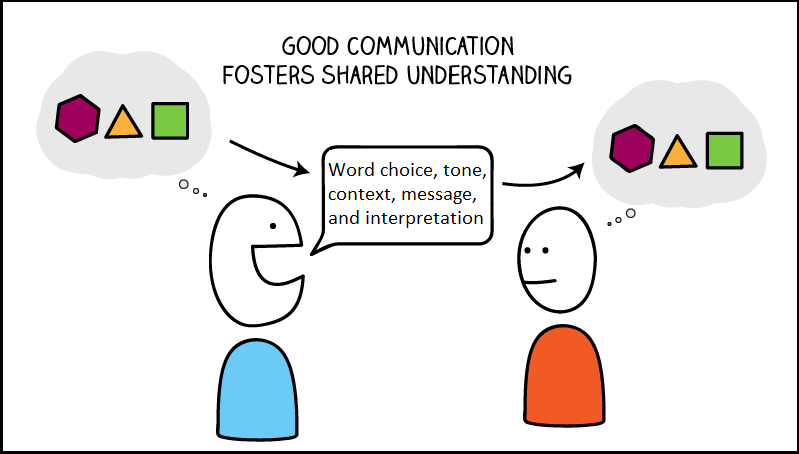
Think back to a day that you were put in a bad mood because of something someone said to you - it may not have been what they said, but how they said it or the specific words they used that nagged at you. The way that we share and receive information matters, especially about something as emotionally charged as wildfire (and associated land management and community preparedness practices). This section provides some suggestions from the Wildfire Resilience Roadmap about being mindful of our fire language.


Summary: Across the country, a majority of Americans believe that forest health as worsening, and concern about wildfires has been steadily growing even among those not directly impacted. They overwhelmingly support a framework to reduce severe fire risk through improved forest management and the use of intentional fire – support that cuts across geography, party, gender, age, race and ethnicity, and socioeconomic status. Research shows that people would rather invest now to reduce severe fire risk than later to address the aftermath of fires, including investments in year-round, trained teams to reduce the risk of severe wildfires. At the same time, innate and growing skepticism about government makes it challenging but important to document these policies’ proven track record and to highlight provisions requiring accountability and transparency in carrying out risk reduction strategies.


Communication Recommendations

These recommendations are taken from Appendix B of the Wildfire Resilience Roadmap and are based on 2022 general public opinion research. See the excerpted PDF here.

Image adapted from Patrick Buggy’s explanation of effective communication

  • Build on growing concern that fires are more severe and more frequent: messaging does not need to persuade voters that a problem exists – rather, it needs to funnel their existing concern into support for action.

  • Do not rely on concern about wildfire smoke to leverage action: while poor air quality tends to be a concern when and where problems with wildfire smoke are occurring, as the winds shift and fires die down, intensity of concern does as well. Instead, focus on fires themselves.

  • Do not count on using climate change as a rationale for action: climate change ranks in the middle-tier of a list of factors that the general public believes is contributing to increasingly frequent and severe wildfires. Deep ideological polarization continues to play a substantial role in perceptions of climate change.

  • Focus on impacts of climate change, most notably the contribution of droughts to the greater frequency and severity of fires: even without explicitly naming climate change as the cause, clearly describe its visible, tangible and current impacts on forests and pivoting to how to help them.

  • Acknowledge the important ecological role of fire: highlighting the benefits of normal, healthy fire cycles can be helpful.

  • Stress the need for improved forest management to prepare for fire: there is bipartisan agreement that the current approach to forest management isn’t working and that the overall condition of America’s forests has worsened over the last few years.

  • Do not ignore the need for more careful public behavior in and around fire-prone forests: many members of the public believe that a large share of wildland fires is started by humans, whether through a discarded cigarette or a campfire left unattended. Have open communication about fire exclusion versus fire suppression.

Respondents of the research survey voted on who they felt should bear the burden of responsibility for reducing the risk of severe wildfire.

  • Focus on the role of partnerships in acting to reduce fire risk: every level of government, timber companies, residents of fire-prone areas, conservation organizations, and insurance companies bear responsibility for reducing the risk of severe wildfire.

  • Use the term “controlled burn”: while it may be considered less scientifically accurate, the general public prefers and better understands the term “controlled burn” in comparison to “prescribed fire.”

  • Focus on the principle of preparation: we intuitively understand and value saving money and lives by stopping unnecessary fires from happening and ensuring that ones that do occur are manageable and limited in their negative impacts. Contrasting the high financial and emotional cost of in the aftermath of a wildfire with the relatively low cost of intervention before the fact is highly persuasive. “When it comes to reducing wildfire risk, an ounce of prevention is worth a pound of cure.”

  • Highlight the creation and support of a year-round workforce: while wildfires are seasonal, land management is not, necessarily. It makes sense to invest more evenly throughout the year, keeping workers stably-employed, fairly-paid, and connected to the land, than to hurriedly try to assemble a competent workforce as fires occur.

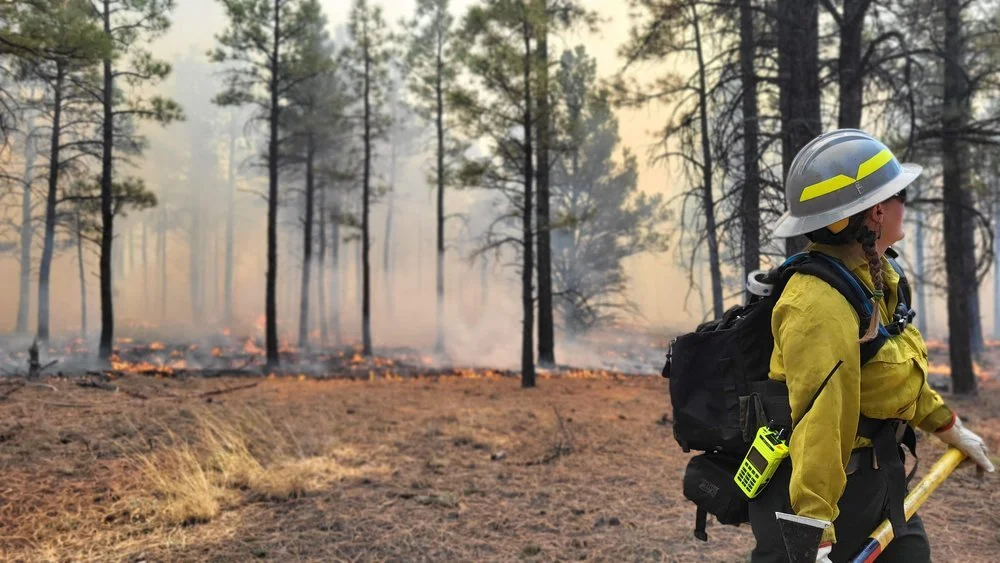
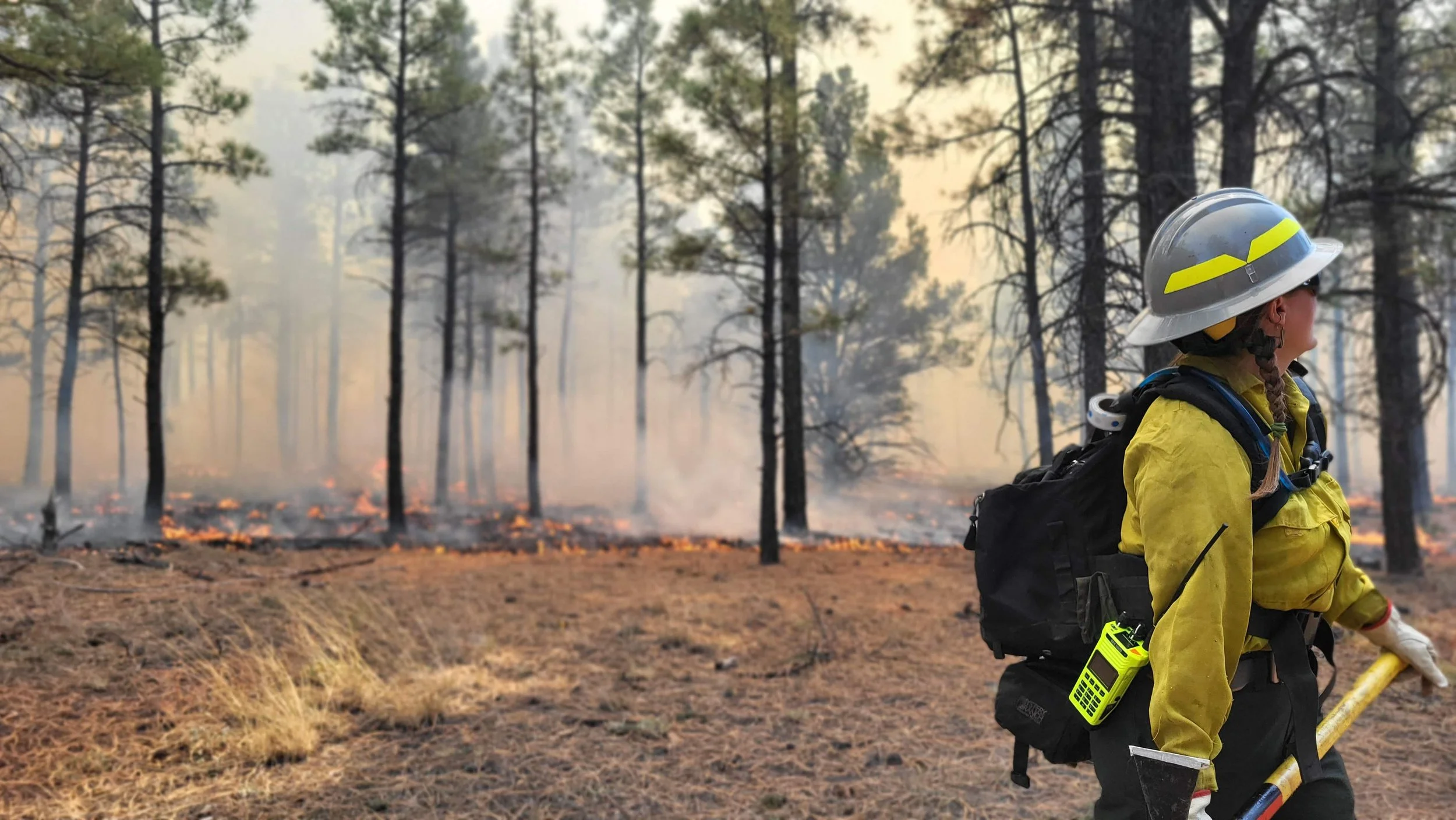
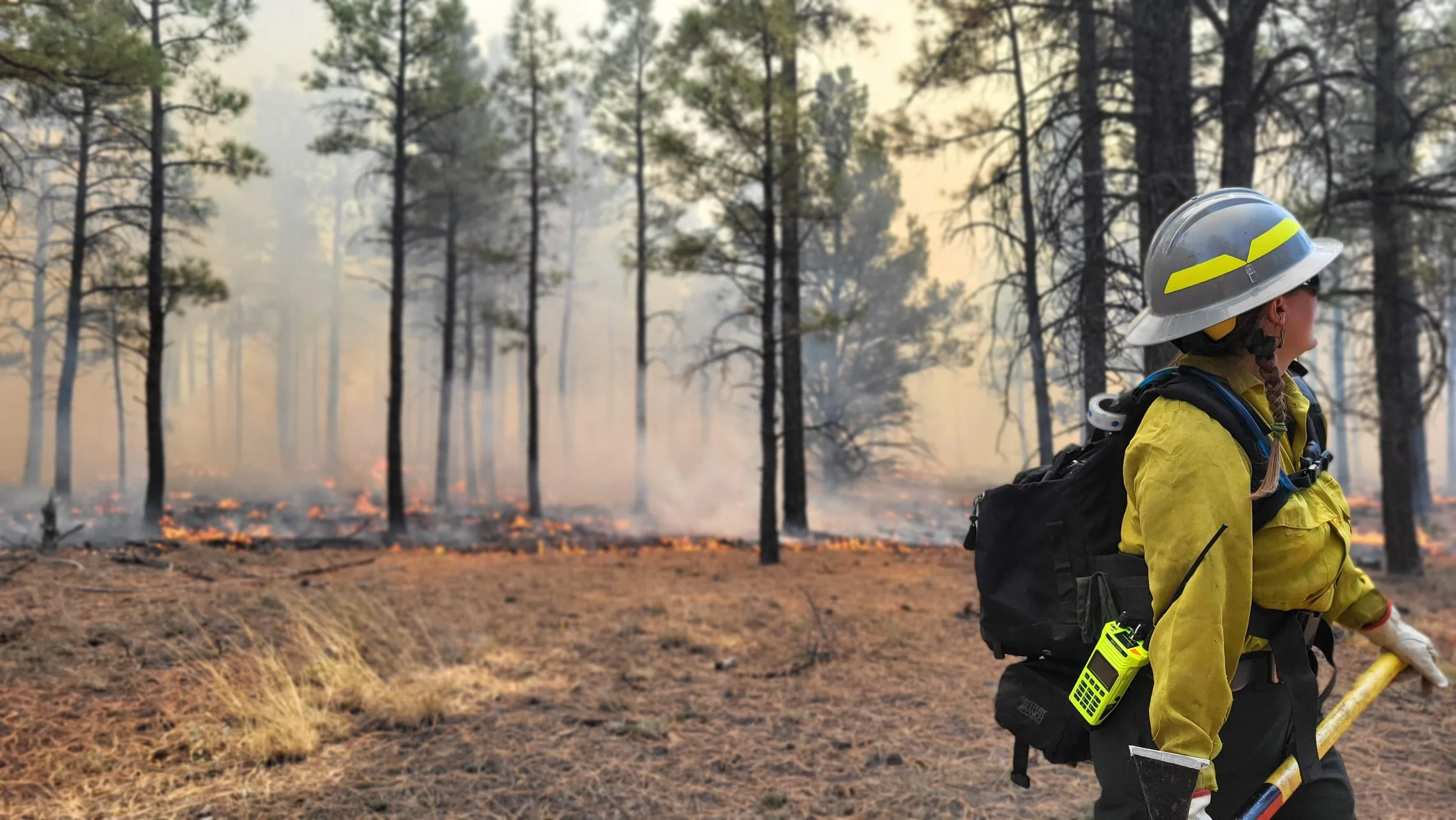
Woman in yellow nomex stands holding an ax and looking away from the camera, back toward some low-burning flames in a smoky pine forest.
  • Call out the need to protect and support first responders whose lives are at risk in addressing wildfires: build support for investments in wildfire risk reduction by reminding people that reducing the intensity and severity of wildfires makes a tough job less dangerous and more manageable.

  • Do not use language focused generally on equity in distributing funds, but instead explain the context: given careful wording, members of the public consider communities with high risk and few resources as a high priority for funding.

  • Do not focus on investing in protection of timber supplies or recreational areas: these are things that could be restored or recovered more easily if need be than water supply, habitat, or human communities.

  • Do not rely on the word “resilience” alone: resilience is seen as a quality displayed in recovery after a disaster has struck, rather than one that reflects an ability to avoid its worst harms. Preparation, safety and health are better since they leave open the possibility that a community could avoid the worst impacts of a disaster – rather than conceding that they will occur. Focus on concrete and desirable outcomes, such as “safe and healthy forests” or “fire-prepared communities.”

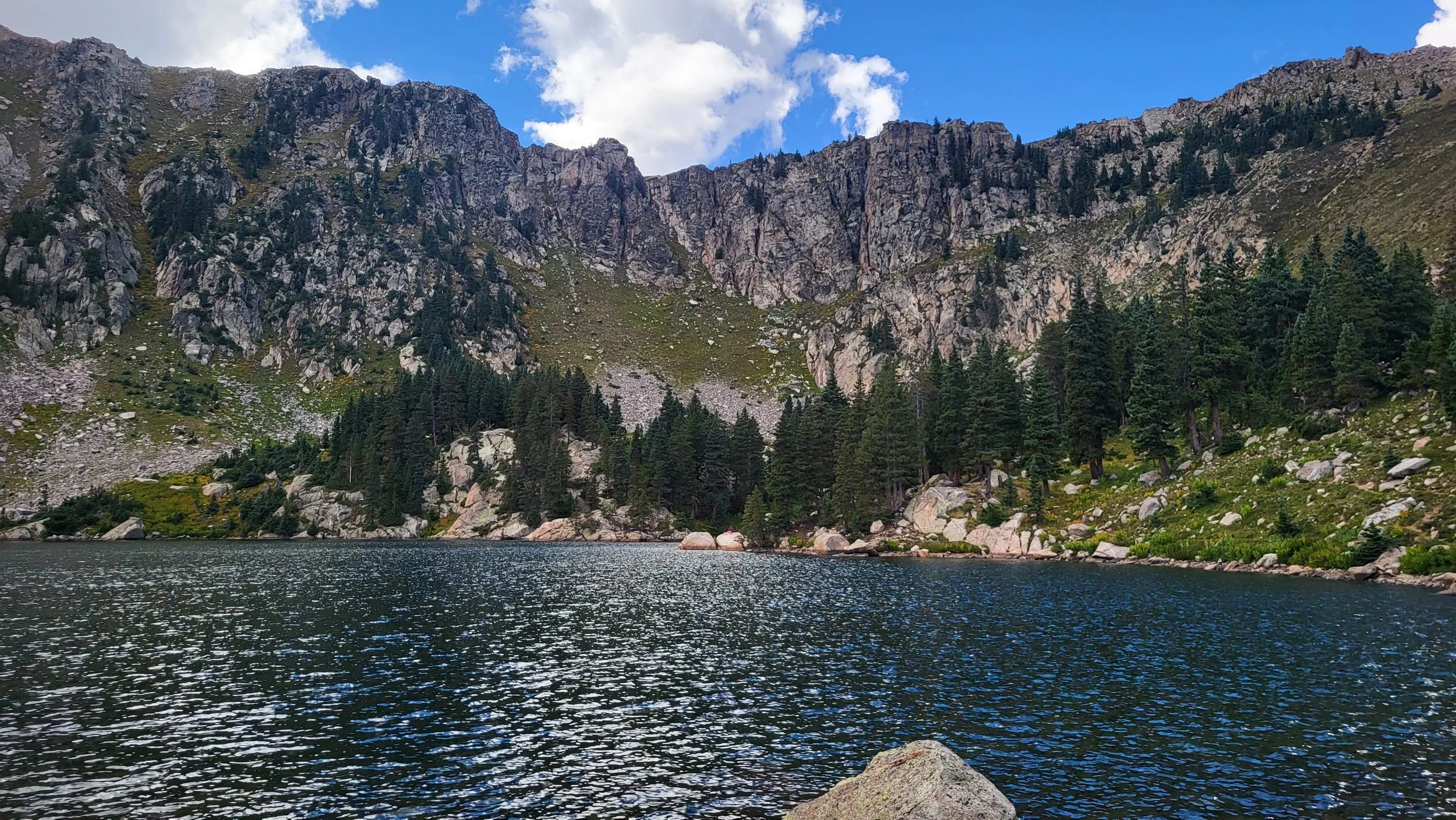
Rocky jutting grey mountain crags slope steeply down to a deep blue choppy lake ringed by green conifer trees

Lake Katherine, just south of Santa Fe Baldy, in the Pecos Wilderness east of Santa Fe.

  • Do not assume that people understand how fire threatens water supplies - rather, convey the reality and seriousness of the risks: once the process by which fires lead to contamination of survey water is briefly explained, people find it compelling.

  • Stress provisions for public disclosure, audits, and fiscal accountability in any public spending proposal: in general, we show high degrees of skepticism about “government” writ large. In any discussion of significant federal investment in wildfire risk reduction, that skepticism (and related fears of waste) emerges as the biggest obstacle to winning public support.

  • Use state and federal agencies with land management responsibility as messengers: people understand federal land managers as being guided by the mission of protecting the health of forests for current and future generations and wildlife, and largely trust information from these groups as being free of a profit motive or ideological agenda.

  • Give wildland firefighters, park rangers, wildlife biologists and Tribal leaders prominent roles as messengers: we trust messengers who we see as neutral experts on fire issues, such as park rangers, wildlife biologists, and tribal leaders. We also value those with firsthand experience, such as people who have lost their homes to wildfires.


Resources and Opportunities

Webinars

7 December, 2023 at 2:00pm: Supporting Prescribed Fire in New Mexico
Join FACNM as we discuss New Mexico's new certified burn program and ways to responsibly and safely increase implementation of prescribed fire across jurisdictions and land boundaries in the state! This presentation is open to practitioners, leaders, and members of the public. Read more about the new certification program here.

For those interested in getting involved now, the self-paced online training for the New Mexico Certified Burn Manager Program is available, with options for pile burn or broadcast burn certification!

REGISTER NOW VIA ZOOM
Watch on facebook live

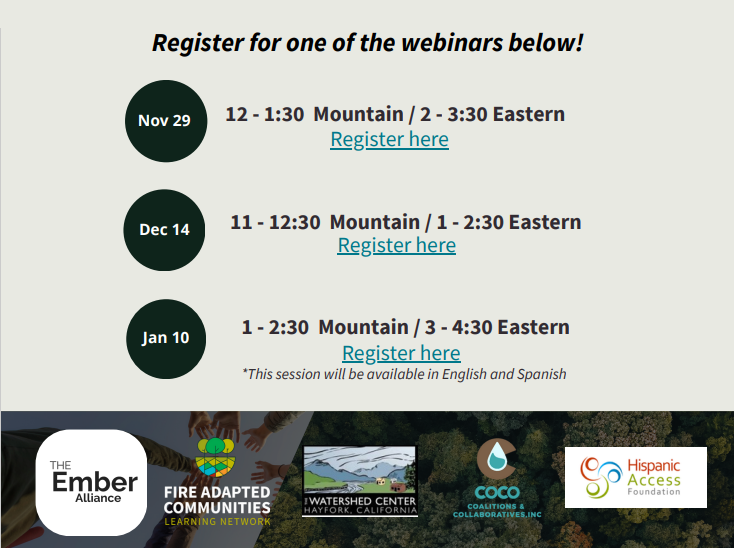
29 November / 14 December, 2023 / 10 January, 2024 at 12:00pm: Developing Community Wildfire Protection Plans in Your Community

Flyer excerpt for the CWPP webinar

Learn what a Community Wildfire Protection Plan (CWPP) is and why your community may need one, what the process involves and what the components are, what resources you need to complete a CWPP, how to use CWPPs to support funding for implementation and more! Join the webinar to hear about how CWPPs are increasingly being used to direct various funding opportunities, including Community Wildfire Defense Grants (CWDG). This program will also be offered en español.

Online Portals

White text over a dark picture of flames burning low through a smokey conifer forest.

Landing page for the new Fire Networks website.

One site to access fire resources, news and events, and contacts: the Fire Learning Network (FLN), Fire Adapted Communities Learning Network (FAC Net), Indigenous Peoples Burning Network (IPBN), and Prescribed Fire Training Exchanges (TREX and WTREX) have launched a new website! At firenetworks.org you’ll find information about each of the networks and the way they tackle our fire challenges with unique and complementary approaches to a common goal.

In the News

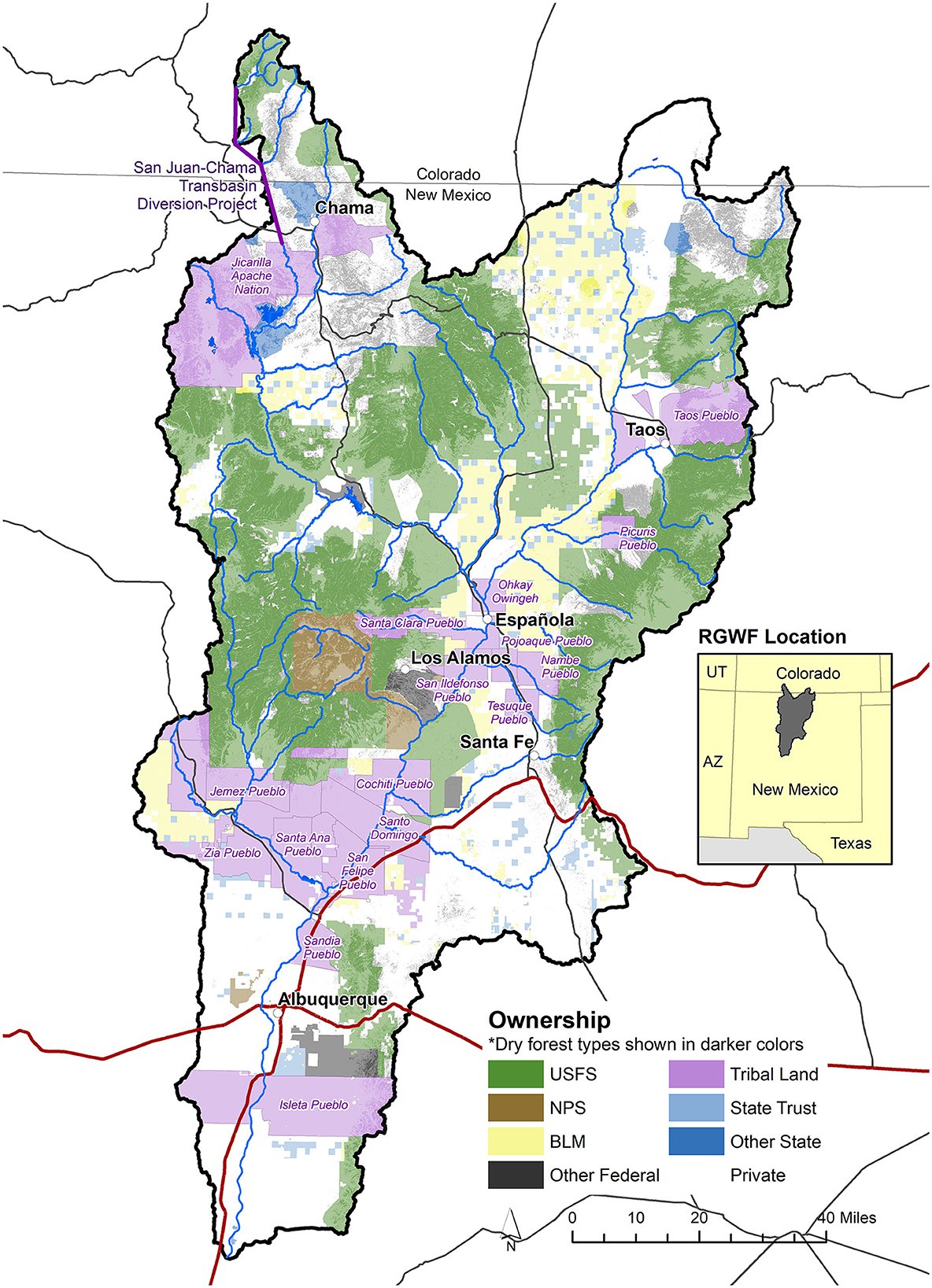
Map of the Rio Grande Water Fund spanning land ownership and jurisdictions

The Rio Grande Water Fund is highlighted as “one example of an emerging adaptation strategy that is working within—and beyond—existing legal and policy frameworks to accomplish more collaborative efforts across jurisdictional lines and administrative barriers” in the Frontiers in Climate article “Adaptive Governance Strategies to Address Wildfire and Watershed Resilience in New Mexico's Upper Rio Grande Watershed.

Wildfire Wednesdays #123: How Cross-Boundary Partnerships Bolster Fire Adapted Communities - A Success Story

 Hello FAC NM followers,

Starting the process of working within our communities to become fire adapted is often challenging, and it can be even more difficult to sustain. Making headway requires a force of will, a collective push for change, and ideal conditions coalescing! While the barriers to progress can feel daunting, you are far from alone in your work to build communal resilience. This week, we highlight the success of one community’s partnerships and the extensive wildfire mitigation work that these partnerships have enabled.

Today’s Wildfire Wednesday features:

  • The story of Horseshoe Springs Association’s (HSA) Jemez Mountains wildfire mitigation work

  • Takeaways from HSA’s success

  • Updates and opportunities

Best,
Dayl


Horseshoe Springs Association’s wildfire mitigation work in the Jemez Mountains

Fall scene in the Jemez Mountains captured using a drone camera. Photo by Mario Pratti

Working together for landscape resilience

Picture this: It’s a warm summer day in a lovely, forested neighborhood in the Jemez Mountains of northern New Mexico. Picturesque cabins dot the hillsides and nestle among the trees. The sun is streaming through a canopy of spruce, fir, and pine, the air smells astringent and fresh, and the sounds of equipment and voices are deadened by a hush created by the mature coniferous forest and its soft duff-covered floor. Residents are out in their yards raking pine needles, chipping slash, and pruning and thinning ladder fuels from the forest around their homes. Everyone is pitching in to do the work that can keep their community safe from wildfire. The community recently received wildfire risk mitigation funding from their local Soil and Water Conservation District, a crucial partnership which enables them to complete this work to improve defensible space in the neighborhood. Nearby, on adjacent Forest Service land, contractors are completing a thinning project on hundreds of acres that will further ensure the community’s resilience to fire. All this work lies within the footprint and is one component of a larger cross-jurisdictional project to increase the resilience of forests and watersheds…

If it sounds a bit too idyllic to be true, we invite you to learn about the Horseshoe Springs Association (HSA).

This scene (with some artistic license on the writer’s part) is the story of HSA, a neighborhood of 50 homes and cabins established in the La Cueva area of the Jemez Mountains in the 1950s and 60s. Their community showcases the success enabled by functional partnerships across agencies and organizations.
In the early days of the neighborhood, there were fire and safety rules in place that required cabin owners to rake pine needles within 30 feet of structures or fuel sources such as wood piles and propane tanks—rules which were later incorporated into the Association’s covenants. Community chipper days to process slash have been held by the Association nearly annually for the last 15 years. Moving beyond individual responsibility, the community has actively partnered with the Forest Service for decades. In the early 2000s, forest thinning to reduce tree densities was completed on HSA’s 64 acres of common land through the USDA Forest Land Enhancement Program (FLEP). The Forest Service began thinning 257 acres of National Forest adjacent to the neighborhood in summer of 2023. A recent partnership with the Cuba Soil and Water Conservation District has brought in grant funding to support hazardous fuel reduction by contractors on private land in the community.
Current status and future work

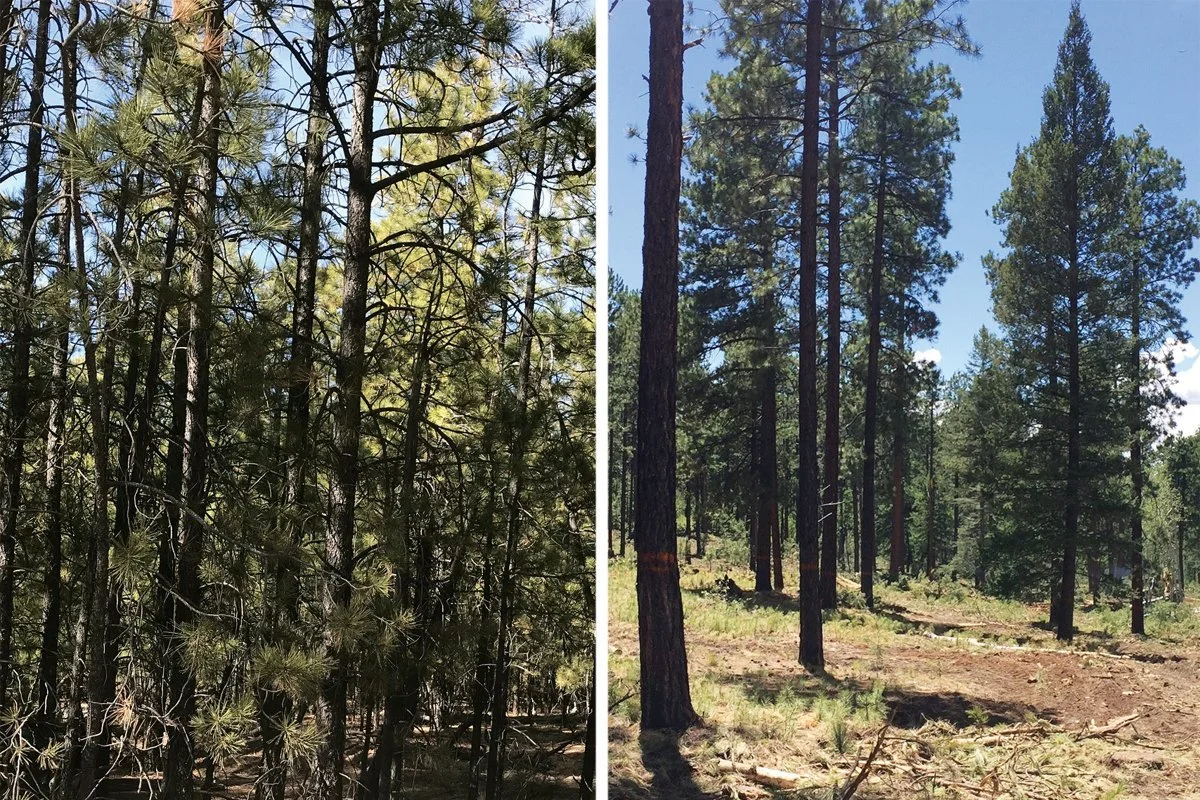
A ponderosa pine forest in the Jemez Mountains, before and after a thinning project. Sue Harrelson/USFS

As of fall 2023, 27 out of 50 cabin owners in HSA have signed up for thinning through the Cuba SWCD grant and about half of those have already had their property thinned.  Another 10-15 cabins were already at or below the target density level, leaving fewer than twenty percent of the cabins with higher-than-recommended tree density.  In addition, HSA has applied to have 20 acres of common land thinned under the grant program, focusing on the areas closest to possible ignition sources. This community-level work dovetails with the mission of the 2-3-2 Cohesive Strategy Partnership, a landscape-scale effort to promote resilient forests and watersheds in northern New Mexico and Southern Colorado. HSA lies within the project boundary of the 2-3-2, allowing for each project to leverage the funding and forest resilience work of the other by creating landscape-scale restoration areas. This overlap will further enhance the Association’s dedicated mitigation work.

Horseshoe Springs Association is well on its way to becoming fully realized as a Fire Adapted Community, but they couldn’t have done it alone. It is through cross-boundary partnerships and landscape-scale work that they continue to protect themselves from wildfires that regularly move through the Jemez Mountains. When thinking about our work in forest resilience, it is important to acknowledge that much of our regional land management wisdom is derived from the selective logging performed by Ancestral Pueblo people who coexisted with frequent fires in the Jemez. The work of HSA also takes root in the residents’ respect for fire and their understanding that “fire is a question of when, not if”, in the words of resident Brent Bonwell.


Learning from the Success of Others

Close calls as a call to action

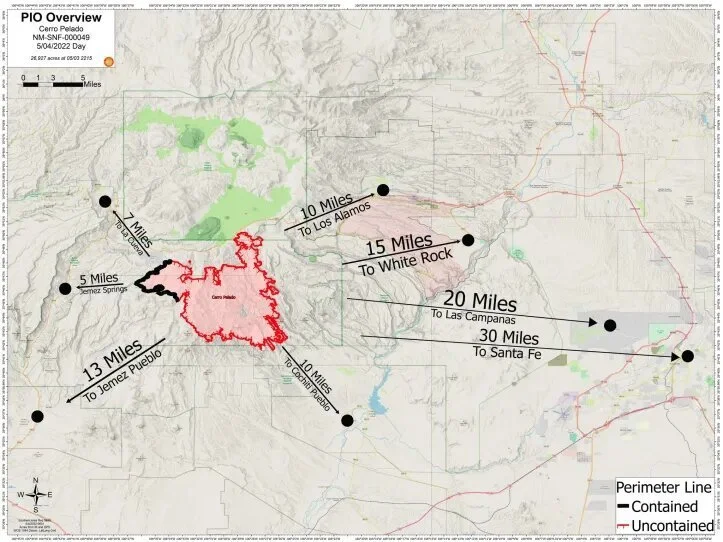
This map shows the proximity of the Cerro Pelado Fire to local communities on May 4, 2022. La Cueva, where HSA is located, was 7 miles from the fire. Image sourced from Los Alamos Reporter.

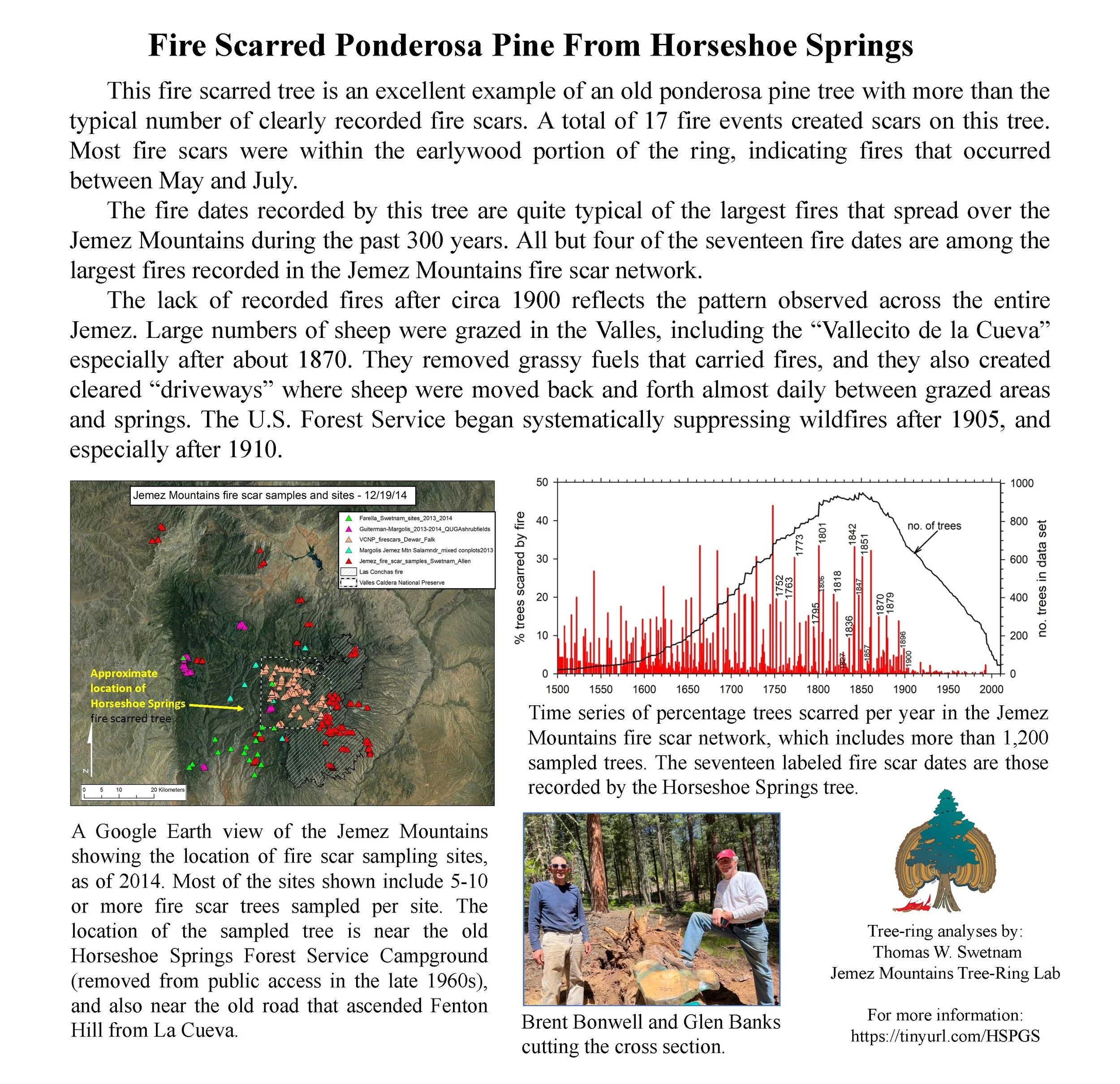
Wildfires have come close to the community - the 2022 Cerro Pelado fire came within seven miles of the neighborhood, and large fires in the past, such as Las Conchas in 2011 and Thompson Ridge in 2013, have loomed threateningly nearby. While fire has played an important ecological role in ponderosa pine forests for millennia and historical tree-ring fire scar evidence shows that the large size of these modern fires is not unusual, the high-severity tree-killing nature of them is (see this story map of fires in the Jemez). That catastrophic quality is precisely what threatens neighborhoods in the wildland urban interface (WUI), like Horseshoe Springs, and compels them to accelerate their community protection efforts.

Learn more about the fire history of the La Cueva area of the Jemez Mountains in this report by Dendrochrologist Dr. Tom Swetnam.
Listen to Tom speak about fire history in the area at 12pm on November 14 in a FACNM webinar on Fire, Forests, and People in the Jemez Mountains, NM.

Key takeaways from HSA’s work

Communication across boundaries is essential. Without a strong relationship with the Forest Service, Cuba SWCD, and others, much of the thinning work in and around Horseshoe Springs may never have been completed.

Opportunities to fund these projects are important—without the money, how can we do the work? Property owners within the Cuba Soil and Water Conservation District had the opportunity to enter into cost-share agreements and have up to 80% of the cost of their thinning work paid. Local grant programs like these are essential to empowering communities. FAC NM offers microgrants to provide seed funding for community protection efforts like this.

This work takes time. It has taken HSA decades, the dedication of individual landowners, and opportunistic partnerships to reach the point they are at now, with over 80% of properties in the neighborhood thinned to a recommended tree density.

Everyone has a role to play in fire adaptation and ecological restoration. It is through collective action, education, and overlapping projects that we will see large-scale fire adaptation.


Upcoming Events and Opportunities

Webinars

November 1st, 2023, 10:00 - 11:30am MDT: Smoke: State of the Science
Join for a live virtual session focused on the State of the Science about smoke. This facilitated panel discussion will be guided by your questions. Registration is required. Live session will be recorded and posted on the Rocky Mountain Research Station website here: SYCU - Webinars | US Forest Service Research and Development

REGISTER HERE

December 14th, 2023 9am - 10:30am ET: The Future is Smoky, one of four Fueling Collaboration sessions.
With increasing wildfire activity due to changes in climate, smoke will likely become more prevalent and continue to have an effect on society. Earlier this year, smoke from Canada wildfires lowered air quality in the eastern U.S. to its worst levels in recorded history. As the climate heats up and creates drier conditions, smoky skies will grow increasingly common. Health concerns and prescribed burning actions needed to restore functioning ecosystems will be impacted by already smoky conditions across the country. Panelists include research meteorologists, air quality experts, and fire practitioners. Together, they will explore how we can address and adapt to a smoky future.

REGISTER HERE