Wildfire Wednesdays #108: Legislative Updates

Happy Wednesday, Fireshed community,

This week is Southwest Wildfire Awareness Week and the theme for this year is “Preparing Together.” After a year that produced the most destructive wildland fires in New Mexico’s history, it’s important to look forward to the upcoming fire season. As families, neighborhoods, communities, and shared partners across the southwest, we resolve to remind ourselves to be conscious of fire, and to help spread that message of awareness. This year, New Mexico is preparing together.

This week’s Wildfire Wednesdays will focus on sharing some legislative updates. Collective action initiatives, like FACNM, have the ability to amplify issues and interests into the policy sphere and effect change from the top-down. While FACNM has not typically delved into the policy sphere, an important starting point for influencing this type of change is to be aware of existing legislation and initiatives that relate to fire and forestry work. With that in mind, this week’s Wildfire Wednesday will focus on sharing updates from our partners at New Mexico State Forestry Division about recently legislation.

Please stay tuned for a webinar this May for a FACNM webinar with New Mexico State Forestry Division where we will share updates on recent legislation.

This week’s Wildfire Wednesday includes a bit of information on the following:

  • Senate Bill 206 to create a Forestry Division Procurement Exemption

  • Senate Bill 9 to Create Legacy Permanent Funds 

  • House Bill 195, Forest Conservation Act Amendments 

Best,

Gabe

SB 206 - Forest Restoration Procurement Code Exemption

What does SB 206 do?
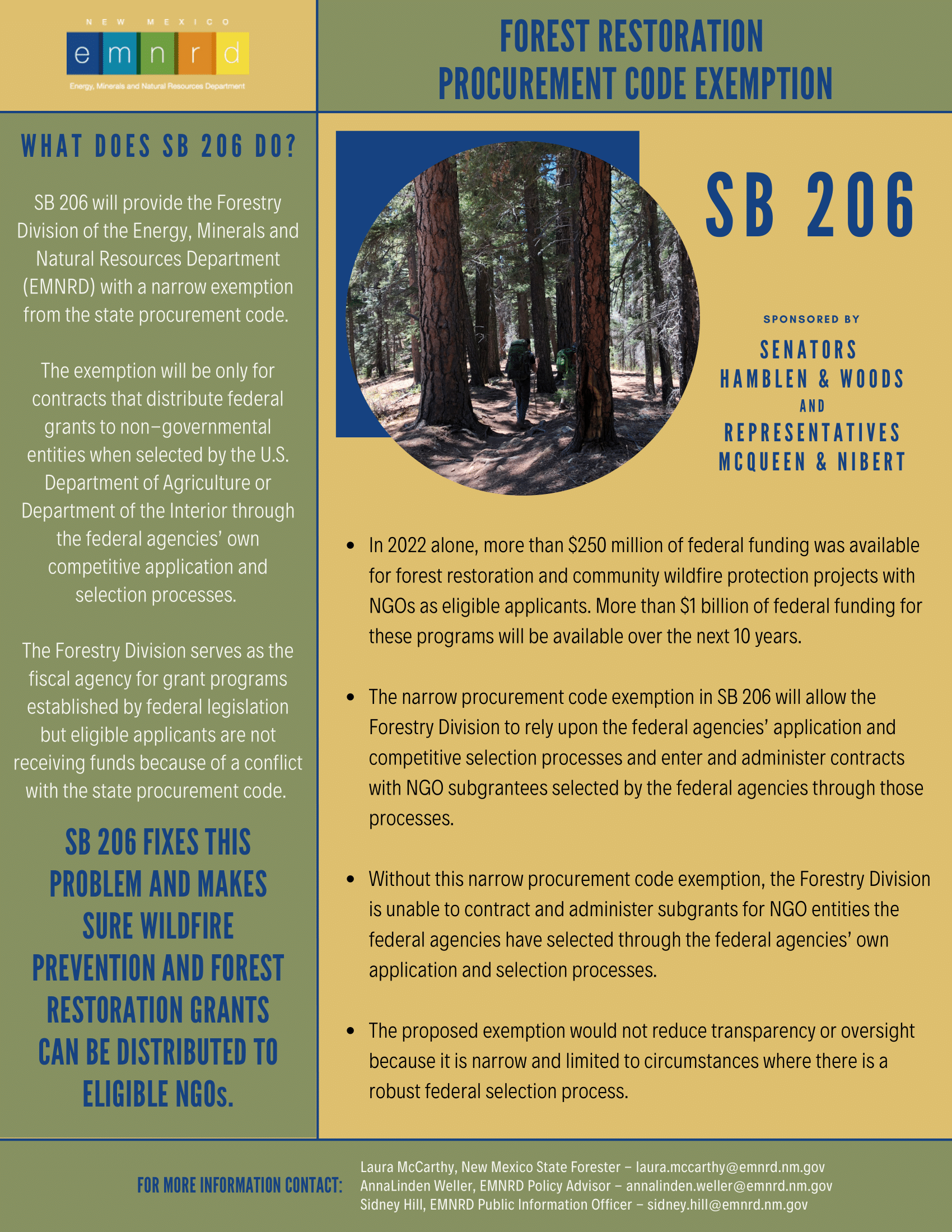
Click here to download the full fact sheet from New Mexico State Forestry.

SB 206 will provide the Forestry Division of the Energy, Minerals and Natural Resources Department (EMNRD) with a narrow exemption from the state procurement code.

The exemption will be only for contracts that distribute federal grants to non-governmental entities when selected by the U.S. Department of Agriculture or Department of the Interior through the federal agencies’ own competitive application and selection processes.

The Forestry Division serves as the fiscal agency for grant programs established by federal legislation but eligible applicants are not receiving funds because of a conflict with the state procurement code.

SB 206 fixes this problem and makes sure wildfire prevention and forest restoration grants can be distributed to eligible NGOs.

  • In 2022 alone, more than $250 million of federal funding was available for forest restoration and community wildfire protection projects with NGOs as eligible applicants. More than $1 billion of federal funding for these programs will be available over the next 10 years.

  • The narrow procurement code exemption in SB 206 will allow the Forestry Division to rely upon the federal agencies’ application and competitive selection processes and enter and administer contracts with NGO subgrantees selected by the federal agencies through those processes.

  • Without this narrow procurement code exemption, the Forestry Division is unable to contract and administer subgrants for NGO entities the federal agencies have selected through the federal agencies’ own application and selection processes.

  • The proposed exemption would not reduce transparency or oversight because it is narrow and limited to circumstances where there is a robust federal selection process.

To download the full fact sheet about SB 206 from New Mexico State Forestry Division, click here.

Senate Bill 9 - Creating Legacy Permanent Funds 
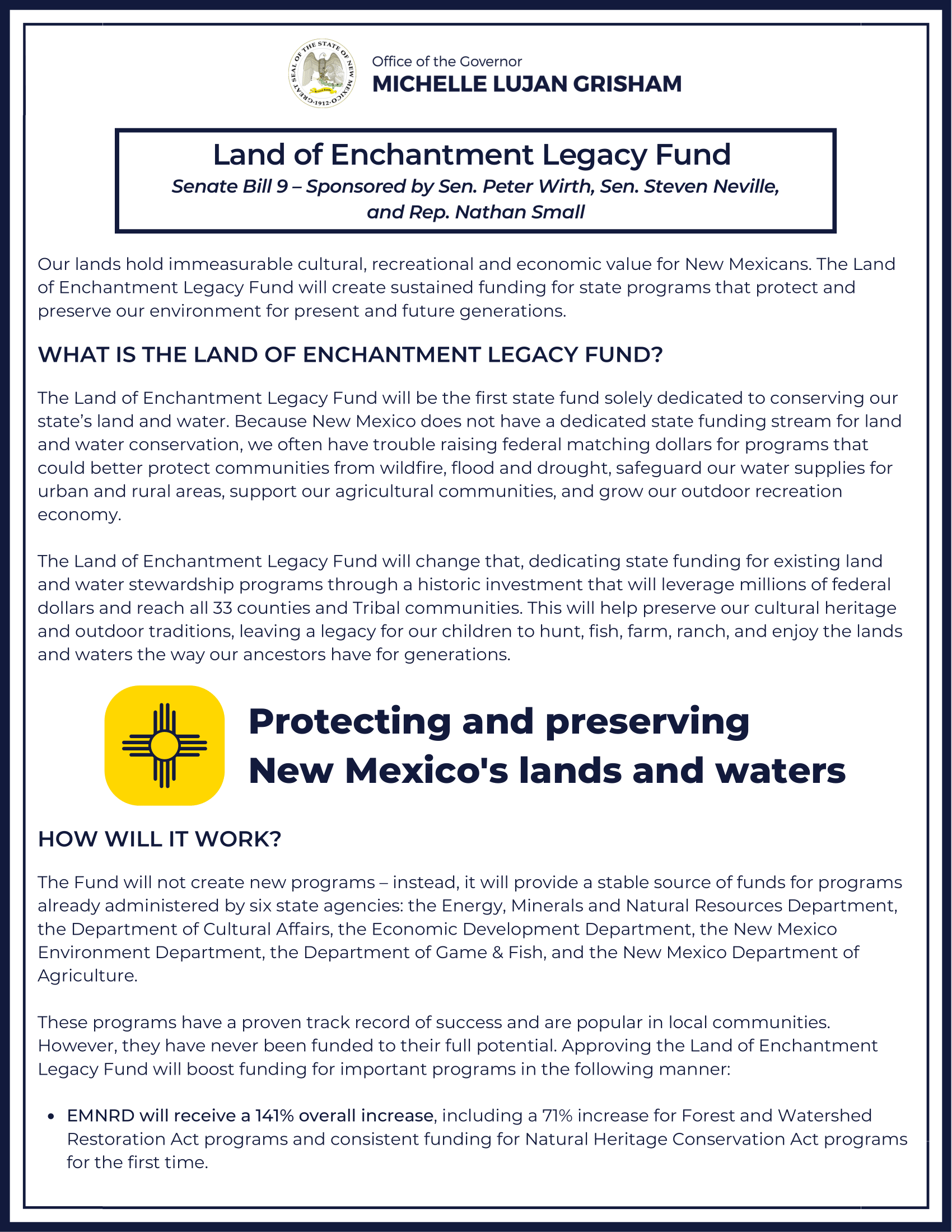
Click here for the full fact sheet from Michell Lujan Grisham’s office.

What is the Land of Enchantment Legacy Fund?

The Land of Enchantment Legacy Fund will be the first state fund solely dedicated to conserving our state’s land and water. Because New Mexico does not have a dedicated state funding stream for land and water conservation, we often have trouble raising federal matching dollars for programs that could better protect communities from wildfire, flood and drought, safeguard our water supplies for urban and rural areas, support our agricultural communities, and grow our outdoor recreation economy.

The Land of Enchantment Legacy Fund will change that, dedicating state funding for existing land and water stewardship programs through a historic investment that will leverage millions of federal dollars and reach all 33 counties and Tribal communities. This will help preserve our cultural heritage and outdoor traditions, leaving a legacy for our children to hunt, fish, farm, ranch, and enjoy the lands and waters the way our ancestors have for generations.

How will it work?

The Fund will not create new programs – instead, it will provide a stable source of funds for programs already administered by six state agencies: the Energy, Minerals and Natural Resources Department, the Department of Cultural Affairs, the Economic Development Department, the New Mexico Environment Department, the Department of Game & Fish, and the New Mexico Department of Agriculture. These programs have a proven track record of success and are popular in local communities. However, they have never been funded to their full potential. Approving the Land of Enchantment Legacy Fund will boost funding for important programs in the following manner:

  • EMNRD will receive a 141% overall increase, including a 71% increase for Forest and Watershed Restoration Act programs and consistent funding for Natural Heritage Conservation Act programs for the first time.

  • NMDA will receive a 331% overall increase, including a 158% increase in Soil & Water Conservation District funding, a 51% increase in funding for the Healthy Soils Program, and consistent stateappropriated funding for the Noxious Weed Management Program.

  • NMED River Stewardship program will receive an 83% increase.

  • EDD Outdoor Recreation Division will receive a 450% overall increase, with a 44% increase for the Outdoor Equity Fund and a 470% increase for Special Projects and the Outdoor Infrastructure Fund.

  • DCA will receive the first consistent state funding for Cultural Properties Protection Act programs.

  • DGF will receive consistent state appropriations for the Game Protection Fund that will be in addition to receipts from license fees and federal grants.

HB 195 - Forest Conservation Act Amendments
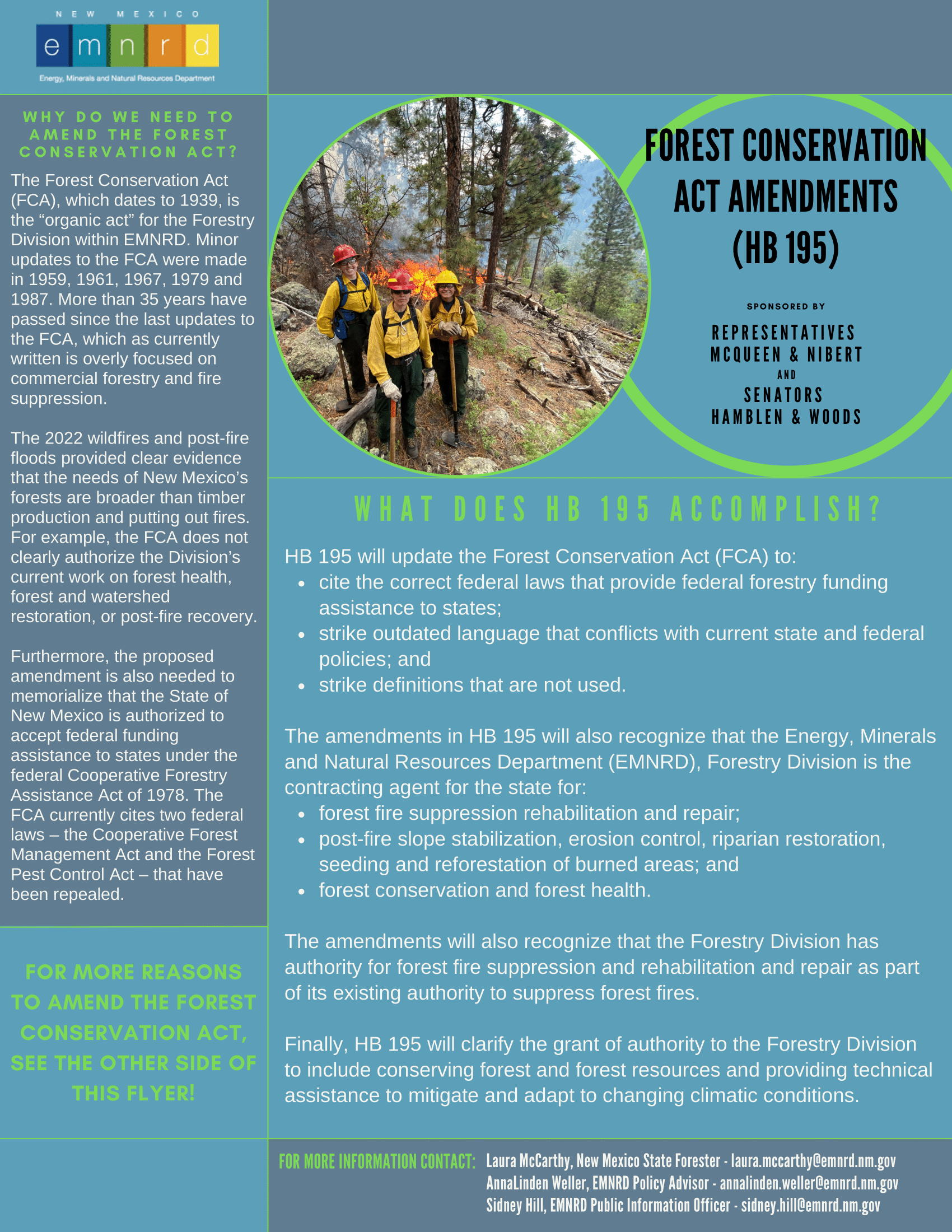
Click here to download the full fact sheet from New Mexico State Forestry Division

Why do we need the forest conservation act?

The Forest Conservation Act (FCA), which dates to 1939, is the “organic act” for the Forestry Division within EMNRD. Minor updates to the FCA were made in 1959, 1961, 1967, 1979 and 1987. More than 35 years have passed since the last updates to the FCA, which as currently written is overly focused on commercial forestry and fire suppression.

The 2022 wildfires and post-fire floods provided clear evidence that the needs of New Mexico’s forests are broader than timber production and putting out fires. For example, the FCA does not clearly authorize the Division’s current work on forest health, forest and watershed restoration, or post-fire recovery.

Furthermore, the proposed amendment is also needed to memorialize that the State of New Mexico is authorized to accept federal funding assistance to states under the federal Cooperative Forestry Assistance Act of 1978. The FCA currently cites two federal laws – the Cooperative Forest Management Act and the Forest Pest Control Act – that have been repealed.

What does the HB 195 accomplish?

HB 195 will update the Forest Conservation Act (FCA) to:

  • cite the correct federal laws that provide federal forestry funding assistance to states;

  • strike outdated language that conflicts with current state and federal policies;

  • and strike definitions that are not used. forest fire suppression rehabilitation and repair; post-fire slope stabilization, erosion control, riparian restoration, seeding and reforestation of burned areas; and forest conservation and forest health.

The amendments in HB 195 will also recognize that the Energy, Minerals and Natural Resources Department (EMNRD), Forestry Division is the contracting agent for the state for:

  • The amendments will also recognize that the Forestry Division has authority for forest fire suppression and rehabilitation and repair as part of its existing authority to suppress forest fires.

  • Finally, HB 195 will clarify the grant of authority to the Forestry Division to include conserving forest and forest resources and providing technical assistance to mitigate and adapt to changing climatic conditions.

The amendments will also recognize that the Forestry Division has authority for forest fire suppression and rehabilitation and repair as part of its existing authority to suppress forest fires.

Finally, HB 195 will clarify the grant of authority to the Forestry Division to include conserving forest and forest resources and providing technical assistance to mitigate and adapt to changing climatic conditions.
Wildfire Wednesdays #107: Legacies of Land Management - Fire Exclusion vs. Fire Suppression

Happy Wednesday, Fireshed community!

Last month we covered the difference between two parts of the fire management triangle - ignitions prevention and fuels reduction. Today we will be discussing the last piece of that triangle - fire suppression - and how it differs from fire exclusion. The West has a long and complicated history with both suppression and exclusion, and this history influences how hot, fast, and frequently wildfires burn in the current day.

Today’s Wildfire Wednesday features:

  • A brief history of wildfire in the West

  • Differences between fire exclusion and fire suppression

  • Upcoming webinars and workshops

Take care as spring rolls in,

Rachel


Wildfire in the West

European colonization

Homo sapiens, and before them Homo erectus, have been using fire for more than 400,000 years​. Indigenous peoples across the continent have been using fire since at least 12,550 BCE for a range of objectives such as hunting, crop management, increased plant yield, pest management, fire hazard reduction, and warfare, ​as well as managing fuels around communities. Early Americans selectively controlled fires burning close to or threatening their communities but left others to burn uninhibited. As explained by the Karuk Tribe Climate Change Projects, “unlike widespread conceptions of fire as ‘bad,’ fire is an essential component of [our] cultural practice and ecosystem health. Fire is medicine. Fire is referenced in our creation stories and is part of our world renewal ceremonies.”

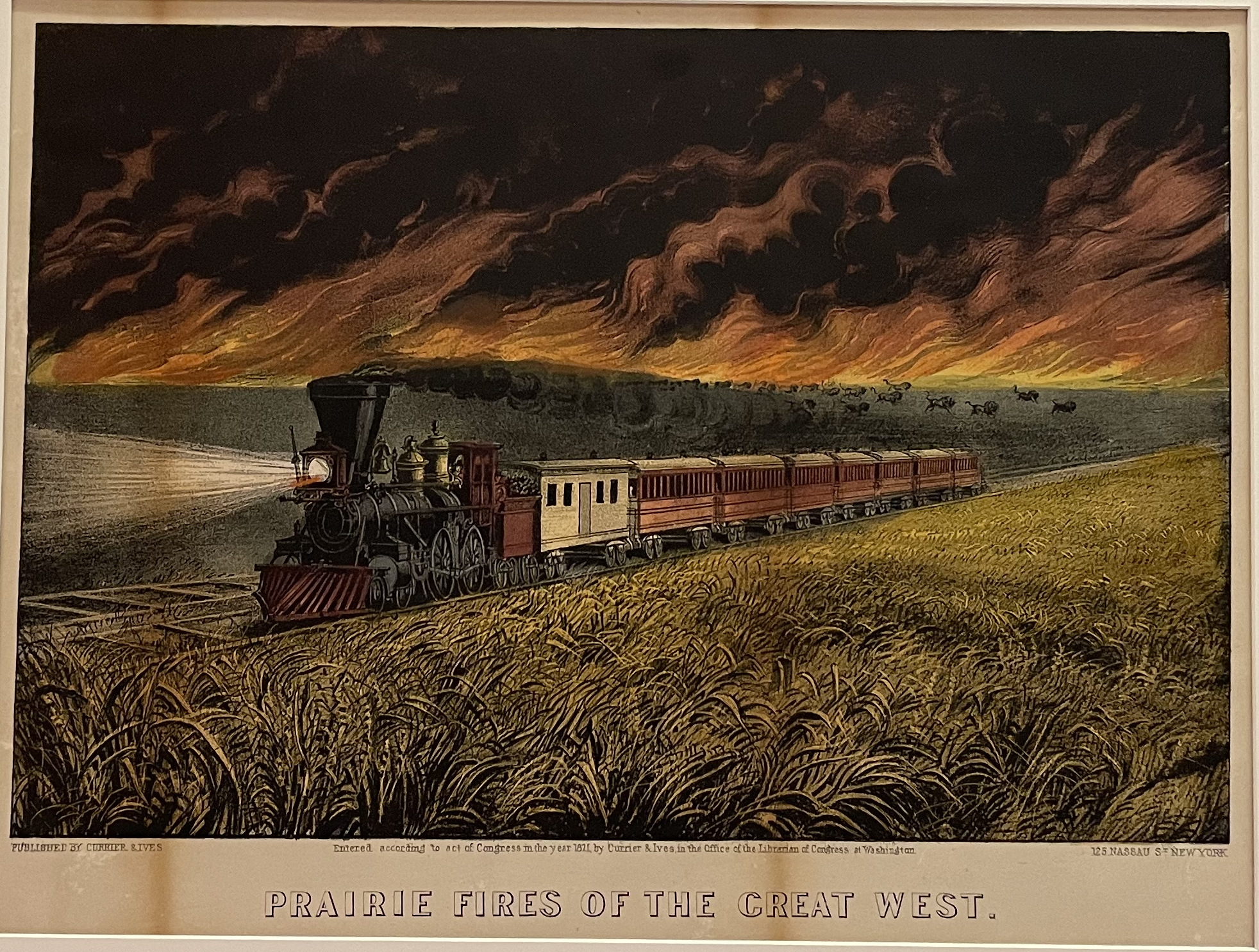
A lithograph of a train and railroad moving away from dark flames and smoke burning on the hills in the background. Sheep can also be seen running from the fire.

“Prairie Fires of the Great West” by Currier & Ives, 1871. Image sourced from Library of Congress.

Western expansion brought an uptick in fire activity due to land clearance, logging, agriculture, and railroads during Euro-American settlement, reaching a peak in the mid-1800s. Close to the end of that century, widespread domestic livestock grazing reduced grassy fuel loads, compacted soils, and greatly reduced fire frequencies. Landscape fragmentation from trail and road building and a sometimes-violent prohibition of indigenous burning practices further limited the spread of fire. By the 1890s, Euro-American settlement-colonization resulted in an emphasis on suppression of wildfires. (Long-term perspective on wildfires in the western USA)

The Big Burn

An analog clock with hands pointing to 10 o'clock

1905 marked the creation of the U.S. Forest Service, whose primary purpose was to "to sustain healthy, diverse, and productive forests and grasslands for present and future generations". Wildfire was seen as a threat to those productive forests. This mode of thinking was solidified five years later with "The Big Burn" in 1910, the largest wildfire in U.S. history which burned 3 million acres in two days and killed 87 people in eastern Washington, Idaho and Montana. The Big Burn prompted the conservation of America's forests and the creation of public lands but also ensured that over the next 90 years, suppression became the default land management approach to wildfire. This strategy was cemented into federal policy in multiple instances, the most notable of which was the US Forest Service’s 1935 implementation of the so-called “10:00 AM Policy”, dictating that all wildfire ignitions should be contained and extinguished by 10 o’clock the morning after they began.

As years passed and fires were both excluded from the landscape and actively suppressed, organic fuels accumulated on the forest floors, trees encroached into areas which were previously maintained as meadows by naturally occurring fire, and the West became increasingly more flammable.

Recognition of fire as a natural process

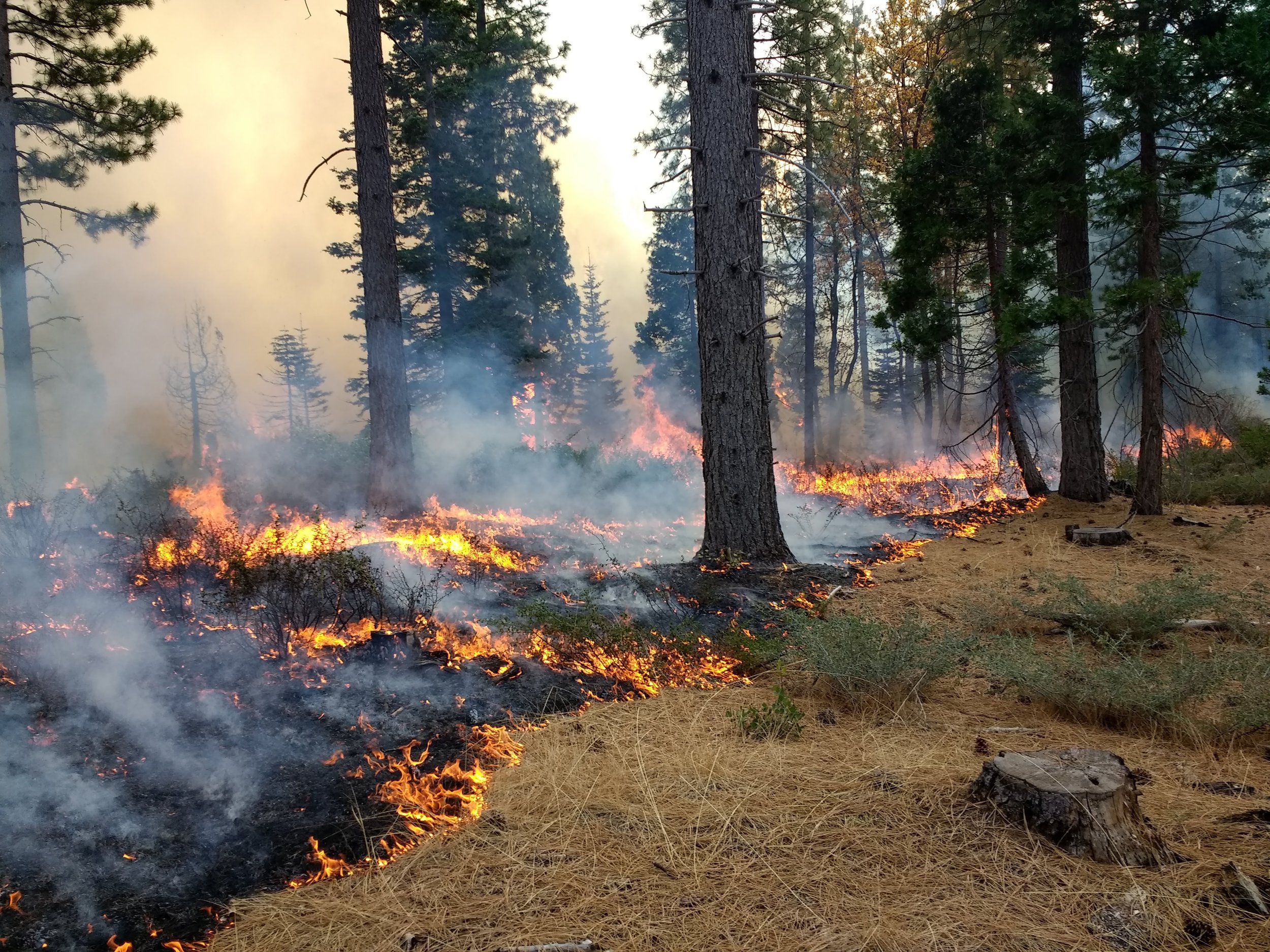
Flames 6 to 12 inches high burn through grass and pine needles at the base of green ponderosa pine and cedar trees

In 1968, the Park Service began to allow lightning-started "prescribed natural fire" to burn within predefined management units in the wilderness, a model which is still in play today. By the late 1980s, the departments of agriculture and the interior were reconsidering the fundamental importance of fire's natural ecological role, but it wasn't until 1995 that the Forest Service introduced legislation allowing lightning-caused fires to burn in wilderness. In 2000, the National Fire Plan was introduced to strike a balance between actively responding to severe wildland fires and their impacts to communities and ensuring landscape restoration through sufficient hazardous fuels reduction and firefighting capacity for the future. Fourteen years later, the Secretaries of Agriculture and the Interior worked with a collaborative interdisciplinary team to establish the National Cohesive Wildland Fire Management Strategy "to safely and effectively extinguish fire when needed; use fire where allowable; manage natural resources; and as a nation, to live with wildland fire.”​ This 2014 document informs current central fire preparedness and response through three tenants:

  1. Restore and maintain resilient landscapes

  2. Create Fire Adapted Communities (FAC)

  3. Safe and effective wildfire response

“In recent decades the U.S. government has officially accepted the idea of restoring fire to public lands wherever doing so will not endanger firefighters or nearby residents. That means using planned burns to clear overgrown lands and letting some wildfires in remote areas burn under supervision instead of putting them out.” Land managers face an increasingly complex set of circumstances as they try to reintroduce fire in a controlled manner to the fire-starved West: “residential development has spread into fire-prone areas, creating pressure to protect exurban homes, and climate change has made some areas, especially the West, hotter, drier and more fire-prone.” (Jennifer Weeks, The Fire Historian)

READ MORE ABOUT THE HISTORY OF WILDFIRE IN THE WEST

Fire Exclusion vs Fire Suppression

Fire suppression

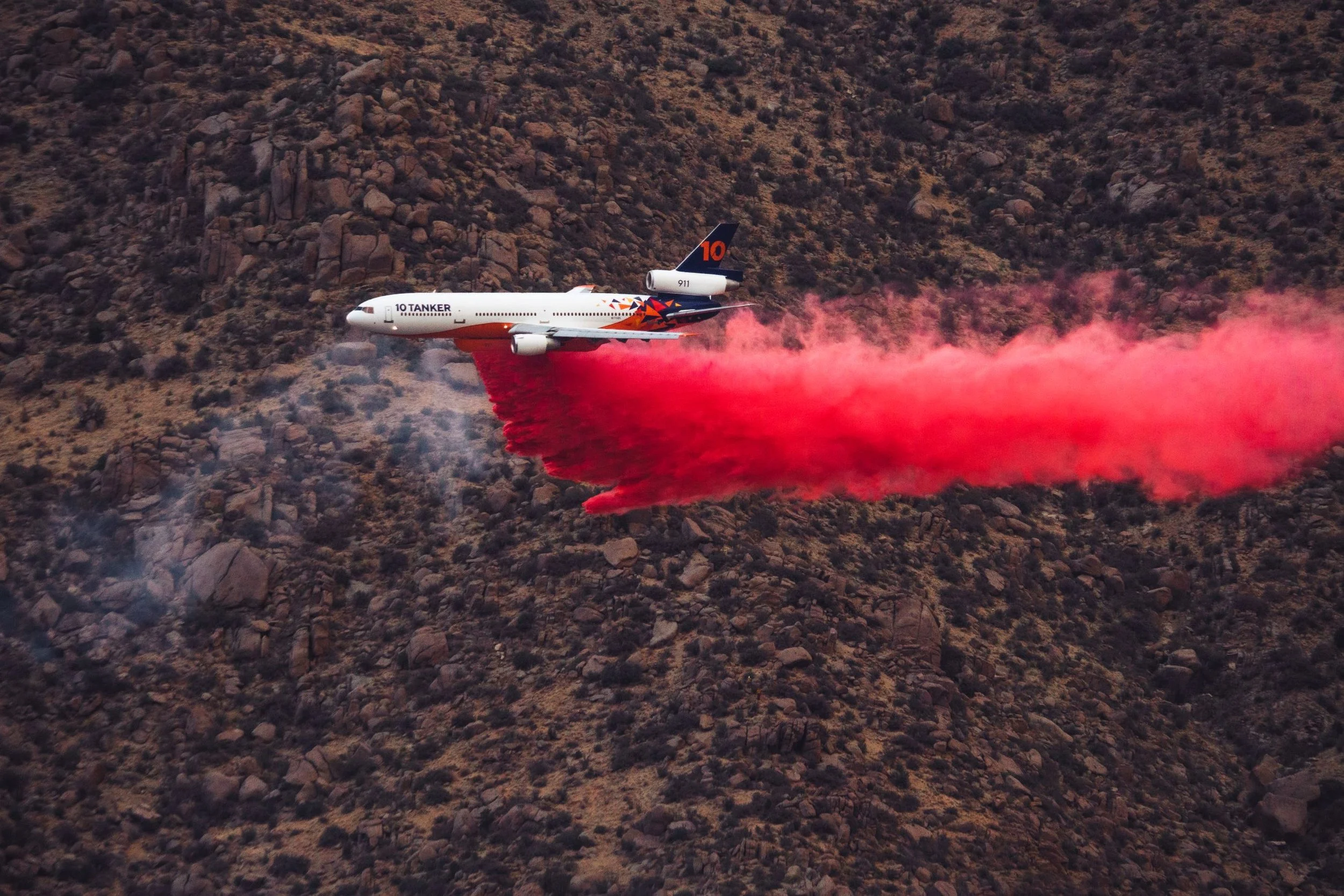
An airplane flying over smoking desert scrub and grass, dropping a long plume of bright red fire retardant

Image courtesy of Alex Poli.
Shrubland fire near Carnuel, NM, 2022.

Fire suppression refers to a range of operations used to extinguish a wildfire or prevent or modify the movement of unwanted fire. Firefighters control a fire's spread (or put it out) by removing one of the three ingredients fire needs to burn: heat, oxygen, or fuel. They remove heat by applying water or fire retardant on the ground or by air. They remove fuel by cutting and digging to remove burnable vegetation with hand tools, by using heavy equipment like bulldozers to clear large areas of brush and trees, and by deliberately setting fires to rob an approaching wildfire of fuel (fighting fire with fire). (US DOI)

Fire suppression is needed to protect homes, businesses, recreation and cultural sites, and other values that could be at risk of loss when a wildfire burns through. Suppression puts an emphasis, first and foremost, on firefighter safety, while taking into consideration a plethora of other factors - location, timing, fuel type, resources available, and more. While the technology to assist with wildfire suppression decisions (such as PODS) is advancing, so is the cost; the total cost of wildfire suppression in 2021 was over $2.8 billion.

A coordinated effort to minimize the threat of wildfires made fire suppression the default response by federal, state, and local entities for decades, resulting in the near eradication of wildfires from the landscape. However, successful wildfire suppression has resulted in accumulated fuels that lead to larger and more severe wildfires in the long-term—what is known today as the “wildfire paradox.”

Fire exclusion

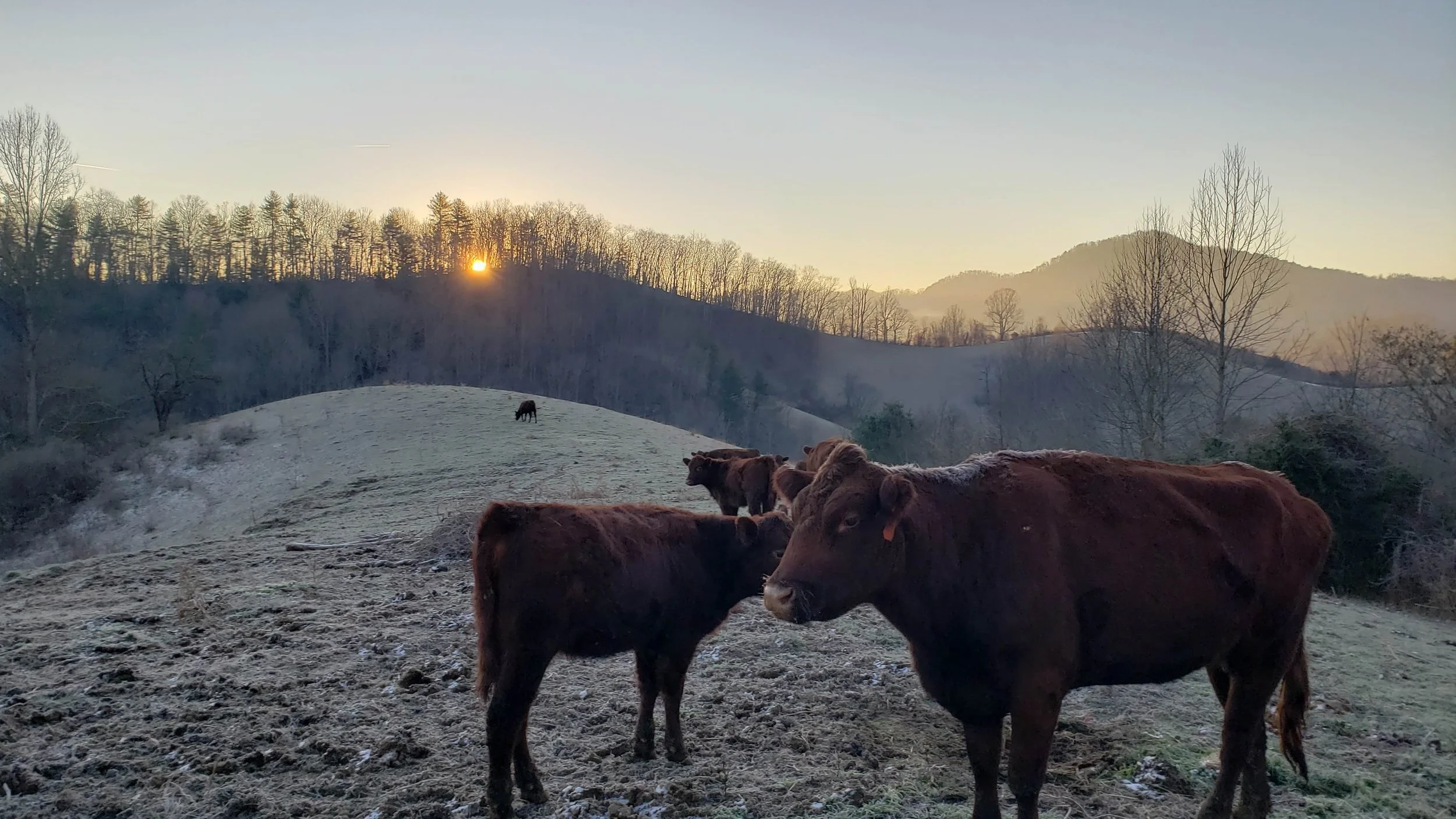
Brown cows standing on a yellow grassy hill at sunrise with sunlit trees and mountains in the backgroundBrown cows standing on a yellow grassy hill at sunrise with sunlit trees and mountains in the background

According to the US Forest Service, Fire exclusion is “the effort of deliberately excluding or preventing fire in an area regardless of [whether] the fire is natural or human caused.” Fire can be excluded through a number of intentional actions such as wildland fire control lines and environmental planning which designates some areas as protected activity centers. It can also be excluded unintentionally through activities such as landscape fragmentation and heavy grazing which removes all of the fine fuels, such as grasses and shrubs, necessary to carry low-intensity fire across the landscape.

“There have been marked human influences on western wildfires since Euro-American settlement, including increased ignitions (e.g., from forest clearance, agriculture, logging, and railroads), and fire exclusion. Other significant impacts on vegetation and fire occurred indirectly, such as changes in plant succession pathways and the introduction of nonnative species.” (Long-term perspectives on wildfires) As ecosystems have evolved with fire, so too have the plants and animals. Human activities have altered many of the relationships between fire and plants and animals.

“The impact of fire exclusion on vegetation structure and composition [combined with drought, pests, and disease] leads to fuels that, when ignited, burn hotter, spread faster, last longer, and cover more area than they did under more natural conditions.” (NIFC, Communicator's Guide for Wildland Fire Management) The exclusion of fire from the landscape also creates a situation of denied access for indigenous and traditional communities to spiritual practices and traditional foods, puts cultural identity at risk, and infringes upon political sovereignty.

The takeaway

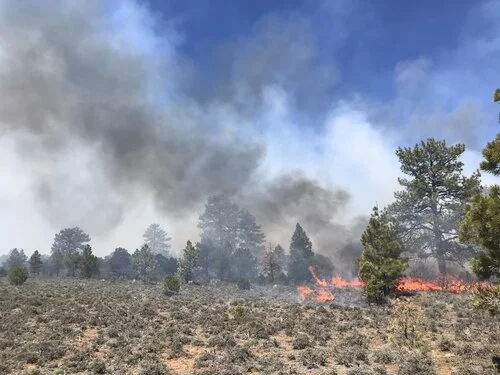
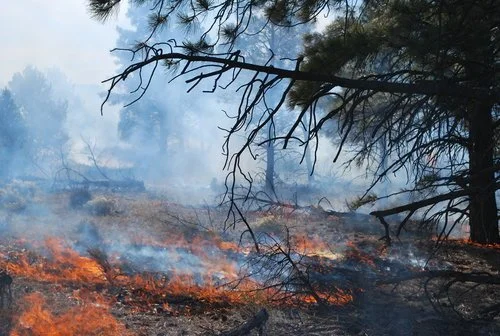
Yellow grass in the foreground with pine trees obscured by a heavy layer of smoke and rolling hills in the background

“There is growing recognition that past land use practices, combined with the effects of fire exclusion, has resulted in heavy accumulations of dead vegetation, altered fuel arrangement, and changes in vegetative structure and composition. When dead fallen material (including tree boles, tree and shrub branches, leaves, and decaying organic matter) accumulates on the ground, it increases fuel quantity and creates a continuous arrangement of fuel. When this occurs, surface fires may ignite more quickly, burn with greater intensity, and spread more rapidly and extensively than in the past.” (NIFC)

While wildfires must be suppressed sometimes in some locations, land managers are recognizing that we cannot continue to suppress our way out of increasingly severe and lengthy fire seasons. Mindful reintroduction of ecologically appropriate fire to fire-adapted landscapes, creation of resilient and fire-ready communities, and other climate resiliency work are all part of the solution.


Upcoming Opportunities

Webinars

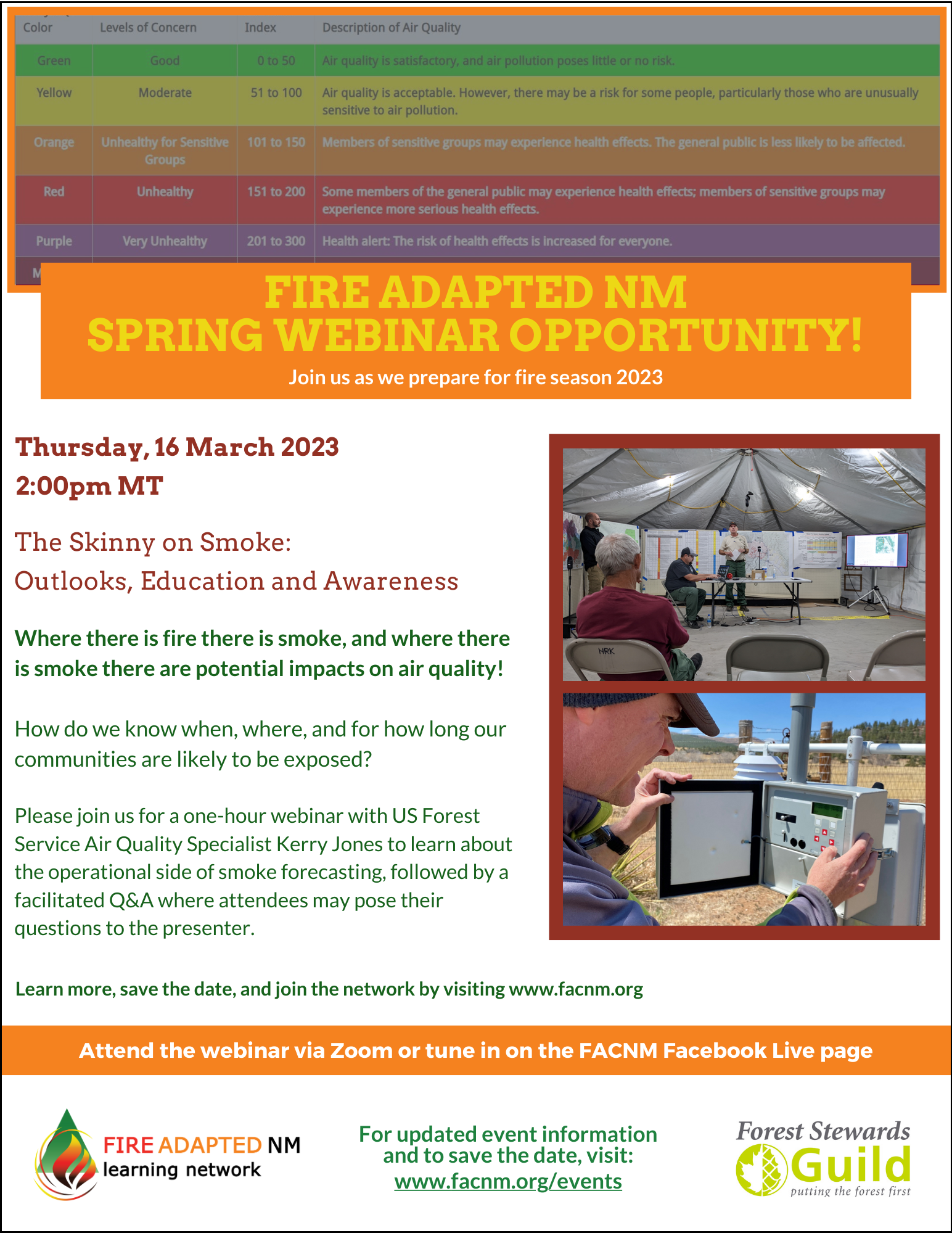
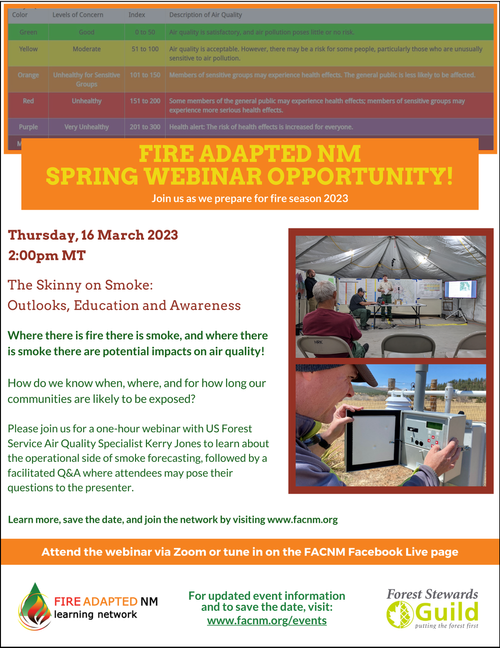
The Skinny on Smoke - Outlooks, Education and Awareness
Join us as Air Quality Specialist Kerry Jones discusses various facets of smoke projections, including what goes into generating seasonal outlooks and fire weather forecasts, the weather conditions that are most conducive to fire and to smoke, and how determinations of air quality are made along with the decision to send air quality advisory alerts out to the public.

When: Thursday, March 16, 2023, 2:00pm - 3:00pm
Where
: Virtual Zoom event - register now

Strategies to reduce wildfire smoke in frequently impacted communities
The SW and NW Fire Science Consortiums and Forest Stewards Guild present a one-hour webinar with USFS speaker Rick Graw on proactive and adaptive land management strategies to reduce wildfire smoke in frequently impacted communities. This webinar focuses on research from the Pacific Northwest but is applicable to land managers and fire adapted communities practitioners everywhere.

When: Tuesday, March 21, 2023, 12:00pm - 1:00pm
Where: Virtual Zoom event - register now

Workshops

Ready, Set, Go! Wildfire Preparedness Workshop
Join us to take positive steps toward building a Fire Adapted Community! This workshop will feature information about wildfire risk in the Santa Fe Fireshed, a presentation by representatives from the Wildfire Research Center, a mini-training on how to conduct a home hazard assessment, what to include in a Ready, Set, Go kit, and much more. Get information and help from experts from the Santa Fe Fireshed Coalition, Forest Stewards Guild, City of Santa Fe Fire Department, and Villages of Santa Fe. This workshop is free and open to the public.

When: Saturday, March 18, 2023, 10:00am - 12:30pm
Where: Christ Church Santa Fe PCA, 1213 Don Gaspar Ave, Santa Fe, NM 87505

Wildfire Wednesdays #106: Smoke Exposure Mitigation

Hi Fireshed Community,

As seasons begin to change, and Spring brings warmer and windier weather, it is a good time to think ahead and prepare for the realities of the upcoming fire season. Smoke from wildfires and prescribed fires is a serious concern as it can cause or exacerbate health conditions for some people living in fire-adapted communities. Living in northern New Mexico we must accept that wildfire and smoke is inevitable but there are measures we can take to reduce our risk and health effects.

To support you in smoke exposure mitigation, this Wildfire Wednesdays includes the following:

  • General info about AQI and PM 2.5

  • Air quality information - Airnow.gov and Purpleair.com

  • Smoke exposure mitigation

    • General air filtration

    • FACNM’s HEPA filter loan program

  • Smoke forecasting webinar with air quality specialist Kerry Jones - March 16th

Stay Safe,

Gabe

Wildfire Smoke Basics

Wildfire smoke is a mixture of gases and fine particles from burning trees and other plant material. The gases and fine particles can be dangerous if inhaled. In wildfires, carbon monoxide is mainly a risk to people (like firefighters) who work near smoldering areas. Smoke can irritate your eyes and your respiratory system, and worsen chronic heart and lung diseases. The amount and length of smoke exposure, as well as a person’s age and degree of susceptibility, play a role in determining if someone will experience smoke-related health problems. If you are experiencing serious medical problems for any reason, seek medical attention immediately.

Air Quality Index (AQI)

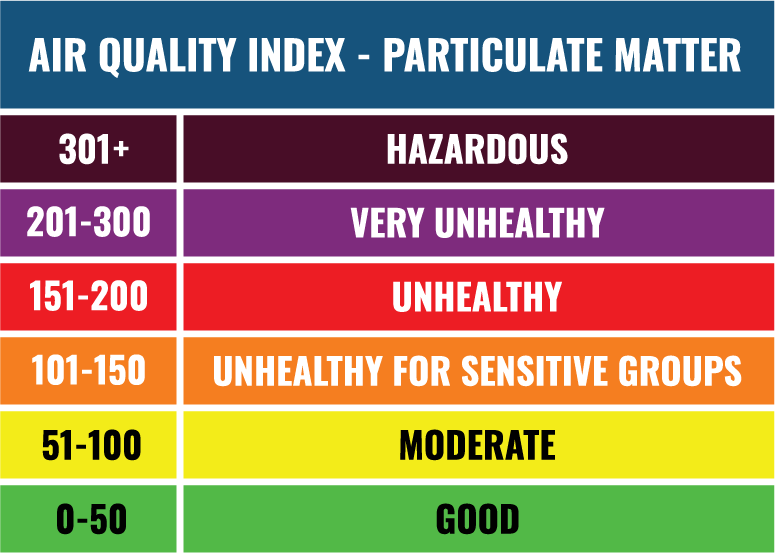
Think of the AQI as a yardstick that runs from 0 to 500. The higher the AQI value, the greater the level of air pollution and the greater the health concern. For example, an AQI value of 50 or below represents good air quality, while an AQI value over 300 represents hazardous air quality.

For each pollutant an AQI value of 100 generally corresponds to an ambient air concentration that equals the level of the short-term national ambient air quality standard for protection of public health. AQI values at or below 100 are generally thought of as satisfactory. When AQI values are above 100, air quality is unhealthy: at first for certain sensitive groups of people, then for everyone as AQI values get higher.

The AQI is divided into six categories. Each category corresponds to a different level of health concern. Each category also has a specific color. The color makes it easy for people to quickly determine whether air quality is reaching unhealthy levels in their communities.

Particulate Matter and PM 2.5

The particulate matter (also called “PM”) in wildfire smoke poses the biggest risk to the public’s health. The potential health effects vary based on the type of plants burning, atmospheric conditions and, most importantly, the size of the particles. Particles larger than 10 micrometers usually irritate only the eyes, nose and throat. Fine particles 2.5 micrometers or smaller (PM2.5) can be inhaled into the deepest part of the lungs, and may cause greater health concern.

Air Quality Information Sources

The first step to mitigating your smoke exposure is getting up-to-date, accurate information about air quality in your area. To support you in finding the best available data, we would like to introduce Airnow.gov for local AQI information and purpleair.com for information

What is Airnow.gov?

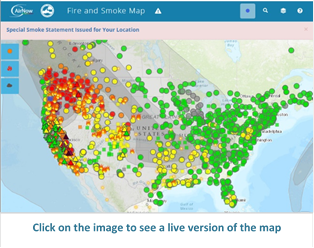
AirNow is your one-stop source for air quality data. Our recently redesigned site highlights air quality in your local area first, while still providing air quality information at state, national, and world views. A new interactive map even lets you zoom out to get the big picture or drill down to see data for a single air quality monitor.

AirNow reports air quality using the official U.S. Air Quality Index (AQI), a color-coded index designed to communicate whether air quality is healthy or unhealthy for you. When you know the AQI in your area, you can take steps to protect your health.

Click here to visit, airnow.gov.


What is Purpleair.com?

PurpleAir makes sensors that empower Community Scientists who collect hyper-local air quality data and share it with the public. PurpleAir's sensors measure particle pollution (PM2.5) both indoors and outdoors.

PurpleAir is built on the ideal of sharing data and by doing this, empowering individuals to effect change. All public PurpleAir data is available to download under various licenses from private, not for profit use to educational and commercial use.

Click here to visit purpleair.com.

Smoke Exposure Mitigation

One of the best ways to reduce the impact of smoke is by reducing the amount of smoke that enters your building and filtering harmful particles from the air. If you have a central air conditioning system in your home, set it to re-circulate or close outdoor air intakes to avoid drawing in smoky outdoor air.  Upgrading the filter efficiency of the heating, ventilating, and air-conditioning (HVAC) system and changing filters frequently during smoke events greatly improves indoor air quality.  

Smaller portable air cleaners are a great way to provide clean air in the areas where you spend most of your time. Essentially these are filters with an attached fan that draws air through the filter and cleans it.  These cleaners can help reduce indoor particle levels, provided the specific air cleaner is properly matched to the size of the indoor environment in which it is placed, and doors and windows are kept shut. They should be placed in the bedrooms or living rooms to provide the most effectiveness. 

When air quality improves, such as during a wind shift or after a rain, make sure to use natural ventilating to flush out the air in your building. 

The Winix 5300-2 and 5500 is what FACNM uses for our HEPA loan program

Selecting a Filter - For either portable filters or HVAC filters make sure to select a filter that is true HEPA or has a MERV rating of 13 or higher. These ratings refer to the size of particles that the filter will remove from the air and in this case they are certified to remove particles down to .3 microns in size. This is the minimum needed to remove the small harmful particles in smoke.

When selecting a portable filter, the other rating to pay attention to is CADR or Clean Air Delivery Rate. This refers to the volume of air that passes trough the unit. A CADR of 200 means the unit provides 200 cubic feet of clean air per minute, and often this number is equated to the room size that it will effectively purify the air in. In a 300 sq foot room a filter with a rating of 200 CADR will cycle the air through the filter 4-5 times per hour. While any filter will provide clean air those with lower CADRs will simply work more slowly. Lastly, make sure to avoid filters that claim to produce ozone to destroy pathogens, as ozone is a respiratory irritant. 

More information about filters and guides to selecting one can be found in the Resources section below.  

Face Masks - Face masks can be an effective way to reduce your exposure to smoke when they are fit correctly and are the proper rating. Make sure the mask you use is rated at least N95 or N100 and that you take care to fit it properly. These masks will filter out the small particles that are the most hazardous to your health. Paper masks only filter out large particles and will not provide the filtration needed to protect you from smoke. 

HEPA Filter Loan Program

With support from the New Mexico State University, the national Fire Adapted Communities Learning Network, and the Forest Stewards Guild, FACNM is pleased to offer this pilot HEPA Filter Loan program. These filters are available to smoke sensitive individuals during periods of smoke impacts in some areas of Northern New Mexico, but we hope to expand to more areas soon. We have a small amount of portable air cleaners that will filter the air in a large room such as a living room or bed room. These will be distributed on a first come- first served basis for predetermined time periods. You will need to provide contact info and come to office listed for your area to sign for the filter and pick it up.  Please look over the HEPA Air Filter Check-Out Contract.

To view contact information for the HEPA loan program in your area, visit the FACNM smoke page.

For general information about the program contact Gabe Kohler at the Forest Stewards Guild at gabe@forestguild.org.

Upcoming Events

Webinar: The Skinny on Smoke - Outlooks, Education and Awareness

Thursday, March 16, 2023 2:00 PM 3:00 PM

Click here for full event information and to register.

Where there is fire there is smoke, and where there is smoke there are potential impacts on air quality!

How do we know when, where, and for how long our communities are likely to be exposed?

In this one-hour presentation, Air Quality Specialist Kerry Jones will discuss various facets of smoke projections, including what goes into generating seasonal outlooks and fire weather forecasts, the weather conditions that are most conducive to fire and to smoke, and how determinations of air quality are made along with the decision to send air quality advisory alerts out to the public.

Please join us to learn about the operational side of smoke forecasting, followed by a facilitated Q&A session where attendees may pose their questions to the presenter.

When: Thursday, March 16th from 2-3pm MT
Where: Zoom and FACNM Facebook Live
Who: Kerry Jones, USFS Air Quality Specialist

Wildfire Wednesdays #105: Fire Prevention vs Fuels Reduction

Hello and happy Wednesday, Greater Santa Fe Fireshed community!

Fire management comes with a vast vocabulary of unique or unusual terminology. For individuals who are not exposed to these terms every day, exact definitions and usage can be pretty confusing. Having a clear understanding of terminology is important for cross-disciplinary discussion, public education, and to foster a common understanding of what goes into fire management. Today we will be distinguishing between and delving into two sides of wildfire management - fire prevention and fuels reduction.

Today’s Wildfire Wednesday features:

  • The fire management triangle - before and during a fire

  • Differences between fire prevention and fuels reduction

  • Common questions and misinformation

Be well and stay warm,

Rachel


The Fire Management Triangle

What is wildland fire management?

Colorado State Forestry defines fire management as the “activities concerned with the protection of people, property, and landscapes from [severe] wildfire and the use of [ecologically appropriate] burning for… forest management and other land use objectives, all conducted in a manner that considers environmental, social and economic factors.”

An illustration of a meeting boardroom with a table, chairs, a large window overlooking a city silhouette, and fire posters on the wall

At its core, fire management describes all potential actions for controlling or guiding when, where, and how a wildland fire burns. It takes into consideration what ‘values’ would be at risk were a wildfire to burn through a given area, the ecological impacts of wildfire, and the human factors involved - from ignition to suppression to post-fire recovery.

Fire management activities include: pre-suppression, readiness, fuels management, training, prevention, suppression, prescribed fire, fire analysis and planning, rehabilitation, public affairs, and other beneficial efforts. These activities generally fit into two categories - pre-fire and during fire - and can be broken into three distinct branches: fire prevention, fuels reduction, and fire suppression.

What tools do we have?

Fire prevention, or the activities associated with reducing unplanned human-caused ignitions, and fuels reduction, or the management of organic fuels through removal or modification, are generally implemented before a wildfire happens. Fire suppression, or the containment and extinguishing of a fire, is implemented as a wildfire is burning.

Fire prevention: Activities intended to reduce the incidence of unplanned human-caused wildfires [and the risks they pose to life, property or resources], including public education, law enforcement, personal contact, and other actions taken to reduce ignitions. (NWCG Glossary of Wildland Fire)

Fuels reduction: Manipulation, including combustion, or removal of fuels [vegetation and organic debris] to reduce the likelihood of ignition and/or to lessen potential damage and resistance to control. The act or practice of controlling flammability and reducing resistance to control of wildland fuels through mechanical, chemical, biological or manual means, or by fire in support of land management objectives. (CSFS Forestry & Wildfire Glossaries of Terms)

Wildland fire suppression: An appropriate management response to wildland fire that results in curtailment of fire spread and eliminates all identified threats from a particular fire. All wildland fire suppression activities provide for firefighter and public safety as the highest consideration, but minimize loss of resource values, economic expenditures, and/or the use of critical firefighting resources. (NIFC, Wildland Fire Management Terminology)

Distinguishing Between Fire Prevention and Fuels Reduction

Both involve pre-fire work, so what is the difference?

Fire prevention

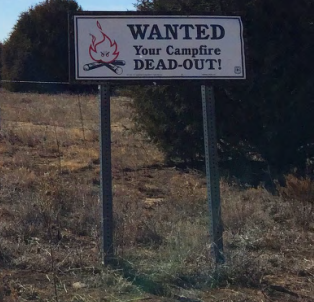
A sign in the forest which reads "wanted:  your campfire dead out"

An example of signage intended to raise awareness of the risks of human ignitions and simple prevention techniques.

Wildfires are started either by natural causes (usually lightning) or by human activity. People start wildfires in a wide variety of ways: vehicle exhaust pipes, cigarette butts, poorly extinguished campfires, burning debris piles, and sparking equipment such as chainsaws are all common causes. Other human-caused ignitions come from arson, fireworks, powerlines, and more. With nearly 90% of unplanned ignitions being started by humans, simply reducing the spark can make a big difference in reducing unwanted wildfires.

Fire prevention, which focuses on stopping a fire before it starts, is accomplished primarily through education. Research has shown that human ignitions tend to be clustered, or occur most commonly, around cities, roadways, and busy recreation areas such as trailheads and campgrounds. Fire prevention efforts seek to inform the general public of the ways in which fires are started, the impacts of those fires as they burn, and how they can be prevented. In general, prevention programs most likely to be effective are those that give people information and tools that enhance their perception of their power, as individuals, to prevent wildfires.

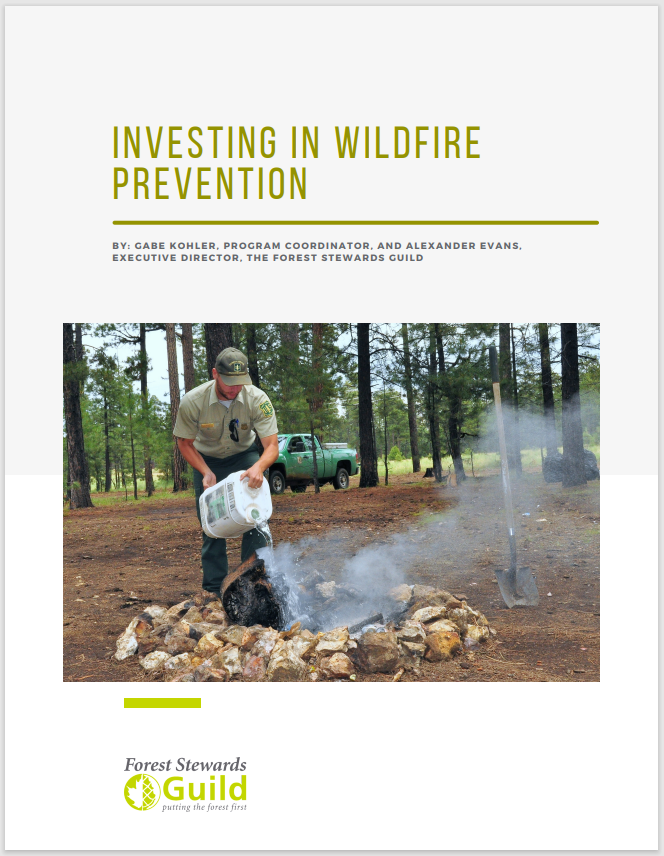
Read more about fire prevention in the 2018 report on reducing human-caused ignitions in New Mexico, a 2021 report on investing in wildfire prevention, the DOI’s 10 tips to prevent wildfires and NM Forest Division’s fire prevention tips.


Fuels reduction

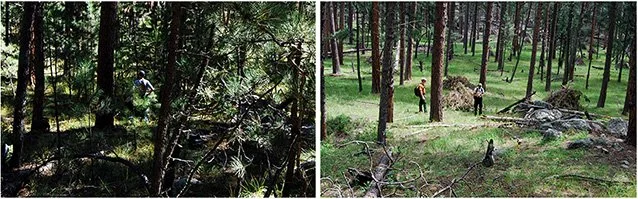
“When vegetation, or fuels, accumulate, they allow fires to burn hotter, faster, and with higher flame lengths. When fire encounters areas of continuous brush or small trees, it can burn these ‘ladder fuels’ and may quickly move from a ground fire into the treetops, creating a crown fire… [The objective of fuels reduction] is to remove enough vegetation (fuels) so that when a wildfire burns, it is less severe and can be more easily managed.” (NPS, What is Hazard Fuel Reduction)

(Left) an overcrowded forest with plentiful ladder fuel, (Right) a resilient forest following fuels reduction thinning treatments.
Photos courtesy of NPS.

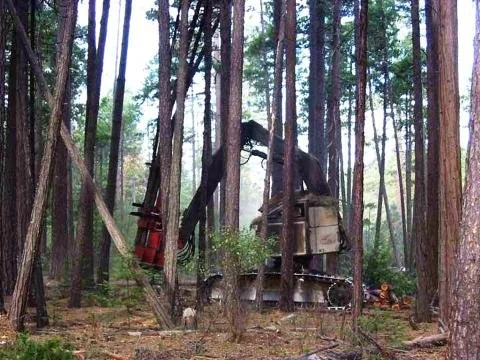
Fuels reduction aims to thin out living and dead vegetation from forested areas to reduce the total amount of fuel that is available for a fire to burn. It also is designed to create breaks in the fuel type and arrangement (e.g. reducing ladder fuels) so that even if a fire starts, it cannot quickly move from the ground level into the tree canopy. These goals may be accomplished through ecologically-based forest thinning (the mechanical removal of shrubs and small trees), mastication, chipping, and prescribed fire (the purposeful introduction of fire under favorable conditions).

Fuels reduction is not intended to stop the forward progress of a wildfire as soon as it hits the treatment area; instead, fuels reduction treatments are designed to reduce the growth of fires that ignite in treated areas, moderate fire behavior by reducing crown-to-crown movement when a flaming front encounters a treated area, and enable fire management activities (containment and suppression) by giving firefighters a safe space to directly interact with the fire.

A red feller-buncher machine cuts and grabs multiple small trees in a thick forest

A feller-buncher thins small-diameter trees from an overgrown forest.
Photo courtesy of USFS.

Wildfire ecologists almost universally support fuels reduction — especially in forests that used to flourish under frequent ground fires, such as the ponderosa pine forests of the Southwest. Fuels reduction is also an effective pre-fire treatment in wildland-urban interfaces and in home defensible spaces. Read more about fuels reduction in the High Country News article, Does thinning work, a Forest Service article on thinning the forest for the trees, and an NPR interview with UNM professor Matthew Hurteau.

Continuing the Conversation

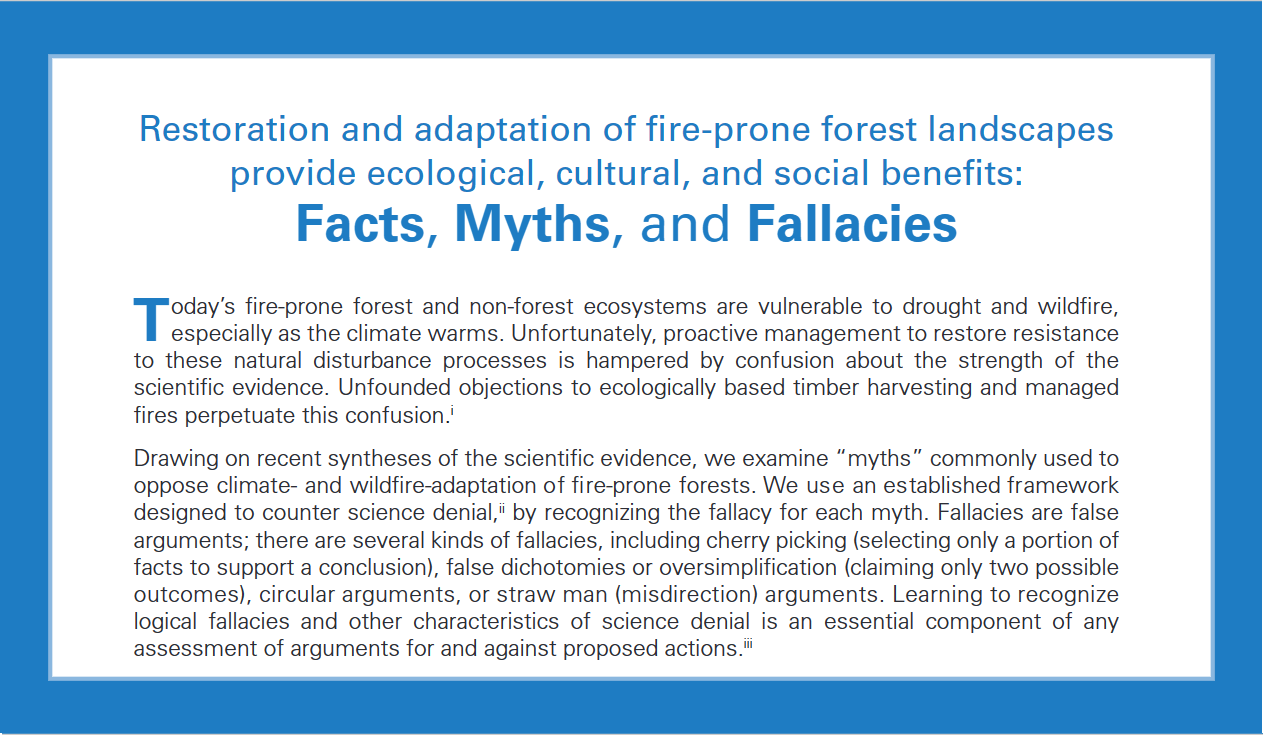
Common questions and misinformation

Still have questions about fire management and what can be done to prevent or control a fire before it happens? Refer to the resources below for more information.

Top of a blue-lined fact sheet reading "restoration and adaptation of fire prone-forest landscapes: facts, myths, and fallacies"
Text on a green background spelling out the 10 common questions about adapting forests
Page header with black text on an olive green background, the western environmental law center logo, and an infographic showing overgrown versus thinned forests