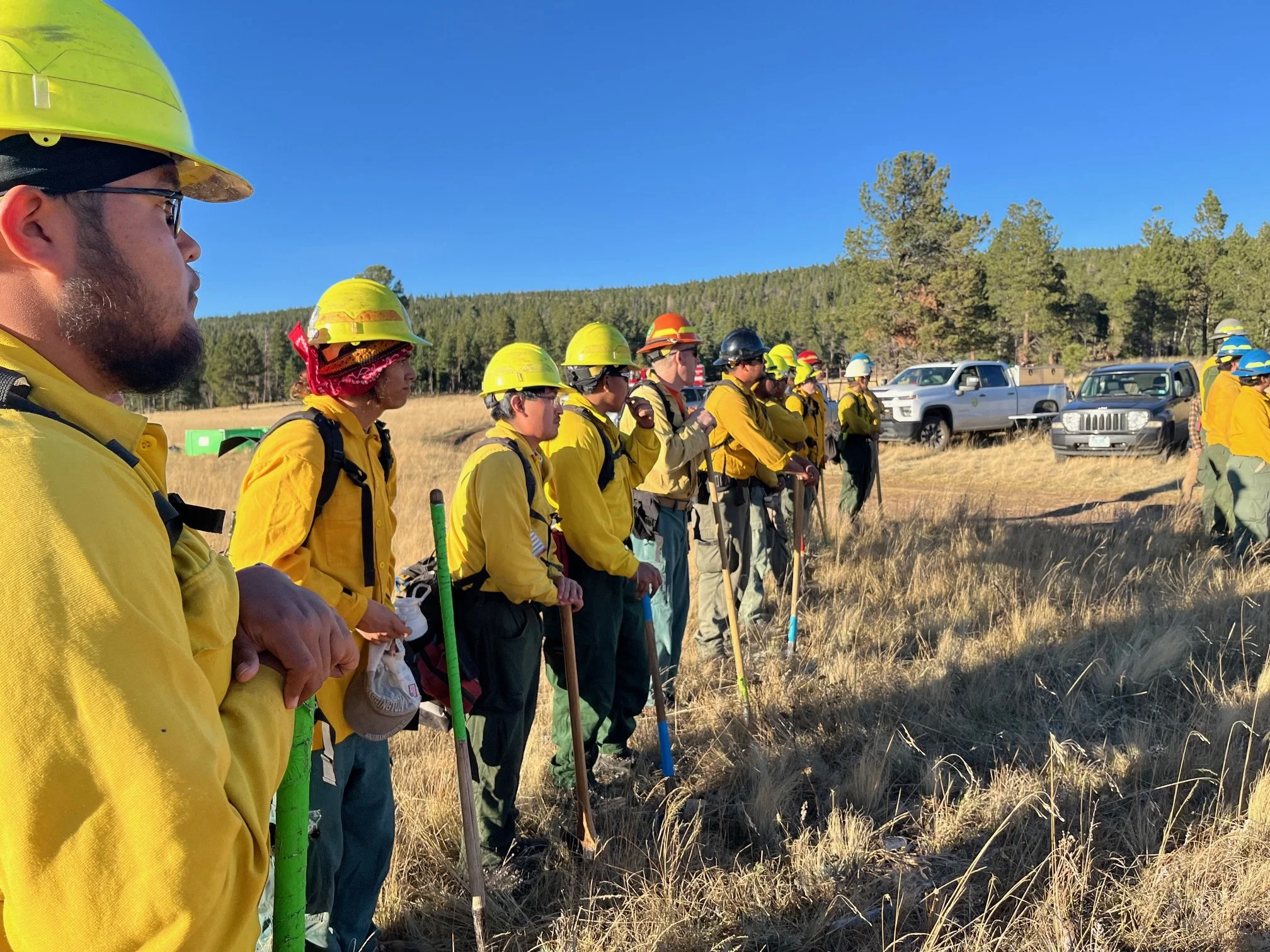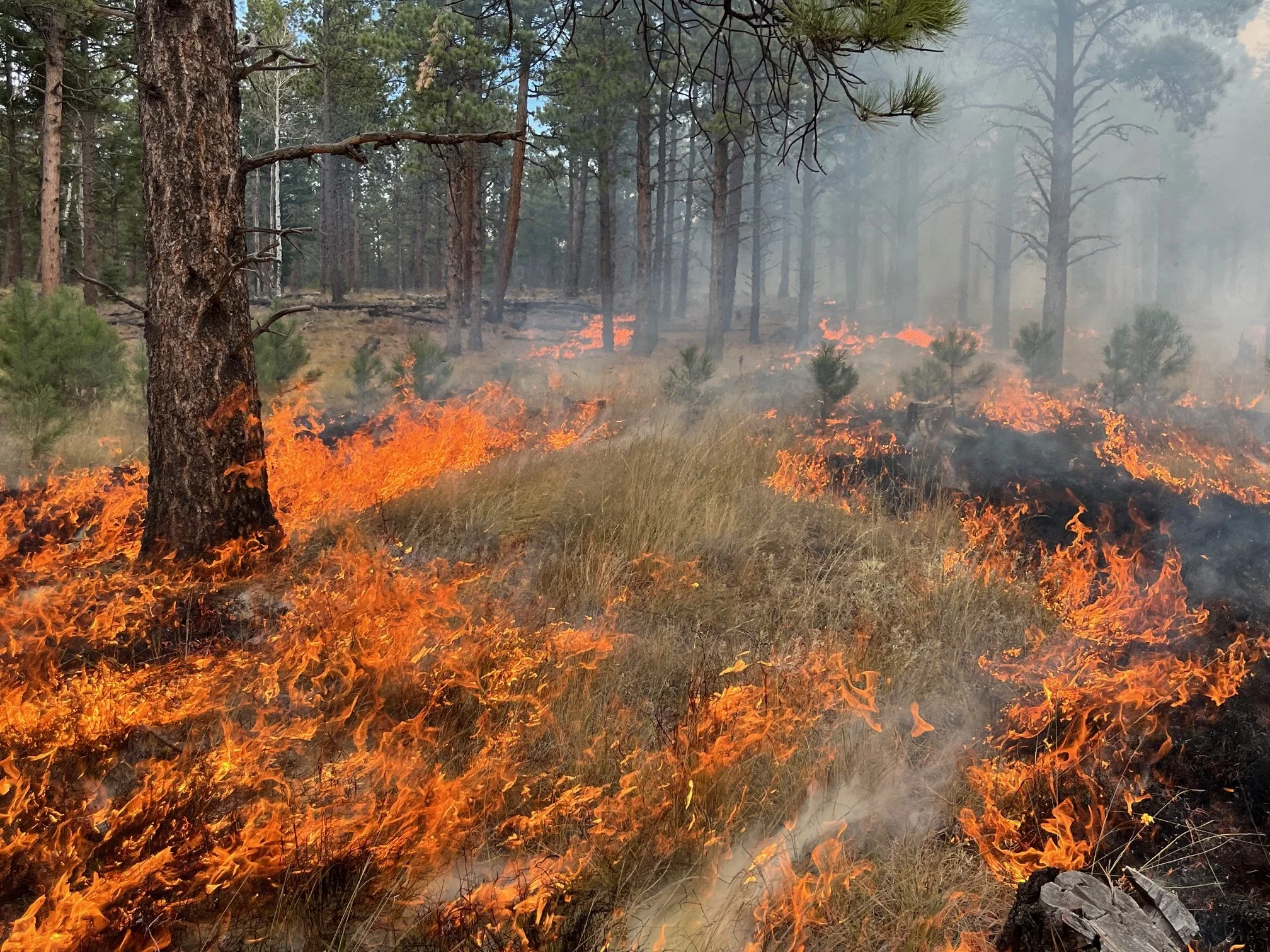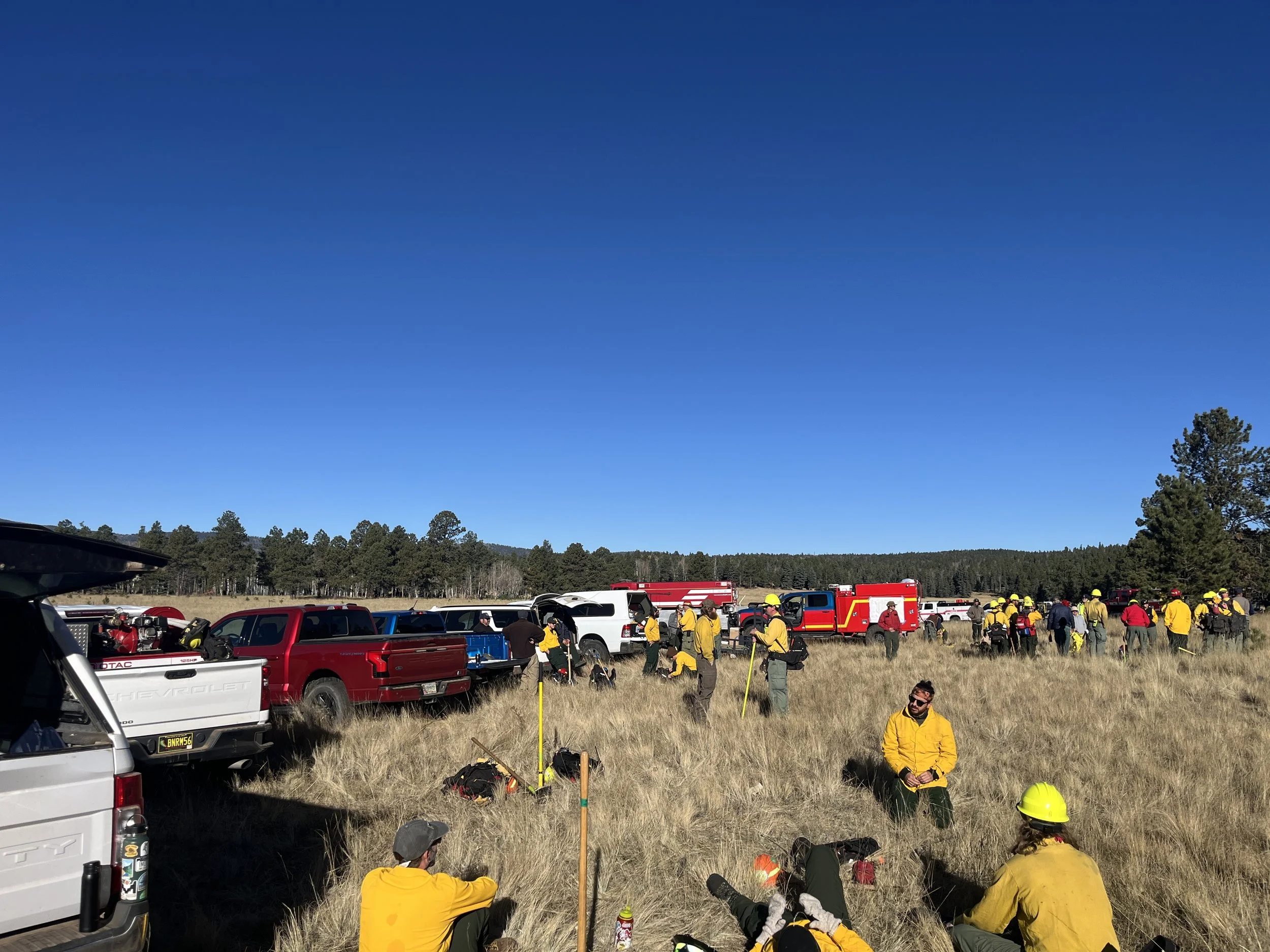
Continued pile burning at Glorieta Camps

Glorieta Camps Winter Pile Burning to Continue with Arrival of Snow on January 25th

Glorieta Camps and the Forest Stewards Guild plan to take advantage of favorable weather conditions and continue prescribed pile burning at Glorieta Camps on Sunday, January 25, 2026. This burn will be implemented by the All Hands All Lands Burn Team’s Pile Squad, a program of the Forest Stewards Guild.

Up to 74 acres of piles will be treated with hand ignitions by trained and qualified firefighters working within the parameters of an approved and permitted burn plan. All burn operations will occur with snow on the ground and piles will be patrolled until they are completely out. This prescribed pile burn is a part of a long-term and science-based commitment by Glorieta Camps to improve forest health and reduce the risks wildfire poses to communities, forests, and watersheds.

Smoke and flames may be visible due to the proximity of the site to I-25 and Glorieta. Smoke may be visible from Pecos, La Cueva, and Eldorado. The Forest Stewards Guild works closely with the New Mexico Environment Department (NMED) and the New Mexico Department of Health (NMDOH) to monitor air quality during the burn and limit the severity of smoke impacts. This prescribed burn is happening in the context of the Greater Santa Fe Fireshed Coalition landscape. The Fireshed Coalition supports a HEPA Filter Loan Program so that smoke sensitive individuals can borrow a filter for the duration of the impacts.

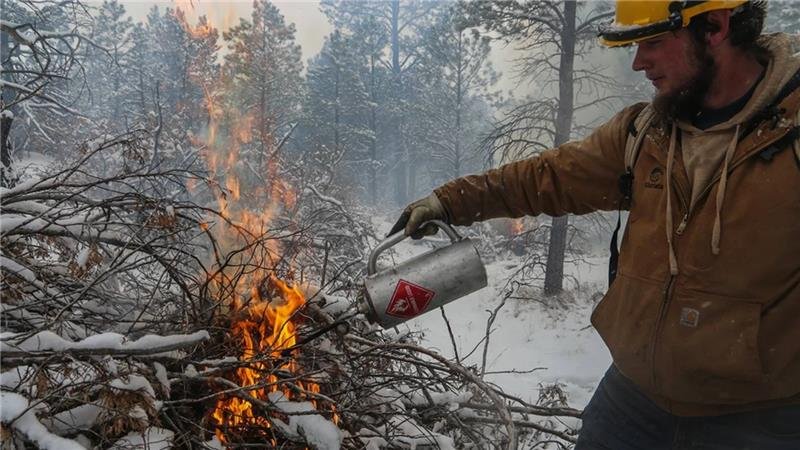
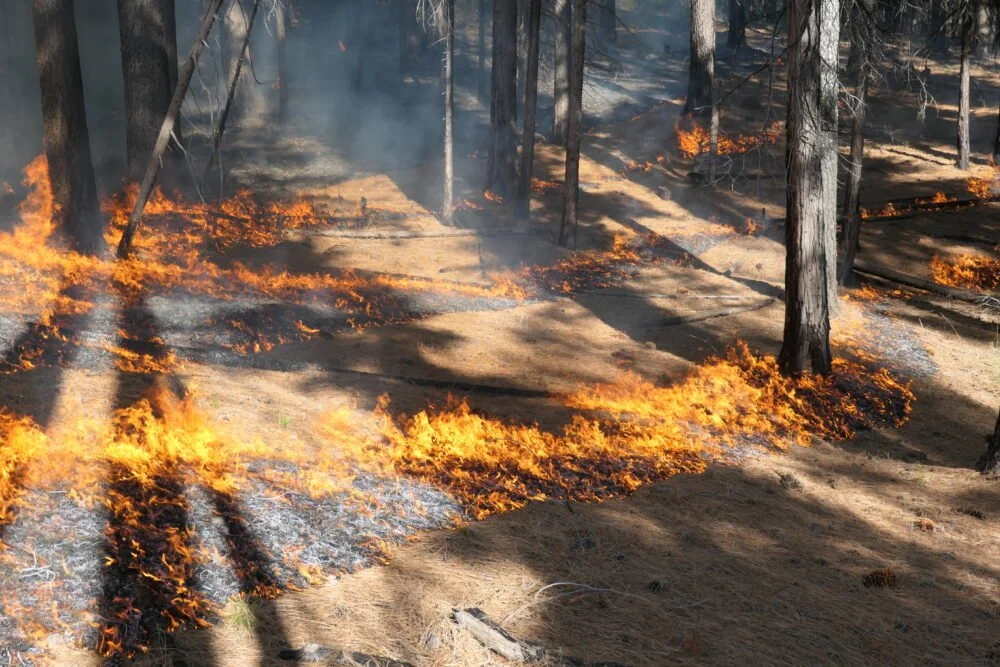
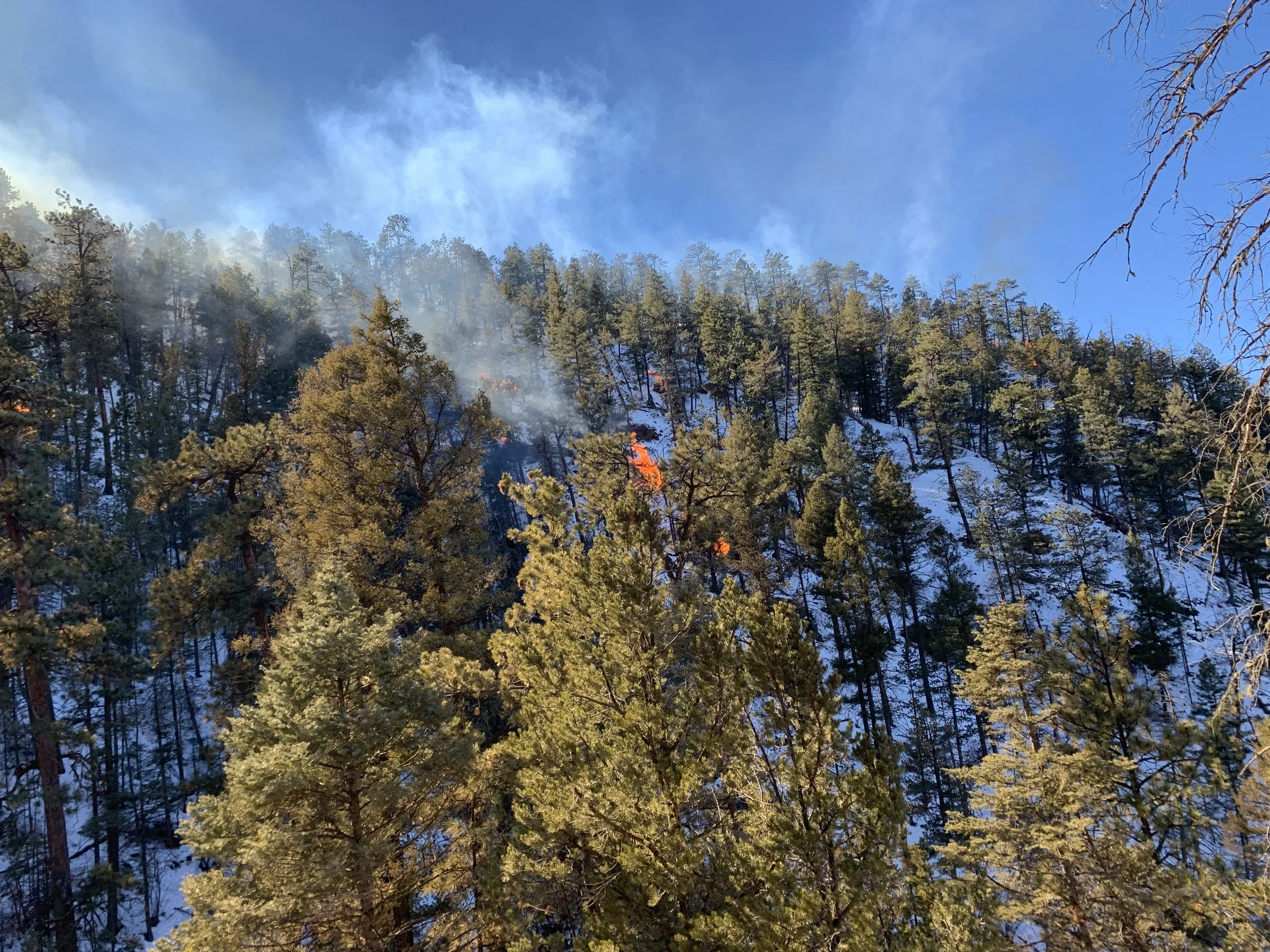
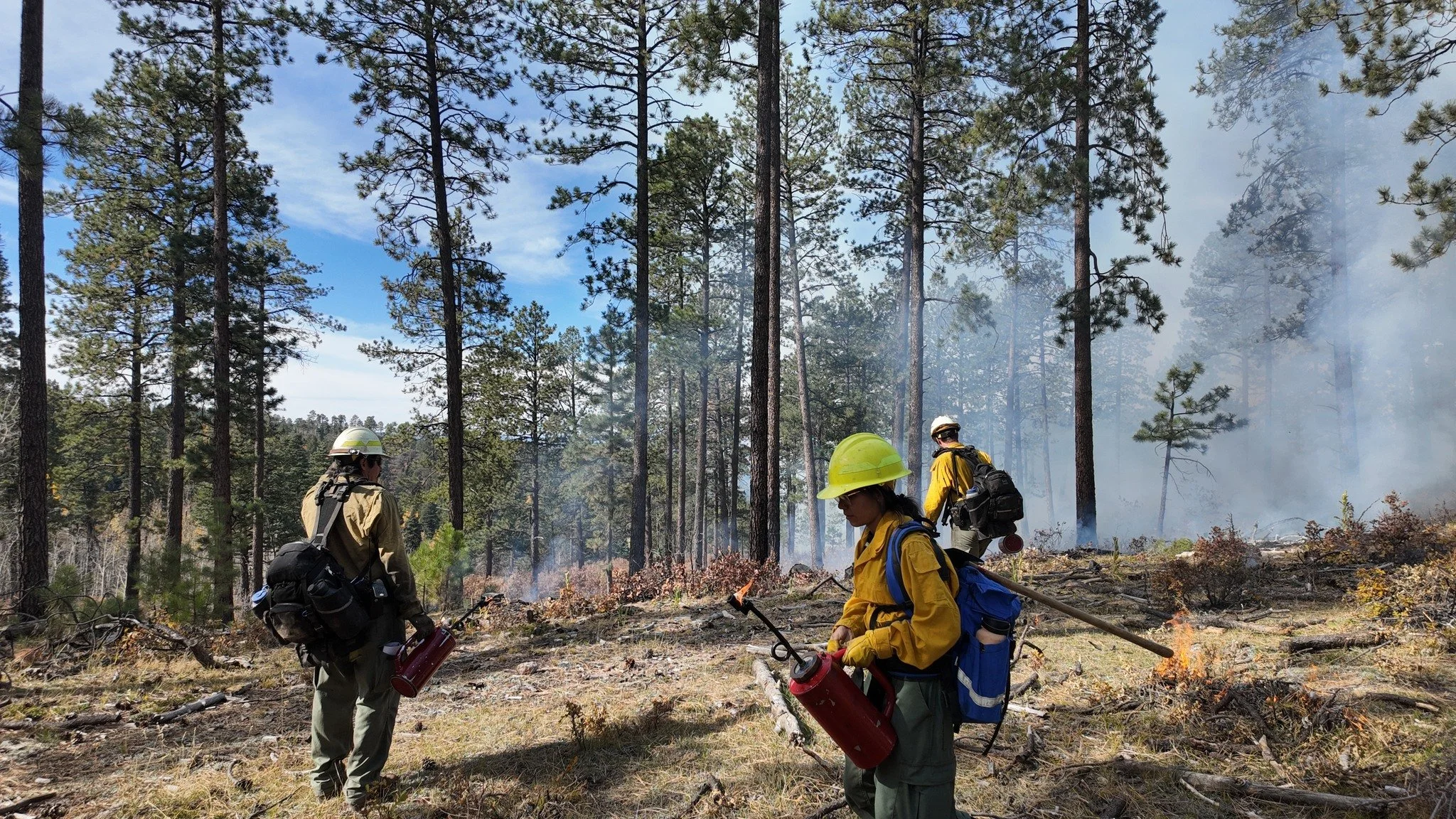
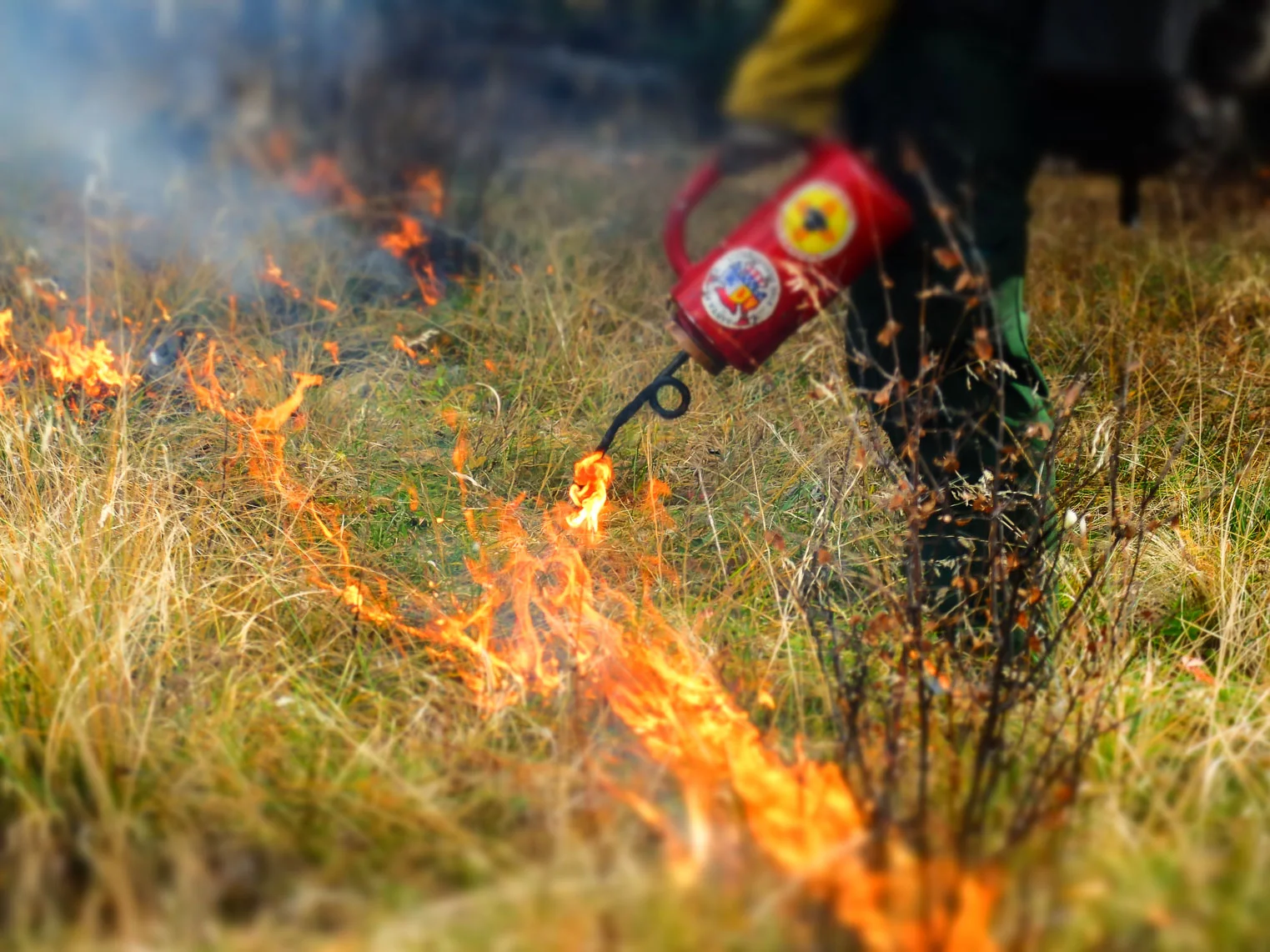
An employee of Glorieta Adventure Camps uses a drip torch to light a pile.
Click here for the full press release.

Want to learn more?

Wildfire Wednesday #176: Evaluating the Effects of Fire (FEMO)

Happy Friday, Fireshed folks!

Land managers, fire personnel, private landowners, and others all work, in varying capacities, to care for the land under their jurisdiction. However, caring for the land can mean different things, to different people, in different places. We live in a fire-adapted environment, so fire (prescribed or wildfire) is one consideration when thinking about caring for and managing the land.

It all begs the question - how do we understand the effects of our land management decisions? How do we improve our management of wildfire, intentional fire, and fire-adapted ecosystems? This is where monitoring (observing and tracking changes in ecosystems over time) and observations-based adaptive management comes in. For fire specifically, we can monitor fire effects (the way that fire changes the area it burns through) to understand the conditions and tools used to influence fire outcomes. Today’s newsletter dives deeper into the what, where, and why of Fire Effects Monitoring.
This Fire Friday features:

Be well,
Rachel


Fire Effects Monitoring: the Basics

What is Fire Effects Monitoring?

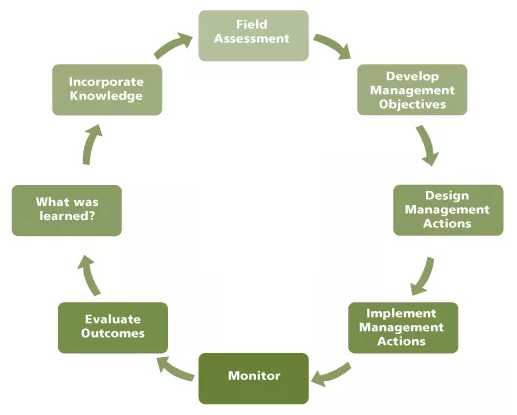
A visualization of the adaptive management cycle.
Illustration credit: National Park Service.

Fire effects monitoring is a term used to describe the observation and evaluation of landscape conditions before, during, and after fires. It helps us understand how those fires impact ecosystems, assess management effectiveness, ensure firefighter safety, and guide future land management decisions (a process called adaptive management).

Why is it done?

  • Safety: observations provide real-time information on fire behavior, spread, perimeter location, and changing conditions that can impact these things for tactical decisions during burns.

  • Effectiveness: monitoring measures ecosystem health, damage, and benefits over time, providing unbiased data that can be used to evaluate if fires meet hazardous fuel reduction/ecological goals or otherwise improve ecosystem health and function.

  • Knowledge: knowing real-world fire effects provides actionable data and lessons learned for adaptive management, providing suggestions for improvement on future burns.

Who does it?

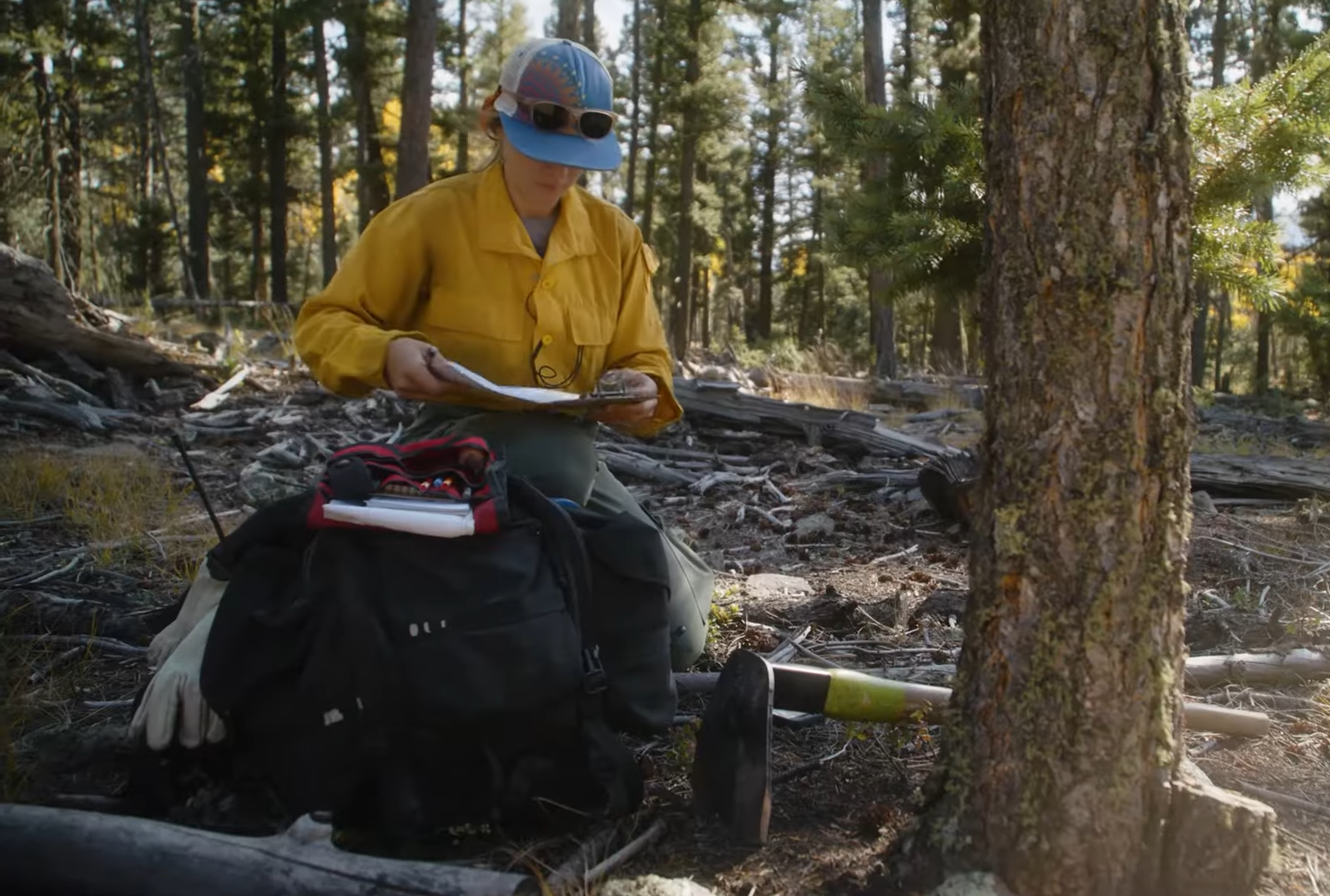
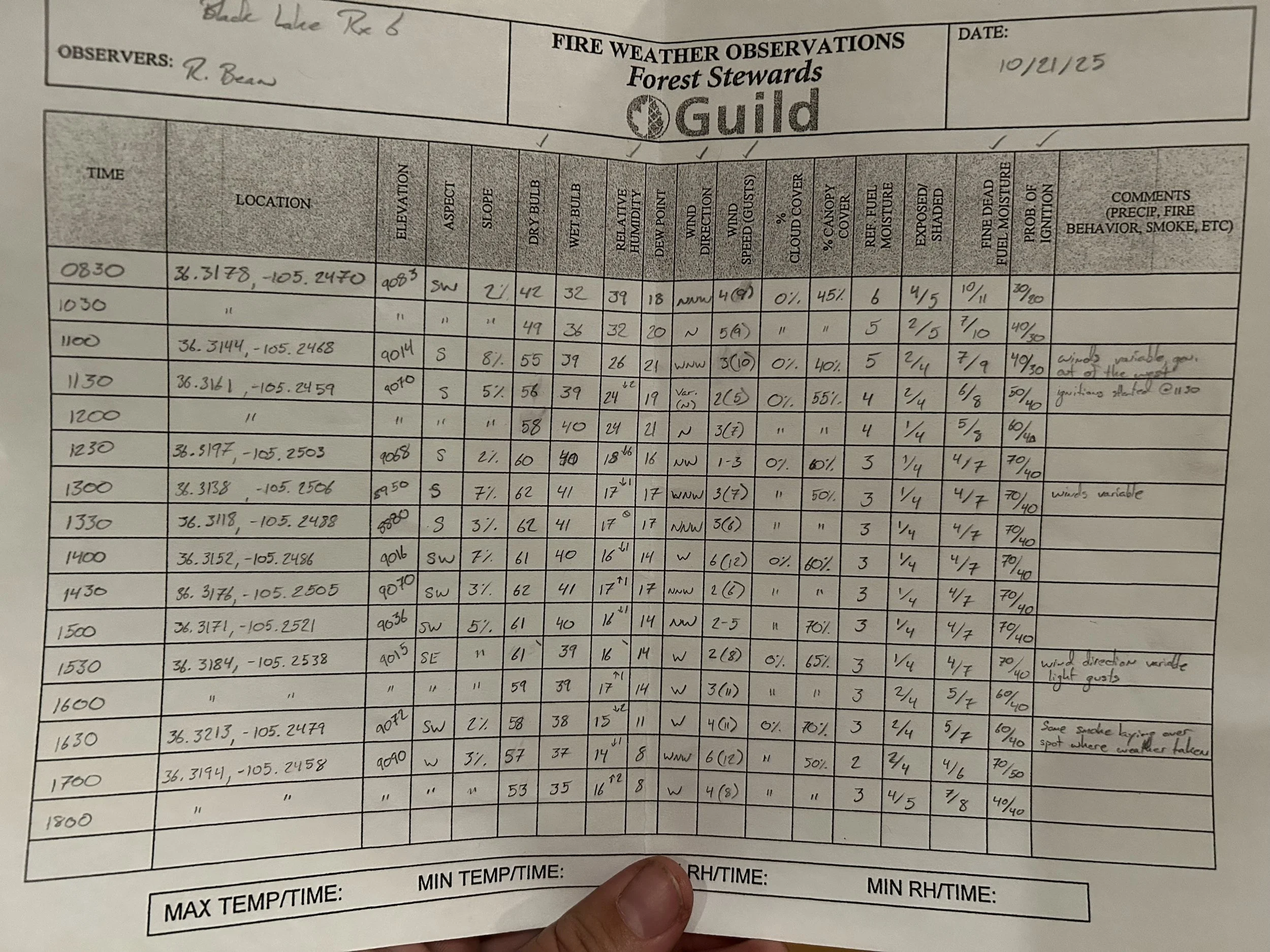
A fire effects monitor records on-site weather data (temperature, relative humidity, wind, etc.) prior to ignitions on a prescribed burn. Having up-to-date weather and conditions information allows burn managers to make the best decisions about how, where, and if to light a burn. In this photo, a red pocket kit with scientific tools for measuring weather parameters can been seen sitting on top of the FEMO’s fire pack.

Fire Effects Monitoring Officers (FEMOs), also called Fire Effects Monitors, collect data to inform their team’s understanding of what fire is doing and changing on the ground and help managers assess safety and achieve objectives. They are individuals who have experience with fire and have received training on how to measure and evaluate the different metrics necessary to determine fire effects. Depending on their affiliation, these Monitors will follow different Fire Effects Monitoring protocols and focus on collecting different data. For example, Monitors with the National Park Service regularly and frequently collect in-depth environmental data from specific locations (called plots), allowing them to directly compare pre-fire conditions to post-fire measurements (check out the NPS monitoring handbook for more information). Monitors with the U.S. Forest Service generally focus on providing their personal observations of wildfires to their module leader, crew boss, or other fireline supervisors to inform safety, suppression, and tactical decisions. Monitors with nonprofits, universities, and other organizations will tailor monitoring protocols to their unique needs, or the needs of each individual burn (e.g. focusing on smoke observations during a prescribed burn to ensure that nearby communities are not being unnecessarily impacted).

What is collected?

FEMO data collection can include measurements of fuel (amount and condition of flammable material), fire behavior, weather, smoke, and environmental effects on vegetation and fuels. On wildfires, monitoring helps maintain tactical situational awareness for the safety of fire crews and determine whether the team is achieving incident goals. On intentional (prescribed or controlled) burns, monitoring helps to ensure that fire behavior and effects remain within the range of conditions allowed by the prescription (the fire plan which establishes objectives, desired effects, and allowable fire behavior). Some data, like weather observations and fire behavior and spread, will generally be collected daily for each day that the fire is active, while other data, like measurements of fuel and vegetation moisture or amount of fuel consumed, will be collected less frequently. The type and frequency of data collection is based on incident management needs, reporting requirements, and objectives.


How FEMO Findings Are Used

So what happens to all of this monitoring data?

During a burn, a FEMO’s observations may be used to improve the SPOT weather forecast (a location-specific hourly weather forecast from NOAA) or help the burn boss (individual overseeing a prescribed burn) understand whether they are meeting their burn objectives. This can help the whole team adjust their actions and be immediately reactive to improve outcomes in the short-term (while a fire is ongoing).

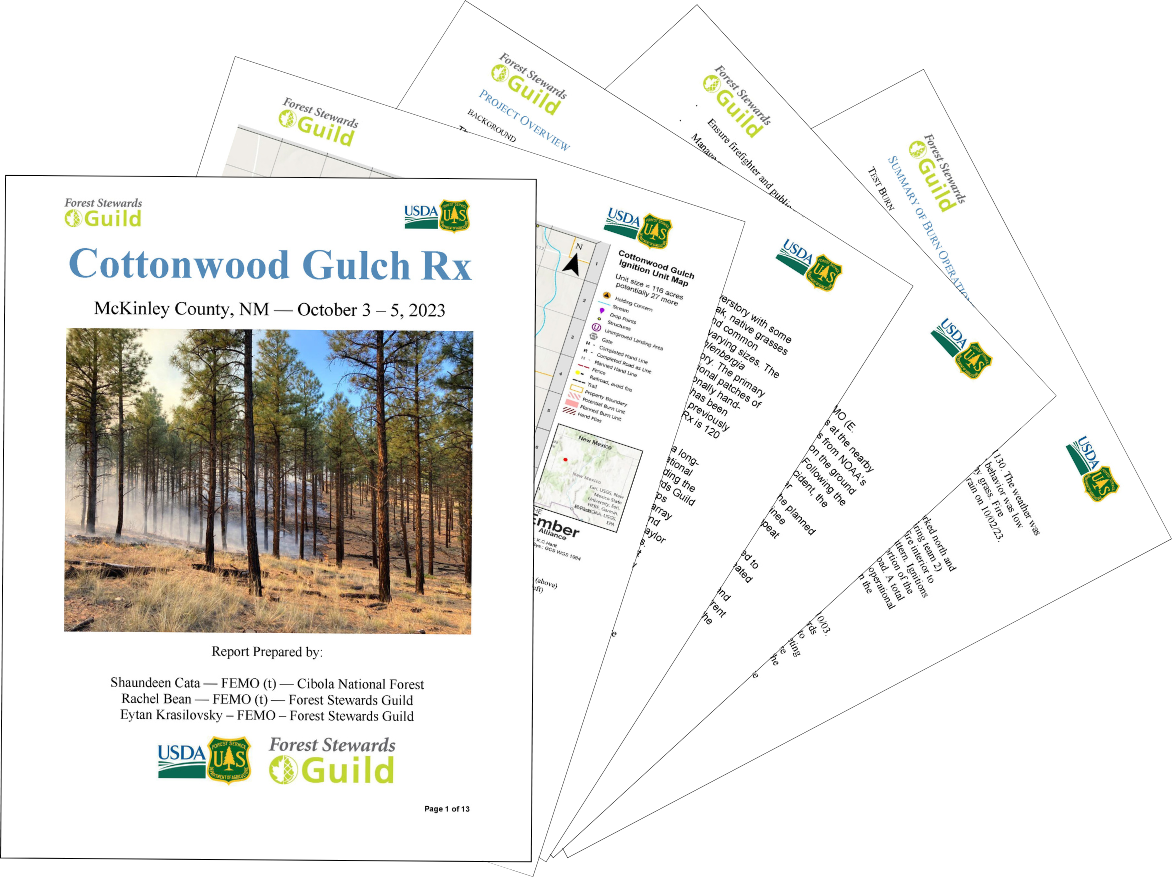
An example FEMO report from a prescribed burn in west-central New Mexico. The contents of the report will vary based on landowner needs and the individual writing the report, but they will generally contain maps and background on the burn, objectives and methods, a summary of the burn activities and weather, and detailed information on the burn behavior, smoke, and fire effects.

After a burn, FEMO observations may be summarized into a report which is shared with all incident leaders and partners. FEMO reports provide a clear and fully encompassing written record of a fire’s background, timeline, effects, and lessons learned. They can be referred to after the fact, allowing fire practitioners and managers to see the big picture, learn from their mistakes, and adapt their approach for the next burn, leading to better outcomes in the long term. (e.g. A fire manager might see that fuels reduction objectives were not met because the temperature was low and humidity was high, moderating fire intensity and behavior. From this they could learn that they’ll need to burn that area a little hotter next time to consume the slash and woody debris they want gone.)

FEMO reports can also be shared with external partners and agencies, contributing to collective and collaborative knowledge sharing. As lifelong students of fire there is always something to learn from others’ experiences.


Ecological Benefits of Fire

Periodic, low- to moderate-intensity fire can have many positive effects across ecosystems. Keep reading to learn more or click on any of these resources to dive deeper.

“Cleans” the forest floor

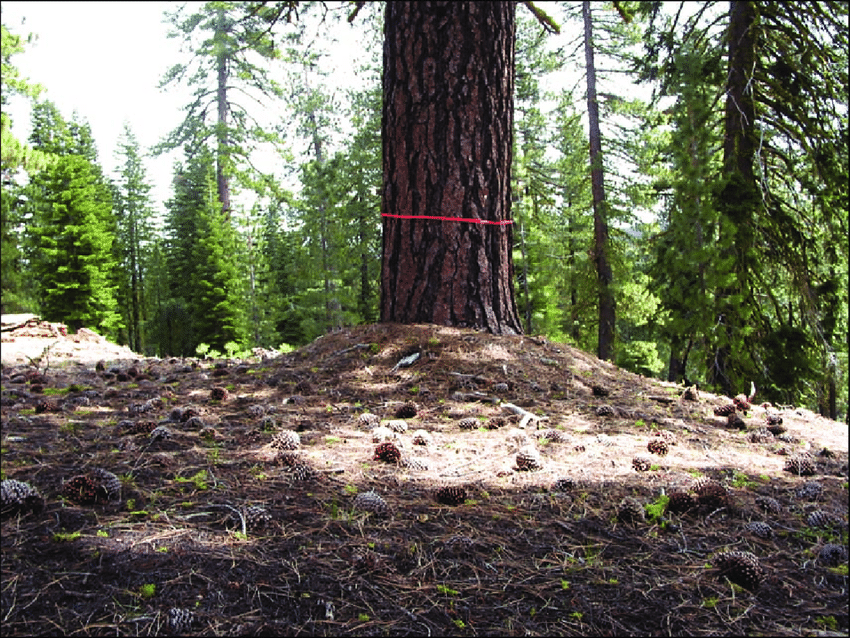
Deep duff, or pine needles and other forest debris, can be seen piled at the base of this fire-adapted ponderosa pine tree following decades of fire suppression and interruption of the natural fire cycle. Reintroduction of fire to these systems can “clean up” the forest, cycle nutrients back into the soil, and help restore resilience to severe fire, drought, and pests and disease.

  • When fire travels through the forest understory, it removes the topmost layer of leaves, needles, and dead or decaying plants. By removing this debris, it opens up space on the forest floor where growth of new plants is encouraged and reduces the amount of fuel that could burn in a future fire, therefore reducing the likelihood of negative future outcomes.

  • Returns nutrients to soil

    The relationship between fire and soil nutrients is complex because of the interactions among many factors. Some soil nutrients will be lost as a low- to moderate-intensity fire consumes organic material in the upper soil layers (greater nutrient losses occurs with higher fire intensity). However, in the long-term fire helps to kickstart the nutrient cycle (the amount of available nutrients in an ecosystem) by increasing soil nutrient turnover rates and redistributing nutrients through the soil profile. For example, soil fertility increases after low-intensity fire as the fire chemically converts nutrients in dead plants that would otherwise take much longer to decay and return to the soil.

  • Increases diversity

    When fire is removed from or suppressed in fire-adapted forests, it leads to over-crowding (trees growing thick and dense) and prevents sunlight from reaching the forest floor, creating intense competition for water and available nutrients. Low- and moderate-intensity fire creates gaps in the canopy, allowing sunlight to filter through and (after several years) increasing the availability of soil nutrients and water. The right kind of fire can also reduce invasive/noxious weed infestations, allowing an opportunity for native plants to grow and establish. Some native species require fire for seed germination!

  • Creates new habitat

    Fire removes thick brush, maintains open meadows, and thins out dense forests, all creating new habitat for animals and birds. Trees that do not survive the fire create new habitat for insects and cavity nesting birds and animals. When a fire burns in a mosaic pattern (burns at variable intensity and severity depending on the terrain and conditions), it creates a diverse patchwork of habitat for different species of wildlife.

  • Kills pests and diseases

    Fire can reduce or eradicate populations of beetles, mites and other harmful pests, reducing disease and keeping forests healthier.

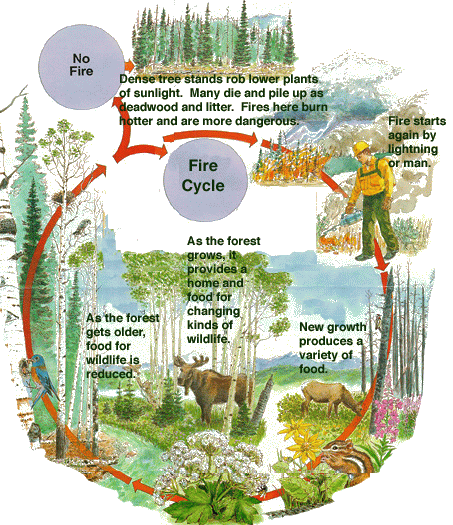
The fire cycle, simplified.
Photo credit: Harvey Mudd College


Additional Resources

Upcoming Webinars

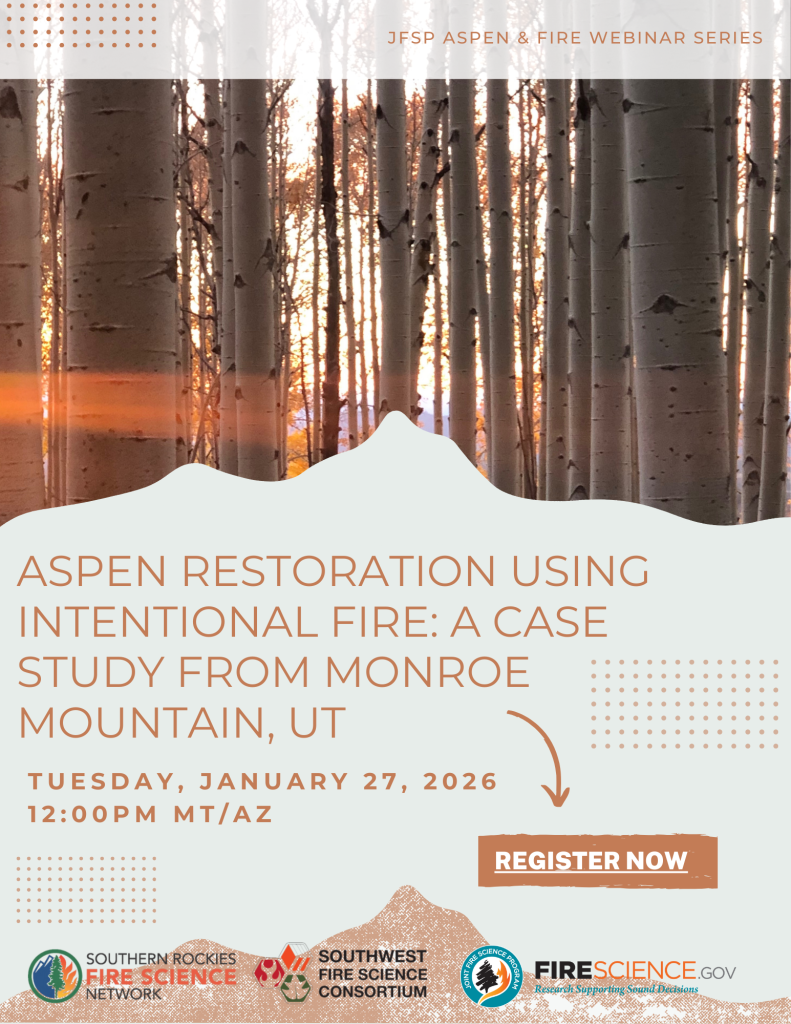
27 January, 12pm MT: Aspen Restoration Using Intentional Fire: A Case Study from Monroe Mountain, UT
This webinar from the Southwest Fire Science Consortium and Southern Rockies Fire Science Network will offer information on an aspen restoration case study from south-central Utah which used high-intensity, high-severity prescribed fire coupled with conifer thinning to improve aspen ecosystem health.

Register Now

4 February, 11:30am MT: Loss of Old-Growth Forest to Fire
Fire suppression and past selective logging of large trees have fundamentally changed frequent-fire-adapted forests. In this Prescribed Fire for Forest Management series webinar, speaker Scott Stephens will discuss the multiple pathways for achieving success in management of mixed conifer forests, with a focus on the Sierra Nevada Mountains.

Join Link

10 February, 11am MT: Fuel Break Effectiveness: What Have We Learned So Far?

Jen Croft, Stephen Filmore, Mark Finney, Kit O’Connor, Brad Pietruszka and Erin Belval will be the panelists for this webinar in the USDA Forest Service Research & Development Deep Dive Panel Discussions series. This series is intended for fire, fuels and land managers on critical topics associated with fuels and fire management.

Register Now

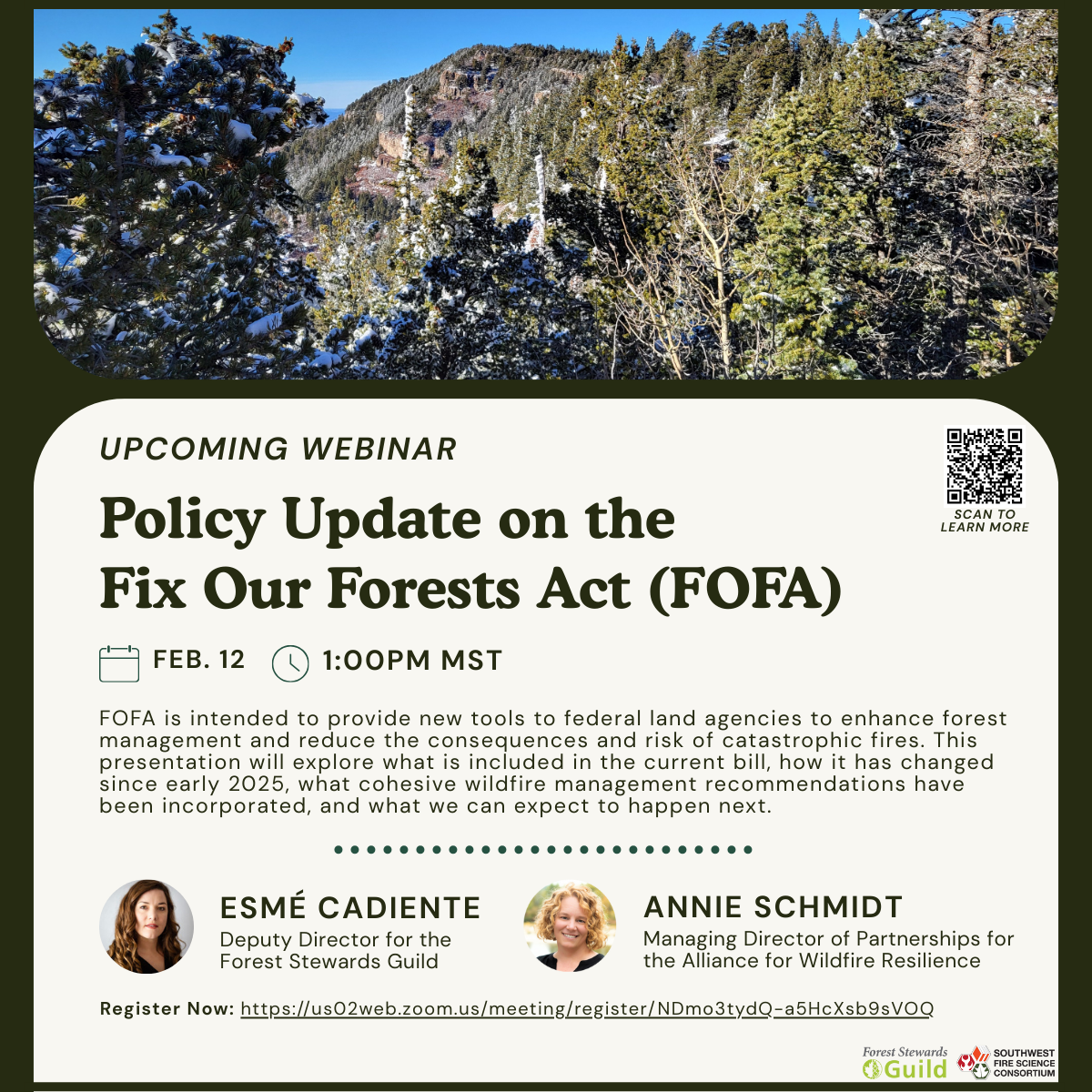
12 February, 1pm MT: Policy Update on the Fix Our Forests Act (FOFA)
This policy update presentation from the Forest Stewards Guild and Southwest Fire Science Consortium will provide insights into the Fix Our Forests Act, including the uptake of wildfire management recommendations to congress and the potential impacts on federal land management agencies and the forests they oversee.

Register Now

…………………………………………………..

Resources

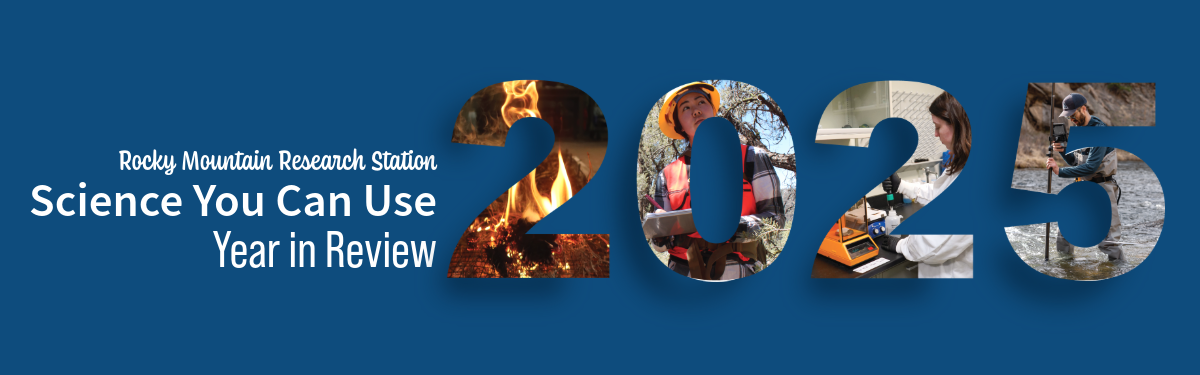
Annual Round Up: Science You Can Use
2025 marked another year of impactful science from the USDA - Rocky Mountain Research Station. Now, all of their bite-sized and information-packed Science You Can Use bulletins, fact sheets, and more from the past year are available in one place, from bees to beavers and biochar to smoke! To listen instead, you can now stream their science.
Click here to view a multi-year archive of science briefs from the RMRS.

View the 2025 collection

Opinion Article from the NM State Forester: Wildfire prevention costs less than suppression
In this article, New Mexico state forester Laura McCarthy calls wildfire prevention “suppression’s undercover partner” and identifies the three fronts for fire prevention: public awareness and early detection, fuel treatments, and individual defensible space and home hardening action. You can learn about the difference between fire prevention and fire suppression in Wildfire Wednesday #107.

Read the article

…………………………………………………..

Funding

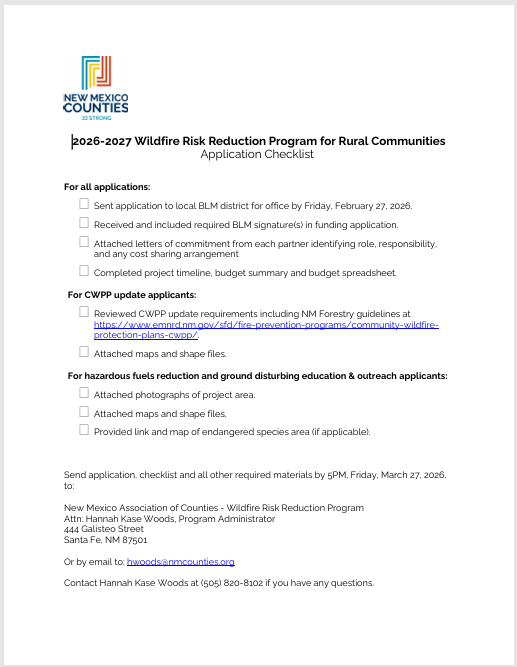
New Mexico Counties is pleased to announce the 2026-2027 Wildfire Risk Reduction Program. The grant program assists communities throughout New Mexico in reducing their risk from wildland fire on non-federal lands. Funding for this program is provided by the National Fire Plan through the Department of the Interior/Bureau of Land Management for communities in the wildland-urban interface and is intended to directly benefit communities that may be impacted by wildland fire initiating from or spreading to BLM public land. 

 Funding categories include:

  • CWPP updates up to $30,000/project

  • Education and outreach activities up to $20,000/project

  • Hazardous fuels reduction projects up to $100,000/project

The application and checklist are located on the NMC website: https://www.nmcounties.org/services/programs/

Click to view the application packet
Click to view the application form

Pile burning in the Santa Fe National Forest (Week of Jan. 5)

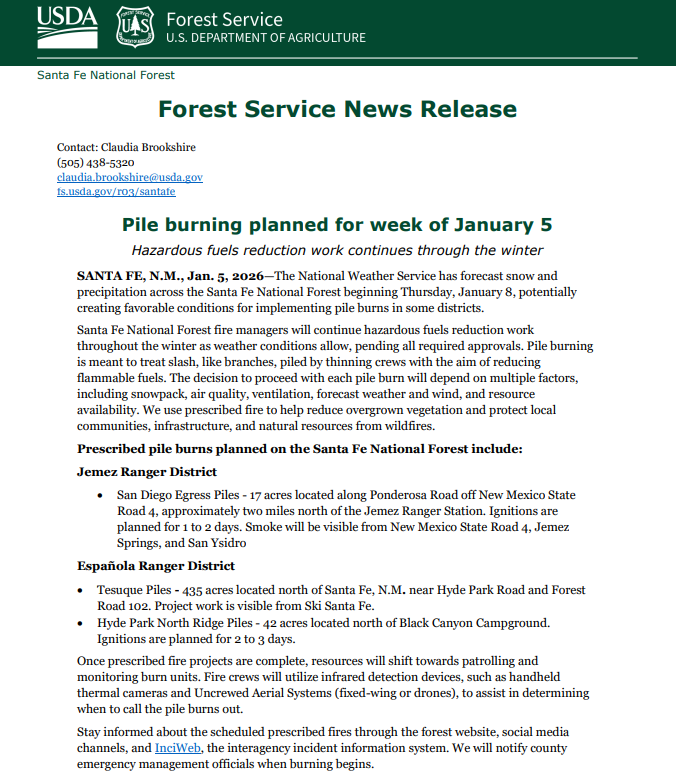
The Española Ranger District of the Santa Fe National Forest plans to burn piles in the Tesuque Creek area Jan. 8-9th (snow dependent).

After igniting the piles, fire crews will continue work to secure and then patrol the piles over the weekend and beyond. Patrols will continue until no smoke or heat are detected on the unit from hand cold-trailing by on-the-ground crews or infrared technology. The burn will not be declared out until infrared flights detect no heat.

To mitigate smoke impacts, ignitions will end around by mid-afternoon if ventilation is poor.

The purpose of this pile burn is to increase resiliency of the forest to high-severity wildfire as well as drought and insect and disease outbreaks (such as the visible recent Douglas-fir tussock moth outbreak). Projects like this will also protect our water from the Santa Fe Municipal Watershed and surrounding watersheds that are currently threated by high-severity fire.

Want to learn more?

Photos from collaborative pile burning in previous years in the Santa Fe National Forest (in Pacheco Canyon). Photo Credit: Forest Service

Click below to read the Forest Service news release:


Wildfire Wednesday #174: Lessons from Large Urban Conflagrations

Historically, most wildfires in the United States occurred between May and November with peak fire season happening in August when conditions are hottest and driest. However, as weather patterns change, temperatures rise, drought events increase, and pests, disease, and invasive species make forests more vulnerable, wildfires outside of the traditional fire season have become more common over the past two decades. Since 2017, some of the most destructive fires in the western U.S. have burned outside of that typical fire season (Thomas Fire, CA; Marshall Fire, CO; Smokehouse Creek Fire, TX; Palisades/Eaton Fires, CA). Many of these have been fueled by unseasonable or long-lasting (and often record-breaking) heat and strong winds, causing explosive fire growth. Recovery from these fires takes years to decades and the landscape, and the communities impacted, will be permanently changed.

As we approach the one year anniversary of the LA conflagrations (the Palisades and Eaton Fires) and consider the changing reality of large destructive fire events, the question becomes what we can learn from past fires - how they burned, how fire personnel and emergency managers responded, how communities faired, and how we have or have not been able to recover - to inform and improve how we live with and prepare for fire in the future.

This Fire Friday features:

Have a peaceful and restful end to your year,
Rachel


Lessons from recent large urban conflagrations

One key aspect of what made the 2025 LA urban conflagrations - the Palisades and Eaton Fires - so intense is that they burned under red flag conditions (strong winds, low relative humidity, and dry fuels) which indicate an increased potential for extreme fire behavior and rapid fire growth. During the first five hours following ignitions, these fires were burning under environmental conditions which exceeded the extreme fire behavior thresholds of 2-minute sustained wind speeds exceeding 20 mph, peak 5-second gusts exceeding 30 mph, and relative humidity below 15%. These conditions meant that vegetation was dry and ready to burn and very high winds pushed the fires further and faster than firefighters could respond.

Anne Cope, an Institute for Business and Home Safety staffer who helped write the findings report on the LA Conflagrations, notes that “each wildfire event reminds us communities must prepare for the few days a year of dry hot winds — not the calm of everyday life. When fires ignite on the worst days, these winds push embers, flames and heat into entire neighborhoods. But the science is clear – when communities work together, we can disrupt the path of conflagration.” Below are some key takeaways from that report which may inform or reinforce our preparedness priorities and actions.


Individual preparedness

  • Nearly all aspects of the potential for structure ignition fall into two primary categories: the building materials used to construct the exterior of the structure and the intensity of fire exposure from the surrounding environment. The latter is closely correlated with connective fuels and the distance to surrounding fuel (e.g., decks, shrubs, sheds, or structures). (pg. 18)

    • When connective fuels allow the fire into close proximity of the structure, vulnerable components - windows, decks, and open eaves - provide the initial ignition points that determine a structure’s outcome. (pg. 57)

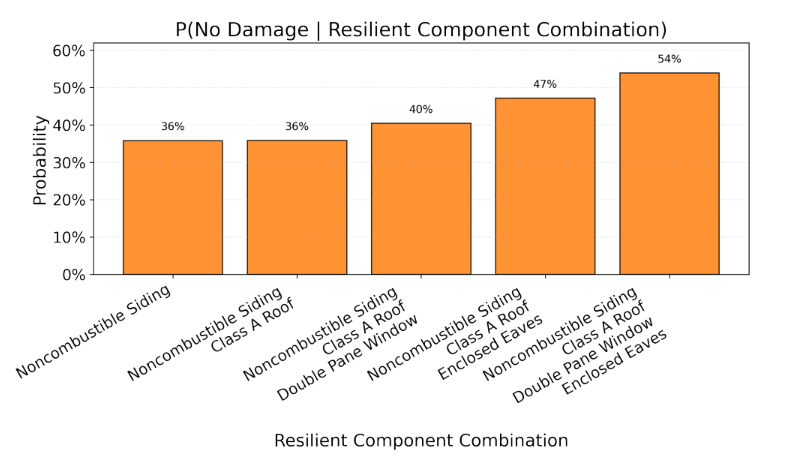
Probability of a structure remaining undamaged with an increasing number of resilient building component characteristics, showing an increasing trend in survival likelihood with greater mitigation. Analysis based on DINS data from both the Palisades and Eaton Fires.

  • Mitigation only works as a system, and partially executed mitigation strategies allow fire pathways and vulnerabilities to persist. Most homes exposed in the Palisades and Eaton Fires featured at least one resilient component, with noncombustible siding and Class A roofs being the most common (enhanced resistance to radiant heat and direct flame contact) and ember-resistant mesh screens on vents being the least (left these openings vulnerable to ember exposure). Many structures also had inconsistent resilience in different parts of their Zone 0 (e.g. a noncombustible pathway around three sides with vegetation and flammable furniture on the fourth side) which increased their vulnerability to near-structure flame exposure. These partial resilience improvements left major vulnerabilities, highlighting that resilience must be evaluated as a system of building components and defensible space. A structure is only as resilient as its weakest component. (pg. 45)

    • As the number of resilient components increases (e.g. noncombustible siding, Class A roof, double-pane windows, and enclosed eaves) the probability of experiencing no damage increases from 36% to 54%, demonstrating effectiveness of using systems-based home-hardening. These findings underscore the importance of establishing minimum performance requirements through parcel-level building codes.

    • This parcel-level approach is especially important in typical suburban neighborhoods, where maintaining more than 30 ft of separation between structures is often not feasible. Where structural density cannot be reduced in suburban environments, the building materials and connective fuels—especially those closest to the structure—become even more important. (pg. 4)

The zone immediately surrounding the home (Zone 0) is the most impactful place to make improvements.

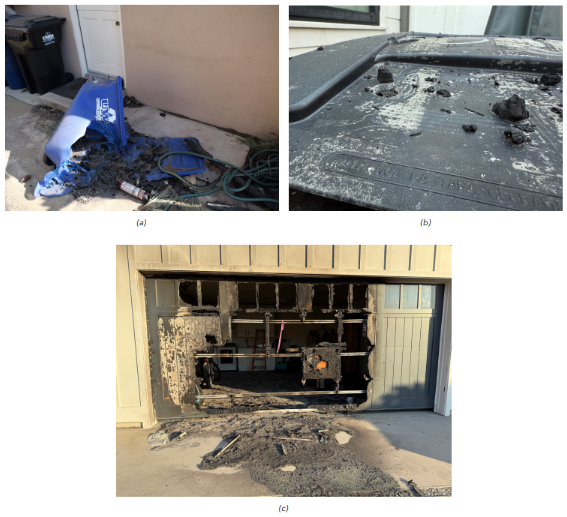
  • Some types of fuel commonly observed within Zone 0 can unexpectedly threaten structures under extreme fire conditions. In the communities impacted by the Eaton and Palisades Fires, trash bins, hot tubs, furniture, vegetation, and more within 5 feet of homes created ignition pathways (bins caught fire which then ignited the adjacent structure) and caused damage. In these cases, the primary combustible component was not the plastic bin itself but rather its contents inside. (pg. 32)


(a) Partially consumed trash bin with consumed contents. (b) Embers accumulated on top of a trash bin with holes created by embers. These holes create pathways for fire to reach the contents of the bin. (c) Consumed trash bin that ignited an adjacent garage as it burned.


  • No plant, regardless of its flammability rating, is fireproof, and even well-maintained, well-hydrated vegetation can be rapidly dried to the point of ignition due to the intensity and duration of fire exposure during the extreme fire behavior scenarios of a conflagration. This burning vegetation close to homes can then compromise the building’s integrity when combined with other forms of exposure. (pg. 30)

  • Many studies have shown that fences built out of combustible materials, such as wood or latillas, can enable fire to move through communities; the use of noncombustible fences (e.g. metal or chainlink) reduces the potential for fire spread, particularly for fences that touch the home. However, in LA vegetation that caught fire was observed growing up or through noncombustible fences, reducing or eliminating the resilient effect of the noncombustible fence material. (pg. 35)

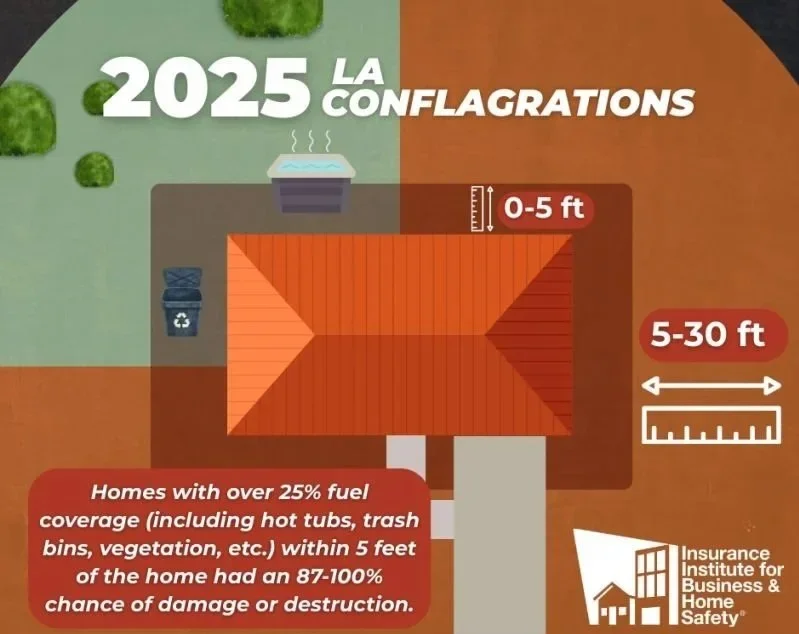
  • Even if homeowners reduce fuels in the zone that is 5-30 feet away from the home (Zone 1), structures with dense fuel coverage - greater than 25% - in Zone 0 are almost guaranteed to sustain damage or destruction (probabilities exceeding 87%). Overall, reducing fuel coverage both in Zone 0 and Zone 1 to less than 25% produces a meaningful reduction in the probability of damage or destruction to structures. (pg. 55)

    • Resilient building components offer limited benefit when heavy fuel loads remain close to the structure. (pg. 57)


Community preparedness

  • Firefighter effectiveness is strongly impacted by community design. (pg. 26)

    • Neighborhoods with high structure density and limited separation distances are likely to experience multiple near-simultaneous ignitions, quickly overwhelming suppression capacity. Communities with tight structure spacing and dense connective fuels have amplified fire risk exposures between homes and reduced effectiveness of defensive actions (fire suppression and structure protection).

    • The presence of defensible space increases the effectiveness of defensive actions (e.g. during the Eaton Fire, homes threatened in Kinneloa Mesa were reported to have good defensible space, which allowed Los Angeles County Firefighters to effectively defend them).

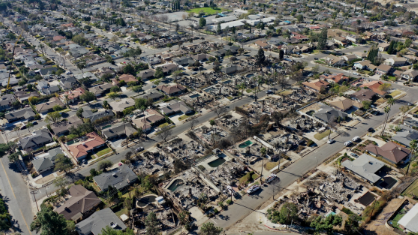
Structure-to-structure fire spread in Altadena, California following the Eaton Fire.

  • While parcel-level mitigation is necessary, it is not always sufficient to prevent large-scale loss, particularly under extreme fire weather conditions or in densely built neighborhoods. Post-conflagration studies have shown that structure separation, connective fuels, and building materials are the three central pillars of risk, with structure separation and connective fuels controlling the intensity of heat exposure and building materials defining a structure’s capacity to resist it. (pg. 51)

    • Even structures with 4 resilient building component characteristics but which have less than 10 ft of separation have a greater than 50% chance of being damaged. When the space between structures is less than 10 ft, the likelihood that a fire will exploit the weakest link in a structure greatly increases, often overwhelming the protective benefits of one or two resilient building features. At such tight spacing, if one building ignites, it is almost certain that wind driven flames will extend the full 10 ft downwind to touch the adjacent structure. (pg. 53)

    • When structure spacing is greater than 30 ft, the probability of no damage increases to 66% with those same 4 resilient building component characteristics. Adding either enclosed eaves or double pane windows to the resilient system (on top of noncombustible siding and a Class A roof) increases the probability of no damage.

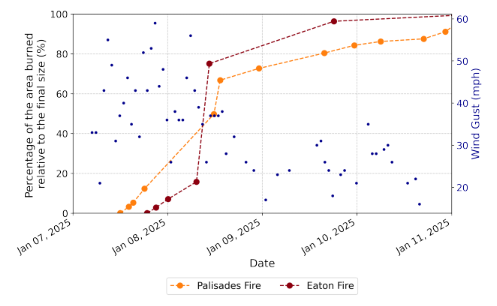
Percentage of total fire size over the first four days of development for Palisades and Eaton Fires, shown alongside wind gust data representing general wind patterns in the area.

The most dramatic fire growth corresponds with periods when 5-second wind gusts exceeded 40 mph, highlighting the direct relationship between extreme wind activity and fire spread. Once the wind subsided, fire growth slowed, not only due to the loss of wind-driven oxygen supply, ember transport, and flame extension, but also because suppression efforts became more effective both from the air and on the ground.

  • Houses oriented downwind of the fire were consistently damaged or destroyed at higher rates than structures in crosswind or upwind exposures (due to diminished intensity of heat transfer in the upwind and crosswind directions); however, structures at all wind exposure orientations remain highly vulnerable when spacing between structures is minimal. (pg. 51)


Overall takeaways

  • Parcel-level resilience must be applied as a comprehensive system and paired with reductions in connective fuels at the neighborhood scale to meaningfully limit structure loss during wind-driven built-environment conflagrations. (pg. 58) To reduce overall suburban conflagration risk, parcel-level measures must be complemented by community-level actions—particularly efforts to reduce structural density and connective fuels. (pg. 4)

  • In urban conflagrations, damage is driven by the intensity of the fire, driving conditions (e.g. strong winds), and the fire’s ability to access an ignition pathway from one structure to another. These ignition pathways are created through either localized flame exposures that exceed the tolerance of building materials or through ember intrusion into unmitigated openings.

  • A systems-based approach that combines resilient construction, strategic fuel management, and community-wide mitigation is essential for wildfire resilience.

  • Spacing between structures (homes) and connective fuels, combined with environmental factors like wind speed and direction, are the two biggest driving factors which determine whether fire moves between homes, becoming a conflagration, or where structures are defensible.

  • When creating separation between structures isn’t possible, homeowners must take key steps. When homes featured 4 hardened components – a Class A roof, noncombustible siding, double-pane windows and enclosed eaves – the likelihood of avoiding wildfire damage was 54%, regardless of how close homes were to one another.

  • Homes with fuel covering more than 25% of Zone 0 faced an 87-100% chance of damage or destruction. That includes trash cans, patio furniture, and shrubs.

Read the full report


Upcoming Opportunities and Additional Resources

PNM Wildfire Awareness Town Halls

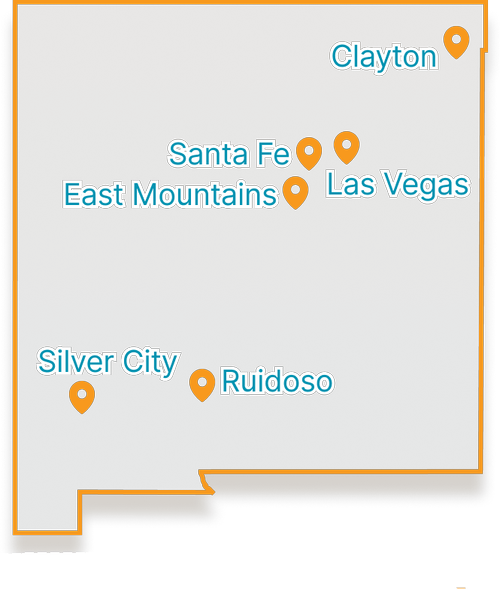
East Mountains Town Hall - 1/12, 5PM Ruidoso Town Hall - 1/15, 5PM
Los Vecinos Community Center Ruidoso Convention Center

Join PNM at an upcoming community event focused on wildfire safety and learning more about their Public Safety Power Shutoff (PSPS) process. These gatherings are designed to share critical information, local resources, and practical tips to help protect your home and neighborhood.

PNM Public Safety Power Shutoff (PSPS) map of high fire risk areas that may experience a PSPS.


PNM Public Safety Power Shutoff (PSPS) map of high fire risk areas that may experience a PSPS.


………………………………

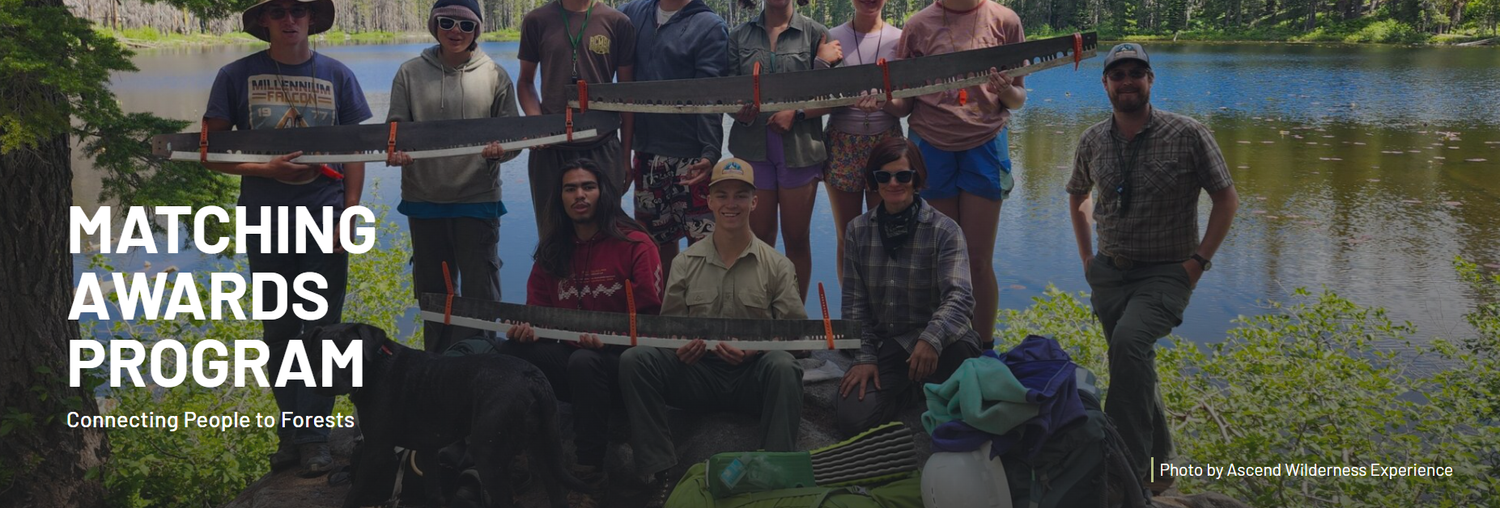
National Forest Foundation - Matching Awards Program (MAP): Connecting People to Forests

January 22, 2026: Deadline for Round 1 2026 MAP Applications

MAP funds projects that inspire participants to be personally involved in caring for their public lands. NFF requires that all MAP projects include three elements: community engagement, hands-on stewardship activities completed by the engaged community members, and a direct benefit to the National Forest System. Nonprofit organizations, Tribal governments and organizations, and universities are eligible to receive MAP grants.

View the Round 1 Request for Proposals (RFP)

………………………………

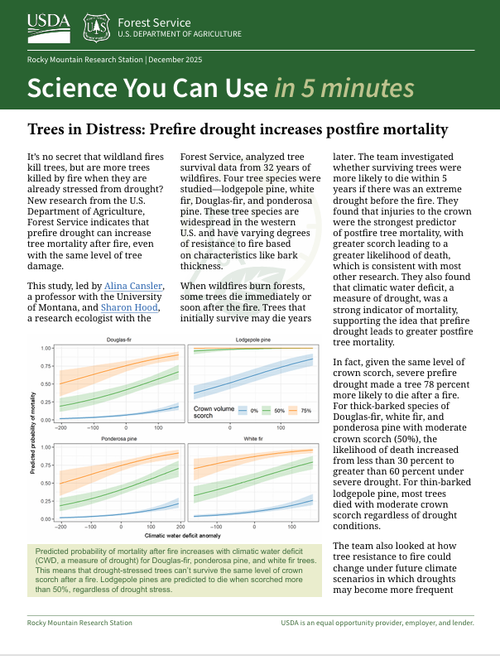
Rocky Mountain Research Station - Science You Can Use in 5 minutes

Trees in Distress: Prefire drought increases postfire mortality

Looking at four tree species—lodgepole pine, white fir, Douglas-fir, and ponderosa pine—a study led by a professor with the University of Montana and a research ecologist with the Forest Service investigated whether surviving trees were more likely to die within 5 years of a fire if there was an extreme drought before the fire. They found given the same level of crown scorch, severe prefire drought made a tree 78 percent more likely to die after a fire. Therefore, into the future, western forests that have thick barked tree species may become less resilient to fire because of increasing drought stress.

Read the Full Fact Sheet from RMRS

………………………………

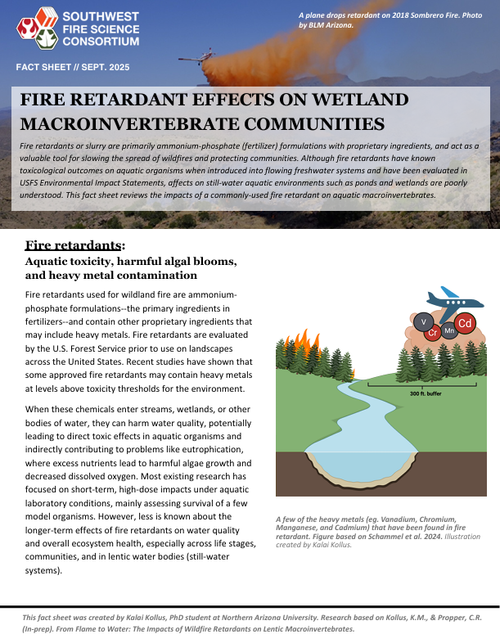
Fact sheet: Fire retardant effects on wetland macroinvertebrate communities

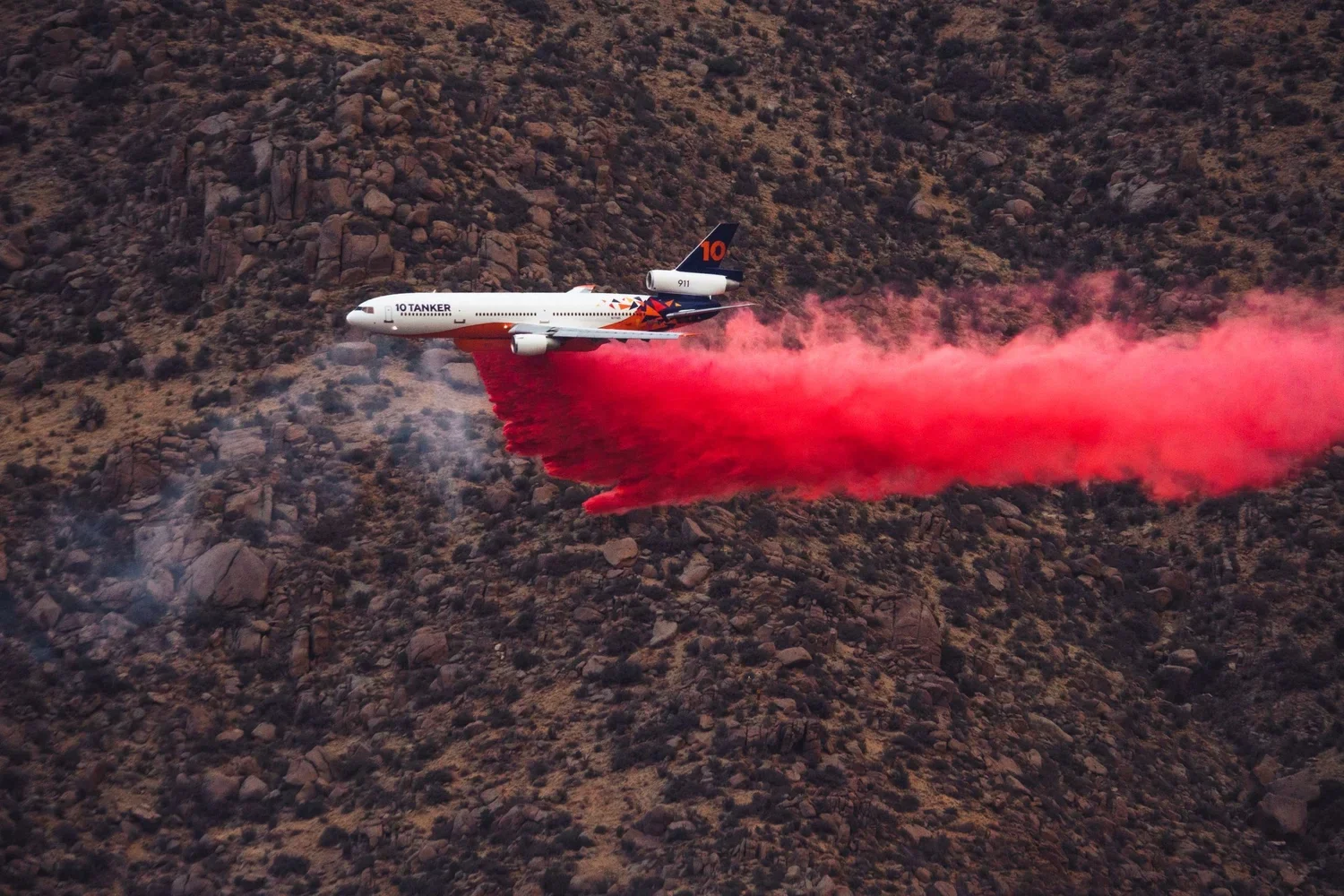
The Southwest Fire Science Consortium released a fact sheet that discusses a review of the impacts of a commonly used fire retardant on aquatic macroinvertebrates. The main takeaway from the research highlighted in the fact sheet is fire retardants can seriously affect aquatic life and may contribute to water quality problems, especially in wetlands and ponds where the water is stagnant and exposure may be prolonged. Researchers also highlight that proactive fuel reduction and prescribed fire—especially near water sources and communities—can reduce unplanned fire risk and the need for chemical fire retardants.

Read the full fact sheet from SWFSC

Wildfire Wednesday #173: Beyond Acres Treated - All Hands All Lands Collaboration This Fall Burn Season

Happy Holidays Fireshed community,

As temperatures drop and snow begins to fall, many land managers across New Mexico have shifted from summer forest treatments to winter management activities, such as burning slash piles. But before winter settled in, land management agencies and partners across the state achieved several major milestones, with this fall experiencing a great amount of collaborative, landscape-scale prescribed fire work.

After prescribed fire operations conclude, agencies typically release updates on acres treated, smoke impacts, and long-term monitoring plans. What’s often missing from these summaries, however, is the larger story: why each burn mattered, how it contributes to landscape resilience, and what it means for the people putting fire on the ground. Each operation represents meaningful progress, not only in reducing the risk of a future consequential fire and restoring ecosystems adapted to fire, but also in developing the future fire workforce and strengthening cross-jurisdictional partnerships.

Highlighted below are several of the autumn prescribed burns supported or led by the All Hands All Lands (AHAL) Burn Network, a critical resource that helps land managers reintroduce fire at the right place and time and increase the pace and geographic scale at which it is happening.

This Wildfire Wednesday features:

  • All Hands All Lands Fall 2025 Prescribed Fires Successes

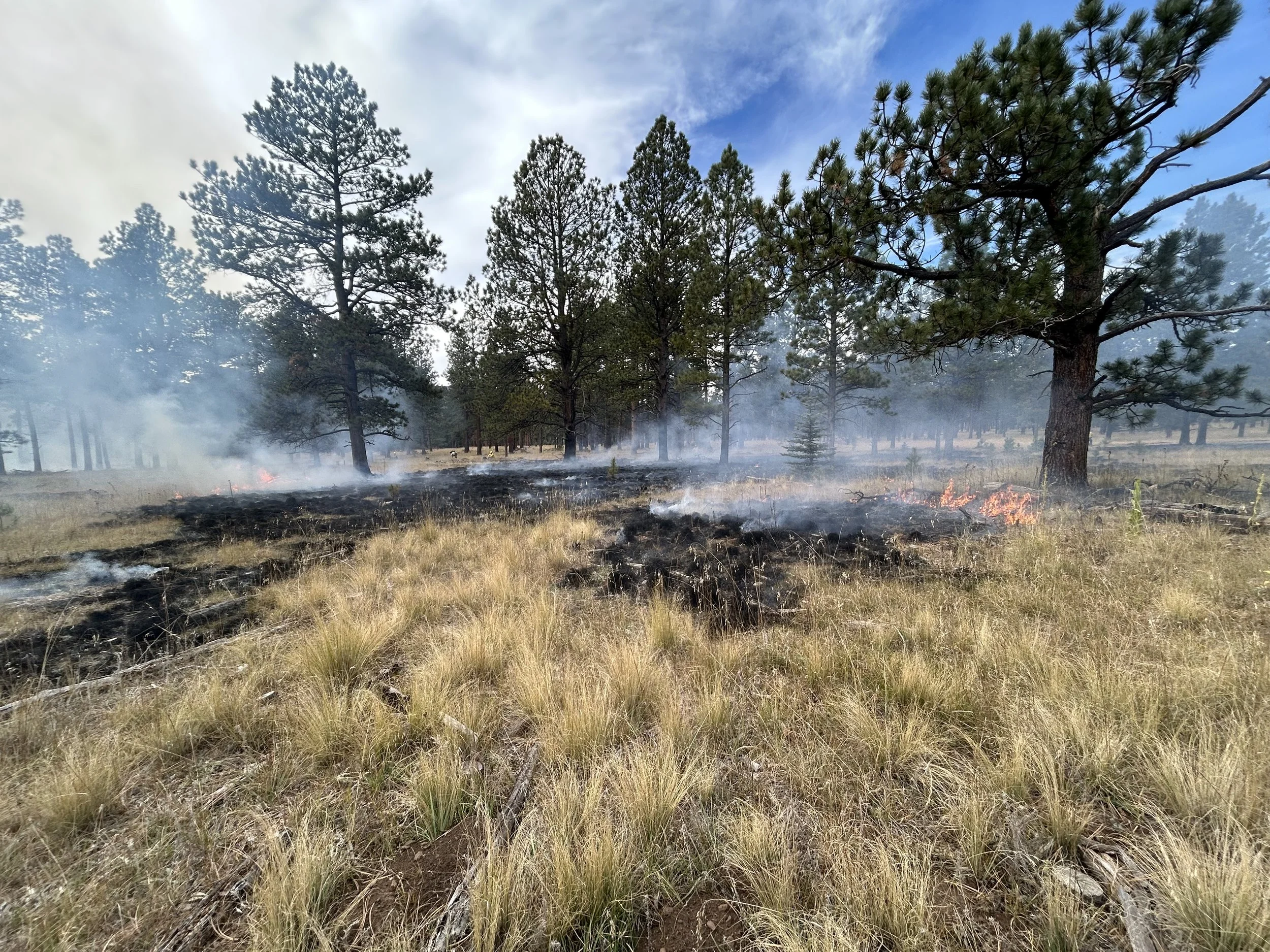
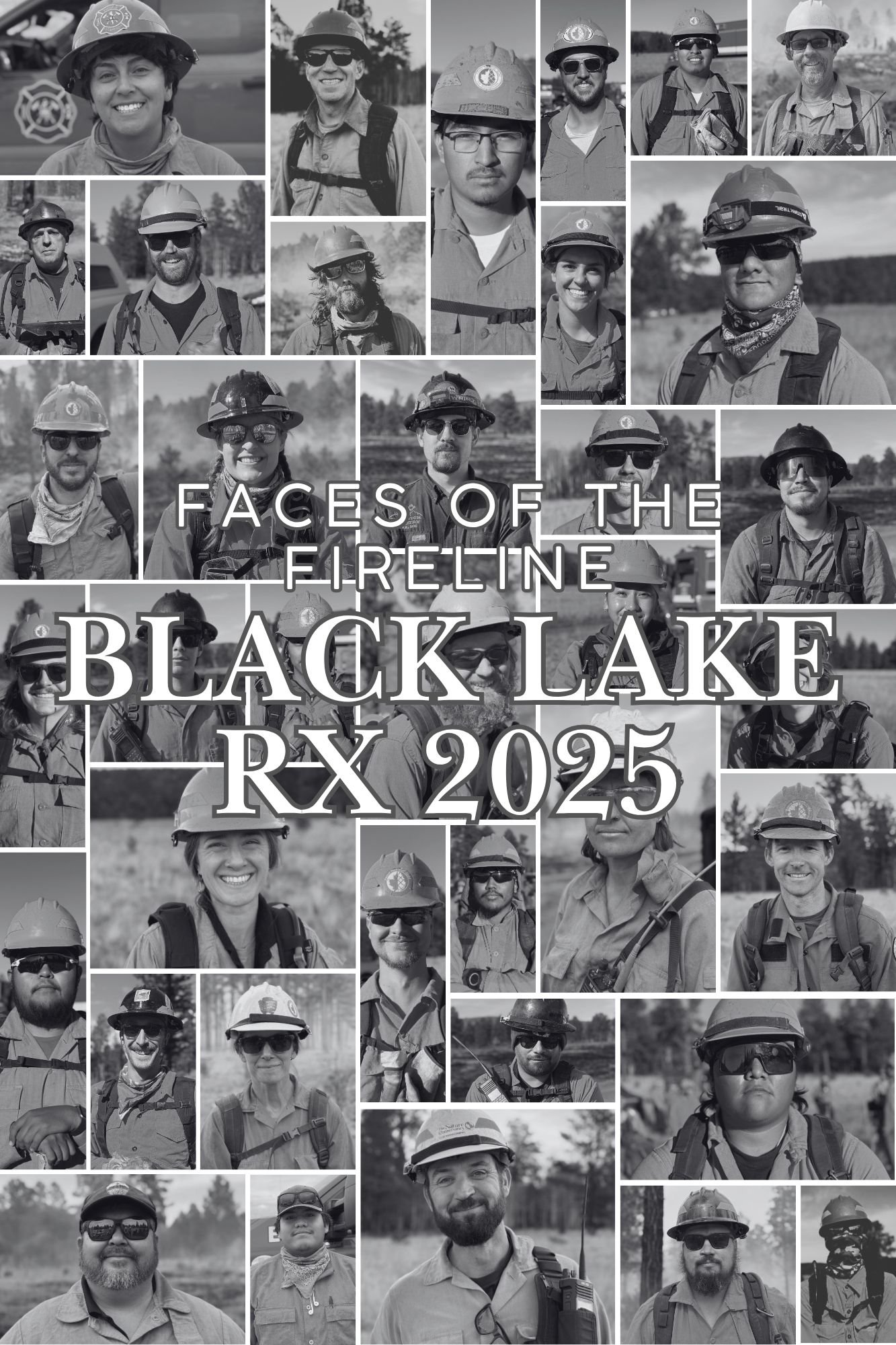
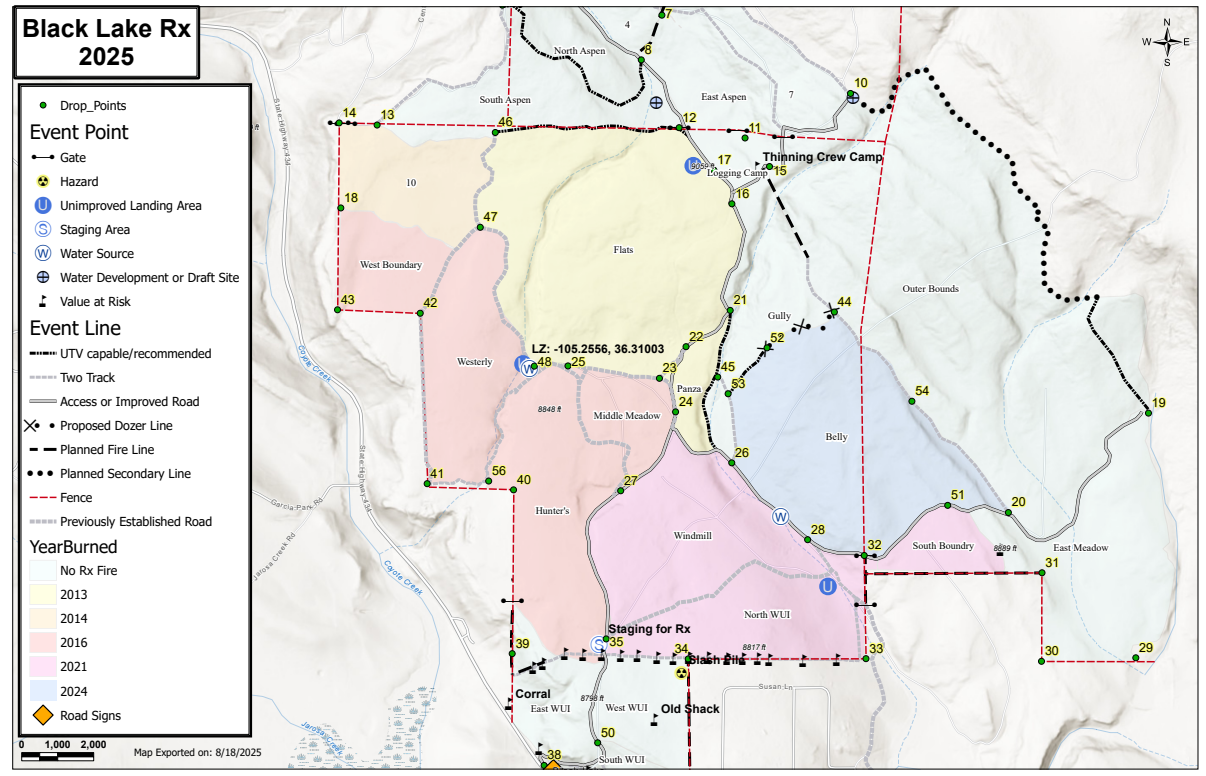
    • Black Lake Prescribed Broadcast Burn (deep dive on the burn and its impact)

    • Borrego Mesa Prescribed Jackpot Burn (Truchas/Santa Fe NF, NM)

    • Ojo Sarco Prescribed Broadcast Burn (Ojo Sarco/Carson NF, NM)

    • Holiday Mesa Prescribed Broadcast Burn (Jemez Springs/Santa Fe NF, NM)

    • Espinosa Prescribed Broadcast Burn (Mountainair, NM)

  • Additional Resources

    • The Paseo Project - Art X Fire in northern NM

    • Conservation Seedling Program - taking orders now

    • New! Prescribed Burn Planner Webinar

    • National Wildfire Mitigation Awards

Be merry and be well,
Megan


All Hands All Lands Fall 2025 Prescribed Fire Successes

Black Lake Prescribed Broadcast Burn

In a nutshell: the 2025 burn, the sixth in this area, was part of a much larger landscape-scale restoration effort—one that requires long-term commitment.

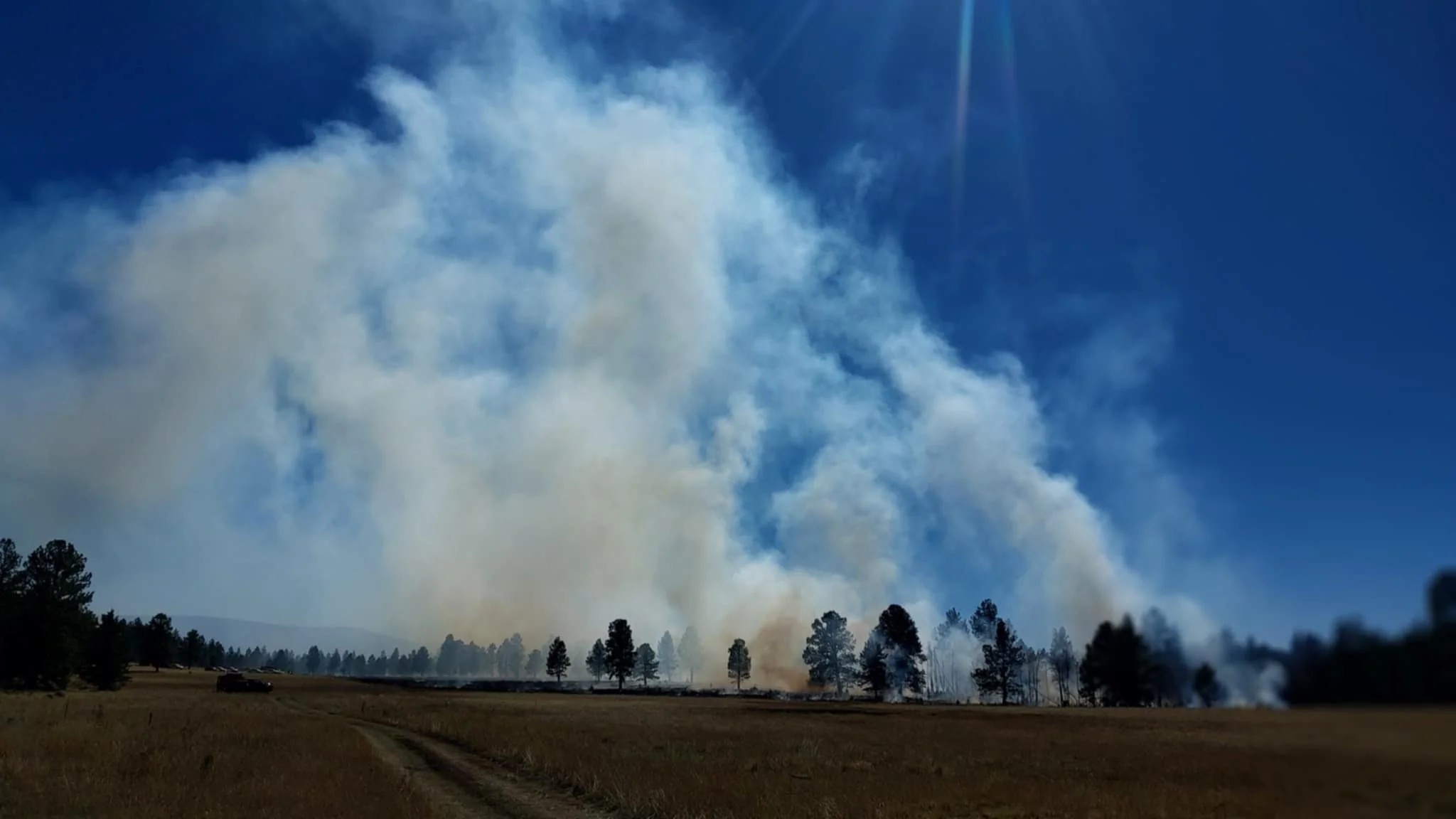
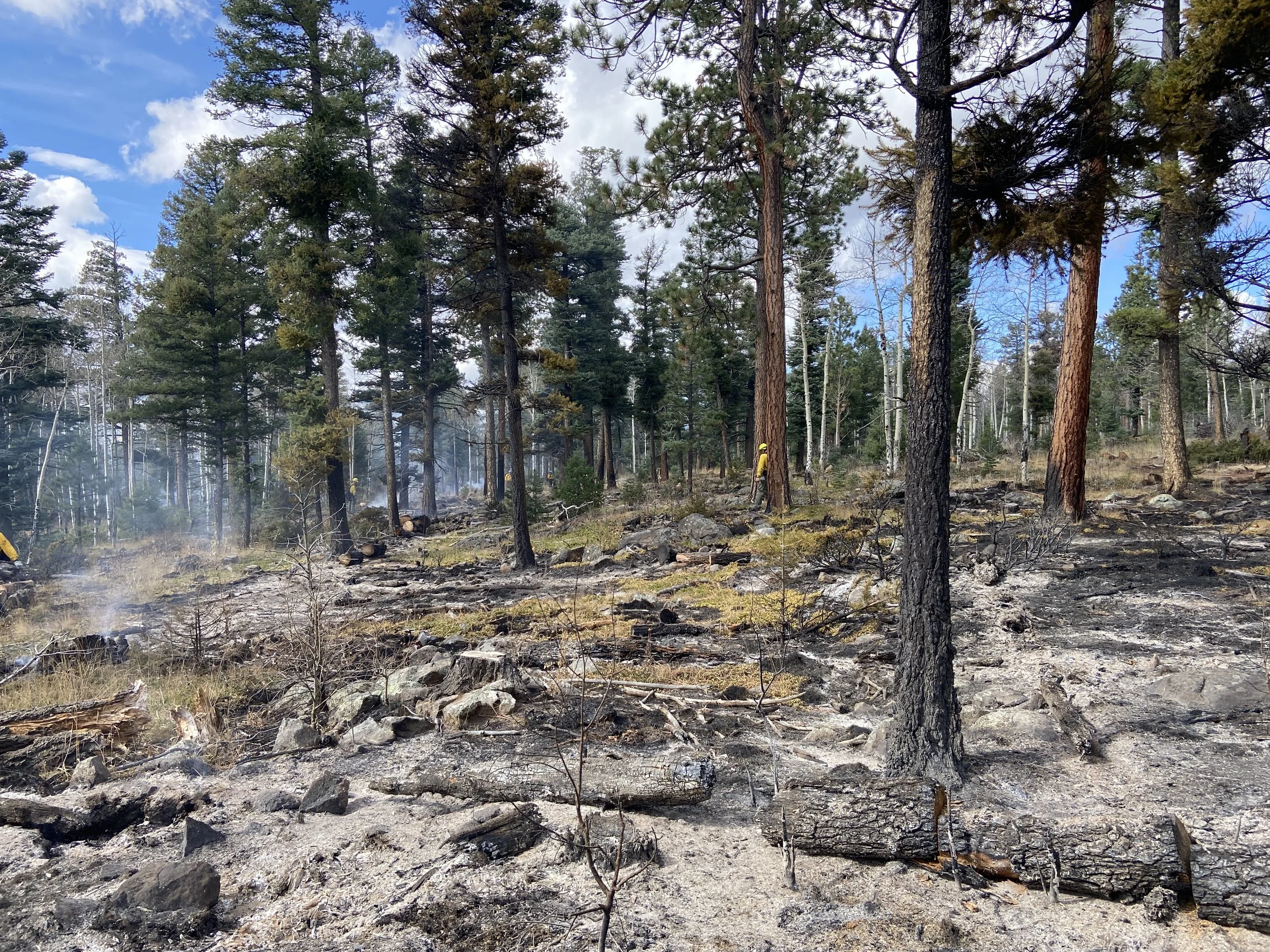
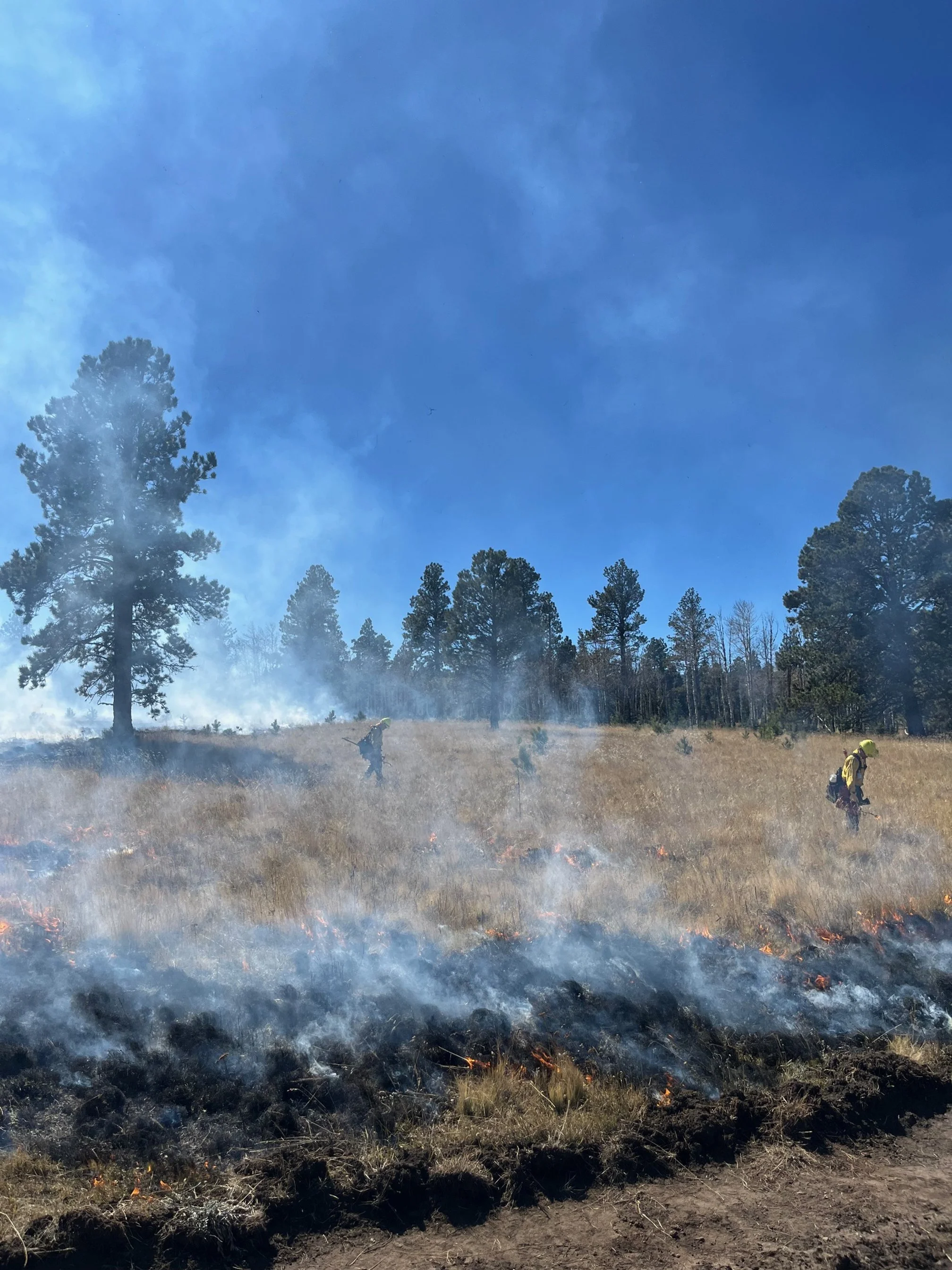
During the third week of October, roughly 50 people from agencies, organizations, and local departments across New Mexico gathered in Black Lake (a small community just east of Angel Fire) to complete a 370-acre collaborative prescribed broadcast burn. Organized by the Forest Stewards Guild and bossed (overseen) by The Nature Conservancy, the burn took place on State Trust Land managed by the New Mexico State Land Office. Participants represented a wide range of partners, including the Forest Stewards Guild and its youth crews, Angel Fire Fire Department, Picuris Pueblo, New Mexico Highlands University, the New Mexico Forest and Watershed Restoration Institute (NMFWRI), The Nature Conservancy, Philmont Scout Ranch, the New Mexico Forestry Division, and Moreno Valley Fire Department.

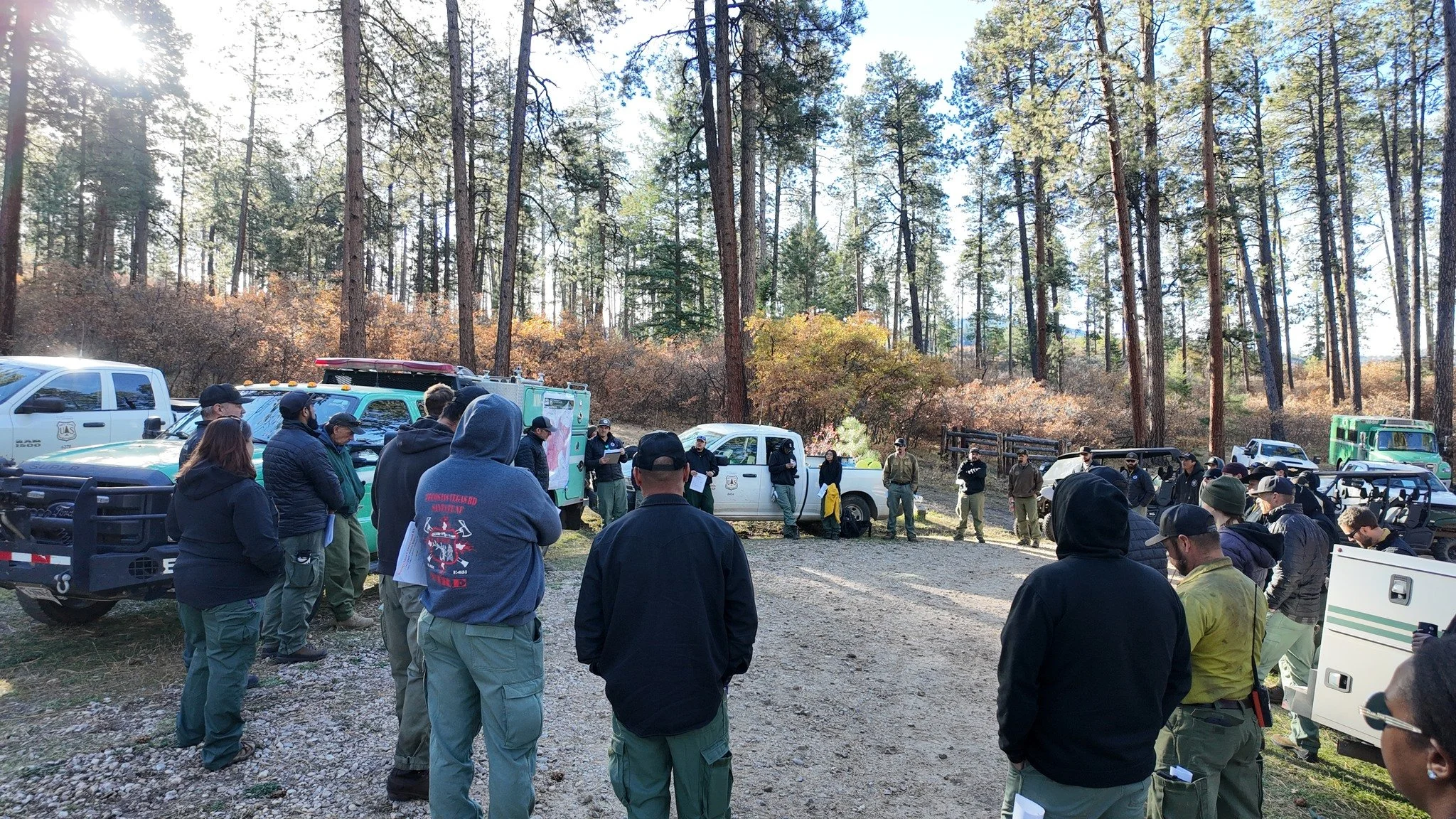
The impact of this burn comes from both the collaborative execution and the strong training and learning environment it created. As participants gathered for morning briefing early on day one of the burn, the circle was filled predominantly by FFT2s—firefighter type 2 personnel who hold basic fire qualifications—with several experiencing prescribed fire for the first time. Many individuals, especially from local fire departments and non-profit organizations, were placed in trainee roles, working to advance their fire qualifications and gain experience that can be put to use in future assignments. Many of the FFT2 roles (holding the containment lines, putting strips of fire on the ground to carry the flames in a controlled manner, mopping up after the burn was completed to ensure its containment) were filled by members of the Forest Stewards Youth Corps crews and students from New Mexico Highlands University. Through this training and hands-on experience, collaborative burns can strengthen local capacity and provide meaningful workforce development opportunities for young adults looking to explore careers in forestry, wildland fire, and natural resource management.

Burn organizers additionally hosted a public tour of the burn, bringing more than a dozen community members onto the landscape to observe operations firsthand, learn about safety measures that reduce the risk of escapes, and watch active fire on the ground. Public tours play a critical role in building familiarity and comfort with prescribed fire, especially in a landscape which has been impacted by large severe wildfires in the recent past. This is exemplified with NMFWRI, where staff members took the initiative to become fire-qualified active burners after attending a public tour during the 2024 Black Lake prescribed burn. As one 2025 FFT1 noted, the tours help grow the next generation of practitioners as much as they help educate the public.

Reflecting on the field tour, one of the facilitators shared:

The field tour was time for attendees to interact with low intensity fire up-close, to watch it move in the grass based on fuels, winds, and topography, and to feel the heat of different flame lengths. The questions and dialogue that resulted showed that all attendees brought their curiosity and an open mind to the day. Questions ranged from firing techniques, how does the operation that we were observing relate to the burn plan, to more broad questions about high elevation ponderosa pine ecology.
— Deputy Director, Forest Stewards Guild

The 2025 burn is part of a much larger landscape-scale restoration effort—one that requires long-term commitment. A representative of the New Mexico State Land Office emphasized that this work is a sustained endeavor in forest and fire restoration. This commitment is evident in the years of effort that partners have invested in returning fire to this landscape, with treatments beginning back in 2013. The 2025 burn was the sixth in this area and the second entry burn for these units, which first burned in 2013 and 2016.

This year’s work highlights the culmination of years of relationship- and trust-building among the Forest Stewards Guild, the New Mexico State Land Office, The Nature Conservancy, fire organizations across northern New Mexico, universities, and the broader Black Lake community, who continue to support this form of land stewardship.

In the closing briefing, the Black Lake 2025 burn boss—who brings several decades of wildland and prescribed fire experience—offered words of appreciation that captured the spirit of the entire effort:

I work with a lot of groups that want to be like this and so I think what you have here and what you have been developing for over a decade is really a premiere product... If you don’t already know this, you are a part of something really special up here.
— Black Lake Rx Burn Boss - Jeremy Bailey, TNC

These words reflect what many felt throughout the operation. The Black Lake prescribed burn represents not only technical success, but the strength of long-term partnerships, shared learning, and a community that believes in the power of beneficial fire.


Borrego Mesa Prescribed Jackpot Burn

This 399-acre broadcast burn on the Santa Fe National Forest was the first burn on the Española Ranger District since post-Hermit’s Peak-Calf Canyon, marking one step in rebuilding public trust and safely re-initiating prescribed fire operations. On the landscape, this burn helped reduce heavy jackpots of dead and down fuels that had accumulated during the past few years of limited fire use. The project was also significant for its interagency coordination, led by Forest Service but also involving the City of Santa Fe Fire Department, the New Mexico Energy, Minerals, and Natural Resources Department, and the Forest Stewards Youth Corps.


Ojo Sarco Prescribed Broadcast Burn

This 391-acre WUI (wildland–urban interface) broadcast burn on the Carson National Forest was located along Highway 76 near the community of Ojo Sarco and directly adjacent to private land. This burn not only achieved the objective of reducing hazardous fuels, but did so in an area where homes, transportation corridors, and forested lands meet, an example area where wildfire poses a high risk for destructive impact on a community. Successfully treating this area reduced fuels that pose a risk to Ojo Sarco, demonstrated careful coordination with landowners, and showcased how prescribed fire can be safely applied even in complex boundary conditions where private land boundaries are just feet away from active ignitions.


Holiday Mesa Prescribed Broadcast Burn

Members of the Forest Stewards Youth Corps - Jemez Pueblo Youth Crew were involved in this 878-acre burn led by the USDA Forest Service. Through it, they were able to return fire to the landscape on ancestral territory near the Pueblo. It supported Jemez’s ongoing work to restore traditional fire practices, empowered tribal youth through hands-on experience in land stewardship, and demonstrated the ability of federal partners to engage in land management beyond the limited scope of federal employees.

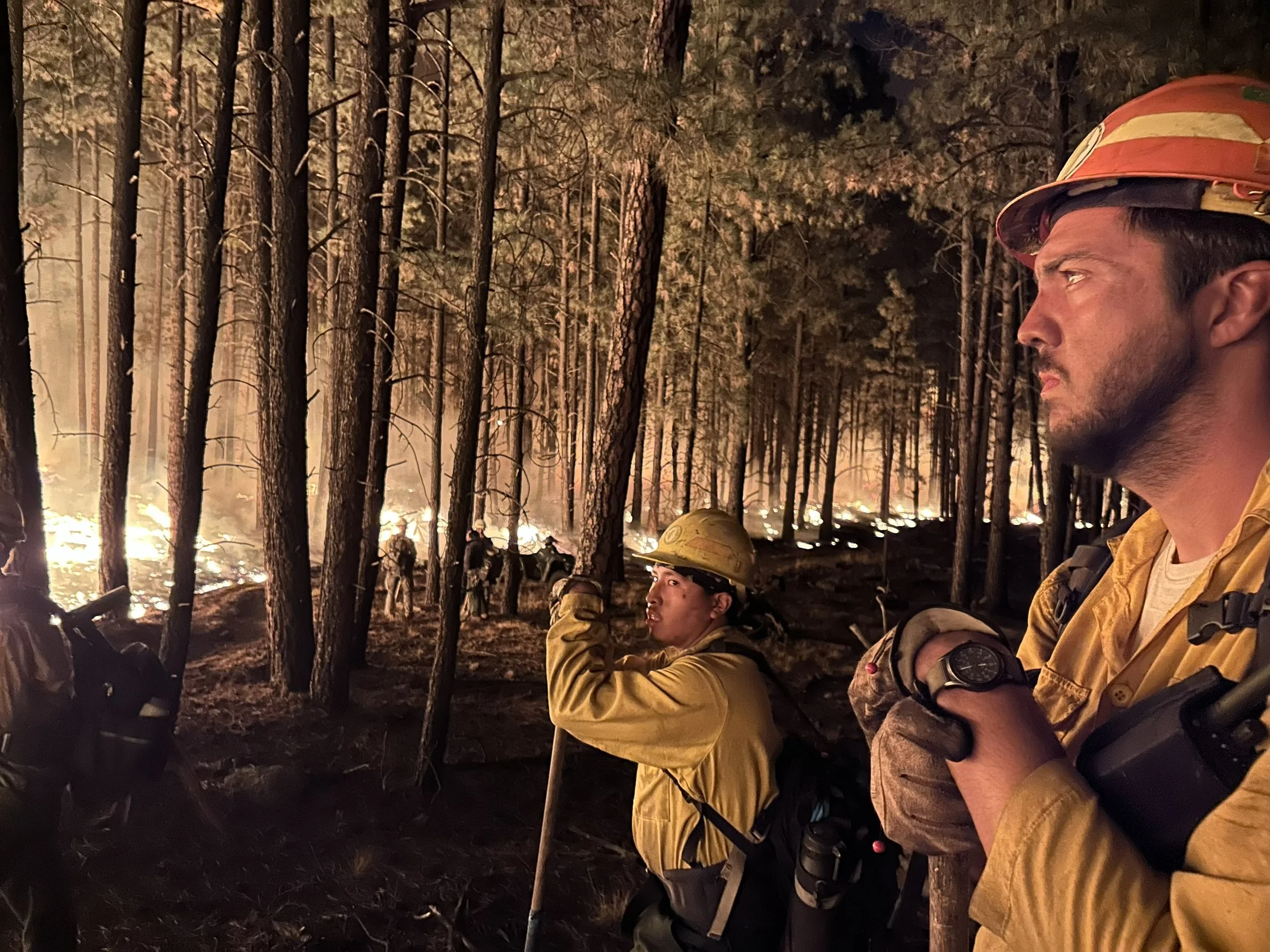
Forest Stewards Youth Corps Program Coordinator and member of Jemez Forest Stewards Youth Crew holding on the fireline

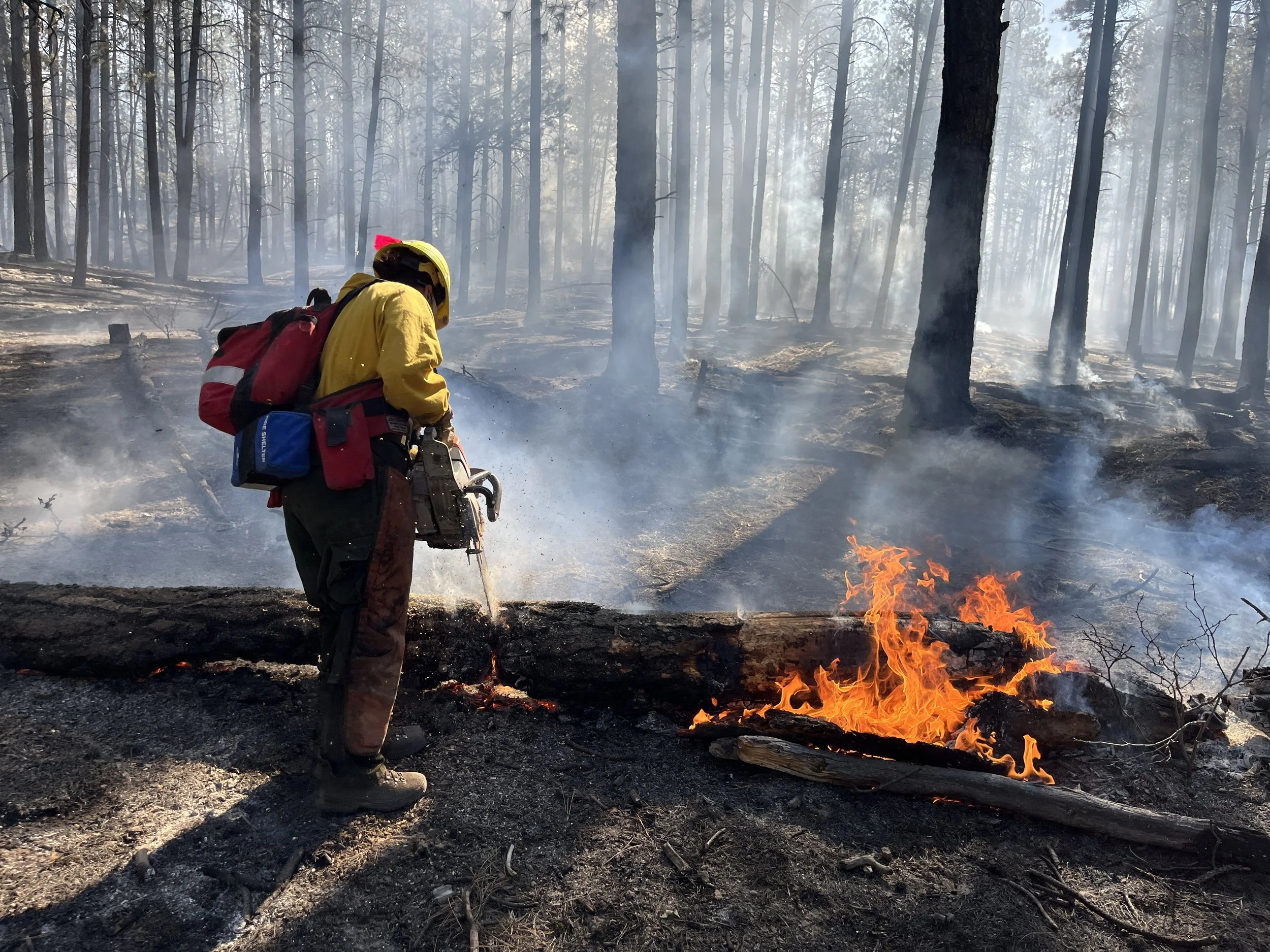
Member of Jemez Forest Stewards Youth Crew bucking a flaming log

Strips of fire being applied by igniters

Espinosa Prescribed Broadcast Burn

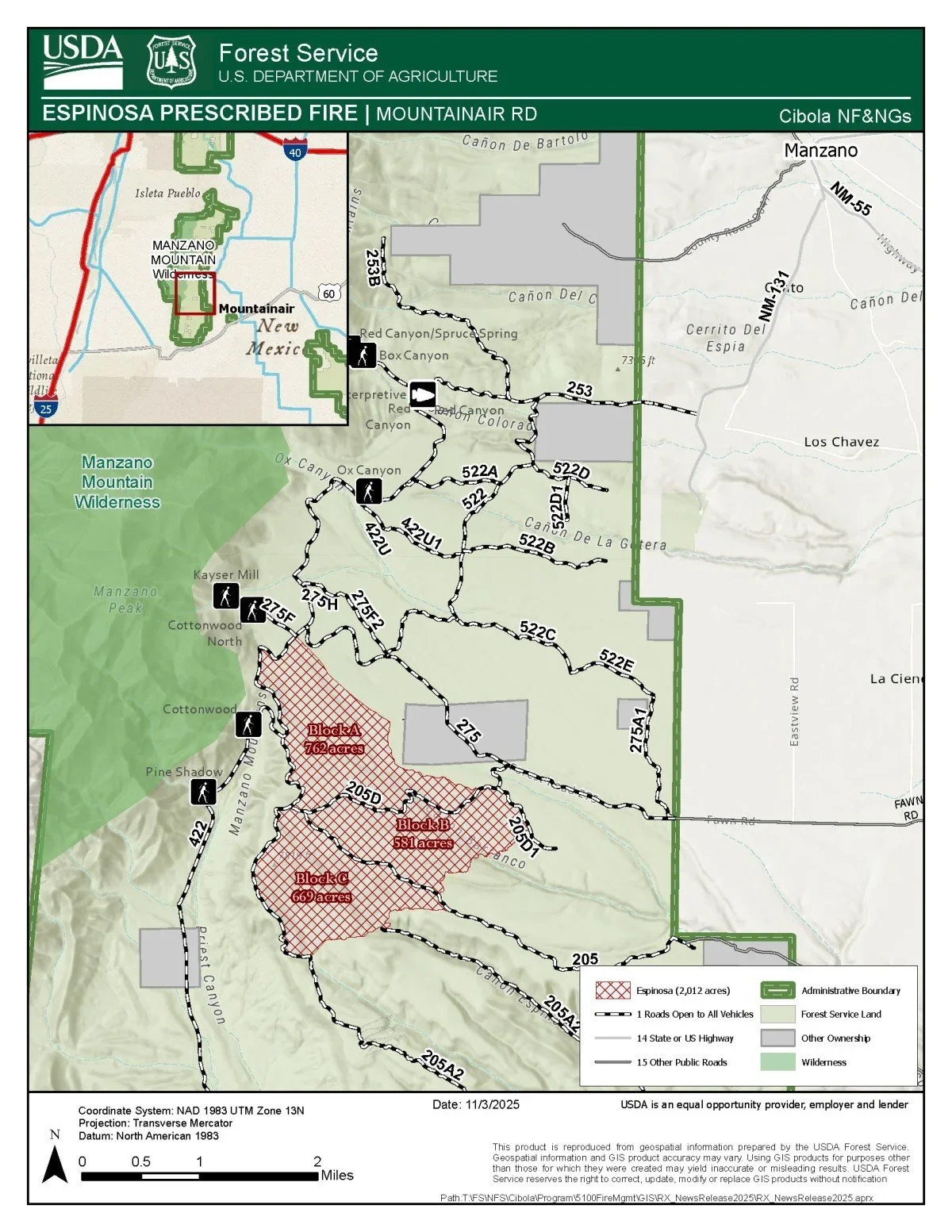
The 1,343-acre burn, the largest ever conducted on the Mountainair Ranger District, occurred within the Espinosa–Barranco Wildlife Improvement Project area. The scale made it an important milestone for the district’s capacity to implement large landscape-level prescribed fire. The project relied heavily on aerial ignition, allowing crews to treat over 1,000 acres in just a single day, a significant win in increasing the scale and pace to landscape treatment. In a landscape which is still feeling the impacts of severe wildfires such as the 2016 Dog head Fire, this collaborative burn represented a shift toward improving habitat conditions for wildlife, enhancing ecosystem resilience, and advancing the district’s long-term landscape restoration goals through the use of good fire.

Smoke drifting from the burn area north across the Manzano Mountains after ignitions were completed.


Additional Resources

The Paseo Project - Taos, New Mexico

The Paseo Project invites artists working in all media (2D, 3D, installation, writing, sound, projection, performance, interdisciplinary forms) to apply for participation in Disturbance, a new interdisciplinary program that pairs artists with scientists to explore wildfire as both a destabilizing force and a regenerative element in ecological and social systems. This project will culminate in an exhibition and series of events in Taos, New Mexico, September–December 2026.

Through a required four-day Northern New Mexico based “fire ecology boot camp,” selected artists will be immersed in collaborative dialogue with fire practitioners and ecologists, and site visits to burn scars and post-fire landscapes. Artists will then return to their home studios to develop new work that reflects on the ecological, cultural, and emotional dimensions of wildfire. These works will then be shared in an exhibition, outdoor installations, and public programs in Taos, NM, designed to engage the broader community in dialogue about living with fire in a climate-altered future.

Applications will be accepted through February 1, 2026.

Apply Now
 

New Mexico Forestry Division offers low-cost seedlings in over 60 varieties for landowners to use in reforestation, erosion control, windbreaks, streambank restoration, and wildlife habitat improvement. Spring season orders for seedlings are now open. Ordering is first come first serve, so order early for the best selection. 

Learn more about tree types and uses and order seedlings at Conservation Seedling Program - Forestry.

To participate in the program you must own at least one acre of land in New Mexico and the seedlings purchased through the program must be used for conservation purposes.


Webinar: Plan, Predict, and Burn - The New Prescribed Burn Planner
Wednesday, December 17, 2025, 1pm ET

Join Karen Cummins and Dr. Holly Nowell from Tall Timbers for a free one hour webinar as they demonstrate the Prescribed Burn Planner v2’s new capabilities.

The Prescribed Burn Planner (PBP) was originally developed to help users plan and prioritize prescribed burns by providing weather forecasts for individual burn units, thus hopefully reducing the number of missed burn windows. After receiving funding support from USDA Forest Service, Southern Region (R8), PBP version 2 was created to take prescribed burn planning to the next level.

The new release includes:

  • Updated meteorological data

  • Ability to draw the boundaries of a burn unit, rather than just a point location

  • Simple smoke plume modeling with a list of potentially impacted locations

  • Burn history tracking

  • Email notification for upcoming ideal burn windows as specified by the user for each individual location.

Register for the Webinar

The National Wildfire Mitigation Awards (WMAs) recognize outstanding work and significant program impact in wildfire preparedness and mitigation. The program was established in 2014 by the National Association of State Foresters (NASF), the International Association of Fire Chiefs (IAFC), the National Fire Protection Association (NFPA), and the USDA Forest Service (USFS), including the National Wildfire Mitigation Award, the National Mitigation Hero Award, and the Wildfire Mitigation Legacy Award.

Nominations for the 2026 awards are open and must be submitted by January 7, 2026. Past awardees, both individuals and organizations, have displayed outstanding dedication to wildfire mitigation across a broad spectrum of activities.

Submit Nominations Here