Wildfire Wednesdays #144: Fall Prescribed Fire Season

Hello Fireshed Community,

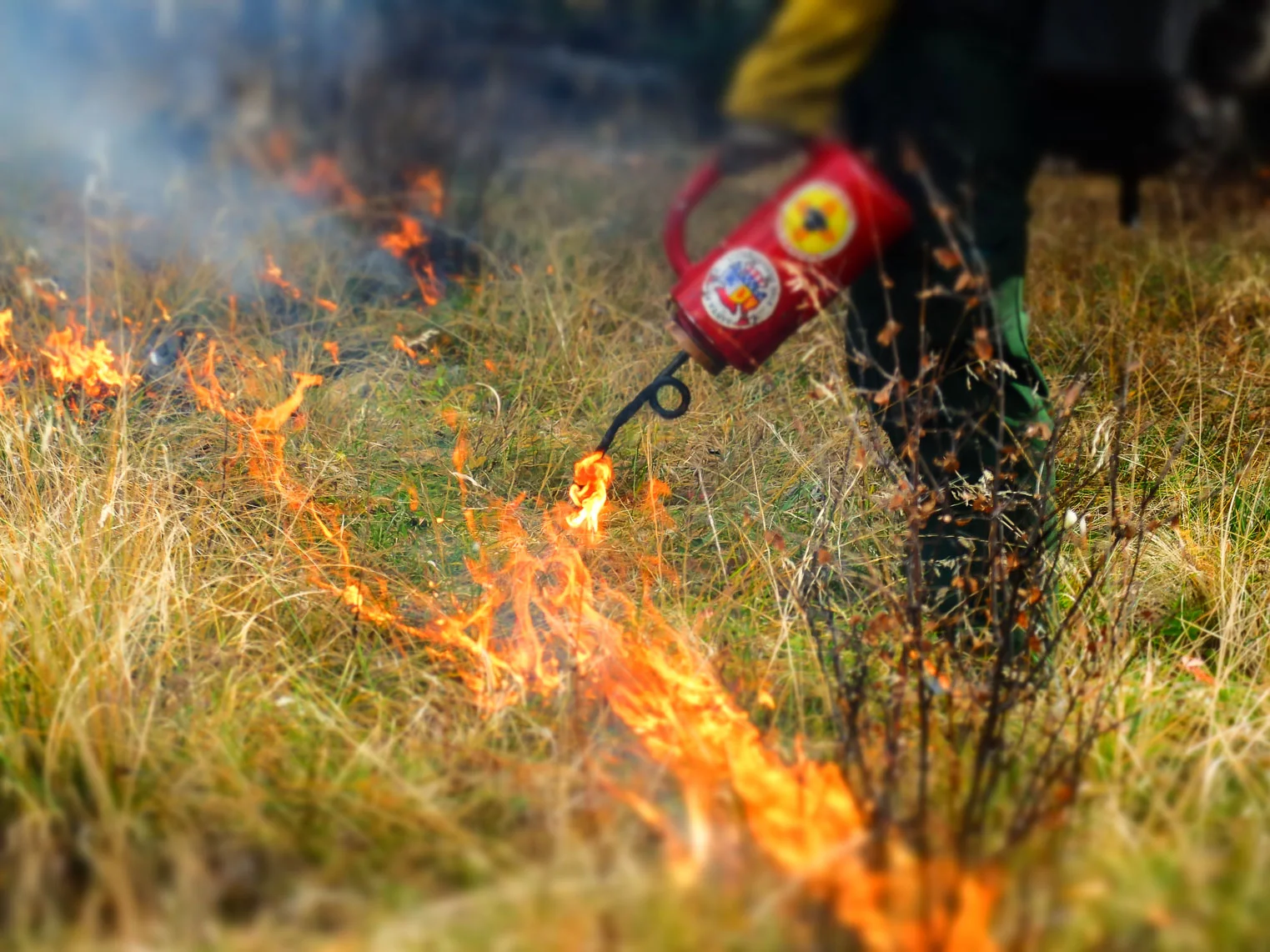
It’s Fall and there is smoke in the air — and not just from the green chile roasting. Fall is a time when prescribed fires are commonly implemented. With Winter on the way and temperature and humidity dropping steadily, the mild weather conditions of Fall in New Mexico are supportive of the lower intensity prescribed fire that land managers want to see more of on the landscape. Lower intensity prescribed fire allows land managers to accomplish a wide range of ecological and public safety objectives.

Through carefully planning and implementation of prescribed fire, land managers are able to reduce the severity of future wildfires by influencing the residual densities and fuel loadings of forested areas while at the same time supporting nutrient cycling, regeneration, and understory diversity of many fire-adapted forests across New Mexico. The reduction in fire severity that prescribed fire generates not only protects forests from being converted to shrublands by high severity wildfire, but it also supports a more effective fire response from land management agencies, keeping our communities and water resources safer.

So, as you may be smelling smoke in the coming weeks, read on for a better understanding of the rationale and context surrounding the use of prescribed fire on both public and private lands in New Mexico.

This week’s Wildfire Wednesdays, includes:

  • Prescribed Fire 101

    • NM RX Fire Council

    • NM Certified Burner Program

  • Prescribed Fire Information - NMfireinfo.com

  • Smoke Exposure Mitigation

  • NM Wildland Urban Fire Summit - Next week in Taos!

Prescribed Fire 101
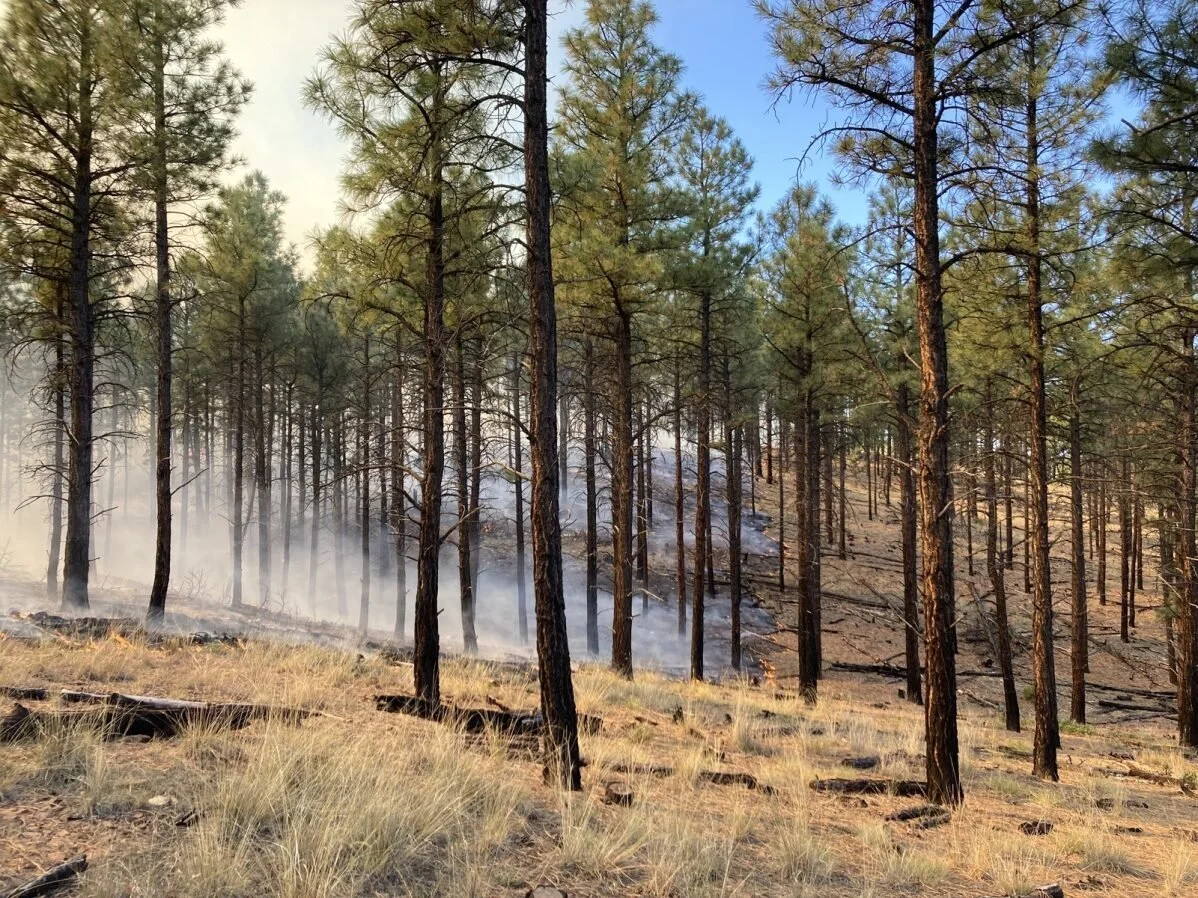
Over a century of fire exclusion and suppression has led to negative impacts for fire-adapted ecosystems across New Mexico through the increasing prevalence of uncharacteristically large and severe fires that threaten lives, property, forests, wildlife, and clean water. Wildfires can be reduced in severity and made easier to manage by reducing the density and connectivity of trees within forests and reducing the prevalence of dense forests across landscapes. The pace and scale of forest management needs to increase in order to reduce the threats of large, high severity wildfires, most notably within the wildland-urban interface (WUI) and on private lands.

Both the need to reduce the threat of wildfires by changing fire behavior, and the need to return fire as an ecological process, are addressed through prescribed burning. It is called prescribed burning because land managers carefully prescribe the weather conditions that will support the fire behavior they need to meet their objectives and only ignite the prescribed fire if the current and forecasted conditions match the prescription. Within the WUI, where homes are interspersed throughout naturally vegetated areas, prescribed burning is more difficult and complex. Liability and insurance are two elements that make prescribed burning on private lands difficult, especially within the WUI.

NM RX Fire Council
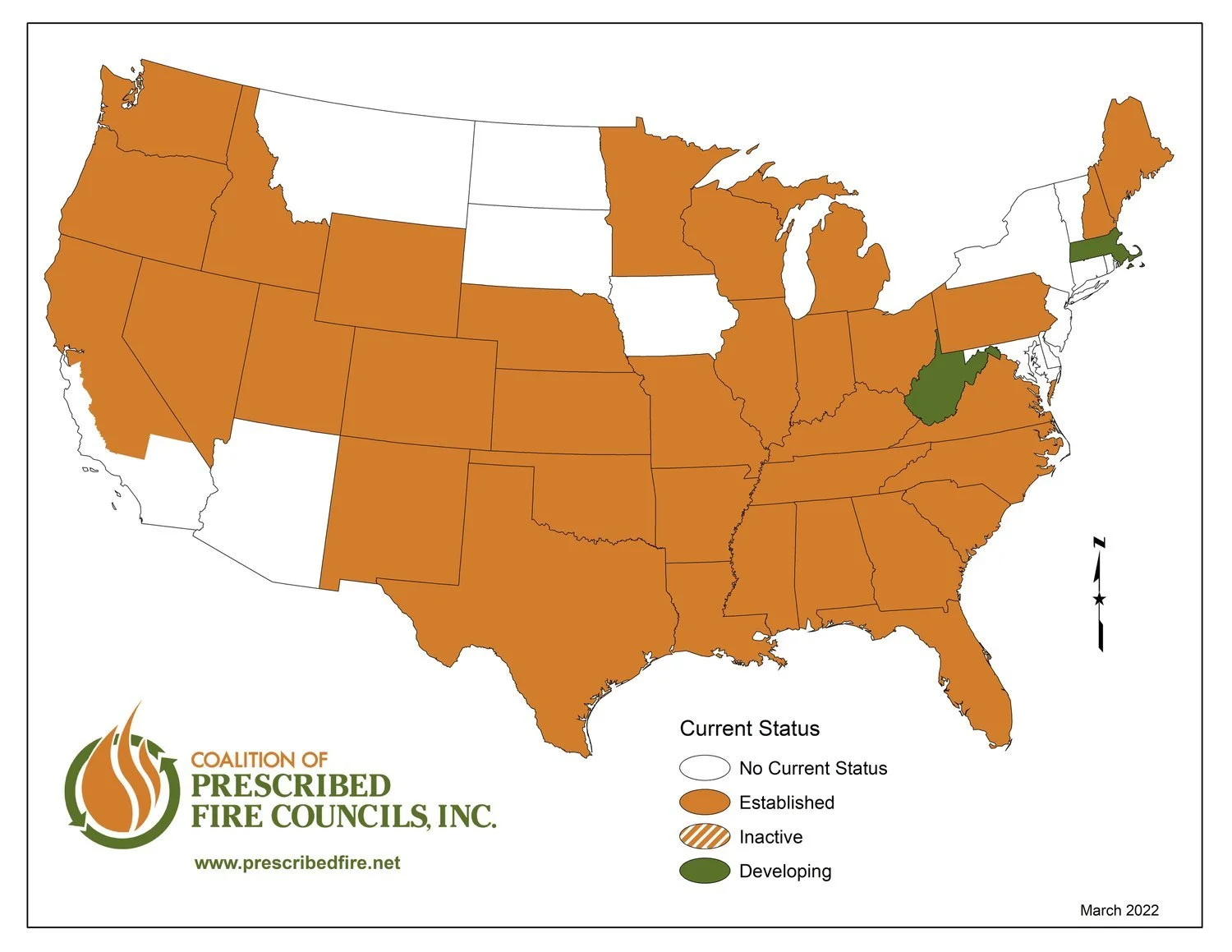
New Mexico has what is called a Prescribed Fire Council (PFC). These councils are generally statewide organizations that often work in tandem and share many common goals with localized prescribed burn associations. PFCs allow private landowners, fire practitioners, agencies, non-governmental organizations, policymakers, regulators, and others to exchange information related to prescribed fire and promote public understanding of the importance and benefits of fire use.

A map showing which states have Prescribed Fire Councils, from the Coalition of Prescribed Fire Councils, Inc.

PFCs date back to 1975, when the first council in the US was created in Florida in response to rapid development in Miami. Shortly thereafter, the North Florida Prescribed Fire Council was created in 1989 and more explicitly focused on prescribed fire. Neighboring states observed the success of Florida’s programs and began adopting the council model to incorporate federal, state, and private interests. Eventually, prescribed fire councils started to spread beyond the Southeast and across the country. Today, most states have established councils.

For those who want to get involved in New Mexico, membership in the New Mexico Prescribed Fire Council is open to anyone who has a passion for utilizing beneficial fire as a land management tool. Visit the website to become a member or to learn more about the resources provided by the council.

For more information about prescribed fire councils, view this FAC Learning Network webinar recording for a brief overview!

NM Certified Burner Program

New Mexico EMNRD Forestry Division (‘State Forestry’) launched a free publicly available prescribed burning curriculum in autumn 2023. This training, required by the passage of the 2021 Prescribed Burning Act, is accessed through their website. Both primary training and certification waivers are offered through their Canvas portal, where interested individuals can create a free account using the code provided on the Forestry Division - Prescribed Burning webpage. You can choose to sign up for pile burning or broadcast burning courses and progress through the interactive modules which cover topics such as safety, public relations, fire behavior, techniques, etc. Learn more about the Act, and the Curriculum available to landowners and individuals interested in learning how to conduct prescribed burns in a safe manner, by viewing the recording of the FACNM webinar on Supporting Prescribed Fire in New Mexico.

Prescribed Fire Information

NMfireinfo.com
NMfireinfo.com is an interagency effort by federal and state agencies in New Mexico to provide timely, accurate, fire and restriction information for the entire state, including updates about prescribed fires across the state. The agencies that support this site are the Bureau of Indian Affairs, Bureau of Land Management, Fish and Wildlife Service, National Park Service, State of New Mexico, and US Forest Service.
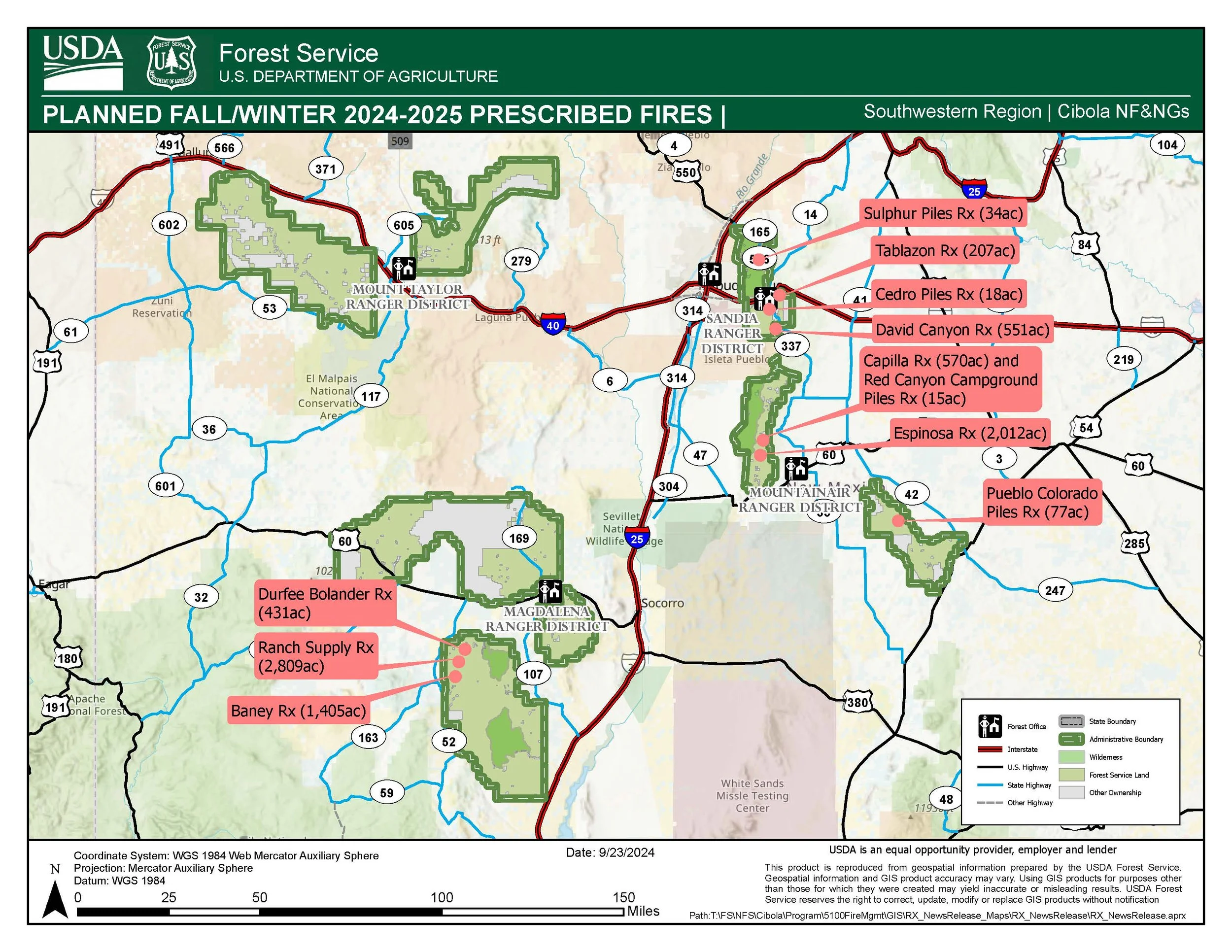
This site is updated as often as new information is available from the Southwest Coordination Center, individual forests, national parks, state lands, tribal lands and BLM offices. The aim of NMfireinfo.com is to provide one website where the best available information and links related to wildfire and restrictions can be accessed.

Smoke Exposure Mitigation
One of the best ways to reduce the impact of smoke is by reducing the amount of smoke that enters your building and filtering harmful particles from the air. If you have a central air conditioning system in your home, set it to re-circulate or close outdoor air intakes to avoid drawing in smoky outdoor air.  Upgrading the filter efficiency of the heating, ventilating, and air-conditioning (HVAC) system and changing filters frequently during smoke events greatly improves indoor air quality.  

Smaller portable air cleaners are a great way to provide clean air in the areas where you spend most of your time. Essentially these are filters with an attached fan that draws air through the filter and cleans it.  These cleaners can help reduce indoor particle levels, provided the specific air cleaner is properly matched to the size of the indoor environment in which it is placed, and doors and windows are kept shut. They should be placed in the bedrooms or living rooms to provide the most effectiveness. 

When air quality improves, such as during a wind shift or after a rain, make sure to use natural ventilating to flush out the air in your building. 

The Winix 5300-2 and 5500 is what FACNM uses for our HEPA loan program

Selecting a Filter - For either portable filters or HVAC filters make sure to select a filter that is true HEPA or has a MERV rating of 13 or higher. These ratings refer to the size of particles that the filter will remove from the air and in this case they are certified to remove particles down to .3 microns in size. This is the minimum needed to remove the small harmful particles in smoke.

When selecting a portable filter, the other rating to pay attention to is CADR or Clean Air Delivery Rate. This refers to the volume of air that passes trough the unit. A CADR of 200 means the unit provides 200 cubic feet of clean air per minute, and often this number is equated to the room size that it will effectively purify the air in. In a 300 sq foot room a filter with a rating of 200 CADR will cycle the air through the filter 4-5 times per hour. While any filter will provide clean air those with lower CADRs will simply work more slowly. Lastly, make sure to avoid filters that claim to produce ozone to destroy pathogens, as ozone is a respiratory irritant. 

More information about filters and guides to selecting one can be found in the Resources section below.  

Face Masks - Face masks can be an effective way to reduce your exposure to smoke when they are fit correctly and are the proper rating. Make sure the mask you use is rated at least N95 or N100 and that you take care to fit it properly. These masks will filter out the small particles that are the most hazardous to your health. Paper masks only filter out large particles and will not provide the filtration needed to protect you from smoke. 

HEPA Filter Loan Program

With support from the New Mexico State University, the national Fire Adapted Communities Learning Network, and the Forest Stewards Guild, FACNM is pleased to offer this pilot HEPA Filter Loan program. These filters are available to smoke sensitive individuals during periods of smoke impacts in some areas of Northern New Mexico, but we hope to expand to more areas soon. We have a small amount of portable air cleaners that will filter the air in a large room such as a living room or bed room. These will be distributed on a first come- first served basis for predetermined time periods. You will need to provide contact info and come to office listed for your area to sign for the filter and pick it up.  Please look over the HEPA Air Filter Check-Out Contract.

To view contact information for the HEPA loan program in your area, visit the FACNM smoke page.

For general information about the program contact Gabe Kohler at the Forest Stewards Guild at gabe@forestguild.org.

Upcoming Events

NM Wildland Urban Fire Summit - Oct. 8-10th in Taos, New Mexico!

October 8th-10th in Taos, NM at the Sagebrush Inn

Register Now!

Join us next week in Taos County for the Wildland Urban Fire Summit! WUFS is New Mexico’s leading event for wildfire preparedness and planning. Join your peers, community leaders, fire service professionals, and federal, state, tribal, and local governments for this in-person event. Community members will share regional history and discuss living in and adapting to the Wildland Urban Interface. Learn the latest techniques, strategies, and resources for wildfire preparedness, mitigation, and recovery. Expand your network of peers and experts to assist you in your fire/disaster resiliency goals. This event is open to the public, and we encourage everyone to attend.

Summit highlights:

  • Welcome from NM State Forester Laura McCarthy

  • Property insurance & home mitigation 

  • Taos-region focus & field trip (Wednesday)

  • Emergency communications

  • Finding and using funding

  • Ruidoso 2024 events
Download Agenda


Wildfire Wednesdays #143: It Takes a Village to Save a Village

Happy Wednesday and happy autumn, Fireshed Coalition!

As summer comes to a close, western skies continue to be filled with wildfire smoke from blazes in California, Oregon, Idaho, Washington, and other hot and dry forested states. Wildfires continue to follow the trend of igniting earlier and burning later into the year, breaking out of what we have traditionally thought of as ‘wildfire season’ and blurring the lines of property ownership and fire response decision jurisdiction as they race across entire landscapes. What can we do in response to ensure that our homes, businesses, and communities are ready for wildfire year-round?

Emerging guidance from the Institute for Home and Business Safety, United Policyholders, and others suggests that the best protection is strength in numbers. While single parcel defensible space and home hardening has been shown to work, it works a lot better when neighbors meet and do the work together, creating fuel breaks that protect the entire community, designing their defensible space together, and investing in neighborhood-wide protection plans, home hardening upgrades, safety ordinances, and more.

Today’s Wildfire Wednesday features:

Be well and enjoy the equinox,
Rachel


Updated Fire Preparedness Guidelines

Expanding beyond individual parcels to encompass community readiness

The history and drivers of wildfire

For much of the West, fire is part of the natural landscape. However, wildfires become catastrophes when they burn at historically high severity, frequency, are driven by extreme weather, and move into our built environment. This can lead to uncontrollable structure-to-structure fire spread where an urban conflagration unfolds. Urban fire follows humans (population), drought, and wind. New Mexico has these all of these conflagration conditions:

  • The state has experienced the same population boom as the rest of the West, especially since 2020.

  • Almost all of New Mexico is in some state of drought and has been since 2019.

  • The state regularly experiences high wind, which often coincides with and exacerbates dry periods.

Urban firestorms have been a part of cities and their evolution across the globe for centuries. They have been applied as weapons of war as well. The 1666 London Fire was one of the first well documented urban conflagrations. It had similar characteristics to what we see in today’s wildfire-driven built environment conflagrations: drought conditions, human causation for ignition, and a high structure density with fuels between buildings. From the 1600s through the early 1900s, urban fire plagued cities globally (IBHS, The Return of Conflagration in Our Built Environment). Over the last century, we have solved this problem in our city centers but have recreated the risky conditions in our suburban and WUI areas.

The importance of community-level preparedness

The Institute for Business and Home Safety (IBHS) and other prominent fire preparedness organizations recommend using WUI code requirements to increase resilience, in addition to encouraging cities to make different individual, community, and policy choices. In this way, fire science can inform resilient thinking.

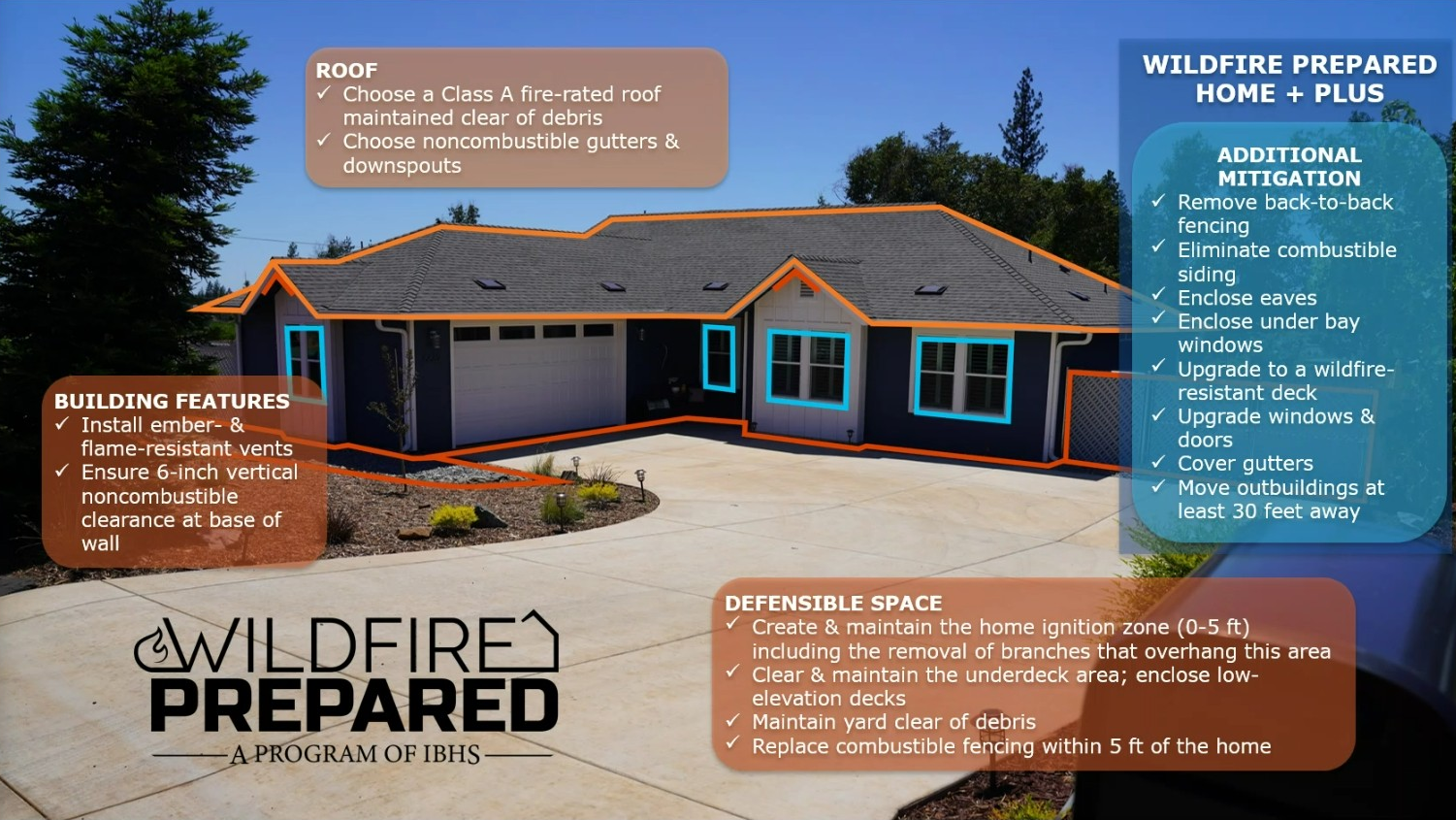
Critical elements of fire resilience:

Click on the image to view a full-size version.

  • Individual

    • A non-combustible “zone 0”.

    • Impenetrable vents and roofs.

    • Combustible elements between properties - find ways to break those connections.

  • Community

    • Parcel-level measures must be implemented at scale (such as fuel buffers along roads) so that communities can break the chain of conflagration and act as fuel breaks, not fuel sources.

  • Policy

    • Clustered financial incentives from the State to implement resilient retrofits (treat an entire neighborhood at once).

    • Require defensible space and fire-resistant design of new homes.

Most buildings are not designed to resist intense flame contact, and once ignited, they contribute as additional fuel to the fire. Therefore, to stall this “domino effect,” maintaining a proper separation between buildings is crucial in a resilient community. High fuel continuity, where fuels are densely distributed and interconnected, can promote the rapid spread of fire, as flames can easily move from one fuel source to another. The concept of fuel connectivity observed in vegetation fuels, such as grass and pine needles, can also be extended to structural fuels such as fences, sheds, accessory dwelling units (ADUs), and other similar objects. The underlying mechanism driving fire spread remains the same: when these structural fuels are closely spaced or connected, heat transfer between burned and unburned occurs at a high rate, leading to rapid fire spread.

It is important to thin, create defensible space, and implement home hardening measuring in and around your own home. It is equally important to talk to your neighbors about their fire risk, and hazards that you share, such as a coyote fence which separates your property but which would act as a connective wick for both homes during a wildfire. It takes action at all levels to prevent a fire becoming a conflagration.

Learn about these and other recommended actions as part of the new Wildfire Prepared Home program from IBHS, a designation program which enables homeowners to take preventative measures for their home and yard to protect against wildfire.


Wildfire Preparedness in Action: success stories from the frontlines

Home hardening, defensible space, and fire ordinances: lessons from the South Fork Fire, NM, 2024

Dick Cooke, Forester for the Village of Ruidoso and FACNM Leader, has been working for a long time to prepare the village for a wildfire. Those preparations were tested when, in June 2024, the South Fork Fire exploded to 15,000 acres in its first 24 hours and rapidly approached the community with ember showers falling a mile in front of the crowning flaming front.

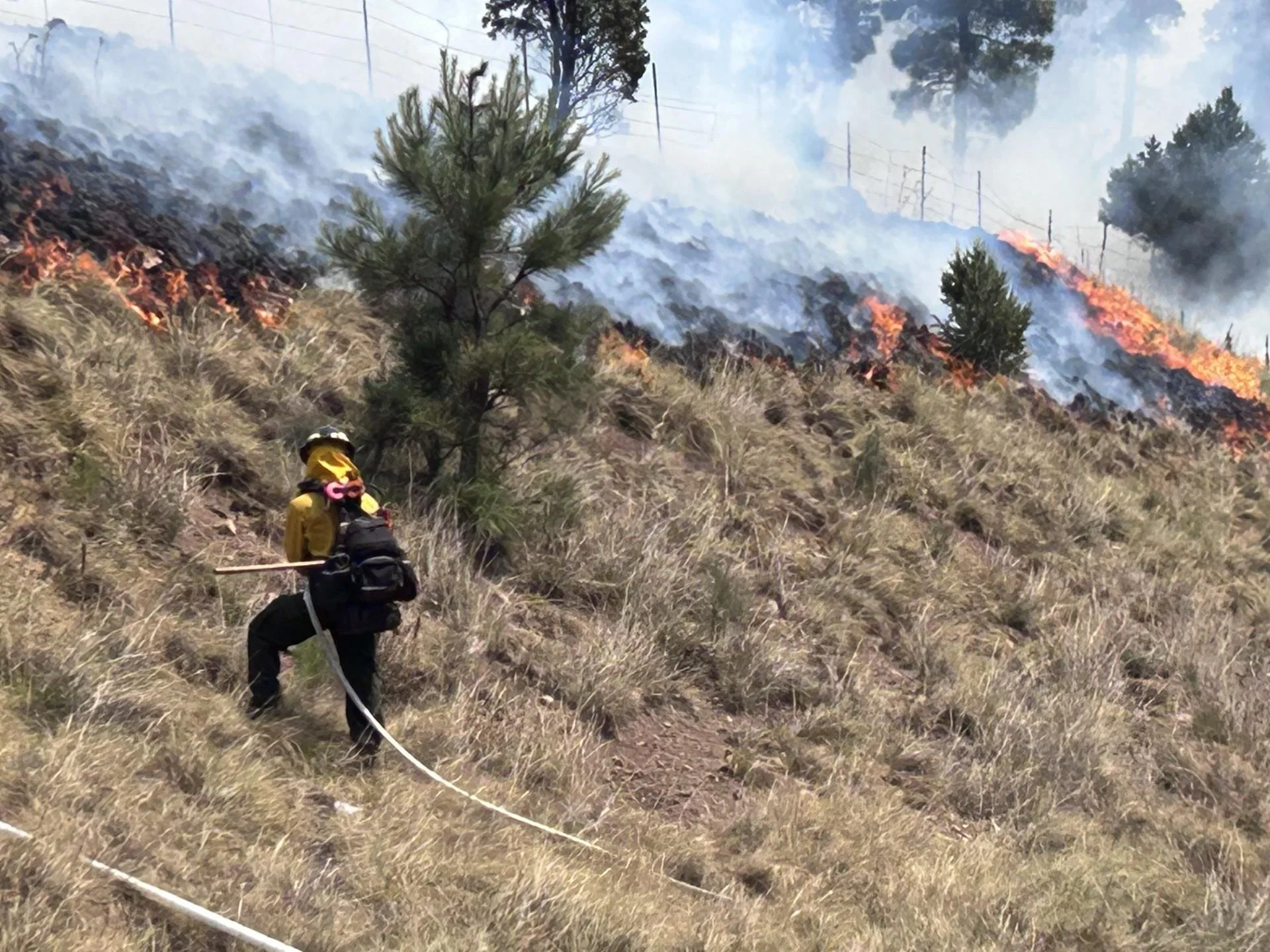
A federal firefighter assigned to the South Fork Fire stands at a property boundary. Image credit: INCIWEB.

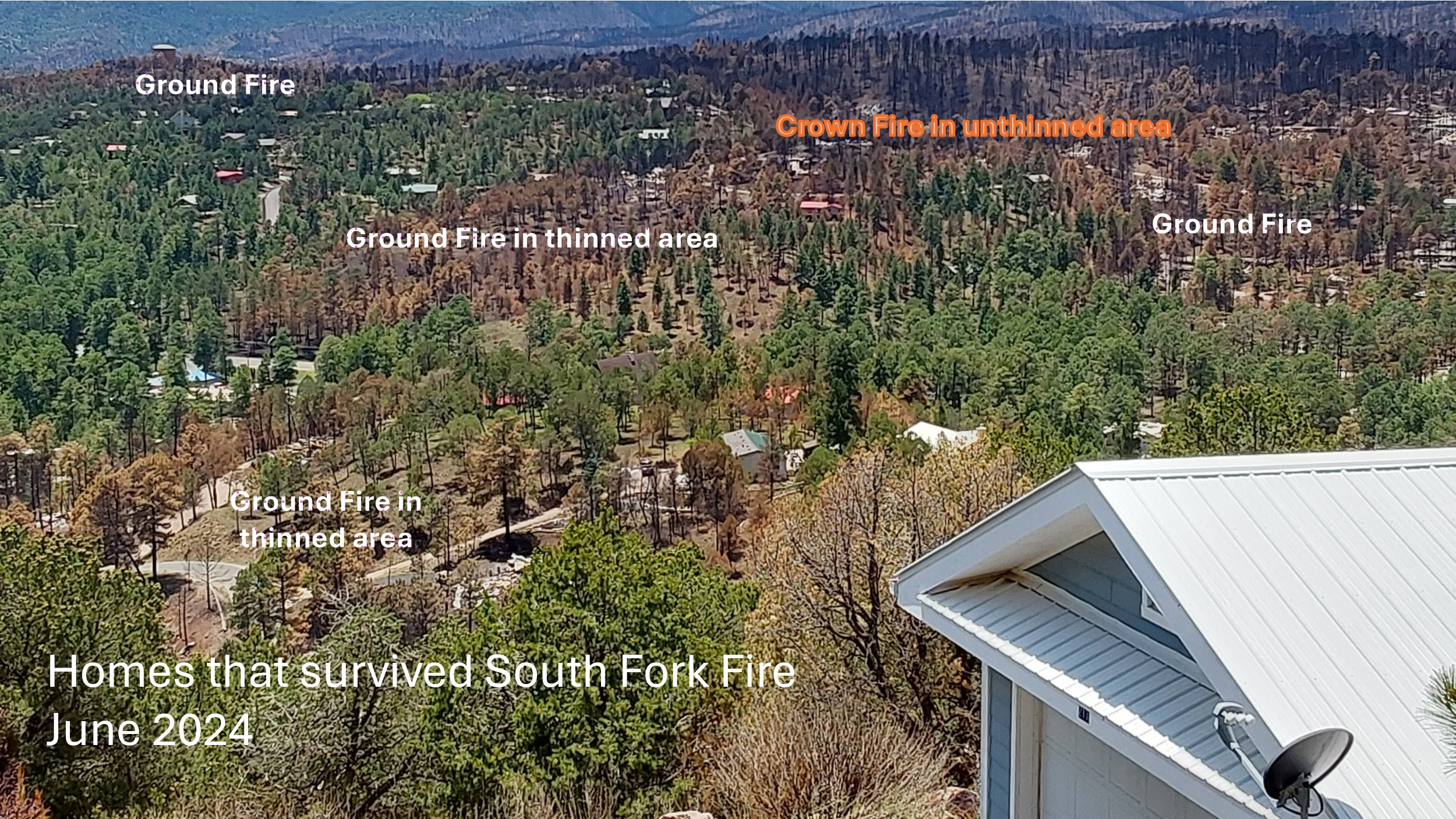
As Dick recounts, when the fire hit the village boundary, it almost immediately dropped from the tree crowns to the ground, creating a more favorable environment for firefighters to work around structures. He credits this to a thinning program that community leaders put in place decades ago. Ruidoso has a fire ordinance that requires all residents and landowners to thin the natural spaces around their homes and businesses to reduce the likelihood of fires spreading, either up or out. In most of the village, the South Fork burned as a ground fire with relatively low flame lengths, allowing firefighters to save numerous homes. However, firefighting personnel still had to contend with extreme weather, a wind-driven flaming front, and the ember storm which preceded the flaming front, with some saying that embers the size of basketballs landed on porches, roofs, and throughout the community.

After evacuation orders were lifted, village leaders started looking around at which houses survived and which burned. They noticed that most of the houses that burned didn’t meet home hardening recommendations. Some had wooden fences that caught on fire and were connected to a wooden deck or some part of the structure that was flammable, causing the fire to spread to the house. There were a lot of homes that use railroad ties in landscaping or as supports under decks, or that had fabric cushions on porch furniture - those ties and cushions caught on fire during the ember storm, which then spread to the house. Even with the ordinance in place requiring residents to thin around their houses, not everyone was following the rules or hadn’t done the work to protect their houses from embers through home hardening. When homes did survive, it’s because they were hardened from embers and flames and the neighborhood vegetation was mitigated (defensible space and forest thinning).

Image showing a patchwork of fire severity and structure loss in the Village of Ruidoso following the South Fork Fire. Courtesy of Dick Cooke, Village of Ruidoso.

The village is one of the only places in New Mexico with a fire preparation ordinance, so Dick believes that community level preparation made a big difference. 95% of properties in the village have been thinned to get into compliance with the ordinance, with properties being revisited every 10 years to ensure they stay in compliance. The intent of these rules is exactly what Dick saw happen in real time - putting the fire on the ground and preventing it from climbing back into the crown.

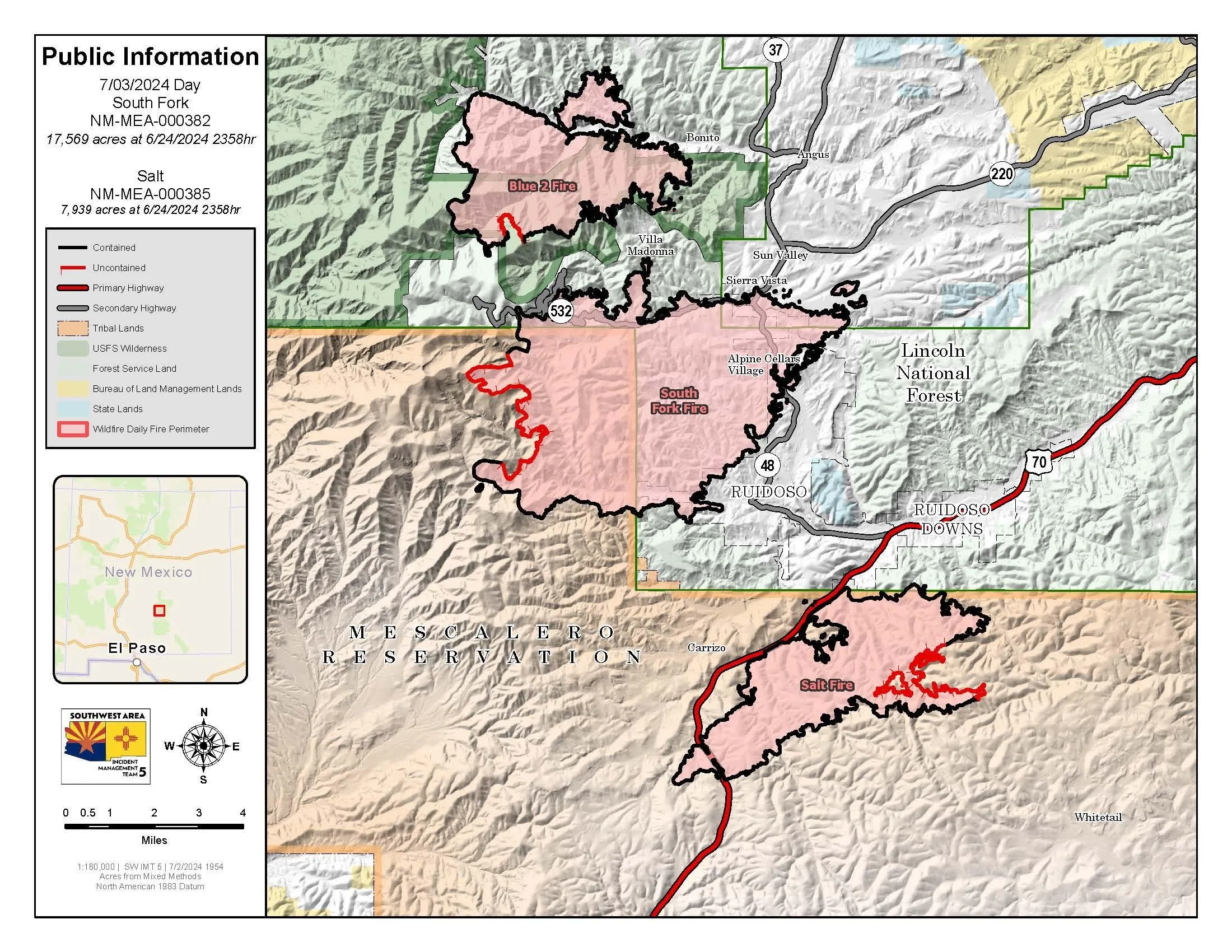
The final incident map from the Salt and South Fork Fire Complex, dated 7/3/24, shows the extent of both fires and the area within the Village of Ruidoso which was affected. Image credit: INCIWEB.

Dick believes that the work would have been a lot more effective if the area around the Village of Ruidoso had been treated in a similar fashion. However, the County, which has jurisdiction over the surrounding communities, doesn’t have a similar fire ordinance, and forest treatments on the surrounding National Forest System property were patchy, leading to a mosaic of thinned and unthinned land in the greater Ruidoso area. While each individual subdivision needs to do the work together, they also need to work with surrounding communities to create a cohesive landscape of fire prepared homes, businesses, and wild areas.

Hear about Ruidoso’s efforts from Dick and learn more about safety ordinances, Home Hazard Assessments, and fire preparedness in this archived webinar from Fire Adapted New Mexico.

A neighborhood saved: Circle Oaks, CA, 2017

Cheryl Lynn de Werff was certain her Napa County house was going to burn when she was forced to flee as a massive fire sped toward her Circle Oaks community. It was 1 a.m. and she had just gone to sleep in her second-story bedroom when a sheriff’s deputy pounded on her door. “I came running to the door and he says, ‘Get out! Get out now, there’s a fire coming!’” de Werff recalled. Over the next few days, the Atlas fire burned more than 51,000 acres, killed six people and destroyed more than 300 homes. A week after the community was evacuated, de Werff and her neighbors got the best kind of news possible: all of their homes were safe (Los Angeles Times).

The community of Circle Oaks survived the 2017 Atlas Fire due, in part, to their yearslong defensible space efforts. Photo from United Policyholders.

United Policyholders looked into what saved this community when so many others in the surrounding area burned during a rash of intense fires in California’s North Bay in summer of 2017. They concluded that “Circle Oaks in Napa, though evacuated, was largely spared alleged ‘due to vigorous fire prevention programs conducted by residents.’” Several contributing factors aligned to spare the community:

  • In 2005, a law spurred a change to the Cal. Pub. Res. Code sec. 4291, changing the defensible requirement from 30 to 100 feet. According to CalFire, “proper clearance to 100 feet dramatically increases the chance of your house surviving a wildfire. This defensible space also provides for firefighter safety when protecting homes during a wildland fire.”

  • The community had spent years installing fire breaks and brush clearance on public land near neighborhoods, which helped to slow the fire.

Neighborhood Ambassadors leading the charge

After the FAC Ambassador Workshop in Spring 2019, Firewise Resident Leaders began gathering quarterly, providing an opportunity to learn from regional experts, and to get updates from Ashland Fire & Rescue. Photo by Ashland Fire & Rescue.

Firewise Resident Leader! FAC Leader! Spark Plug! Firewise Ambassador! Road Ambassador! Fireshed Ambassador! Neighborhood Ambassador! Volunteer neighborhood leaders who lead wildfire preparedness in their neighborhoods and beyond, regardless of their name or title, can provide great benefits. A wealth of knowledge, skill, tools, and social capacity exists within most neighborhoods, official or not, and working within Wildland-Urban Interface (WUI) neighborhoods are a critical scale to improve fire outcomes. Residents in many WUI neighborhoods see firefighters and professional foresters as reliable sources of information; however, these professionals have limited capacity and must focus in high-risk areas where their efforts are likely to yield results. Enter the neighborhood ambassador - because neighbors notice what their neighbors are doing and will often listen to them as sources of information and ideas.

The home of Philip and Linda Walters who were serving as Neighborhood Ambassadors when the Weber Fire approached their home in 2012. Note the red retardant line just above the house and the mitigated area between the house and the road. Photo by Rich Graeber, Division Chief in East Canyon on the Southwest Colorado Incident Management Team during the Weber Fire.

In 2012, the 10,000+ acre Weber Fire blew through a wilderness study area and into the canyon of a neighborhood where wildfire preparedness was being supported through neighborhood ambassadors. The residents’ defensible space and roadside thinning enabled firefighters to protect every structure and build a fire line along their dead-end road and defensible spaces, a feat which would not have been possible a few years earlier. “We ALL had been collectively thinking about THIS fire for a long time.  I have told many people that there have been a lot of dedicated folks who have been fighting this fire in their mind, on paper, and on the ground for a decade or more,” wrote Philip Walters, Wildfire Adapted Partnership Neighborhood Ambassador.

Read the full article from 2020 to learn about the origins of the FAC Ambassador Guide, the role that FACNM played in its creation, the importance of neighborhood ambassadors, and real-life examples of neighborhood organization leading to better fire outcomes.


Additional Resources

Upcoming Events

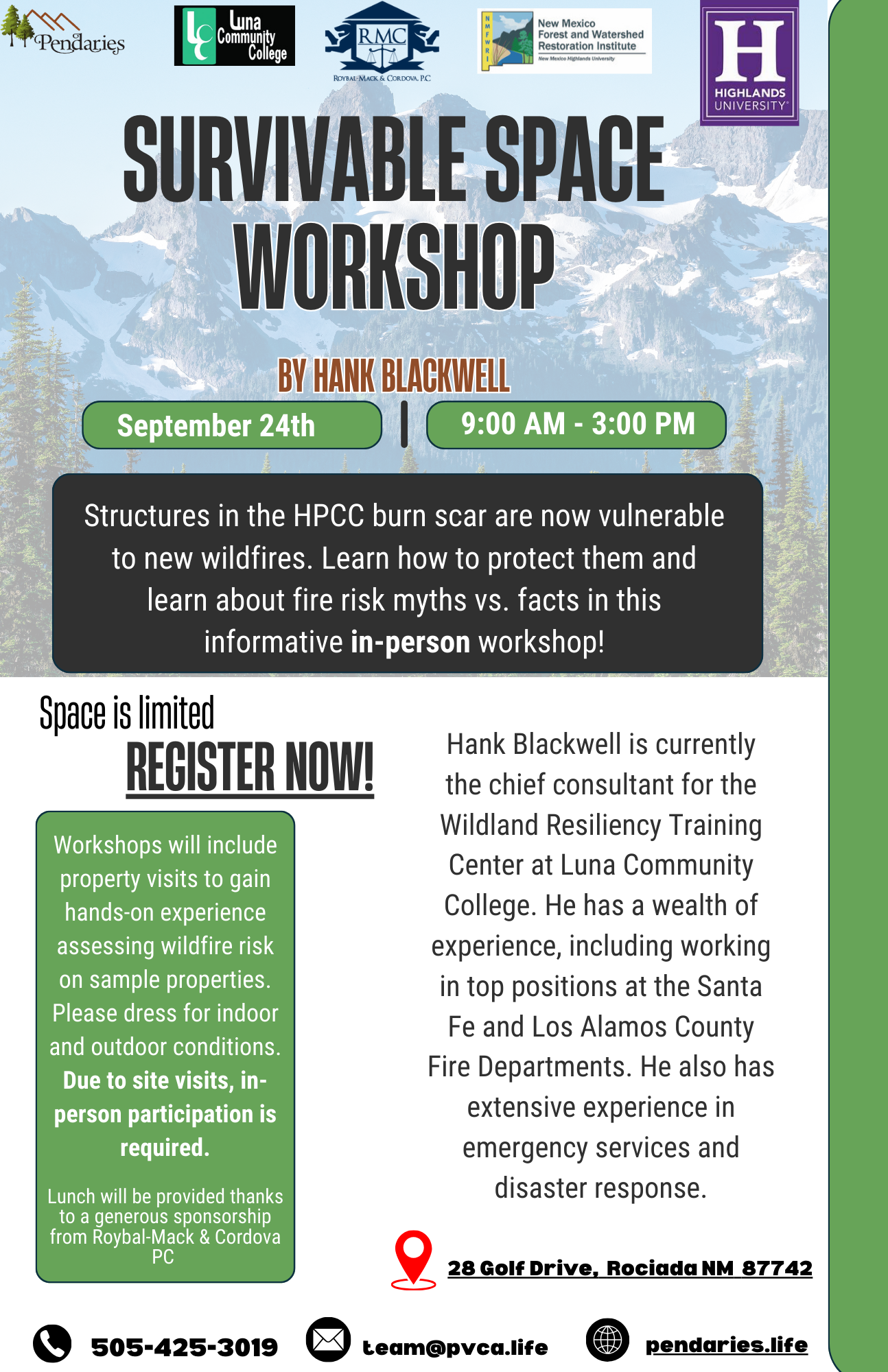
September 24th, 9:00am-3:00pm MT; Rociada, NM: Survivable Space Workshop

It is hard to imagine the possibility of more fires within the HPCC burn scar, but we know it is a reality. What are some simple ways to reduce wildfire risks to homes?
Hank Blackwell, chief consultant for the Wildland Resiliency Training Center, will lead a workshop teaching attendees how to protect structures in the HP/CC burn scar that are now vulnerable to new wildfires. Learn about fire risk myths vs. facts at this in-person event which will include property visits to gain hands-on experience assessing wildfire risk on sample properties.

Space is limited, register now! To learn more, email team@pvca.life or call 505-425-3019.

………………………………….

In the News

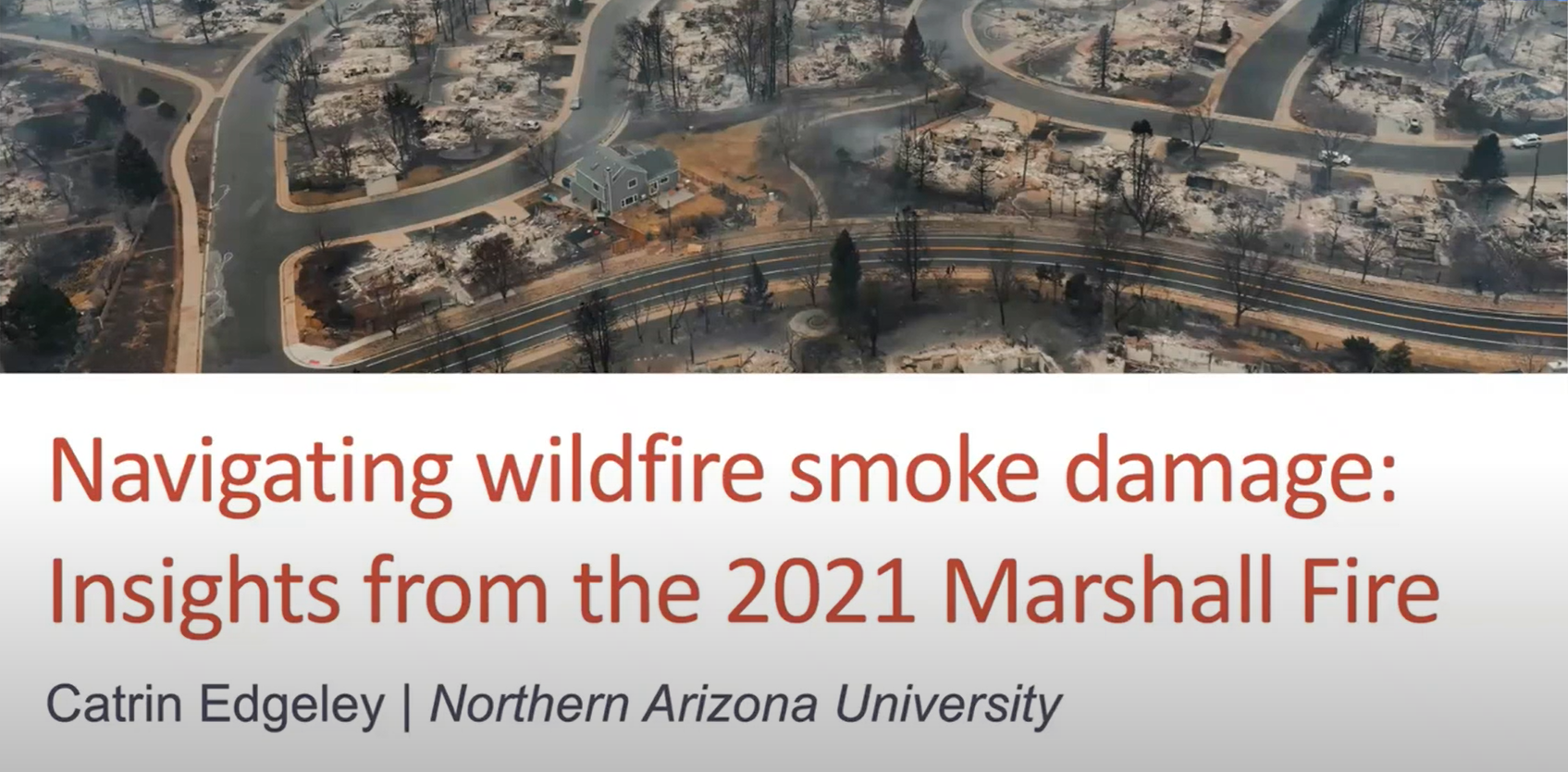
Navigating wildfire smoke damage: Insights from the 2021 Marshall Fire
Catrin Edgeley | Northern Arizona University

Dr. Cat Edgeley is a natural resource sociologist interested in social components of forest management. As a wildfire social scientist, she conducts research about how human communities adapt to wildfire. In this presentation she shares research on navigating smoke damage after the Marshall Fire.

………………………………………

Practitioner Paper: Prescribed Fire Planning and Implementation Capacity of Non-governmental Organizations

In 2022, the U.S. Congress made historic investments in wildfire and fuels management through passage of the Infrastructure Investment & Jobs Act (IIJA) and the Inflation Reduction Act (IRA). Researchers from the Public Lands Policy Group at Colorado State University recognized that federal agencies need a better understanding of the community-based capacity available to support and implement prescribed burn projects if they hope to be successful in strategically deploying these funds across ownership boundaries and at scale (i.e., a large enough spatial extent to achieve fuels and fire management objectives). Additionally, there are many unknowns with how the widespread loss or unavailability of prescribed fire insurance policies has affected prescribed fire practitioners and will therefore affect prescribed burn operations in the future.

To answer these questions and inform effective policy solutions for prescribed fire challenges, the PLPC conducted a national online survey for non-governmental organizations (NGOs) who plan, support, and conduct prescribed fire. They had four goals in mind when designing and conducting the survey:

  1. Describe the organizations that support, plan, and/or implement prescribed fire in the U.S.

  2. Identify their capacities and resource needs.

  3. Gauge how they may be impacted by the current scarcity of prescribed fire insurance.

  4. Determine how federal resources could be invested to support these organizations’ workforce.

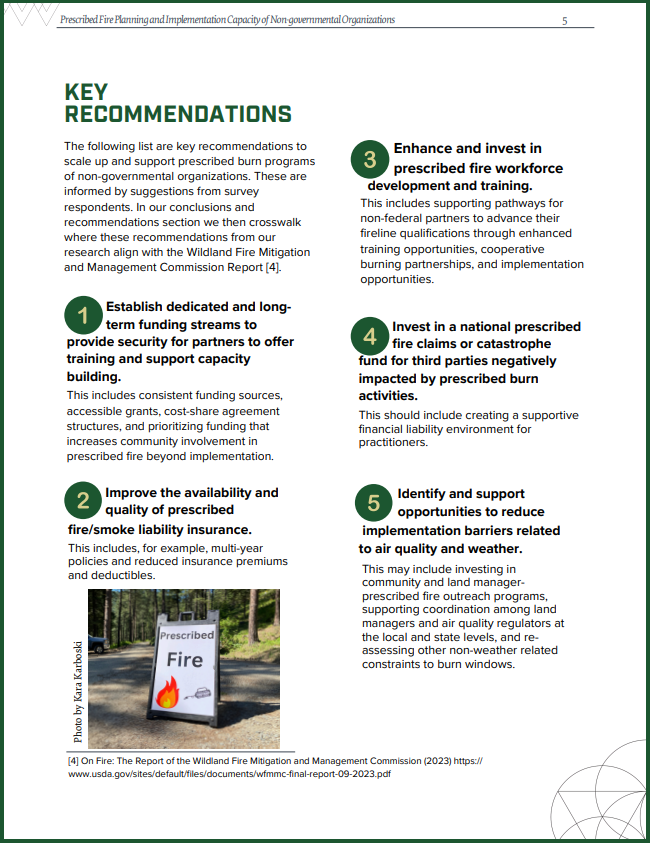
The resulting report finds that NGOs across the West are generally well set up to conduct outreach to landowners, residents, and natural resources practitioners, to administer grants and manage funds, and assist with or lead prescribed fire implementation. There is room for improvement with educational programming, outreach to disadvantaged communities, outreach to Tribal governments, providing trainings and technical support, and improving direct community outreach before and after burns. The report’s key recommendation for scaling and supporting grassroots prescribed fire efforts in the West include:

  1. Establish dedicated and long-term funding streams to provide security for partners to offer training and support capacity building.

  2. Improve the availability and quality of prescribed fire/smoke liability insurance.

  3. Enhance and invest in prescribed fire workforce Invest in a national prescribed fire claims or catastrophe.

  4. Invest in a national prescribed fire claims or catastrophe fund for third parties negatively impacted by prescribed burn activities.

  5. Identify and support opportunities to reduce implementation barriers related to air quality and waether.

Wildfire Wednesdays #142: Diversity of Perspectives in Wildfire Preparedness

Happy Wednesday, Fireshed Community!

Over the past decade, the wildland fire community has been experiencing a paradigm shift from thinking of wildfire resilience in simple terms to recognizing the complexities of risk. An emerging theme within this shift is that simple conceptualizations of risk do not account for the social and ecological diversity of fire-prone areas. From international organizations to grassroots efforts, those groups working to address our wildfire dilemma and work for better fire outcomes are working together to better account for diversity of perspectives and experiences in wildfire preparedness.

Today’s Wildfire Wednesday features:

Be well,
Rachel


Wildland Urban Fire Summit

The 2024 New Mexico Wildland Urban Fire Summit (WUFS) is happening October 8-10 at the Sagebrush Inn in Taos, NM! This is a space for community members, fire service volunteers and professionals, non-profit conservation groups, and federal, state, and local government representatives to gather and discuss challenges, innovations, and solutions for engagement in fire adaptation. During the in-person event, local community members will share regional history and discuss living in and adapting to the Wildland Urban Interface.

This year, the summit will focus on strengthening partnership through diverse perspectives – taking action in the WUI, including how new partners are developed, revitalizing or strengthening existing partnerships, and how the perspectives and resources they can provide help us to take action in our communities.

Agenda highlights include:

  • Welcome from NM State Forester Laura McCarthy

  • Property insurance & home mitigation 

  • Taos-region focus & field trip (Wednesday)

  • Emergency communications

  • Finding and using funding

  • Ruidoso 2024 events
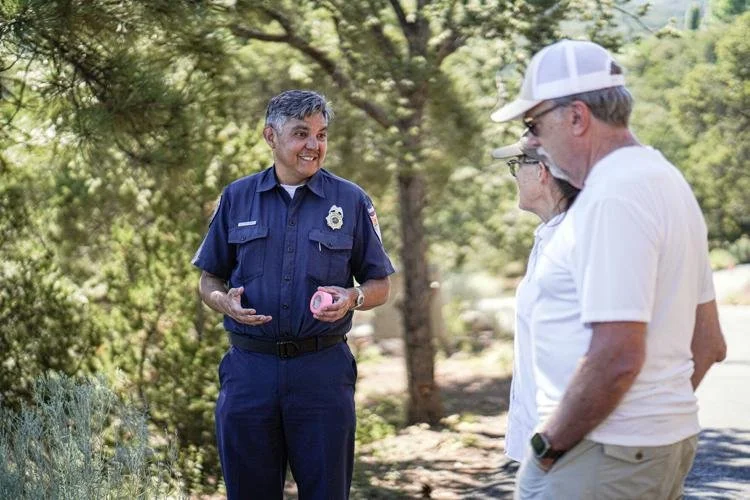
View the full draft agenda and learn more now!

Register for WUFS 2024!

Diversity in Fire Adaptation: a Review

Researchers and practitioners from across the management spectrum have begun considering and making recommendations for how to make fire adaptation more diverse and reflective of physical communities, and therefore more effective and innovative, in recent years. Below is a brief collection of challenges, considerations, and recommendations for improving inclusion.

……….……….

Vulnerability to Wildfire: Going Beyond Wildfire Hazard Analysis

Massive wildfires, which are becoming more frequent due to climate change and a long history of fire-suppression, have strikingly unequal effects on minority communities. The Nature Conservancy recently highlighted a study which integrates the physical risk of wildfire with the social and economic resilience of communities to see which areas across the country are most vulnerable, a complexity acknowledged in their resulting “vulnerability index”. The results highlight the difference between wildfire hazard potential and wildfire vulnerability, showing that racial and ethnic minorities face greater vulnerability to wildfires compared with primarily white communities; in particular, Native Americans are six times more likely than other groups to live in areas most prone to wildfires. These findings “help dispel some myths surrounding wildfires — in particular, that avoiding disaster is simply a matter of eliminating fuels and reducing fire hazards or that wildfire risk is constrained to rural, white communities.”

The map on the left considers socioeconomic considerations to show wildfire vulnerability as a measure of how likely an area is to adapt and recover. The map on the right only shows wildfire potential across Washington, considering factors such as burnable fuels on the landscape, vegetation, weather and historic fire activity.

The takeaway is that “ultimately it’s about connections, building relationships and breaking down cultural barriers that will bring us to a better outcome.”

Read the overview and dive into the study here.

……….……….

Incorporating Social Diversity into Wildfire Management

Characteristics influencing differential adaptation to wildfire among diverse communities (adapted from Paveglio et al. 2012).

While research suggests that adoption or development of various wildfire management strategies differs across communities, there have been few attempts to design diverse strategies for local populations to better “live with fire.” Building on an existing approach, managers can adapt to social diversity and needs by using characteristic patterns of local social context to generate a range of fire adaptation “pathways” to be applied variably across communities. Each ‘pathway’ would specify a distinct combination of actions, potential policies, and incentives that best reflect the social dynamics, ecological stressors, and accepted institutional functions that people in diverse communities are likely to enact. This inclusion can help develop flexible scenario-based approaches for addressing wildfire adaptation in different situations.

Examples of unique pathway components for advancing fire adaptation through adaptive or collective action include:

  • Ways to promote property-level residential adaptation

  • Governance model/structure of collaborative processes

  • Fuels mitigation focus

  • Adaptation leadership and relationships

  • Incident Command teams and outside response

  • Wildfire impacts/short- or longer-term recovery

  • Mitigation aid or grants

  • Resource management focus

  • Means of communication, message framing

Read more about the pathways approach.

……….……….

More Effective Fire Adaptation Through Comprehensive Risk Analysis and Collaboration

Defining risk

The primary goal of simple risk approaches is to minimize the costs associated with hazards and their management. Simple risk approaches have their roots in actuarial insurance, risk management, and rational choice models.

The pri­mary goal of complex risk approaches is not to minimize or eliminate immediate risk (as in simple risk approaches), but to adapt to the risk over time. Concepts of complex risk stem from scholarship on wicked problems, risk governance, and Second Modernity Risk. The complex risk framework accounts for and expands on simple risk ideas and approaches by explicitly considering the multi­plicity of contexts, knowledges, and definitions regarding a particular hazard.

Moving from simple to complex and from exclusionary to inclusive

There is a prevailing tendency of wildfire management agencies and institutions to rely primarily on simple risk approaches to wildfire hazard management that focus on technical risk assessments, such as questions of probability of wildfire event occurrence, but do not reflect the complexity of contemporary wildfire risk. These insufficiently complex conceptualizations of risk do not incorporate and account for the social and ecological diversity of fire-prone areas, reducing options and creativity for addressing risk by disregarding the varied experiences and concerns that influence collective adaptation.

Approaching wildfire as a complex risk can increase adaptation to and coexistence with wildfire by recognizing and accounting for the complexities of wildfire governance amongst a variety of stakeholders who may operate at various scales using different knowledge systems. Such efforts are more likely to yield socially relevant and legitimate strategies for building wildfire adapted communities.

Although centralized simple risk approaches are an often-necessary part of addressing wildfire risk, greater emphasis on wildfire as a complex risk brings atten­tion to the reality that wildfire response and consequences are interconnected - that is, that decisions and outcomes at various temporal points, including mitigation, preparedness, response, and recovery, are linked to place-based networks, processes, activities, decisions, and outcomes of other temporal points.

Five principles to increase adaptation to and coexistence with fire through complex risk consideration

  1. Embrace knowledge plurality and purposefully integrate perspectives other than technical expertise.

    Including other types of expertise (and thus complexity), especially local definitions of risk and key values of concern, can increase the local relevance and legitimacy of the risk analysis which can be critical to local uptake and implementation.

  2. Use inclusive, accountable, and transparent engagement strategies that incorporate collaborative learn­ing processes.

    Effectively implementing the first principle requires participation by a suite of interrelated public and private individuals in an iterative process to find pathways to desirable and feasible situational improvements.

  3. Include underrepresented groups in collaborative processes and wildfire risk governing networks.

    By forgoing assumptions that experts fully understand the experiences or abilities of underserved populations ( e.g., Latine, Black, Indigenous and People of Color), more inclusive processes invite more diverse perspectives and, by so doing, can better reflect the differential adaptation abilities of populations and organizations.

  4. Account for potential uneven distributions of risk and resources to address risk.

    Existing funding models for natural resource and associated wildfire management efforts tend to favor organizations with resources and capacity to pursue grants or whose views on wildfire risk match predominant policy priorities. As a result, groups or communities who have less access to resources and capacity may find their opportunities unchanged or even diminished, furthering an already uneven distribution.

  5. Re-focus or re-balance investments across spatial, institutional, and temporal scales.

    Wildfire investments which are currently concentrated on hazardous fuels reduction, preparedness (hiring and training firefighters), and response (incident management) could be re-focused to provide more resources to a wider range of pre-fire mitigation work and rapid post-fire adaptive recovery for those affected by fire. This means investing in systems of wildfire governance, the social architecture that will support collective action and innovation in ways that are more likely to be responsive to the changing circumstances of on-the-ground fire risk.

Learn more about recognizing complexity, and its inherent diversity, in fire management.

……….……….

Living with Fire: the Influence of Local Social Context and Need for Diversity

One element of meeting our contemporary wildfire challenge must be accepting fire in the landscape and working with instead of against it; essentially, to change our management paradigm from fire resistance to landscape resilience under the umbrella of Living with Fire. Achieving this integrated fire management approach will require a) understanding the intersecting drivers of fire impacts and risks and b) designing creative and effective risk reduction/management and communication strategies. The integrated fire management model that we are collectively moving toward must include innovation through exchange, adoption, and adaptation.

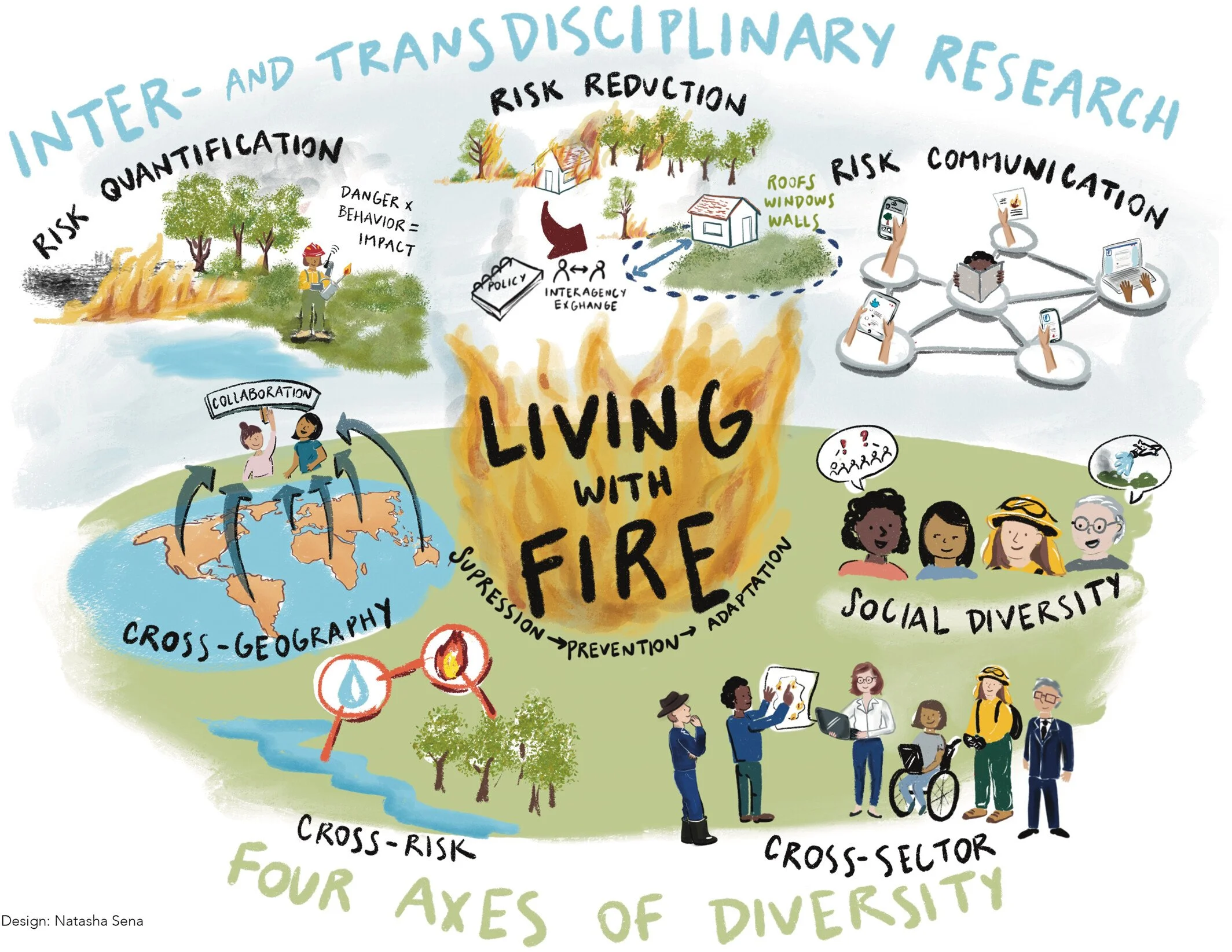
Living with fire rests on four essential pillars of diversity:

  • cross-geography (information and knowledge exchange between communities and countries);

  • cross-risk (learning from water and flood management);

  • cross-sector (connecting science and practice); and

  • social diversity (diversity of voices).

With regard to social diversity, there is a growing recognition that human adaptation to wildfire risk is a contingent exercise that may vary across diverse communities. A long history of social science indicates that any effort to improve adaptation is more likely to succeed when it adopts a holistic view of wildfire management that is tailored to emergent patterns of local social context. The unique combination of local history, culture, interpersonal relationships, trust in or collaboration with government entities, and place-based attachments that human populations develop in a given landscape all can have a large bearing on variable efforts to create fire adapted communities. These fundamental differences between and unique characteristics of individual communities can make a big impact on how planning documents (e.g. Community Wildfire Protection Plans), policies (e.g. homeowner risk  mitigation requirements), mitigation implementation activities (e.g. home hardening), and education or assistance approaches are written or designed and how, or if, they are adopted by the local community in a meaningful way. Who is at the table and how space is created for everyone to engage matters.

Overall, fire researchers, practitioners, managers, and affiliates must better understand and design diverse strategies for fire adaptation that reflect the social diversity of human communities at risk from wildfire.

Learn more about one team's proposal for a set of methodological practices and empirical verifications that constitute a next step in systematically tailoring wildfire adaptation at the community level across diverse populations.


In the News

Porfirio Chavaria, the Santa Fe Fire Department's wildland-urban interface specialist, speaks to Patty and Mark Johnson during a home inspection. Image credit: Gabriela Compos, The New Mexican.

An article in the Santa Fe New Mexican, “Preparation for Wildfires in Santa Fe Starts at Home” recently highlighted the fire department’s community wildfire preparation services - and its wildland-urban interface specialist, Porfirio Chavarria (pnchavarria@santafenm.gov). It focuses on how individual actions tie into landscape-level preparation, saying “fires affect communities, not just individual properties,” and showcases some of the work that Santa Fe has done to improve wildfire outcomes for residents, including community education, wildfire mitigation agreements, home hazard analyses, the fire and weather alert system Alert Santa Fe, and future improvements such as rapid wildfire start detection.

Read more about these services and their success in the article.

Wildfire Wednesdays #141: Hermit's Peak/Calf Canyon Fire

Hello Fireshed community, 

Today marks exactly two years since firefighters at last contained the historic Hermit’s Peak/Calf Canyon Fire on August 21, 2022. 

Families, communities, forests and watersheds in Northern New Mexico are still recovering from the destructive wildfire. In fact, the Santa Fe National Forest is hosting two public meetings next week to present and gather public input on recovery efforts and long-term recovery planning.

Meanwhile, forest, water, and fire managers are rebuilding support for prescribed fire as an essential land management tool – one not without risk, but key to reducing future risk of catastrophic wildfires.

This Wildfire Wednesday features a review of the Hermit’s Peak/Calf Canyon Fire, including: 

Best, Maya 


How the Fire Began

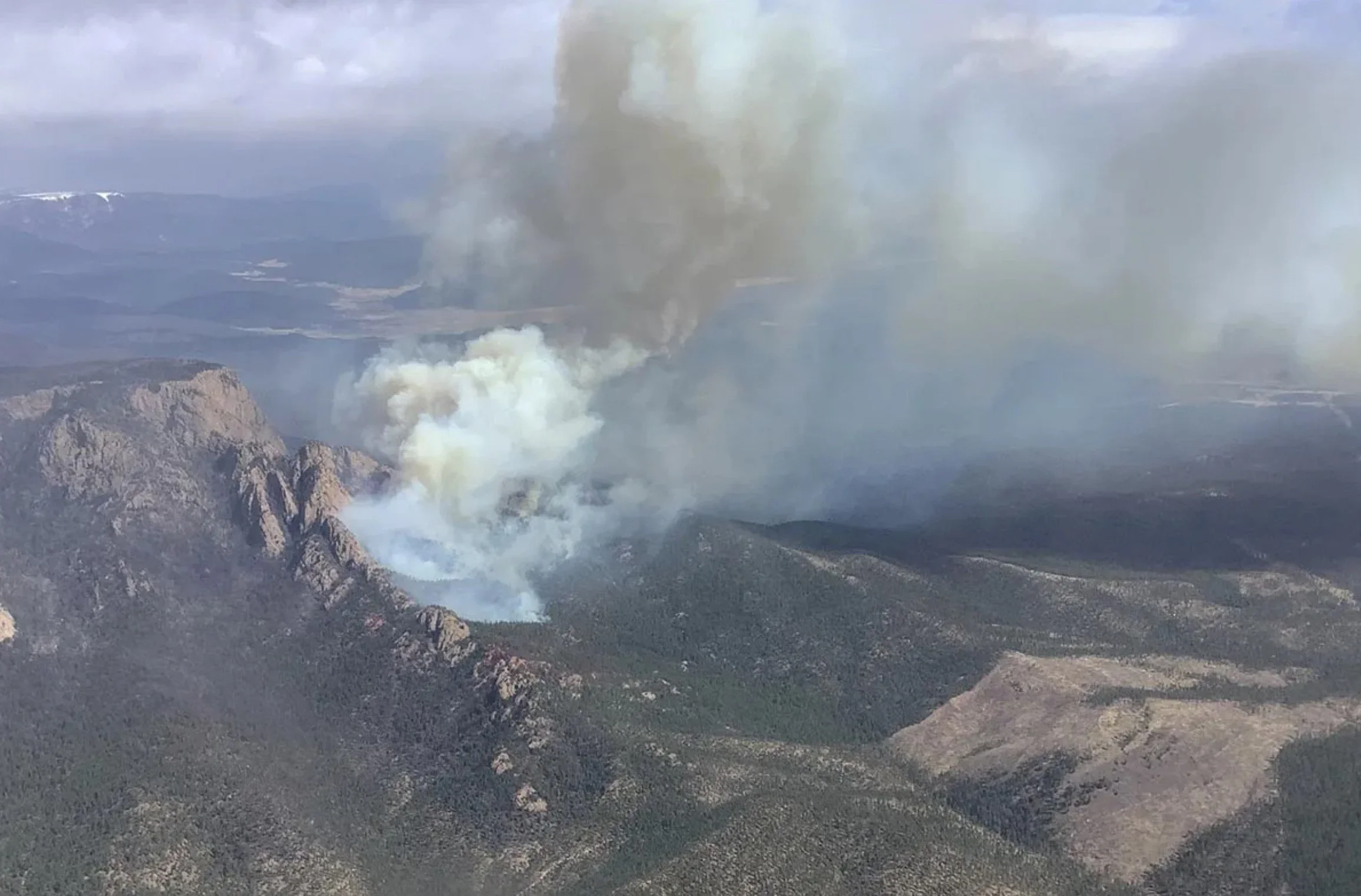
An aerial photo shows smoke rising near of Hermit's Peak, April 10, 2022.

Hermit’s Peak, April 10, 2022. Source: U.S. Forest Service

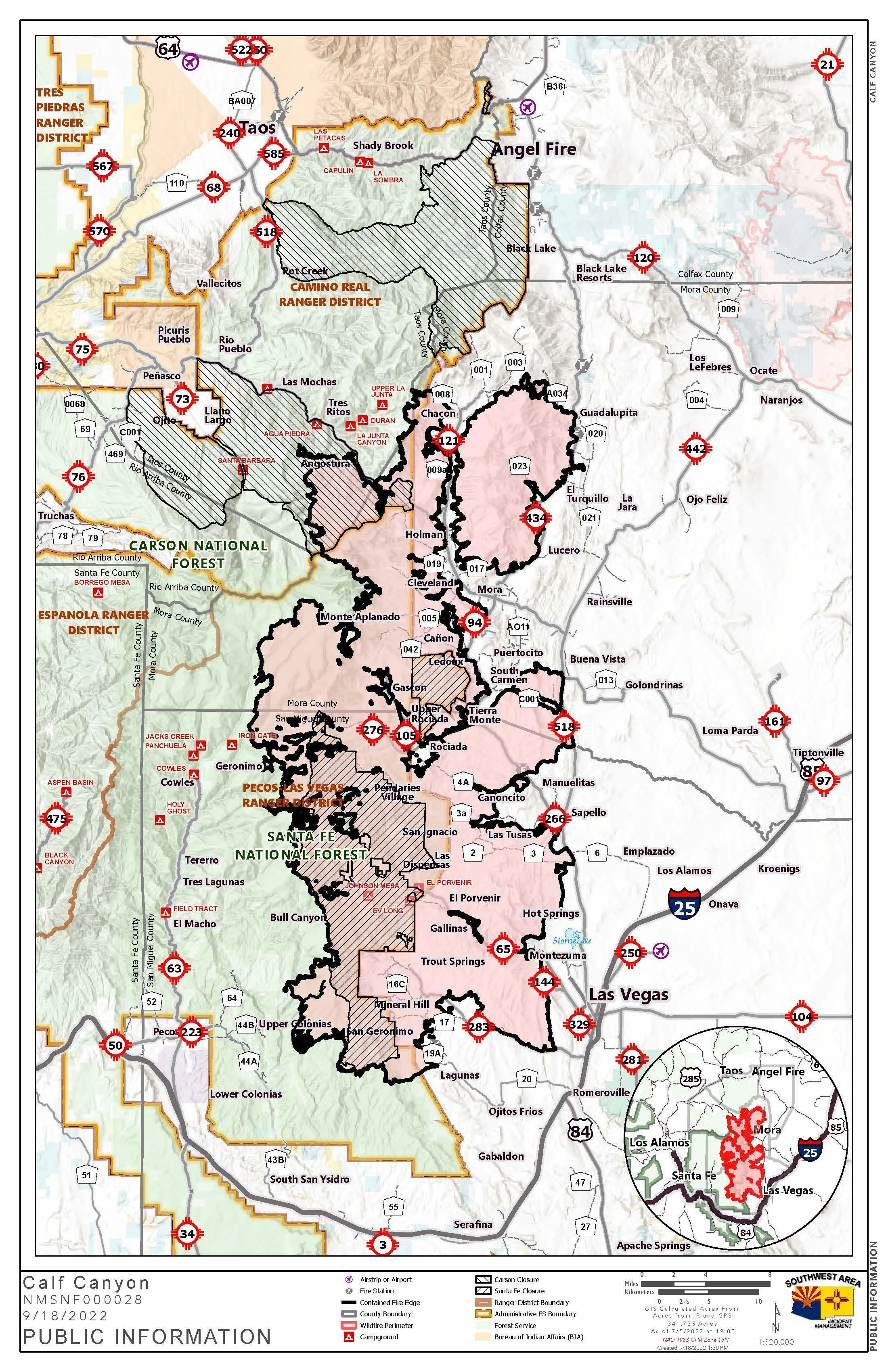
A map of the HPCC wildfire boundary.

HPCC Wildfire Boundary. Source: Inciweb

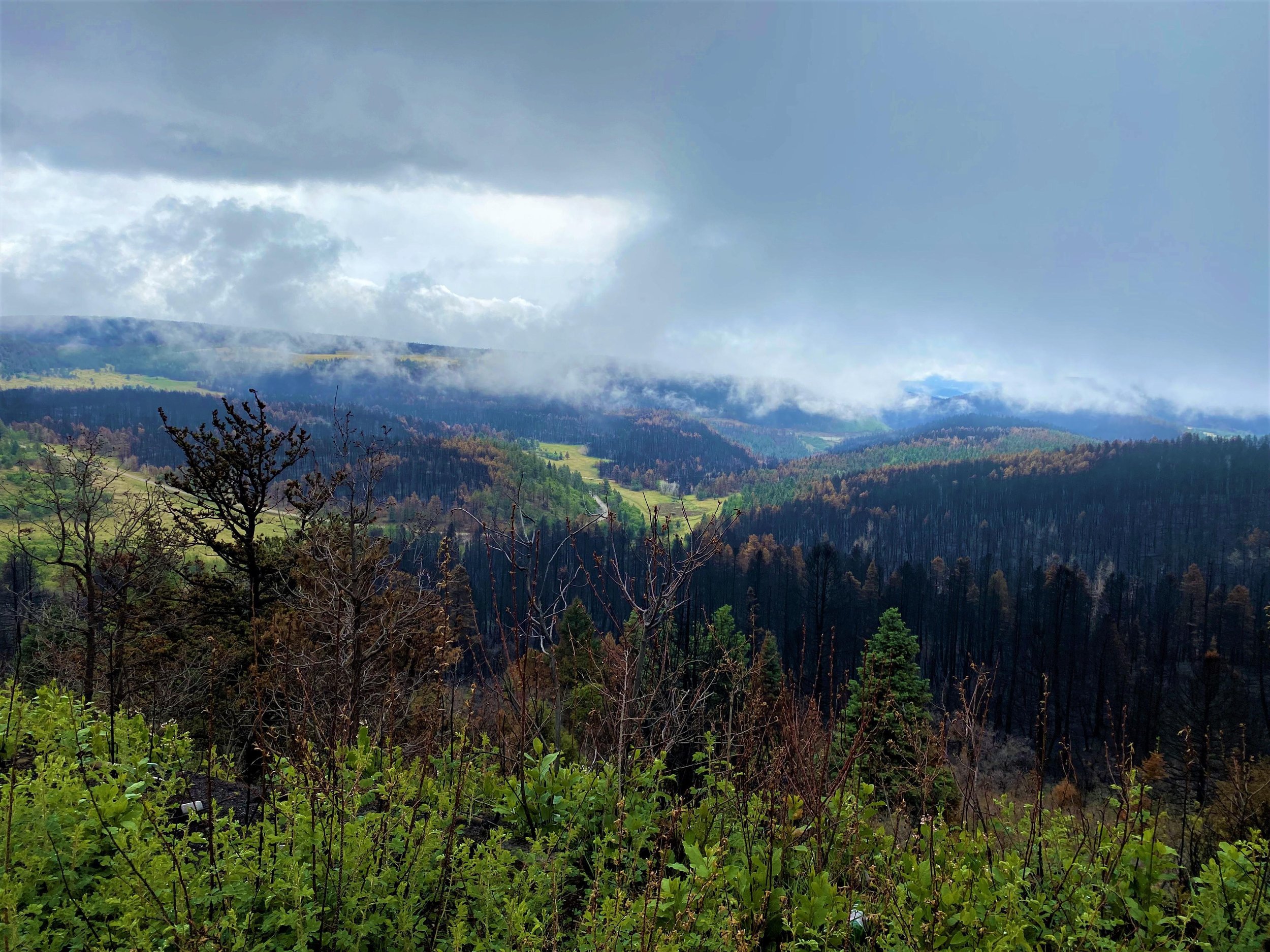
In April 2022, a Forest Service prescribed fire just outside of the Pecos Wilderness area of the Santa Fe National Forest became the Hermit’s Peak wildfire when erratic winds carried embers outside the boundary of the planned burn area and ignited multiple fires in surrounding forests dried out from severe drought.  

About two weeks later, the Calf Canyon Fire began spreading on National Forest land nearby when a pile burn ignited by the Forest Service in January resurfaced. The pile had smoldered underground for months through several snowstorms, an event “nearly unheard of until recently in the century-plus of experience the Forest Service has in working on these landscapes,” Forest Service leaders wrote in a review of the escaped prescribed fires. 

The two wildfires merged due to unprecedented wind events and historically dry fuels and soils and burned more than 530 square miles over four and half months, until firefighters contained the blaze in late August. 

The Costly Road to Recovery

Mora Valley, June 28, 2022. Source: Inciweb

The Hermit’s Peak/Calf Canyon Fire, the largest wildfire in New Mexico history, triggered evacuation orders for more than 27,000 people and destroyed over 900 structures, including 433 homes. Most of the land burned – 58% – was privately owned. 

Because the Forest Service was responsible for igniting the fire, Congress and President Joe Biden allocated almost $4 billion to compensate victims of the fire and subsequent floods. As of July 2024, while still processing and receiving additional claims, the federal government had paid out 5,633 claims totaling $926.7 million.  

Payments covered economic damages, up to five years of flood insurance coverage, and natural resource restoration projects for landowners. Additional recovery efforts in years following the burn have included aerial seeding of the burn scar and flooding prevention work by federal agencies and local organizations. 


Post-fire Flooding: A Prolonged Disaster

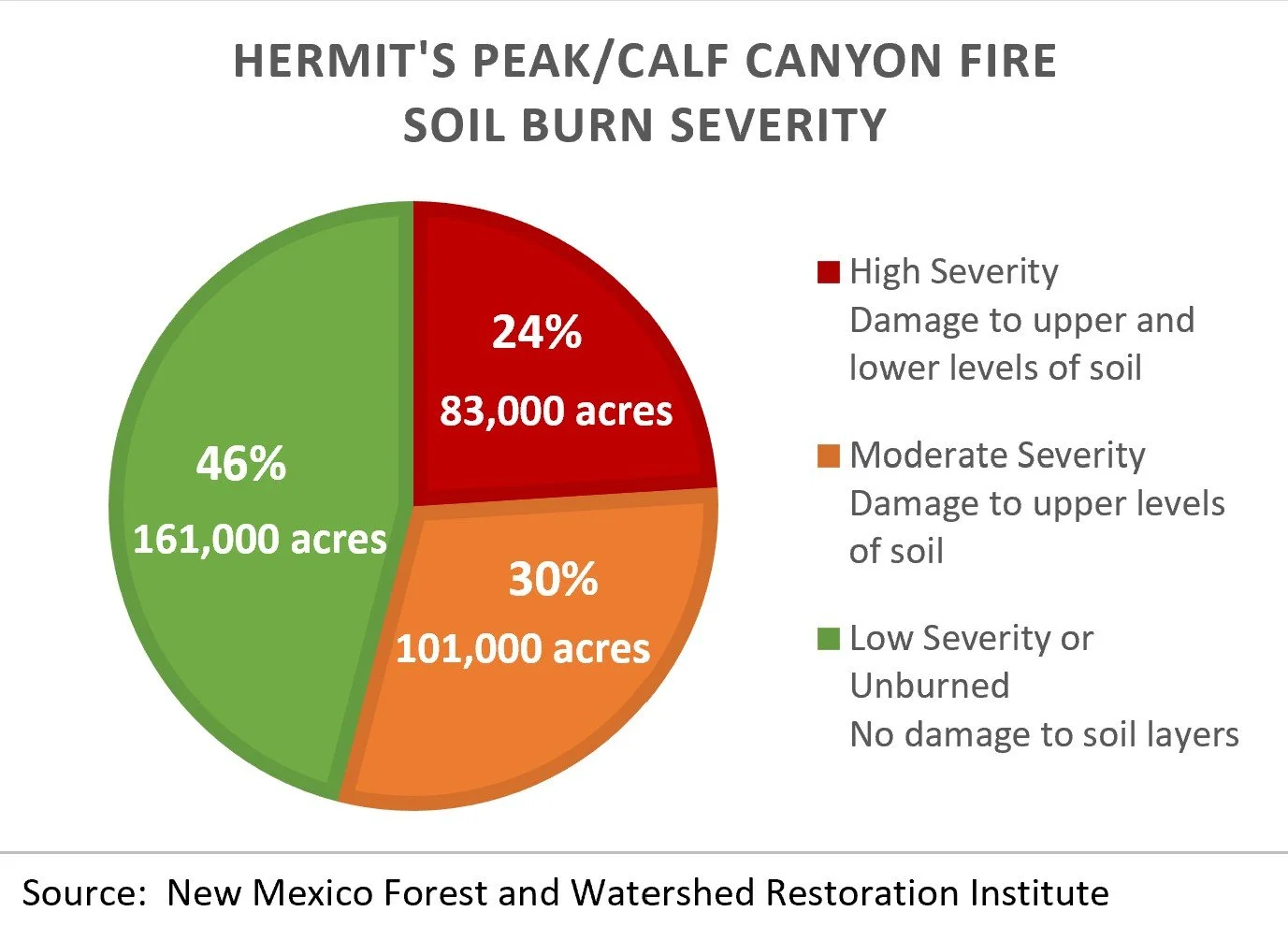
High-severity wildfires burn not only vegetation but also soils, changing the chemical and physical properties of soil such that it becomes hydrophobic, or water-repelling. This reverses forests’ sponge-like ability to soak up rainfall and instead makes burn scars susceptible to debris flows and flash floods.  

The pie chart shows HPCC soil burn severity: 30% (101,000 acres) was moderate severity, with damage to upper levels of soil. 24% (83,000 acres) was high severity, with damage to upper and lower levels of the soil. 46% was unburned or low severity.

The Hermit’s Peak/Calf Canyon Fire damaged soil in over half the burn scar, causing floods that killed at least three people, washed out buildings and infrastructure, and contaminated the city of Las Vegas’s water supply with ash and debris in 2022. The National Weather Service received over 75 preliminary reports of flash floods and debris flows in the burn scar from June 2022 to June 2024. For multiple years following the fire, surrounding communities expect to be at elevated risk for flooding.  


Prescribed Fires Remain a Crucial Tool for Reducing Wildfire Risk

The Hermit’s Peak/Calf Canyon Fire spurred the Forest Service to pause all prescribed burns pending a 90-day review of its national prescribed burn program. Forest Service Chief Randy Moore said the decision “reflected the growing recognition that extreme conditions resulting from drought, weather, dry fuels, and other climate change effects were influencing fire behavior in ways we had never seen before." The prescribed burn that became the Hermit’s Peak Fire had been ignited in “much drier conditions than were recognized,” the review found.  

We cannot guarantee that prescribed fires will never escape, but the alternative to using this proven tool is larger, more destructive wildfires.
— Santa Fe National Forest Supervisor Shaun Sanchez  

The review underscored the necessity of prescribed burns as one of the most effective tools for forest, fire and water managers to reduce the risk of catastrophic wildfires, protect watersheds, and increase the resilience of forests. Over a century of fire suppression in fire-adapted forests of the Southwest has, in combination with climate change, created conditions for high-severity wildfires that threaten people, property and drinking water sources and threaten forests’ ability to regenerate. Prescribed burns, on the other hand, facilitate a return to low-severity fires that promote forest health and increase firefighters’ success in safely managing fires. Of the about 4,500 prescribed burns conducted by the Forest Service annually, 99.84% have gone according to plan, the review noted.  

The Forest Service resumed prescribed burning with updated guidelines aimed at further reducing the risk of escaped prescribed fires. New requirements include daily, higher-level review of prescribed burn plans; more localized weather data; heightened consideration of drought conditions in burn plans; long-term monitoring of burns; and more extensive public outreach about prescribed fires, among other changes. 


Additional Resources

  • View this blog post in an easy-to-read PDF format on the Greater Santa Fe Fireshed Coalition’s Briefing Papers webpage. Other briefing papers on the webpage cover topics including: 

  • Stewarding the Greater Santa Fe Fireshed 

  • Source Water: Fire and the Santa Fe Municipal Watershed 

  • Containing Wildfire: The Medio Fire Success Story 

  • Pollinators and Wildfire 

  • Post-fire Impacts 

  • Forest Type Conversion 

  • Fire History in the Greater Santa Fe Fireshed 

  • NEPA 

  • Insect Defoliation in the Greater Santa Fe Fireshed 

  • The Intersection of Bird Habitat and Forest Restoration in the Southwest 

Wildfire Wednesdays #140: Wildland Fire Workforce

Hi! I am Maya Hilty, a new Fireshed Coordinator with the Forest Stewards Guild. In this role, I support the Greater Santa Fe Fireshed Coalition; conduct home hazard assessments; facilitate fuels reduction projects on public and private lands; and grow our Fireshed Ambassador program, where neighbors influence neighbors to make communities better prepared for fire. I will also be contributing to Fire Adapted New Mexico Learning Network into the future, including authoring Wildfire Wednesday blog posts. 


Hello Fireshed community, 

As of today, almost 28,000 firefighters across the U.S. are battling 95 large fires burning over 3,400 square miles. 

For the past five years, an annual average of ~59,100 wildfires, including both natural ignitions and human-caused fires, have burned almost 12,000 square miles across the nation each year. That includes roughly 2,800 fires per year in Arizona and New Mexico – more than 7 ignitions per day on average, if the fires were spread evenly throughout the year – which have burned 1,150 square miles, or approximately the size of Bernalillo County, annually.  

Many of us take for granted that, where fires ignite, firefighting resources will quickly follow. However, for reasons explored below, those resources are stretched increasingly thin during severe fires or during the most fire-prone times of the year. 

This Wildfire Wednesday features an overview of the wildland fire workforce, including: 

Best, Maya 


The Wildland Fire Workforce: A Who's Who

From the local to federal level, here’s who fights wildfires.

As outlined by the Santa Fe County Community Wildfire Protection Plan as well as U.S. Forest Service and Department of the Interior materials, the wildland firefighting workforce includes responders at the: 

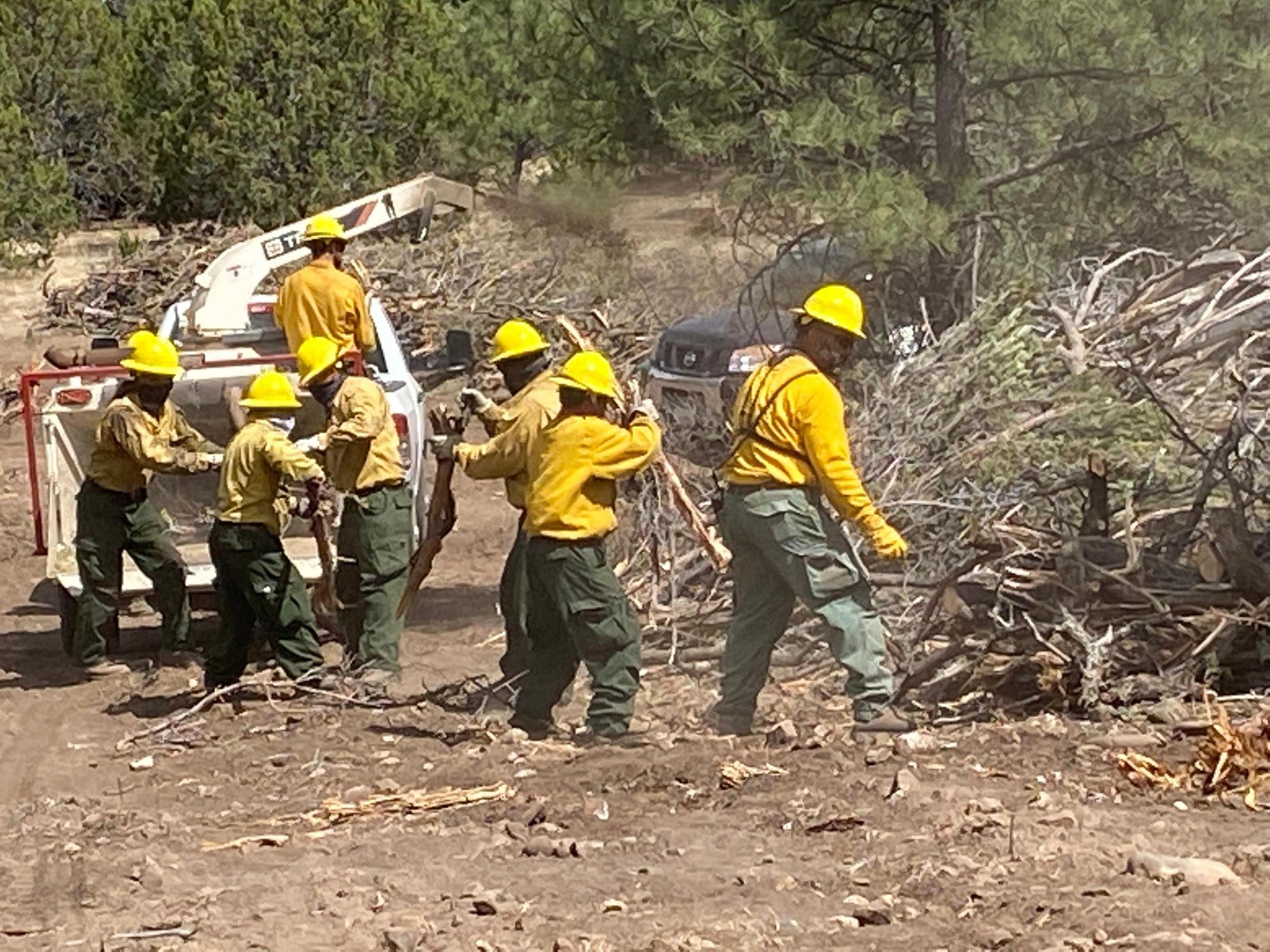
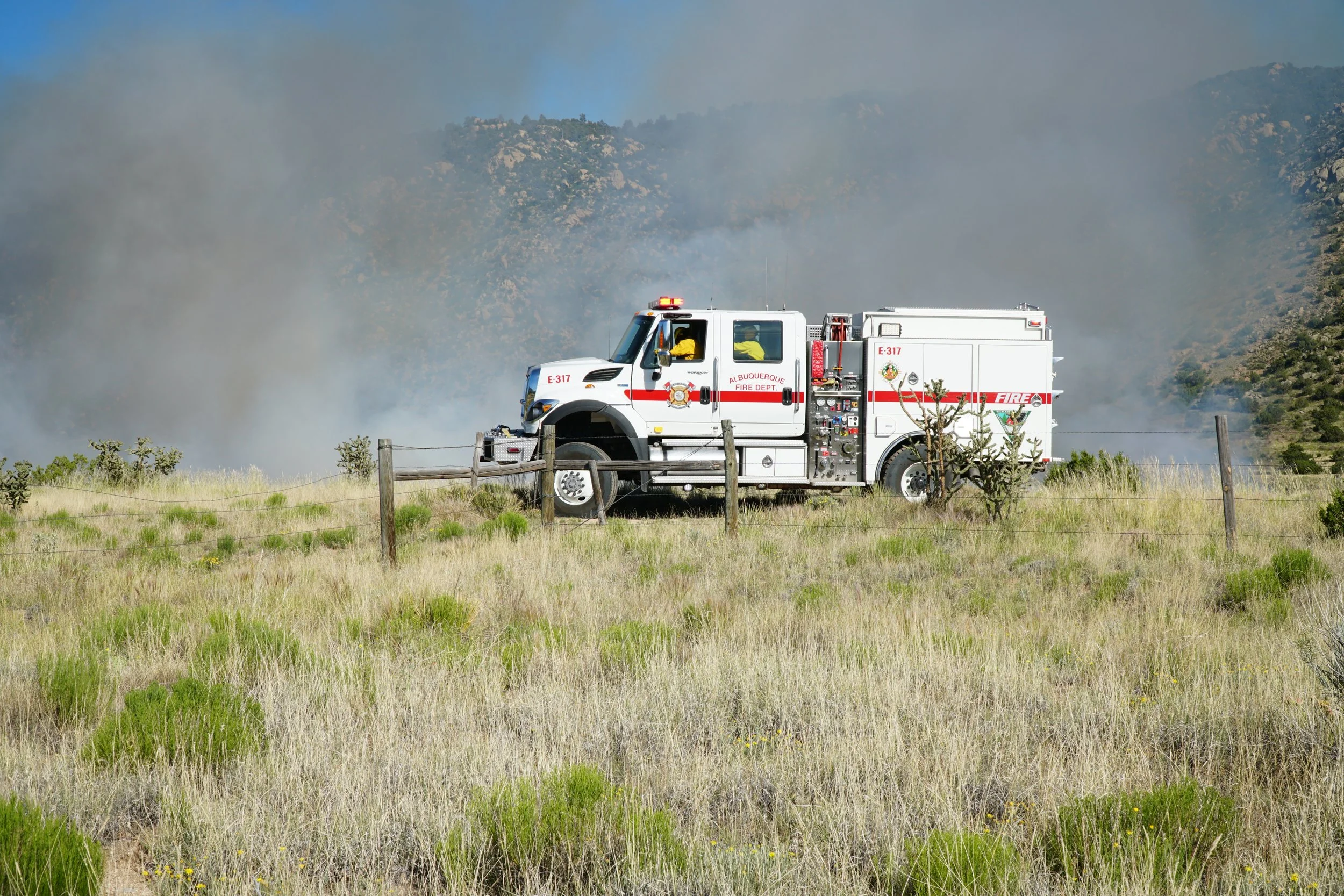
  • Local level. This includes, for example, the Santa Fe city and county Fire Department Wildland Divisions. 

  • State level. The New Mexico Forestry Division created two full-time crews in 2024 and trains additional firefighters for hire in an emergency. The Division also collaborates with a state prison in Los Lunas to run the Inmate Work Camp Program, through which the state hires four to six crews of people who are incarcerated to respond to wildland fires alongside other professional firefighters.

  • Federal level. This year, the federal wildland firefighting workforce includes roughly 11,300 firefighters in the Forest Service and 5,750 firefighters employed by four agencies in the Department of the Interior: the Bureau of Indian Affairs, Bureau of Land Management, Fish and Wildlife Service and National Park Service. Half the federal wildland firefighting workforce is only employed seasonally, for a maximum of six months, according to data from 2022.

In 2023, costs to suppress and contain wildfires amounted to nearly $3.2 billion in federal firefighting costs alone. Still, the Forest Service, which employs most federal wildland firefighters, needs more funding to meet their capacity needs to address the “ongoing wildfire crisis,” agency leaders say. 

Firefighters have a wide range of specialties, from members of handcrews and hotshots, who construct and patrol firelines; engine crews; smokejumpers, who parachute out of airplanes to reach fires in remote areas; helitack crews, who reach fires by helicopter; equipment operators; dispatchers; and other support staff. For more info, visit this Forest Service webpage about firefighting jobs. 

Collaboration is key

Thanks to mutual aid and joint powers agreements between tribes and local, state, and federal government agencies, the geographically closest firefighting forces often respond to the initial report of a fire regardless of their jurisdiction over where the fire started. 

Firefighting agencies also share an Incident Management System that enables initial responders to more seamlessly scale up a response. In northern New Mexico, that usually means soliciting help from a Southwest Area Incident Management Team. 

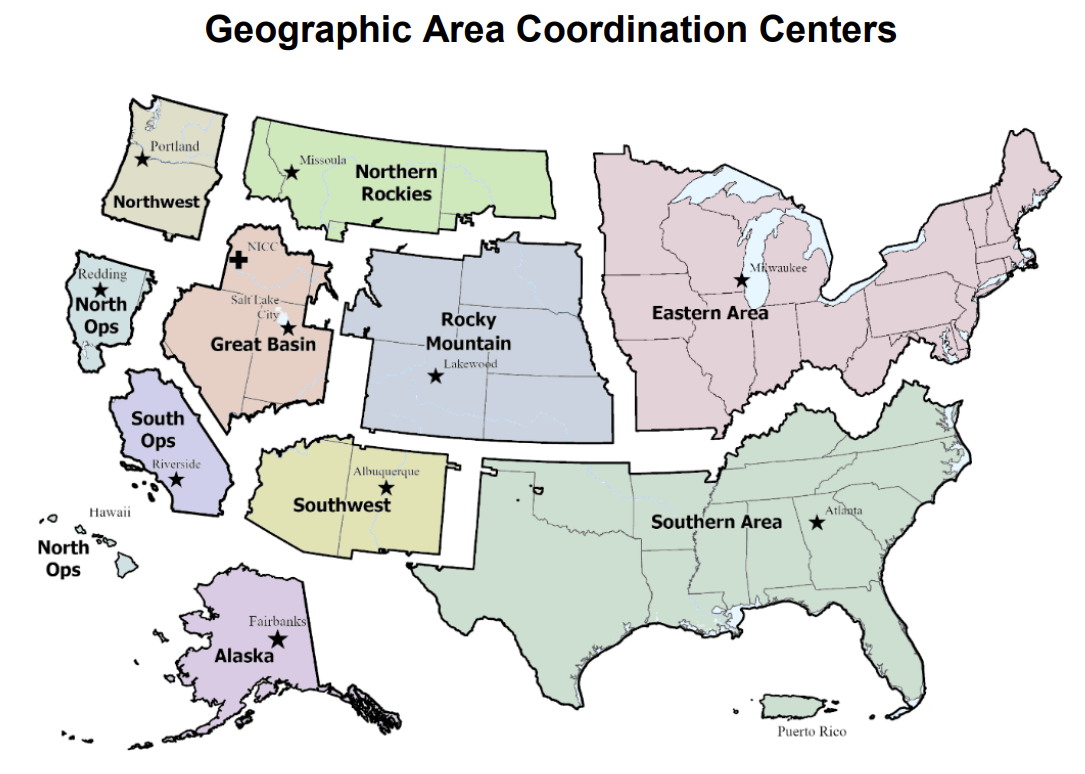
If a wildfire grows beyond the capability of teams in the Southwest Area (one of 10 wildfire Geographic Area Coordination Centers across the U.S.), the Boise, Idaho-based National Interagency Coordination Center assumes responsibility for mobilizing more resources from elsewhere across the nation. Because there is often a greater need than there is availability of firefighting personnel and equipment, the National Multi-Agency Coordinating Group comprised of state and federal fire management leaders ultimately oversees where to allocate firefighting resources.

In addition, the United States has ever-evolving agreements with Canada, Australia, New Zealand, Mexico and Portugal that enable the countries to share firefighting personnel and equipment. The U.S. considers requesting international help when ~60% or more of domestic wildland firefighting personnel are committed to fires, and the U.S. has received assistance in the form of aircraft or up to 600 personnel from Canada, Australia or New Zealand most years over the past two decades, as detailed in this 2022 paper in the journal Fire. 


Challenges in Wildland Fire Management

"Over the last few decades, the wildland fire management environment has profoundly changed. Longer fire seasons; bigger fires and more acres burned on average each year; more extreme fire behavior; and wildfire suppression operations in the wildland urban interface (WUI) have become the norm.” ~ U.S. Forest Service

Growth in fire seasons and severity

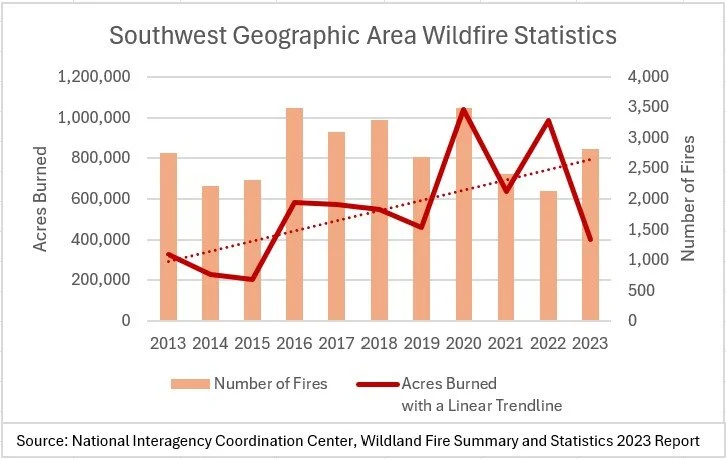
This figure shows the number of fires and acres burned each year in the Southwest Geographic Area from 2013 to 2023. A linear trendline of acres burned steadily trends upwards.

Due to factors including climate change, fuel build-up from fire exclusion, and expansion of the wildland-urban interface through continued construction of the built environment in previously undeveloped areas, wildfires have become larger, more severe, and more destructive. For example, the land area in the U.S. burned annually by wildfire has doubled over the past 20 years. Meanwhile, fire seasons have become longer – more than 80 days longer in the western U.S. – straining seasonal and regionally shared firefighting resources.

“We all recognize now we have a fire year, but we continue staffing for a fire season,” fire managers reflected in a review of the destructive 2022 Hermit’s Peak/Calf Canyon Fire.

Resource strain and scarcity

As we transition out of the months traditionally considered the Southwest fire season – from April to July, when monsoons typically begin – more state and federal firefighting resources will flow to California and the Northwest, and fewer will be readily available to county and community fire managers in the Southwest.

Changes to the workforce

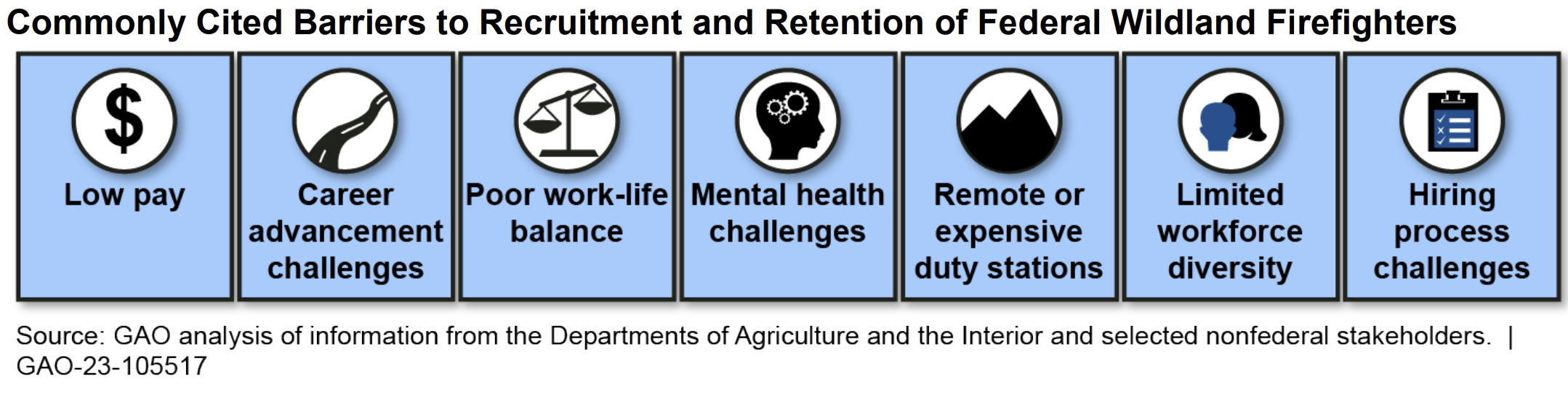
Agencies of varying sizes across the country are struggling to retain and recruit firefighters. In March, the investigative news organization ProPublica reported that the Forest Service has had an attrition rate of 45% of its permanent staff in the past three years. ProPublica and other news outlets reported several factors contributing to attrition in the Forest Service, including low pay, with starting wages of $15 per hour that do not reflect the demands of the job; inadequate attention to physical and mental health problems faced by firefighters; and the growing difficulty of the job as severe fires and extended fire seasons translate more frequent deployments. 

This figure shows 7 barriers to retaining federal wildland firefighters: Low pay, limited career advancement, poor work-life balance, mental health challenges, remote/expensive duty stations, limited workforce diversity and hiring process challenges.

A 2022 Government Accountability Office report similarly identified low pay as the primary barrier to the recruitment and retention of federal wildland firefighters, among other barriers such as a poor work-life balance; mental health challenges; and limited workforce diversity.


Enacted and Proposed Policy Changes

The existing wildfire management system has not kept pace with demands.
— National Cohesive Wildland Fire Management Strategy, 2023 addendum

Bolstering the wildland firefighting workforce

Federal agencies have made some headway in recent years to address challenges facing the wildland fire workforce, including raising the pay of wildland firefighters. In 2022, the Bipartisan Infrastructure Law raised the minimum wage of federal wildland firefighters from $13 to $15 per hour and provided firefighters with a temporary pay increase of at least $20,000 per year, which lawmakers extended through September 2024. 

For the upcoming FY25 fiscal year that begins October 1, the Biden administration has proposed a permanent pay increase for wildland firefighters, along with investments in firefighter mental and physical health and increases in the number of permanent (rather than seasonal) positions. Those proposals are currently making their way through Congress. 

A 2023 update to the National Cohesive Wildland Fire Management Strategy recommended additional solutions, such as ensuring that recruitment efforts reach firefighters of diverse backgrounds and identities. In 2022, 84% of federal firefighters were men and 72% were White. Increasing the representation of women and marginalized groups will not only make the wildland firefighting world more just but will grow the dwindling applicant pool for firefighting positions. 

As outlined in the national strategy, the nation ultimately needs a larger permanent firefighting workforce to tackle the year-round work of wildfire mitigation, preparedness, prevention, and postfire recovery, in addition to what we typically think of when we hear wildland fire workforce: wildfire response and containment. 


Additional Resources

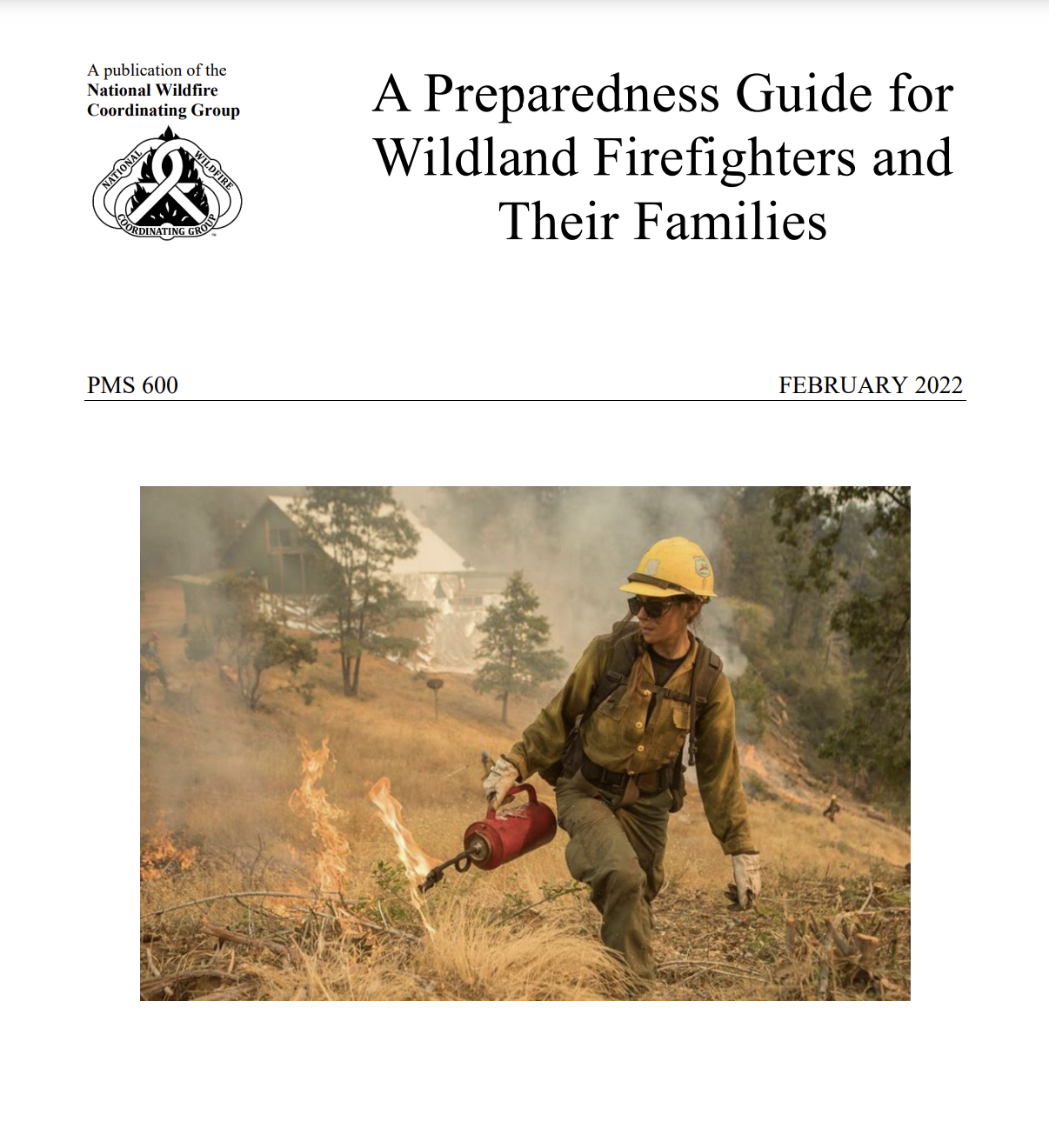
For more information about the rewards and challenges of a career in wildland firefighting, check out this Preparedness Guide for Wildland Firefighters and Their Families from the National Wildfire Coordinating Group.